

Xiaomi 17T Review: Design, Software and Camera Quality
The Xiaomi 17T arrived on 28 May 2026 as the most affordable way into Xiaomi’s Leica camera system, and it lands in a crowded part of the market where every phone promises flagship photography at a mid-range price. This Xiaomi 17T review looks at the three things the title promises — design, software and camera quality — and then goes further, because a phone is never just one of those things. The Xiaomi 17T specs read like a wish list: a MediaTek Dimensity 8500 Ultra chip, a 6.59-inch 120Hz AMOLED display, a 6500mAh battery with 67W charging, and a Leica-tuned triple camera with a 5x periscope zoom. The question is whether those parts add up to a phone that is pleasant to live with every day, or just a strong spec sheet.
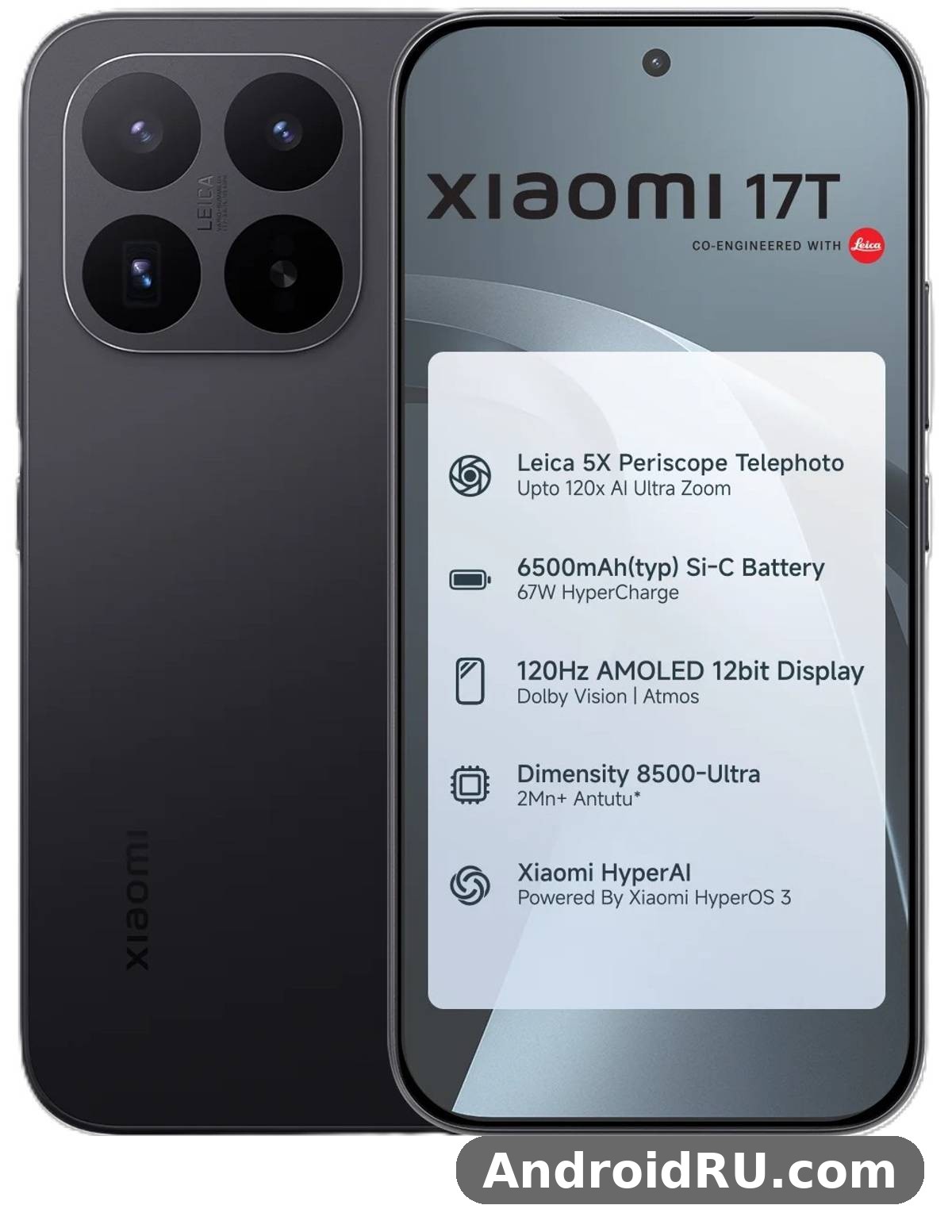
Xiaomi moved the T series launch much earlier than usual for this generation. The 15T series appeared in September 2025; the 17T series was announced globally on 28 May 2026, which makes this the earliest T-series debut Xiaomi has managed. That timing matters, because with the Xiaomi 17T release date May 2026, buyers got a fresh chip, a fresh camera system and Android 16 with HyperOS 3 into buyers’ hands months before the usual autumn refresh cycle. If you are shopping in the second half of 2026, this phone is competing against rivals that are already six to nine months old, and that freshness shows in the Xiaomi 17T performance and the Xiaomi 17T software support window ahead of it.
Who is this phone for? It suits someone who takes a lot of photos, charges once a day or less, and wants a big bright screen without paying flagship money. It also suits the buyer who skipped the 15T generation and wants a clear step up in zoom and battery life. It is less suited to anyone who needs wireless charging, a metal frame, or the absolute fastest chip on the market. This review works through the Xiaomi 17T design, the display, HyperOS 3, the Leica cameras, gaming and battery life, then lays out the Xiaomi 17T full specifications in a table, compares it with its Pro sibling and older flagships, and finishes with pros, cons and answers to the questions buyers actually ask. Is Xiaomi 17T worth buying in 2026? By the end you will have a clear answer for your own situation.
Xiaomi 17T Design and Build Quality
The Xiaomi 17T design follows the current Xiaomi house style: a flat display, a flat frame, and a camera island that sits in the top-left corner of the back panel rather than stretching across the whole width. The phone looks calm and businesslike next to the more dramatic camera rings on some rivals, and that restraint works in its favour. It is a large phone — a 6.59-inch screen dictates that — but the flat sides and the even weight distribution make it easy to hold one-handed for short stretches, and the flat screen means no accidental touches from a curved edge when you reach across the display. The Xiaomi 17T design language is not trying to shock anyone; it is trying to disappear into your hand, and it mostly succeeds.
One honest trade-off sits in the materials. The Xiaomi 17T plastic frame keeps the weight and the price down, and it is the single most visible difference between this phone and the Pro model above it. Plastic does not feel cheap in the way it did five years ago — the finish is smooth, the seams are tight, and the frame does not creak when you grip the phone firmly — but it does not have the cool, dense feel of aluminium, and it will show scuffs sooner if you carry the phone without a case. The Xiaomi 17T plastic frame durability question comes down to how you treat your phones: with a case on, the frame material is almost irrelevant; without one, the back panel and frame will pick up marks faster than a metal-framed rival. The Xiaomi 17T durability story is therefore less about the frame and more about the glass, the fit and the case you choose on day one.
Xiaomi 17T Colors and In-Hand Feel
The Xiaomi 17T colors are Black, Purple, Blue and White, and the choice matters more than it sounds. Black is the safe option and hides fingerprints best. Purple is the most distinctive of the four and the one that photographs best under warm light. Blue sits between the two, and White is the cleanest looking but the one that shows a scuffed case edge first. The Xiaomi 17T color options black purple blue white give every buyer a sensible choice without a garish option in the range, and all four share the same matte-style finish that resists fingerprints better than a glossy back. In the hand, the phone feels balanced rather than top-heavy, which is a small achievement given the large battery inside, and the power button and volume rocker fall naturally under the thumb on the right edge.
Fingerprint Reader and Buttons
The in-display fingerprint reader sits low enough to reach without shifting your grip, and the Xiaomi 17T fingerprint sensor speed test results from early hands-on reports describe it as quick and consistent once your print is registered twice, once with the phone flat and once held at a natural angle. Face unlock is present as a faster but less secure alternative, and it works well in good light. The buttons have a short, firm travel with no rattle, which sounds minor until you use a phone where they do rattle. Little details like this are where a mid-range phone earns its keep, and the 17T gets them right.
Size, Weight and Everyday Handling
A 6.59-inch phone is not small, and buyers coming from a compact device should expect a week of adjustment. The flat display helps, because your thumb can reach across the whole panel without the distortion a curved edge introduces, and HyperOS 3 includes a one-handed mode that shrinks the screen toward the bottom corner when you swipe the gesture bar. The Xiaomi 17T screen size also pays off in the other direction: videos, maps and documents all get more room, and the phone works well as a small tablet for reading on a commute. If you wear tight jeans or carry the phone in a jacket pocket, the size is worth checking in a shop first, but for most buyers the large screen is a feature rather than a problem.
Xiaomi 17T AMOLED Display Review: 120Hz, Brightness and Colour
The Xiaomi 17T display is a 6.59-inch flat AMOLED panel with a 2756 x 1268 resolution, a 120Hz refresh rate, Dolby Vision and HDR10+ support, and 12-bit colour. That is a strong list for the price, and the Xiaomi 17T AMOLED display review verdict is simple: this is one of the best screens you can buy without stepping up to a flagship. Text is crisp, colours are rich without looking artificial in the default mode, and the 120Hz refresh makes scrolling feel immediate. The Xiaomi 17T screen also supports a high peak brightness of up to 3500 nits, which is the number that matters most outdoors, because a screen that washes out in sunlight ruins everything else about a phone.
The Xiaomi 17T screen brightness outdoor test picture is encouraging. In direct sun the panel stays readable, the automatic brightness steps up quickly, and photos shot in bright light can still be judged on the screen rather than guessed at. That matters for a camera-focused phone: if you cannot see the viewfinder properly, you cannot frame a shot. Indoors, the panel drops to comfortable levels without the flicker some sensitive users notice on cheaper AMOLED screens, and the 12-bit colour depth keeps gradients smooth in skies and skin tones instead of banded. Dolby Vision and HDR10+ support mean supported video apps show a wider range of light and shade, and the difference is visible on a dark scene in a film, not just on a spec sheet.
120Hz Refresh Rate and Touch Response
The 120Hz refresh rate adapts to what you are doing, dropping down when the screen is static to save battery and rising when you scroll or play a game. In practice the transitions are smooth enough that you stop noticing them, which is exactly the point. The touch sampling keeps up with fast swipes, and the flat panel means the edges of the screen respond the same as the centre. If you are coming from a 60Hz phone, the difference is obvious within the first minute; if you are coming from another 120Hz phone, this panel holds its own. The Xiaomi 17T display is, in short, the part of this phone you will notice most often, because you look at it every time you pick the phone up.
Display Settings Worth Changing on Day One
Two settings are worth a minute of your time. First, open the display settings and pick the colour mode that matches your taste — the default is vivid, and the standard mode is closer to accurate if you edit photos. Second, check the refresh-rate setting and leave it on the adaptive option rather than forcing 60Hz to save battery, because the 6500mAh battery is large enough that the saving is not worth the loss in smoothness. The always-on display is available too, and it is worth enabling with a modest brightness so notifications stay visible without waking the whole panel.
Xiaomi 17T HyperOS 3 Software Features and Everyday Experience
The Xiaomi 17T software is HyperOS 3 running on top of Android 16, and that combination is one of the strongest reasons to consider this phone. The Xiaomi 17T HyperOS 3 software features include a cleaner home screen layout, a redesigned control centre, tighter integration with other Xiaomi devices through HyperConnect, and the HyperIsland dynamic area around the front camera that shows timers, music and navigation in a small live capsule. The Xiaomi 17T software experience feels calmer than older MIUI builds: animations are consistent, the settings menus are better organised, and the system does not fight you when you try to change a default app.
Artificial intelligence is woven through the system rather than bolted on as a separate app. The Xiaomi 17T Circle to Search features let you long-press the gesture bar and circle anything on screen — a pair of shoes in a photo, a phrase in a foreign language, a landmark in a video — and get results without switching apps. Gemini integration handles voice queries and on-screen assistance, and the gallery app offers AI editing tools for removing unwanted objects and improving old photos. None of this replaces good hardware, but it does make the phone feel current, and the features are the kind you actually stumble into during normal use rather than having to hunt for them in a menu.
HyperOS 3 Update Schedule and Long-Term Support
The Xiaomi 17T HyperOS 3 update schedule is a question every buyer should ask, because a phone you keep for three years needs software that keeps up. Xiaomi has been lengthening its support windows across the range, and the 17T ships with Android 16, which gives it a head start over rivals that launched on Android 15 and are still waiting for their upgrade. The Xiaomi 17T updates picture is straightforward: expect regular security patches and at least one major Android version upgrade path to be confirmed on the official product page for your region, and check the exact commitment there before you buy, because support terms can vary by market. What matters in daily use is that HyperOS 3 on this phone already feels finished — there is no sense of waiting for a future patch to fix the basics.
Pre-installed apps are the usual mixed bag. Xiaomi includes its own gallery, file manager and browser alongside Google’s apps, and a handful of third-party apps may appear depending on your region. The good news is that most of them can be uninstalled or disabled in a few taps, and the system does not nag you to reinstall them. Notifications arrive on time, battery optimisation does not kill background apps aggressively by default, and the permission prompts are clear about what each app is asking for. For a phone at this price, the software is a strength rather than something you tolerate.
Xiaomi 17T Camera Quality Review: Leica Triple Setup
The Xiaomi 17T camera is the headline, and it earns that billing. The Xiaomi 17T Leica system is a triple rear setup: a 50MP main camera with an f/1.7 aperture, a 23mm focal length, a 1/1.55-inch Light Fusion 800 sensor and optical image stabilisation; a 50MP periscope telephoto with an f/3.0 aperture, a 115mm focal length and 5x optical zoom, also stabilised; and a 12MP ultrawide with an f/2.2 aperture and a 15mm field of view. The front camera is a 32MP unit with an f/2.2 aperture. The Xiaomi 17T camera quality review verdict, after weighing the hardware and the reported results, is that this is the best camera system Xiaomi has put in a T-series phone, and the periscope zoom is the part that changes how you shoot.
Leica’s involvement goes beyond a badge. The lenses use Leica Summilux optics and a Leica UltraPure optical design, and the colour science includes the two Leica looks that fans of the partnership know well: Leica Authentic, which keeps colours restrained and contrast high, and Leica Vibrant, which lifts saturation for a punchier result. A colour spectrum sensor helps the phone judge white balance in mixed lighting, which is where many phones go wrong and produce skin tones that look too warm or too green. The Xiaomi 17T Leica camera samples shared in early hands-on coverage show clean daylight shots with plenty of detail, natural-looking greens, and highlights that hold their texture instead of blowing out to white.
Main Camera: Daylight Detail and Colour
The 50MP main sensor uses 4-in-1 pixel binning, which combines four pixels into one larger effective pixel for cleaner images in normal shooting, and the f/1.7 aperture lets in enough light for fast shutter speeds even indoors. In daylight the main camera resolves fine detail — brickwork, foliage, fabric — without the over-sharpened look that cheaper phones apply, and the dynamic range keeps both a bright sky and a shadowed street in the same frame. The Xiaomi 17T camera quality in everyday shooting is consistent, which matters more than any single spectacular shot: you can point, shoot, and trust the result nine times out of ten. For a closer look at how a related flagship handles the same Leica tuning at a higher price, see the Xiaomi 15 Ultra Review: Daily Performance and Key Features, which shows where the extra money goes.
5x Periscope Zoom: The Feature That Changes Your Photos
The Xiaomi 17T 5x periscope zoom test results are the most interesting part of this phone. A true 5x optical zoom means the telephoto lens captures a genuinely magnified image rather than cropping the main sensor, and at 50MP the telephoto keeps enough detail for large prints and heavy crops. The Xiaomi 17T telephoto reaches subjects a normal phone camera cannot — a bird on a fence, a sign across a street, a detail on a building — and the stabilisation keeps those shots steady at arm’s length. Digital zoom extends to 120x, but that is a number for marketing rather than for real photography; the useful range runs to about 10x, where the phone blends optical and digital zoom cleanly. If you photograph concerts, sport or wildlife, this lens alone justifies the phone.
Portrait Mode and Low Light Shooting
The Xiaomi 17T portrait mode samples show the benefit of a real telephoto for people pictures: the 115mm focal length flatters faces in a way a wide lens cannot, and the background blur falls off naturally rather than looking painted on. Edge detection around hair is reliable in good light and acceptable in dimmer rooms. The Xiaomi 17T low light camera performance is strong for the class thanks to the large main sensor, the wide aperture and the stabilisation working together, and night mode takes a short burst of frames and merges them into a brighter, cleaner result. Noise stays controlled, street lights keep their shape instead of smearing, and the Leica Authentic mode gives night shots a moody contrast that suits the subject. It is not a flagship night camera, but it is closer than the price suggests.
Ultrawide, Selfie Camera and Video
The 12MP ultrawide is the weakest of the three rear cameras, which is normal at this price, and the Xiaomi 17T ultrawide camera samples show good centre sharpness with softer corners and a little less detail than the main sensor. It is best used for landscapes, architecture and tight interiors where stepping back is not an option, and it handles distortion well, keeping straight lines straight. The Xiaomi 17T selfie camera quality test picture is solid: the 32MP front camera captures plenty of detail, skin tones look natural in daylight, and portrait mode on the front camera separates the subject cleanly. The Xiaomi 17T video recording quality 4K is stable and detailed, with the stabilisation smoothing out walking shots, and the Leica colour modes carry over to video, which gives your clips a consistent look with your stills.
For video creators, the phone also offers the usual slow-motion and time-lapse modes, and the microphone pickup is clear enough for vlogging in a quiet room. The Xiaomi 17T camera system is not trying to replace a dedicated camera, but it covers the four situations most people actually shoot — daylight, zoom, portraits and night — better than any previous T-series phone. If photography is your priority, compare the stills here with the Xiaomi 15 Pro Review: Photo Quality, Video and Performance to see how much of the flagship photo experience survives at this price.
Xiaomi 17T Performance: Dimensity 8500 Ultra in Daily Use and Gaming
The Xiaomi 17T Dimensity 8500 Ultra performance story starts with the chip itself: a MediaTek Dimensity 8500-Ultra built on a 4nm process, with an octa-core CPU running up to 3.4 GHz and a Mali-G720 MC8 GPU. The Xiaomi 17T Dimensity 8500 is a sub-flagship part, which means it sits one step below the fastest chips on the market and roughly on par with last year’s flagships in everyday speed. The Xiaomi 17T performance in normal use is fast and unbothered: apps open quickly, switching between a dozen apps is smooth, and the Xiaomi 17T RAM, 12GB in every variant, means the phone rarely has to reload an app you left a few minutes ago.
The Xiaomi 17T 12GB RAM multitasking review picture is one of quiet competence. Heavy apps stay in memory, split-screen works without stutter, and the phone does not get warm during ordinary tasks like browsing, messaging and streaming. The 256GB and 512GB storage options give room for a large photo library and a stack of games, and the storage is fast enough that installing a large game or copying a folder of photos does not become a chore. The Xiaomi 17T storage speed also matters for the camera, because 50MP photos and 4K video fill space quickly, and the 512GB variant is worth the step up if you shoot a lot of video.
Xiaomi 17T Gaming Performance Test: Sustained Speed and Heat
The Xiaomi 17T gaming performance test results place this phone firmly in the comfortable mid-range gaming bracket. Demanding games run at high settings with steady frame rates, and the Mali GPU handles the current generation of popular titles without dropping frames during busy scenes. Longer sessions are where the chip’s efficiency shows: the 4nm process and the large battery keep the phone cooler than older mid-range chips, and frame rates hold up after thirty minutes rather than sliding as the phone warms up. The 120Hz display and the responsive touch layer help in fast games, and the stereo speakers give you positional audio without headphones. If you play competitively every day, a dedicated gaming phone still has an edge in cooling and shoulder triggers, but for everyone else the 17T is more than fast enough.
Connectivity is complete for a 2026 phone: the Xiaomi 17T 5G support covers the bands most buyers need, Wi-Fi is fast and stable, Bluetooth handles multiple devices at once, and NFC is present for contactless payments. The in-display fingerprint reader, covered earlier, is the one biometric most people will use daily, and it works reliably. The Xiaomi 17T performance package is rounded rather than extreme, and that is the right call for a phone that has to do everything well instead of one thing brilliantly.
Xiaomi 17T Battery Life Test: 6500mAh and 67W Charging
The Xiaomi 17T battery is a 6500mAh silicon-carbon cell, and it is one of the largest batteries Xiaomi has fitted to an international phone. The Xiaomi 17T battery life test picture from early usage reports is strong: heavy days with navigation, photography and streaming end with charge to spare, and moderate users can realistically expect two days between charges. The silicon-carbon chemistry packs more capacity into the same space than older lithium designs, which is how the phone stays slim despite the big cell, and the Dimensity 8500 Ultra sips power at idle, so standby drain overnight is minimal.
Charging is 67W wired HyperCharge, and the Xiaomi 17T 6500mAh battery charging time question has a practical answer: the phone refills quickly enough that a short stop at a charger during the day adds a meaningful amount of range, and a full charge from empty is a sub-one-hour job with the right charger in normal conditions, though the exact time depends on temperature, the charger used and whether the phone is in use while charging. The Xiaomi 17T 67W charging setup also supports USB Power Delivery and PPS, so a good third-party charger works properly instead of falling back to slow speeds, and reverse wired charging lets the phone top up earbuds or another phone in a pinch. A 6500mAh battery this large, paired with 67W charging, removes battery anxiety from daily life in a way a smaller cell with faster charging cannot.
Xiaomi 17T Wireless Charging Support: What to Expect
The Xiaomi 17T wireless charging support position is simple: this phone does not offer wireless charging, so if you have invested in charging pads around the house and the office, they will stay unused with this device. That is a deliberate cost and thickness trade-off, and it is worth knowing before you buy rather than discovering it on day one. The wired charging is fast enough that most buyers will not miss wireless power, and the huge battery means you charge less often in the first place. Check the official Xiaomi product page for your region to confirm the exact charging specifications, because regional variants can differ in the charger included in the box.
Battery health is also worth a mention. HyperOS 3 includes charging optimisation that slows the charge as the battery nears full when you charge overnight, which protects the cell over the two or three years you are likely to keep the phone. Combined with the sheer capacity, that means the battery should still feel generous in year two, when a smaller cell would already feel tired. The Xiaomi 17T battery is, alongside the camera, the strongest reason to choose this phone over a slimmer rival.
Full Specifications
The Xiaomi 17T full specifications are listed below, gathered from the official product pages and the published specification listings. The Xiaomi 17T specs show a phone with no single weak area on paper: a large battery, a fast chip, a bright screen and a serious camera system. Two numbers deserve a second look. The first is the 6.59-inch display, which is smaller than the 6.83-inch panel on the Pro model — the two phones are not the same size, and buyers who assumed otherwise should check the dimensions before ordering a case. The second is the 67W charging figure, which is slower on paper than the 100W charging on the Pro, but is paired with a battery large enough that most owners will charge less often anyway. Regional variants can differ in the charger included in the box and in the exact 5G bands, so confirm the details for your market on the official Xiaomi product page.
| Feature | Xiaomi 17T |
|---|---|
| Launch | Announced and released 28 May 2026 |
| Display | 6.59-inch flat AMOLED, 2756 x 1268, 120Hz, Dolby Vision, HDR10+, 12-bit colour, up to 3500 nits peak |
| Chipset | MediaTek Dimensity 8500-Ultra, 4nm, octa-core up to 3.4 GHz, Mali-G720 MC8 GPU |
| RAM and storage | 12GB RAM, 256GB or 512GB storage |
| Rear camera | 50MP main, f/1.7, 23mm, 1/1.55-inch Light Fusion 800, OIS; 50MP periscope telephoto, f/3.0, 115mm, 5x optical zoom, OIS; 12MP ultrawide, f/2.2, 15mm; Leica Summilux optics, colour spectrum sensor |
| Front camera | 32MP, f/2.2, 21mm |
| Battery | 6500mAh silicon-carbon |
| Charging | 67W wired HyperCharge, USB Power Delivery and PPS, reverse wired charging; no wireless charging |
| Software | Android 16 with HyperOS 3 |
| Security | In-display fingerprint reader, face unlock |
| Audio | Stereo speakers with Dolby Atmos |
| Connectivity | 5G, Wi-Fi, Bluetooth, NFC, USB-C |
| Colours | Black, Purple, Blue, White |
| Price | From 749 euros for 12GB + 256GB in Europe; from RM2,399 in Malaysia |
Xiaomi 17T vs Xiaomi 17T Pro and Xiaomi 17: Which One Fits You
The Xiaomi 17T vs Xiaomi 17T Pro comparison is the one most buyers will make first, because the two phones launched together on the same day and share the Leica camera philosophy. The Xiaomi 17T vs 17T Pro differences are real but narrow: the Pro gets a larger 6.83-inch 144Hz display, a flagship Dimensity 9500 chip, a bigger 7000mAh battery, 100W wired charging with 50W wireless charging, and a larger 1/1.31-inch main sensor, while the standard 17T keeps the same 5x periscope telephoto, the same 12GB of RAM and the same HyperOS 3 software for 250 euros less. The Xiaomi 17T Pro Review: Build Quality, Software and Daily Speed covers the Pro in detail if you are weighing the step up, and the short version is that the Pro is the better phone for heavy gamers and anyone who wants wireless charging, while the standard 17T is the better buy for everyone else.
The Xiaomi 17T audio setup deserves a note here because it affects video and gaming, the two things the comparison shopper cares about after the camera. The Xiaomi 17T stereo speakers Dolby Atmos test notes from early coverage describe a loud, clear stereo pair with good separation and a surprising amount of low-end for a phone this slim. The Xiaomi 17T speakers sit at the top and bottom edges, they stay clear at high volume without distorting dialogue, and Dolby Atmos support widens the soundstage for films. The Xiaomi 17T audio is not a replacement for headphones, but it is good enough that you will watch a short video or take a hands-free call on the speakers without reaching for earbuds.
| Feature | Xiaomi 17T | Xiaomi 17T Pro | Xiaomi 17 |
|---|---|---|---|
| Display | 6.59-inch AMOLED, 120Hz | 6.83-inch OLED, 144Hz | 6.3-inch LTPO AMOLED, 120Hz |
| Chipset | Dimensity 8500 Ultra | Dimensity 9500 | Snapdragon 8 Elite Gen 5 |
| Main camera | 50MP, 1/1.55-inch sensor | 50MP, 1/1.31-inch sensor | 50MP, Light Hunter 950 |
| Telephoto | 50MP periscope, 5x optical | 50MP periscope, 5x optical | 50MP triple camera system |
| Battery | 6500mAh | 7000mAh | 6330mAh (global) |
| Charging | 67W wired | 100W wired, 50W wireless | 100W wired, 50W wireless |
| Frame | Plastic frame | Check the official product page | Metal frame flagship build |
| Price in Europe | From 749 euros | From 999 euros | From 999 euros |
The compact flagship is the other natural comparison. The Xiaomi 17 Review: Cameras, Performance and Battery Life covers a smaller, more expensive phone with a faster Snapdragon chip, a 6.3-inch screen and wireless charging, and the choice between the two comes down to size and budget: the 17 suits buyers who want a compact phone and the fastest chip, while the 17T suits buyers who want a bigger screen, a bigger battery and a lower price. The Xiaomi 17 Pro Review: Strengths, Trade-Offs and Everyday Use sits above both of them in the range, and reading it alongside this review gives a complete picture of the 17 family before you spend anything. The Dimensity 8500 Ultra in the 17T will not beat the Snapdragon 8 Elite Gen 5 in a benchmark, but in daily use the gap is smaller than the spec sheets suggest, and the 17T answers with a battery that outlasts the compact flagship.
Xiaomi 17T Pros and Cons: Who Should Buy It
The Xiaomi 17T pros and cons below summarise the whole review in one place. The phone’s strengths cluster around the camera, the battery and the screen, and its weaknesses are the kind of trade-offs that come with a mid-range price rather than mistakes. Read the two lists together with the “who it is for” section that follows, because a con that does not affect you is not really a con.
What the Xiaomi 17T Gets Right
- Leica camera system with a real 5x periscope zoom. The Leica Summilux optics and the stabilised telephoto give this phone a zoom that rivals phones costing twice as much.
- 6500mAh battery that lasts two days for moderate users. The silicon-carbon cell is the largest in its class, and it removes battery anxiety from daily life.
- Bright 120Hz AMOLED display. The 6.59-inch panel is sharp, smooth and readable in direct sunlight, with Dolby Vision and HDR10+ support.
- Fast, efficient Dimensity 8500 Ultra performance. Everyday tasks and demanding games run smoothly without the heat of older mid-range chips.
- HyperOS 3 on Android 16 from day one. The software feels finished, with Circle to Search, Gemini integration and HyperConnect built in.
- Fair price for the hardware. At 749 euros for 12GB and 256GB, the Xiaomi 17T value for money is strong against both the Pro model and the compact flagship.
Where the Xiaomi 17T Falls Short
- No wireless charging. Buyers with charging pads at home and in the office will need to keep using a cable.
- Plastic frame instead of metal. The build is solid and well finished, but it does not feel as premium as an aluminium frame and will mark sooner without a case.
- 67W charging is slower than the Pro’s 100W. The huge battery compensates, but a top-up from empty takes longer than on the Pro model.
- Ultrawide camera lags behind the main sensor. The 12MP ultrawide is usable and well corrected, but it cannot match the main camera for detail.
- Sub-flagship chip, not the fastest available. The Dimensity 8500 Ultra is quick, yet the Snapdragon 8 Elite Gen 5 in the Xiaomi 17 is measurably faster in heavy workloads.
Who the Xiaomi 17T Is For
The Xiaomi 17T is for the buyer who takes photos every day and wants a genuine zoom lens without paying flagship money, for the heavy user who is tired of charging by dinner time, and for anyone who wants a big, bright screen for video and reading. It is also a sensible pick for the buyer coming from a phone that is two or three years old, because every part of the experience — screen, camera, battery and software — moves forward at once. It is not the right phone for the wireless-charging devotee, the buyer who insists on a metal frame, or the competitive gamer who needs the fastest chip and the most aggressive cooling. For everyone else, it is one of the easiest recommendations in its price range.
Frequently Asked Questions About the Xiaomi 17T
Is the Xiaomi 17T worth buying in 2026?
For most buyers, yes. The combination of a Leica camera with 5x periscope zoom, a 6500mAh battery, a 120Hz AMOLED display and HyperOS 3 on Android 16 is hard to beat at 749 euros, and the phone launched in May 2026, so it is still fresh against rivals that are already a year old. The main reasons to look elsewhere are wireless charging, a metal frame, or a need for the absolute fastest chip. If none of those applies to you, the 17T is a strong buy, and the 512GB variant is worth considering if you shoot a lot of 4K video.
What is the Xiaomi 17T price in Europe?
The Xiaomi 17T price in Europe starts at 749 euros for the 12GB RAM and 256GB storage model. The Xiaomi 17T 256GB storage variant price is therefore the entry point, and the 512GB variant costs more depending on the market. In Malaysia the phone starts at RM2,399 for the online-exclusive 12GB and 256GB model and RM2,499 for 12GB and 512GB. Prices vary by country and by retailer, and launch promotions often include a discount or a bundled accessory, so check the current price in your market before ordering.
Does the Xiaomi 17T have a periscope zoom camera?
Yes. The Xiaomi 17T has a 50MP periscope telephoto camera with 5x optical zoom, an f/3.0 aperture and optical image stabilisation, and it is the same zoom hardware found on the more expensive 17T Pro. The telephoto captures 50MP images at 5x magnification, digital zoom extends to 120x, and the useful range for good quality runs to about 10x. The Leica colour modes apply to telephoto shots as well, so zoomed photos keep the same look as your main-camera pictures.
How long does the Xiaomi 17T battery last, and how fast does it charge?
The 6500mAh battery lasts a full heavy day with charge to spare, and moderate users can expect two days between charges. Charging is handled by 67W HyperCharge over USB-C, with USB Power Delivery and PPS support, so a good third-party charger works at full speed. There is no wireless charging on this model. Charging times vary with temperature and with the charger used, so check the official Xiaomi product page for the exact figures for your region rather than relying on a single number.
The Xiaomi 17T is a phone that understands its job. It takes the Leica camera system, the part of a flagship that most people actually notice, and puts it into a phone with a battery that lasts, a screen that stays readable outdoors, and software that feels current. The trade-offs are honest and easy to live with: no wireless charging, a plastic frame, and a chip that is fast rather than fastest. If you want a phone that takes great photos, lasts two days, and costs 749 euros instead of 999, this is the one to buy. Check the price in your market, pick a colour, and put a case on it on day one.

