

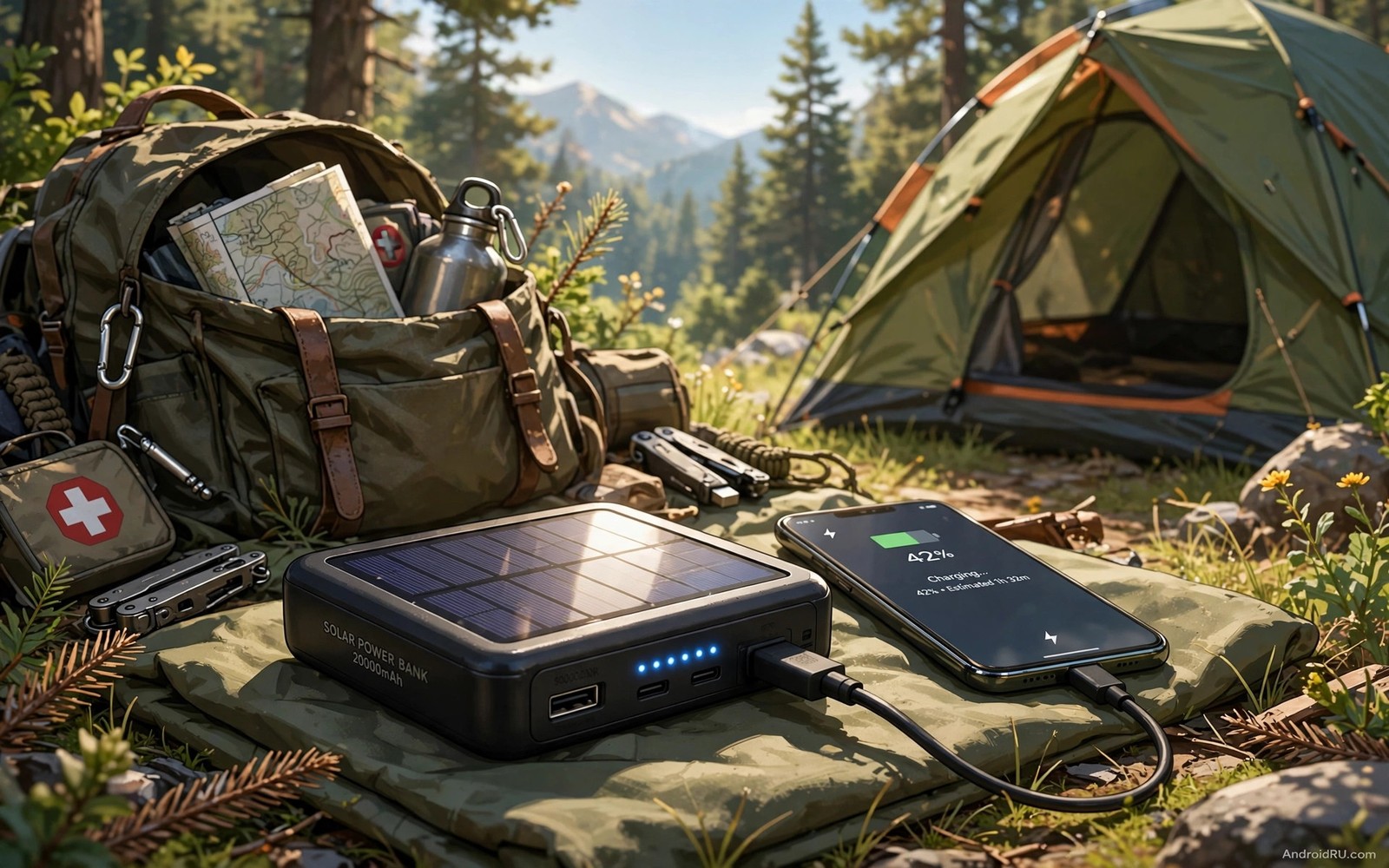
A solar power bank sounds like a perfect emergency tool because it promises free power from sunlight. Real tests tell a more careful story and the gap between the box claim and the field result matters. A small panel on a bank can trickle charge the battery but it rarely replaces a wall charger in a day. Understanding that limit before an emergency helps you plan a kit that actually keeps a phone alive. This guide reports what happens in realistic off-grid tests and how to use the result wisely.
Our test logic was simple and repeatable for any reader with a phone and a sunny window. We placed banks in direct sun at midday and logged the charge gained each hour. We also tested them on a cloudy day and in partial shade under a tree. Phones were charged from the bank at night to see how many full charges the stored energy provided. The aim was not a lab record but a field picture that matches camping and outage use.
The first lesson is that panel size decides everything and marketing watts often describe ideal noon sun. A bank with a small panel may gain only a few percent per hour in strong sun. A bank with a fold out panel gains far more because the panel area is larger. That difference shows up fast when you need power for maps and messages. A good emergency plan pairs a solar bank with a fully charged main bank and treats solar as a slow refill rather than a fast rescue. For power bank shopping basics check power bank features to check before buying before you choose a model.
What the midday sun test showed
In direct midday sun a compact solar bank gained roughly five to ten percent of its own battery per hour. That rate sounds small but it can add a meaningful top up over a full day outdoors. A bank left on a backpack during a hike gained more than a bank left flat on a table because the angle faced the sun better. Heat also mattered because a very hot bank charged slower and sometimes paused to protect the cells. Shade from a strap or a bottle cut the gain sharply even when the sky looked bright.
A fold out panel bank performed far better in the same sun and gained several times more energy per hour. The larger area caught more light and the panel stayed cooler when it hung in moving air. That model could refill a phone by a useful amount after a day of sun exposure. The trade off is size and weight because a fold out panel needs space in a bag. For a car kit or a base camp the larger panel is worth the bulk and for a pocket kit it is not.
Cloud cover changed the picture in a way that surprised new users. Thin cloud still allowed a slow gain but thick cloud reduced the gain to almost nothing. A bank in cloud may show a charging light yet gain only one or two percent in an hour. That slow gain can still help over a long day but it cannot rescue a dead phone quickly. Emergency planning should assume cloudy days and keep a reserve that does not depend on sun at all.
How many phone charges you really get
A bank rated at ten thousand milliamp hours does not deliver ten thousand to a phone. Conversion losses and voltage changes mean a phone may receive roughly sixty to seventy percent of the rated energy. That means a typical phone may get about one and a half full charges from a ten thousand bank in ideal conditions. A twenty thousand bank may give about three charges if it starts full and stays cool. Solar input during the day adds to that total but it does not double it in normal use.
Charging a phone directly from the solar panel is slower than charging from the stored battery. Direct solar charging can also stop and start as clouds pass and that can confuse some phones. A better method is to let the bank store solar energy during the day and charge the phone from the bank at night. That steady output protects the phone and gives a predictable result. Keep the phone in shade while it charges from the bank so heat does not slow the phone charge as well.
Emergency use changes priorities because maps and messages matter more than video and games. A phone in low power mode with a dim screen can stretch one bank charge much further. Turn off background refresh and use offline maps when you can. Those choices matter more than a small solar gain because they reduce demand at the source. A solar bank works best as part of a low power plan and not as a licence to use the phone normally during an outage. For capacity claims that mislead buyers see real power bank capacity test and test any new bank before you rely on it.
A simple field test you can repeat
Start with a fully drained bank or a known starting level and note the time and the weather. Place the bank in direct sun with the panel facing the sun and leave it for two hours without moving it. Record the percentage gained and repeat the test on a cloudy day for comparison. That simple record tells you more than any box claim because it reflects your climate and your habits. Share the record with family members who may use the same kit in an emergency.
Test the phone charge too by charging a phone from a known bank level and noting the phone percentage gained. Use the same cable each time because a poor cable can waste energy and distort the result. A short thick cable usually performs better than a long thin cable for bank charging. Keep the test simple and repeat it once after a month of use to check for aging. A bank that drops sharply in performance may need replacement before the next trip.
solar_bank_field_log.txt
Date and weather: sunny midday
Start bank level: 20 percent
After two hours in sun: 34 percent
Phone charge from bank: 0 to 58 percent
Notes: panel angled toward sun
The log above is an original example written for this guide. It shows the minimum fields for a useful field test without any special tools. Copy the format into a notebook and fill it with your own numbers. Your own numbers will guide your emergency plan better than a generic claim.
Store the log with the emergency kit so anyone can see what the bank can do. A clear log avoids false hope during a real outage and it helps you decide when to buy a larger panel. It also helps you spot a failing bank before a trip. Practical testing is the core of emergency readiness and it costs only a little time in the garden.
Common mistakes
The biggest mistake is buying a solar bank and assuming it will charge itself fully in a day of sun. Most compact panels need several sunny days to fill a large bank from empty. Another mistake is leaving the bank behind a window because glass blocks some useful light and traps heat. Outdoor direct sun works better than indoor window sun for a panel test. A third mistake is using a solar bank as the only power source for a multi day trip without a main bank backup.
People also forget that heat hurts both solar gain and battery health. A bank left on a hot car dashboard may pause charging to protect itself. Keep the bank in moving air and in shade when it is not collecting sun. Do not charge a very hot phone from a very hot bank because both devices may throttle. Cool conditions and steady shade for the phone give a faster and safer result than a hot dashboard in full sun.
A final mistake is trusting the small solar light as proof of useful charging. A light can glow from a tiny current that adds almost no energy. Judge a bank by percentage gained over hours and not by a glowing icon. That honest measure keeps expectations realistic and it helps you choose a panel size that fits your real needs. For cable quality that affects every charge see cheap versus expensive USB-C cables before your next trip.
FAQ
Can a solar power bank charge a phone fully from sunlight in one day?
A compact panel usually cannot fill a large bank in one day of sun. It can add a useful top up that may give a phone a partial charge. A large fold out panel can do much better and may refill a small bank over a full sunny day. The result depends on panel size and weather and latitude. Plan for solar as a slow refill and keep a full main bank as the primary source.
If you need a full phone charge from sun alone then choose a fold out panel with a much larger area. Test it in your own location before a trip. A single sunny test will show whether the panel meets your needs. Do not rely on a box watt figure without a field test.
Is it safe to leave a solar bank in the sun all day?
Most banks have heat protection that pauses charging when the cells get too hot. That protection helps but it also stops solar gain on very hot days. Place the bank where air can move around it and avoid a sealed hot car. Check the bank every hour or two on a very hot day. Remove it from direct sun if the case feels uncomfortably hot to touch.
Long heat exposure can also age the battery faster over time. Store the bank in a cool place when you are not using solar charging. A bank that lives on a dashboard will age faster than a bank stored in a bag. Good storage extends the life of the emergency kit.
Should I buy a solar bank or a larger normal bank for emergencies?
A larger normal bank gives more reliable power for a short outage because it starts full and delivers steady energy. A solar bank adds value for longer off-grid stays where wall power is absent for days. The best emergency kit often includes both types. Use the large bank first and use solar to extend the total over several days. That combination covers short outages and long trips with one plan.
If you can carry only one item then choose based on trip length. For a one day outage choose the larger normal bank. For a multi day hike choose a solar bank with a fold out panel. Match the tool to the scenario and test it before you need it. A tested kit beats a larger untested kit every time.
Conclusion
Solar power banks help in real emergencies but they help slowly and only when the panel is large enough. Compact panels add a trickle that extends a phone over days rather than rescuing it in hours. Fold out panels change the math and can refill a useful amount of energy in strong sun. Honest field tests and low power phone habits turn a solar bank from a hopeful gadget into a real part of an emergency plan.
Your concrete next step is to run a two hour sun test with your own bank this weekend. Record the start level and the level after two hours in direct sun. If the gain is small then add a fold out panel or a larger main bank to your kit before your next trip. That single test will set realistic expectations and it will improve your emergency readiness more than any new purchase alone.

