

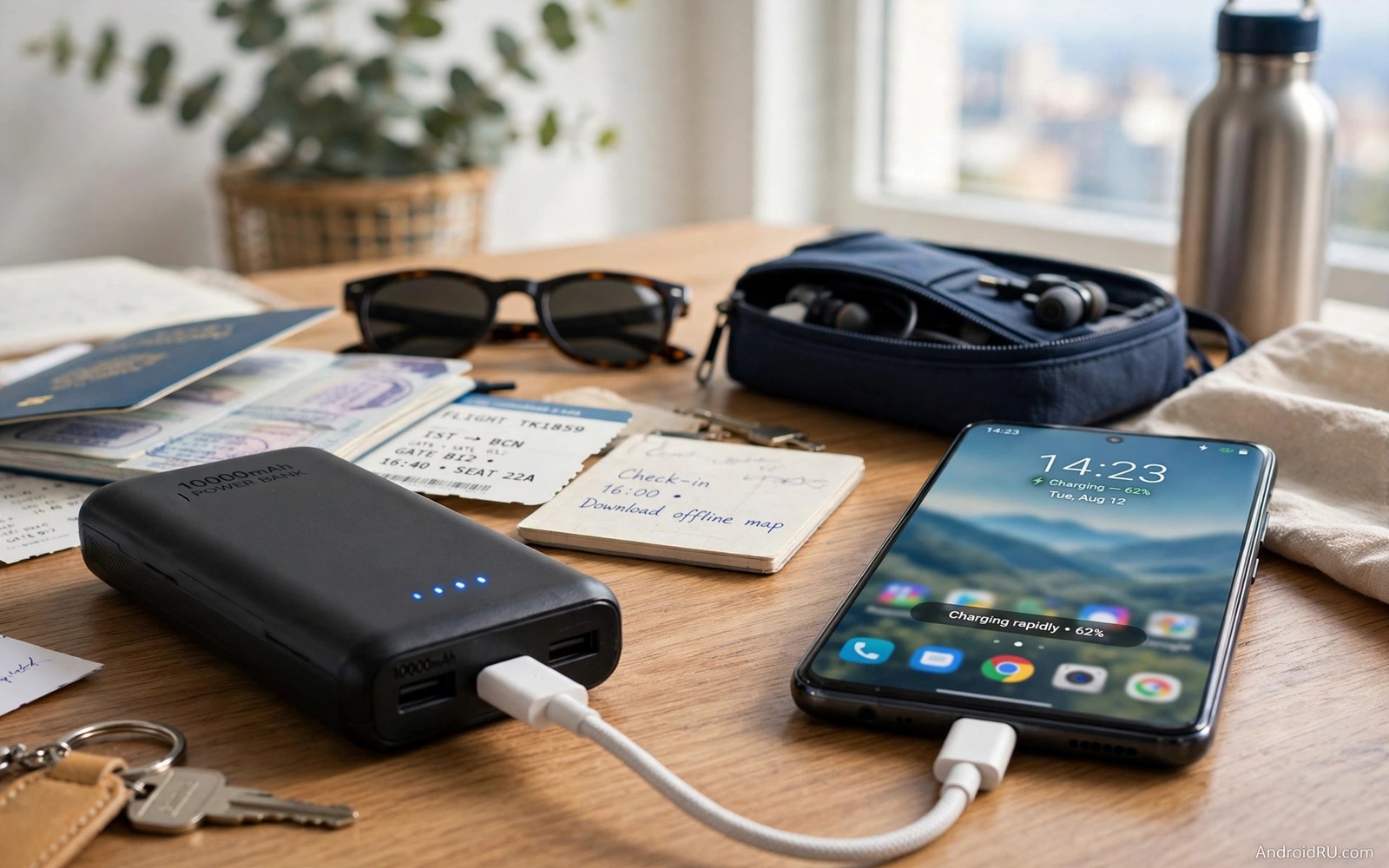
A power bank box can promise a huge capacity and still charge a phone only once. The headline number often counts the internal cell voltage and not the usable output. Ports and output power and safety matter as much as the headline number. A good power bank matches your phone and your travel style. A bad one adds weight without adding useful charges.
This guide gives you seven features to check before you pay. Each feature has a simple test or a clear spec to look for. You do not need engineering knowledge to use the checklist. You need only a clear idea of your phone and your daily travel. Work through the list in order and skip any feature that does not fit your use.
Start with your phone battery size and your charger power. A phone with a large battery needs a larger power bank for two charges. A phone with fast charging needs a power bank with matching output power. A traveller who flies needs a power bank that meets airline limits. Those three facts narrow the choice fast.
Feature One And Two: Real Capacity And Output Power
Check the rated capacity in milliamp hours and the output voltage. A power bank loses energy when it converts cell voltage to phone voltage. A 10000 unit bank often delivers far less usable charge to a phone. Look for a watt hour rating if the box shows it. A watt hour rating makes comparisons fairer across brands.
Check output power in watts for each port. A port with 18 watts suits many Android phones for fast charging. A port with only 5 watts will charge slowly even if capacity looks huge. Check whether output power drops when two ports run at once. A bank that shares power across ports may charge two devices slowly. Test one phone alone first for a fair speed check.
Feature Three And Four: Ports And Cable Support
Check the port types on the power bank. A USB-C port suits modern Android phones for input and output. A USB-A port suits older cables and accessories. A power bank with both types covers more devices on travel days. Check whether the USB-C port supports both charging the bank and charging a phone.
Check whether the bank includes a built in cable. A built in cable saves you from carrying a separate cable. A built in cable that is short may be awkward at a desk. A bank without a built in cable needs a good cable of your own. Pack the cable that matches the bank output power. A weak cable will limit a strong bank.
Feature Five: Pass Through And Low Current Modes
Pass through charging lets the bank charge a phone while the bank itself charges. That feature helps at a hotel with one wall socket. Check the manual for pass through support before you rely on it. Some banks disable pass through for safety. A bank that supports it should state it clearly.
Low current mode suits earbuds and watches that need tiny power. A normal bank may shut off when it senses a tiny load. A low current mode keeps the bank awake for small devices. Turn on low current mode only for small devices. Turn it off again for phones so the bank can deliver full power.
Feature Six And Seven: Safety And Size
Check safety protections on the product page. Look for overcharge and short circuit and temperature protection. Look for safety marks from a recognised testing body. A bank with no safety information is a risk at high power. Read reviews for heat problems before you buy. A bank that gets hot during normal use should be avoided.
Check size and weight against your travel style. A large bank suits a backpack and a long trip. A small bank suits a pocket and a single top up. A heavy bank that stays at home helps no one. Hold the bank size in mind with your phone size. A bank that fits your bag will travel with you every day. The capacity myth is explained further in testing real power bank capacity and the mAh myth before you trust a headline number.
capacity_check = watt_hours_if_shown
output_check = watts_per_port
ports = usb_c_plus_usb_a
safety = overcharge_and_temperature
The snippet above is an original example written for this guide. It shows generic settings that you can adapt to your own device. It does not copy code from any outside source.
Use the example above as a buying checklist for power banks. It is not code to install. Tick each line against the product page before you pay. Keep the checklist for your next travel purchase.
Match Power Bank Size To Trip Length
A day trip needs only a small top up bank. A weekend trip needs a medium bank for two charges. A week long trip needs a large bank or a wall charger plan. Trip length sets bank size more than phone size alone. A bank matched to trip length travels well.
Count charging opportunities during the trip. A hotel night gives a full recharge for the bank itself. A camping trip gives no recharge for days. A bank for camping must hold more total energy. A bank for hotel travel can be smaller because it recharges nightly. Opportunity counting prevents overpacking.
Pack a bank that fits your bag and your hand. A bank that is awkward to carry will stay in the hotel room. A bank in the room cannot charge a phone on a hike. Carry comfort is a functional feature for travel banks. A comfortable bank travels and a heavy bank stays behind.
Test the bank on a real trip before a critical journey. A home test shows charge count but not travel handling. A real trip test shows weight and cable handling. A trip test also shows whether the bank fits your bag pockets. Real world testing beats a spec sheet for travel gear.
Maintain A Power Bank For Long Life
A power bank battery ages with heat and deep discharge. Store the bank at room temperature and away from a hot car. Heat ages lithium cells faster than normal use. A cool storage spot preserves capacity for years. Storage care is free and effective.
Recharge the bank before it sits unused for months. A bank stored empty can fall into a deep discharge state. A bank stored at half charge survives storage better. Top up a stored bank every few months. That top up habit prevents a dead bank surprise.
Use the bank regularly rather than saving it for emergencies only. Regular use keeps the battery chemistry active. A bank used monthly stays healthier than a bank stored for a year. Regular use also reveals faults early. A fault found at home is better than a fault found on a trip. Real capacity checks help maintenance and testing real power bank capacity and the mAh myth shows how to verify output.
Retire a bank that swells or gets very hot during use. Swelling is a safety warning that needs immediate retirement. Do not puncture or bend a swollen bank. Dispose of it through a proper battery recycling route. Safety retirement protects you and your devices.
Charge Power Banks Correctly
A power bank charges best with a charger that matches its input rating. A weak input charger takes many hours to fill a large bank. A matched input charger fills the bank faster. Check input power on the bank product page. Input power matters as much as output power.
Charge the bank fully before a long trip. A partially charged bank may fail on the second phone charge. A full bank gives a predictable number of charges. Predictability matters for travel planning. A full charge is a travel preparation step.
Do not leave a bank charging unattended for days. A bank left on charge for days can heat up unnecessarily. Unplug the bank when it reaches full charge. Full charge awareness protects battery health. A charged bank needs no further charging.
Use a good cable for bank charging as well as phone charging. A weak cable limits bank input power. A weak cable can make a large bank charge overnight instead of in hours. Cable quality affects bank readiness. Solar banks offer an alternative and how solar power banks perform in real off grid emergency tests covers that option.
Store a charged bank at room temperature before travel. A hot car can drain a stored bank faster. A cool room preserves charge for travel day. Storage temperature is a readiness factor. Ready banks start trips at full power.
A power bank for travel should also charge small devices without shutting off. Earbuds and watches need a low current mode to stay charging. A bank without that mode may stop charging a small device early. Test a small device on the bank before a trip. Overheating protection also matters during fast charging and accessories that cool down phones during fast charging covers cooling gear for hot sessions.
Common Mistakes
The first mistake is trusting the headline capacity number alone. Usable output is lower after conversion losses. The second mistake is buying a bank with weak output power for a fast charging phone. Capacity without power gives slow charges. The third mistake is ignoring port types and then carrying the wrong cable. Ports and cables must match your devices.
Another mistake is buying a huge bank for pocket use. A huge bank stays at home and helps no one. A further mistake is ignoring safety marks on a cheap bank. Safety matters more than a low price at high power.
Frequently Asked Questions
How many charges should a 10000 unit bank give?
A 10000 unit bank usually gives one full charge plus a partial charge for a modern phone. Conversion losses reduce the usable output. Phone size and cable losses also affect the result. Expect one solid charge and not two full charges.
Can I take a power bank on a plane?
Most airlines allow power banks in cabin baggage up to a watt hour limit. Check your airline limit before travel. Pack the bank in cabin baggage and not in checked baggage. Keep the capacity label visible for inspection.
Why does my power bank charge slowly?
The port power or the cable may limit speed. Test with a rated cable and a single device. Check whether the bank shares power across ports. A weak cable can limit even a strong bank.
Conclusion
Write down your phone battery size and charger power today. Compare three power banks against the seven features in this guide. Pick the bank with matching output power and ports and safety marks. Test it with one full phone charge in the first week. If it delivers a solid charge without heat then keep it as your travel bank. That test is your concrete next step toward a power bank that actually helps.

