

How to Read Predictions Without Hype
Predictions about Android often mix three kinds of claims. Some claims describe technology that already works in labs. Some claims describe trends that are already visible in shipping phones. Some claims describe wishes that have no working product behind them. A useful prediction separates those three kinds and states what would prove it wrong. Readers who apply that test can enjoy future talk without buying a phone based on a rumour.
The next five years will likely bring gradual change rather than a single revolution. Phones already do most daily tasks well. The gains will come from longer support and better on device intelligence and smoother cross device work and new form factors that mature slowly. A prediction that promises a total replacement for phones in a short time should face extra doubt. A prediction that extends a visible trend deserves a closer look.
On Device Intelligence Will Grow Quieter
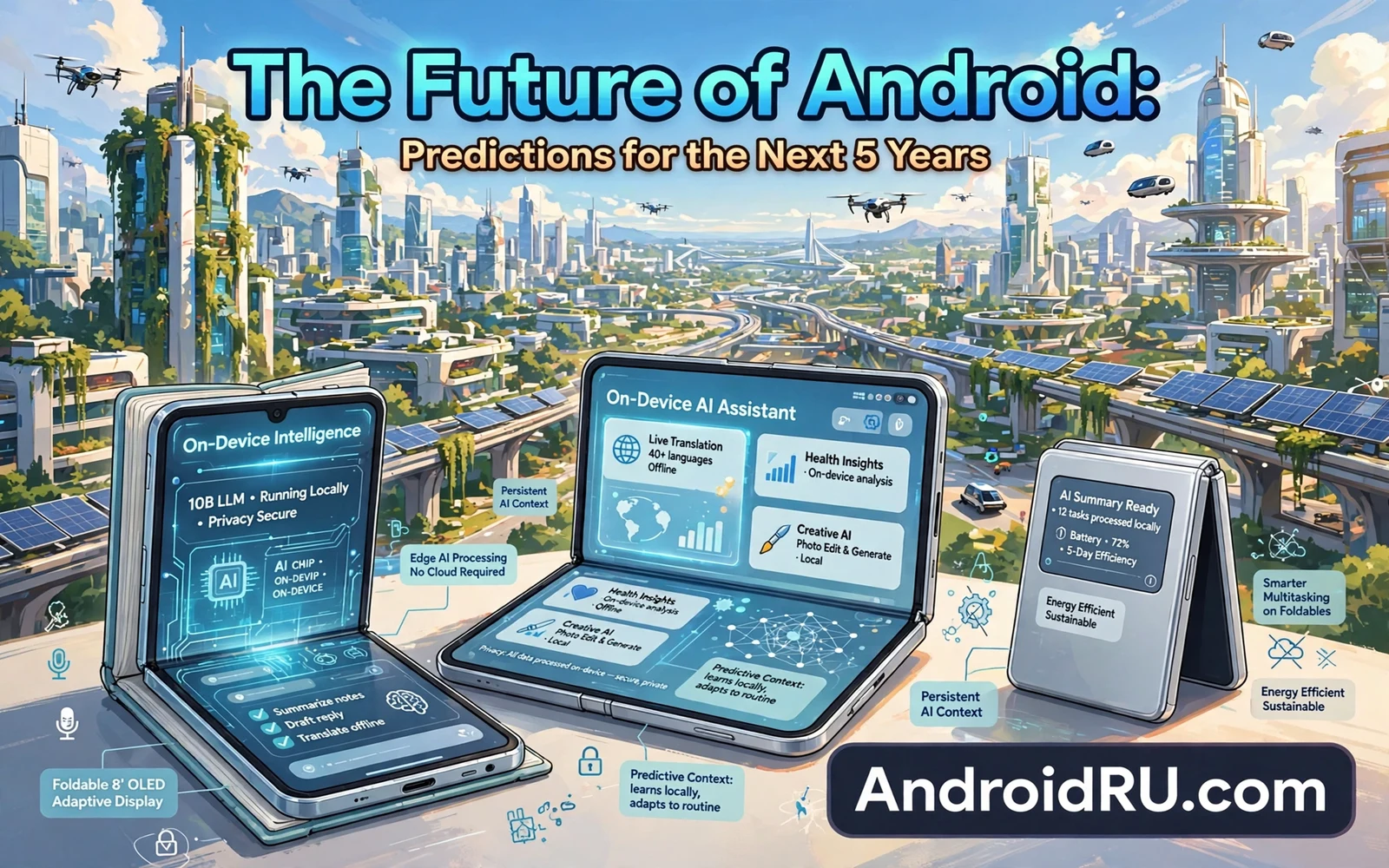
On device intelligence will likely move from flashy demos to quiet daily help. Voice transcription and live translation and photo cleanup already run on phones today. The next step is deeper integration where the phone drafts replies and summarises long threads and finds files without sending every word to a server. Privacy will be a selling point for on device work because data that never leaves the phone is easier to trust.
That shift will demand more efficient chips and more efficient models. Phone makers will tune hardware for intelligence tasks rather than only for games and cameras. Users will judge the result by battery life and by speed rather than by model names. A phone that handles intelligence tasks without heat and without drain will win more praise than a phone that lists the largest model on paper.
Shared services will shape how intelligence reaches apps and how Google Play Services controls your Android device explains the layer that already delivers shared features to many apps at once.
Foldables and Large Screens Will Mature
Foldable phones will likely move from early adopter curiosities to normal choices for users who want a tablet in a pocket. Durability and crease visibility and price remain the barriers. Each generation improves hinges and screens and software for large layouts. The software side matters most because a foldable without apps that use the large screen is only a phone that folds.
Tablets and foldables will push Android toward better window handling and better multitasking. Split screen and desktop style layouts will become more important as screens grow. A phone that folds open deserves a workspace that feels designed for that size rather than a stretched phone layout. Expect makers to invest in that workspace because it is the main reason to pay more for a folding device.
When a foldable opens flat the workspace question becomes practical and Android Desktop Mode is it ready to replace your laptop examines how windowed phone work performs on a larger display for office tasks and where it still falls short.
Support Length Will Become a Buying Factor
Longer update support will likely become a headline feature rather than a footnote. Buyers already ask how long a phone will receive security fixes. Makers that offer longer windows gain trust with buyers who keep phones for many years. That trust matters for business fleets and for families that pass phones down to younger users.
Longer support also changes the used phone market. A phone with years of patches left holds value better than a phone near the end of support. Buyers of used phones will check patch history as carefully as they check battery health. That shift rewards makers that plan support at launch rather than treating it as an afterthought.
Update mechanics will decide whether long promises feel real and how Android system updates work behind the scenes shows why staged delivery and device variants affect how fast a promise reaches a real phone.
Cross Device Work Will Feel More Natural
Phones and tablets and watches and TVs and cars already share accounts but the handoff between them still feels clumsy at times. The next five years will likely smooth those handoffs. A call that moves from phone to car and a document that moves from phone to tablet should feel like one flow rather than a set of separate apps. Fast pairing and shared clipboards and nearby sharing will carry much of that progress.
Desktop style work from a phone may also grow as large screens spread. A phone that drives a monitor for light office work already exists in basic form. The next step is better window handling and better peripheral support and better file handling. That path will not replace laptops for heavy work soon but it may replace a second laptop for travel and for light desk sessions.
Privacy and Control Will Stay Central
Privacy controls will likely grow more granular as users demand clearer choices. One time permissions and approximate location and hidden profiles already point in that direction. The next step may be clearer dashboards that show which app used which sensor and why. Users will reward phones that explain data use in plain words rather than hiding it behind long menus.
Business rules will also shape privacy. Work profiles and managed devices will need clearer separation between work data and personal data. A phone that handles that separation cleanly will suit workers who carry one device for both roles. Expect makers to refine profile handling because hybrid work is now a normal pattern rather than an exception.
Business readiness already has a clear marker and Android Enterprise Recommended what it means for devices explains the baseline that helps buyers judge managed phones today.
What Probably Will Not Change Fast
Battery chemistry will improve slowly. Users should not expect a phone that lasts a week under heavy use in the near term. Efficiency gains will extend life modestly but screens and radios and intelligence tasks will consume much of the gain. Charging will get faster and smarter but the daily charge habit will remain for most users.
App stores and payment rules will also evolve slowly because they involve law and business deals as well as technology. Users should expect gradual policy shifts rather than sudden freedom for every payment path. The safest way to judge such claims is to wait for shipping changes rather than trusting rumours about deals that may never close.
Rollback pressure rises when a promised future arrives as a rough update and how to roll back an Android update to a previous version sets out why moving backward carries data risks that forward fixes avoid.
How AI Features May Change App Design
Apps of the next five years will likely embed intelligence as a quiet feature rather than as a separate chat box. A notes app may summarise a long meeting without a special mode. A photo app may find a receipt without manual tagging. A mail app may draft a polite decline from a short prompt. Users will judge those features by accuracy and by speed and by how well they respect privacy. An app that drafts well but leaks data will lose trust fast.
Developers will face a choice between on device models and server models for each feature. On device models protect privacy and work offline but they limit size and power. Server models handle larger tasks but they need network and they raise data questions. Expect most apps to mix both paths with small tasks on device and large tasks on servers. Users should check which path an app uses for sensitive tasks such as health notes and financial drafts.
How Hardware May Change Phone Shapes
Phone shapes will likely diversify as foldables and rollables and large tablets share the Android platform. A single app may need to work on a small phone and on a large unfolded screen and on a tablet docked with a keyboard. Developers who design for flexible layouts will win users who move between shapes daily. Developers who design for one fixed size will frustrate users on every other shape.
Accessory ecosystems will grow around new shapes. Cases and docks and keyboards for foldables will mature as sales grow. Early buyers pay more for accessories and face fewer choices. Later buyers gain cheaper accessories and better fit. Users who value accessory choice should weigh that cycle before buying a first generation shape. A second generation device often brings the accessory market that the first generation lacked.
How Regulation May Shape the Next Five Years
Regulation will likely shape app stores and payment paths and data handling over the next five years. Rules differ by region and makers must adapt phones per market. Users may see different store options and different default apps depending on where they live. Those differences can confuse travellers who expect one consistent phone behaviour worldwide. Expect makers to explain regional differences more clearly as rules tighten because unexplained differences breed distrust.
Data rules will also push makers toward clearer consent screens and stronger on device processing. A phone that processes sensitive data locally can meet strict rules more easily than a phone that sends everything to servers. That technical shift aligns business needs with user privacy for once. Users should still read consent screens with care because a clear screen can still hide broad data use behind friendly words. Plain language consent is a trend worth rewarding with loyalty.
- Judge predictions by shipping trends rather than rumours
- Expect quieter on device intelligence with better privacy
- Expect foldables to mature through software as well as hardware
- Treat support length as a core buying factor
- Expect smoother handoffs across phone and tablet and car
- Wait for shipping changes before trusting policy rumours
Warning: Do not buy a phone today based only on a prediction about a feature that may arrive years later. Buy for the features that ship today and for the support window that the maker states in writing. A rumoured feature can slip or change or vanish. A phone bought on a rumour can leave you waiting for a promise that never lands.

