

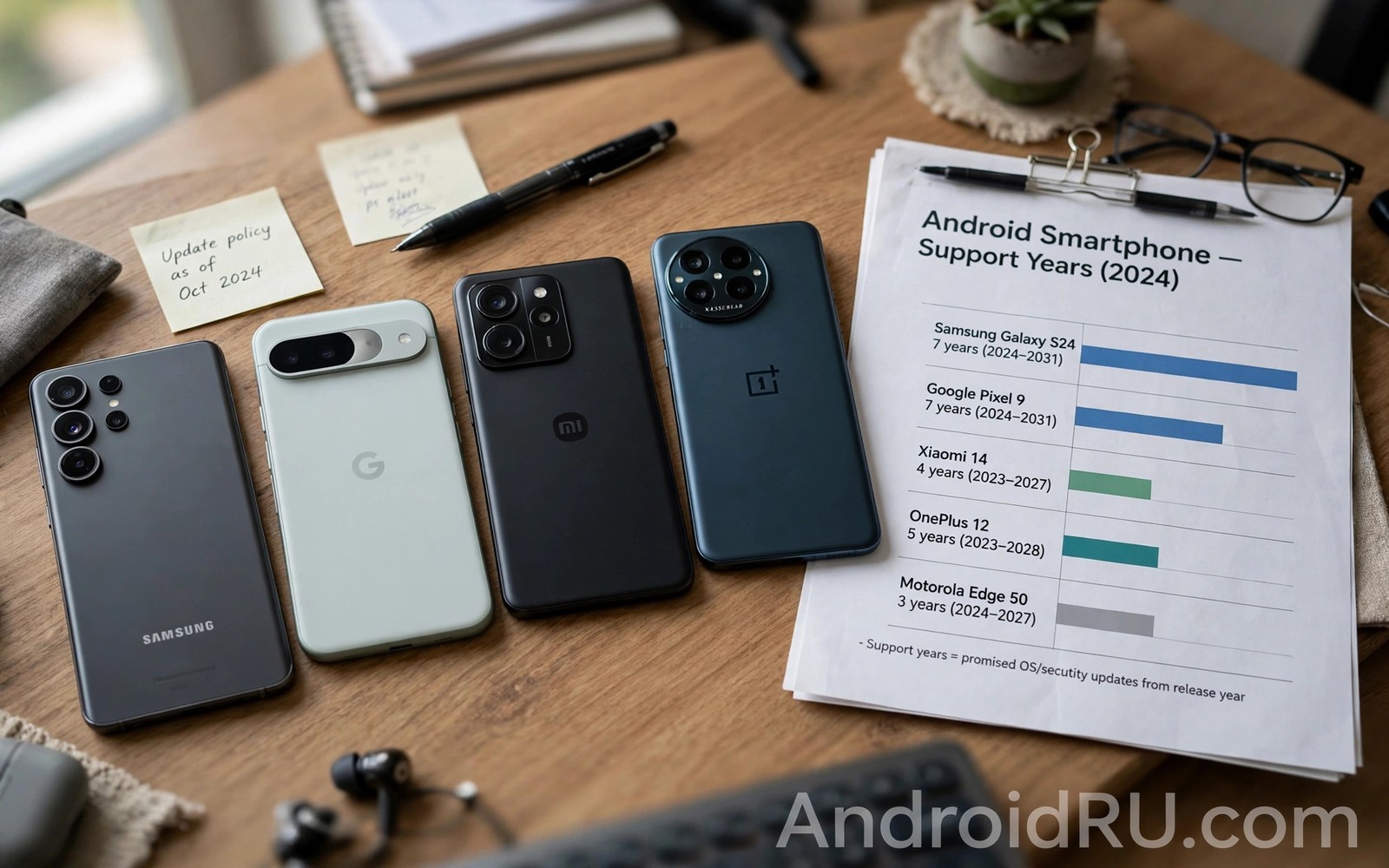
How long different smartphone brands support Android updates has become a key buying factor. A phone with seven years of support can outlast a phone with two years by a wide margin. The support length affects security and features and resale value. Buyers who ignore it may pay for a new phone sooner than expected.
Support promises vary by brand and by price tier within each brand. Flagship promises are usually longer than budget promises. This guide compares the main brands in plain terms. If you want the wider context then Android 14 vs Android 15 performance shows what those extra years actually deliver.
Google Pixel support
Recent Pixel flagships promise up to seven years of major updates and security patches. That promise is the longest in the Android market at present. Older Pixel models follow shorter promises from their launch era. Pixel support starts on launch day and runs on a steady monthly schedule.
Pixel phones also receive feature drops between major versions. Those drops keep the phone feeling fresh during long support years. A seven year promise only helps if the hardware lasts that long. Battery health becomes the real limit for many long term Pixel owners.
Samsung Galaxy support
Samsung promises four major updates for many recent flagships and selected midrange models. Security patches often run for five years on those models. Older Samsung phones follow shorter promises from their launch era. Samsung publishes update schedules by model so owners can check the exact promise.
Samsung support covers a huge model range which makes rollout timing uneven. Flagships receive updates first and midrange models follow later. Budget Galaxy models receive fewer major updates. Buyers should check the promise for the exact series rather than assuming the flagship promise applies everywhere.
Xiaomi OnePlus and Motorola
Xiaomi flagships now promise several major updates though the count varies by series. Budget Redmi phones receive fewer major updates and shorter patch periods. Xiaomi support also depends on region and on the interface layer used by that model. Owners should verify the promise for the exact model and region.
adb shell getprop ro.product.brand
adb shell getprop ro.product.model
adb shell getprop ro.build.version.release
These commands follow the approach described in the official Android developer documentation for reading brand and model details from a device.
OnePlus flagships promise several major updates while Nord models promise fewer. Motorola has improved in recent years but its promises still vary widely by series. Reading about top features of the next Android generation helps you weigh a longer promise against the features you actually want.
Why promises differ by price tier
Flagship phones earn more profit per unit so brands can afford longer testing for them. Budget phones sell on thin margins and brands limit testing to control cost. Hardware also matters because a budget processor may struggle with future Android versions. Brands therefore promise less for cheaper hardware.
Market competition also shapes promises. When one brand extends support rivals feel pressure to match it. That competition has lifted promises across the market in recent years. Buyers benefit as long as brands honour the promises they publish at launch.
How to use support length when buying
Compare the launch date and the promised years before you buy. A phone launched a year ago with a four year promise has three years left. A new phone with a two year promise may offer less remaining support than that older flagship. Remaining support matters more than the headline promise alone.
Also consider battery replacement and repair support. A phone with seven years of software support but a failing battery still needs service. Check repair options before you commit to a long ownership plan. Learning how to force a system update helps you keep any phone current within its window.
Support promises and real world delivery
Published support promises and real world delivery sometimes differ in timing even when the total years match. A brand may promise four major updates but deliver the fourth update very late in the window. Owners may therefore wait months longer than expected for the final update. Total years matter but delivery speed within those years also matters. Tracking owner reports for a model reveals whether a brand delivers promptly or slowly.
Regional delivery differences also affect real world support. A brand may deliver updates quickly in its home market and slowly elsewhere. Owners in smaller markets may wait longer for each update even though the promise covers their region. That gap frustrates owners who paid the same price. Checking regional owner forums before purchase gives a realistic expectation for delivery speed in a specific country.
Carrier variants again complicate real world delivery for brand promises. A brand promise may assume an unlocked model. A carrier variant of the same phone may receive fewer updates because the carrier skips some builds. Owners should therefore read the promise for their exact variant rather than the general brand promise. That distinction explains many cases where a phone appears to break its promise.
Support promises also interact with hardware revisions inside one model name. A phone may receive a processor change midway through production. The newer revision may support updates longer than the older revision. Owners rarely know which revision they own without checking detailed hardware information. That hidden difference can explain why two owners with the same phone name report different update experiences.
Choosing support over specifications
Buyers often choose a phone by camera megapixels and processor speed while ignoring support length. That choice can cost more over time because a phone with short support needs earlier replacement. A phone with slightly weaker specifications but longer support may serve longer and cost less per year. Calculating cost per year of supported use gives a fairer comparison than headline specifications alone.
Camera quality also depends on software support over time. A camera app that stops receiving updates may lose features or compatibility with new services. Long software support keeps camera processing improving for years. Owners who value photography should therefore weigh support length alongside camera hardware. A great camera with short support ages faster than a good camera with long support.
Battery replacement interacts with support length as well. A phone with seven years of software support will likely need a battery replacement during its life. Owners should check whether battery replacement is affordable and available for that model. A long software promise without repair support still limits total ownership life. Both promises together decide how long a phone can truly serve.
Resale markets reward long support in a clear way. Buyers in the used market pay more for phones with remaining updates. Sellers who kept a phone with long support recover more of the purchase price. That resale advantage reduces the effective cost of a flagship with long support. Budget phones with short support lose value faster for the same reason.
How support promises evolved recently
Support promises evolved rapidly in recent years as competition pushed brands to extend coverage. A few years ago two major updates counted as generous for many brands. Today four major updates are common for flagships and seven years appear for leading models. That shift reflects stronger hardware and better testing automation. It also reflects buyer demand for longer lasting phones. Owners benefit from a market where long support became a selling point rather than an afterthought.
Midrange support improved more slowly than flagship support during the same period. Midrange phones gained an extra major update in many cases but they still lag flagships by years. That gap matters because midrange buyers often keep phones longer due to budget constraints. Closing the midrange gap would help the owners who need long support most. Brands that extend midrange promises deserve recognition for serving that audience.
Budget support remains the weakest area despite overall progress. Budget phones often receive only one or two major updates. Their patch periods also end sooner. Budget owners therefore face earlier replacement pressure. That pressure contradicts sustainability goals because budget phones are numerous. Industry progress will feel incomplete until budget support improves meaningfully alongside flagship support.
Future support promises may become a regulated minimum rather than a competitive advantage. Regulators in several regions already discuss minimum update periods. A legal minimum would raise the floor for all brands and price tiers. Owners should watch regulatory developments because they may guarantee support that marketing promises currently offer only for flagships. Regulation could therefore transform the market more than competition alone.
Common mistakes
A common mistake is assuming the flagship promise applies to every phone from a brand. Budget lines often receive far less support. Another mistake is counting support years from the purchase date rather than the launch date. A phone bought a year after launch has already used a year of its promise.
- Assuming a budget phone shares the flagship support promise leads to surprise when updates stop early.
- Counting support from purchase date instead of launch date overstates the remaining update years.
- Ignoring patch length while focusing only on major updates misses half of the real support picture.
Frequently asked questions
Which brand offers the longest Android support?
Recent Pixel flagships lead with up to seven years in many cases. Samsung flagships follow with four major updates and five years of patches. The exact leader depends on the model year you compare.
Do support promises apply worldwide?
Most promises apply broadly but rollout timing and patch availability can vary by region and carrier. Check the brand page for your region and model variant for the precise schedule.
Does a long promise guarantee fast updates?
No a long promise guarantees duration rather than speed. Pixel phones tend to be fastest while other brands lag by weeks or months. Duration and speed are separate qualities.
Conclusion
Brand support length varies sharply by brand and by price tier. Pixel leads on duration and Samsung offers strong flagship support. Xiaomi and OnePlus and Motorola vary by series and owners must check the exact model promise.
Your next step is to compare remaining support years before your next purchase. Choose the phone whose promise matches how long you plan to keep it. That single check can save the cost of an early replacement.

