

POCO M3 Pro 5G Review: Daily Use, Software and Battery Life
This POCO M3 Pro 5G review looks at a budget phone that brought 5G, a 90Hz screen and a 5000mAh battery to a price where those features were still rare. Announced on 19 May 2021 and released on 22 May 2021, the phone arrived as the first 5G model in the POCO M series, built around the MediaTek Dimensity 700 chipset. The POCO M3 Pro 5G specs start with that 7nm chip, 4GB or 6GB of RAM, 64GB or 128GB of space, a 6.5-inch IPS LCD and a 48MP main camera. The POCO M3 Pro 5G price at launch in India started at around 13,999 rupees for the base model, which put genuine 5G within reach of buyers who had previously needed a mid-range phone to get it.
If you searched for a POCO M3 Pro 5G review daily use battery life summary, the short version is that this phone is easy to live with: the battery lasts two days for light users, the screen feels smooth for the price, and the software is full of features with a few ads to manage. The POCO M3 Pro 5G full specifications and price in India are listed in the table near the end of this article, and the sections below work through design, display, performance, software, cameras and charging one by one. POCO M3 Pro 5G is it worth buying in 2026 is a fair question for a phone from 2021, and the answer depends on price, condition and whether 5G coverage matters to you, so the verdict at the end weighs the phone as a used buy rather than as a new launch.
Design and Build Quality
The POCO M3 Pro 5G is a large plastic phone with a glossy back, a big camera module and a side fingerprint reader built into the power button. POCO M3 Pro 5G dimensions are 161.8 x 75.3 x 8.9 mm, so it is tall and fairly wide, and it needs two hands for comfortable typing on the move. POCO M3 Pro 5G weight is 190 grams, which is noticeable in a pocket but not heavy for a phone with a 5000mAh battery inside. The frame is plastic, the back picks up fingerprints quickly, and a clear case in the box helps in most regions. The POCO M3 Pro 5G unboxing includes the phone, an 18W charger, a USB cable and a clear case in most regions, which is a complete package for a budget phone. Among the POCO M3 Pro 5G features are 5G, NFC in some markets, an infrared blaster and FM radio, so the hardware list is generous for the price.
Compared with the POCO M3 Review: Build Quality, Battery and Daily Use, the Pro model trades the huge 6000mAh battery of the standard M3 for a slimmer body, a faster chip and 5G, and that trade shapes the whole phone. POCO M3 Pro 5G durability is typical of a plastic budget phone: it can survive everyday knocks with a case on, but there is no official water resistance rating, so it should be kept away from rain and sinks. The buttons feel solid, the SIM tray holds two nano SIM cards plus a microSD card, and the phone sits flat on a table thanks to a camera module that is wide rather than very thick.
Design, Colours and In-Hand Feel
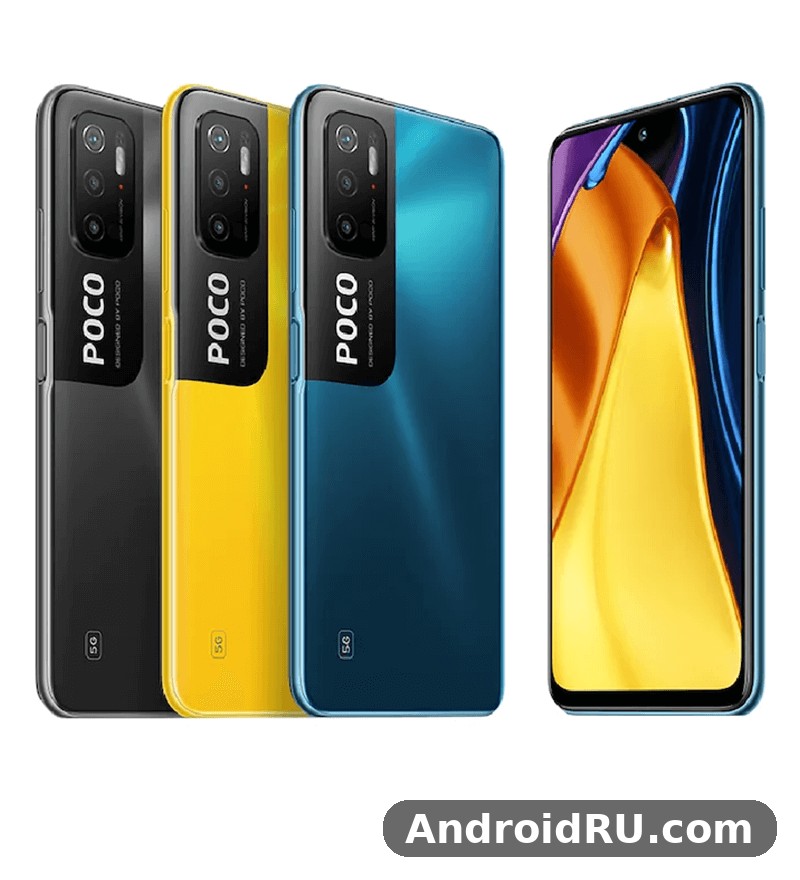
The POCO M3 Pro 5G colours are Power Black, Cool Blue and Poco Yellow, and the yellow version is the one that stands out in a crowd. The POCO M3 Pro 5G Power Black Cool Blue Poco Yellow colours give buyers a plain option, a cool blue option and a loud yellow option, so there is a finish for quiet tastes and for bold tastes alike. The POCO M3 Pro 5G 190 gram weight and 8.9mm thickness in hand feel balanced rather than top heavy, and the curved edges of the back help the phone sit in the palm during long calls. The glossy back looks good when clean, but it shows smudges within minutes, which is why most owners will keep the supplied case on from day one.
Power Black, Cool Blue and Poco Yellow
Power Black is the safest choice and hides scratches best, Cool Blue shifts between blue and teal under different light, and Poco Yellow is bright, cheerful and unmistakably a POCO phone. The large POCO logo on the back is part of the design language of this generation, and it divides opinion: some owners like the bold branding, while others cover it with an opaque case. Whichever colour you pick, the front is the same, with a centred punch hole camera, slim side bezels and a slightly thicker chin at the bottom of the screen.
Fingerprint Sensor, Ports and Connectivity
The POCO M3 Pro 5G fingerprint reader sits on the right edge inside the power button, and it is fast and reliable once the finger is registered from a couple of angles. The POCO M3 Pro 5G side fingerprint sensor and face unlock both work well in daily use, with the fingerprint reader the safer choice in low light and the face unlock the quicker choice when the hands are busy. The POCO M3 Pro 5G USB Type C port and 3.5mm headphone jack sit on the bottom and top edges, so wired headphones still work without an adapter and charging uses the modern reversible connector. The POCO M3 Pro 5G infrared blaster and FM radio features let the phone act as a remote control for a television and play local radio with wired headphones as the antenna, two extras that many pricier phones have dropped.
POCO M3 Pro 5G NFC is present in some markets and absent in others, so buyers should check the exact model for their region before assuming contactless payments will work. The POCO M3 Pro 5G NFC support depends on market and region, and the global model sold in Europe does include it while some other regional versions do not. The POCO M3 Pro 5G dual SIM 5G standby and network bands cover the common sub-6GHz 5G bands for its launch markets, with 4G fallback that is fast enough for video and calls where 5G has not arrived yet. The POCO M3 Pro 5G speakers consist of a single bottom-firing unit, and the POCO M3 Pro 5G stereo speakers or single speaker sound quality question has a simple answer: there is one speaker, it gets loud enough for videos in a quiet room, and it sounds thin at full volume. POCO M3 Pro 5G audio through the headphone jack is cleaner than through the speaker, and wired earphones remain the best way to listen to music on this phone.
Display
The POCO M3 Pro 5G display is a 6.5-inch IPS LCD with a Full HD+ resolution of 1080 x 2400 pixels, a 90Hz refresh rate and a centred punch hole for the front camera. The screen is sharp enough that text looks clean, the colours are natural rather than oversaturated, and the 20:9 shape suits video and social feeds. The panel is protected by Gorilla Glass 3, which guards against scratches from keys and coins in a pocket, though a screen protector is still a sensible addition. Buyers comparing screens can also read the POCO M4 Pro 5G Review: Everyday Speed, Cameras and Value, which covers a later POCO phone with a similar approach to balancing screen quality against price.
90Hz Smoothness and Brightness
The 90Hz refresh rate is the headline feature of this screen, and it makes scrolling through feeds, menus and web pages feel smoother than on a standard 60Hz budget phone. This POCO M3 Pro 5G 90Hz display review and outdoor visibility section notes that the panel reaches around 400 nits in normal use and up to 500 nits in bright light, so it is readable outdoors on a sunny day but not as bright as the best mid-range AMOLED screens. The POCO M3 Pro 5G 6.5 inch IPS LCD screen brightness and colours are good for the price, with decent viewing angles and a colour temperature that can be adjusted in the settings. The refresh rate can be set to 90Hz or 60Hz, and dropping to 60Hz saves a little battery on days when the charger is far away. There is no always-on display, which is normal for an LCD panel, and the notification light is absent too, so the lock screen and the punch hole camera area carry the job of showing alerts.
Performance and Gaming
POCO M3 Pro 5G performance in daily tasks is smooth and dependable for a budget phone, because the Dimensity 700 is a 7nm chip with two fast Cortex-A76 cores at 2.2GHz and six efficient Cortex-A55 cores at 2.0GHz. The Dimensity 700 chipset handles messaging, browsing, video streaming, maps and social apps without hesitation, and it switches between apps quickly when paired with 6GB of RAM. A POCO M3 Pro 5G Dimensity 700 performance and gaming test shows that the chip is a clear step up from the Snapdragon 662 in the standard POCO M3, and the 5G modem is built into the same chip, which helps keep power use down. Buyers who want to compare later Dimensity phones can read the POCO M4 5G Review: App Performance and Camera Quality, which looks at how the next generation of this line performs in the same kind of everyday tasks.
Dimensity 700 in Everyday Tasks
POCO M3 Pro 5G RAM comes in 4GB or 6GB, and the 6GB version is the one to pick when the price gap is small, because it keeps more apps in memory and reduces reloads. POCO M3 Pro 5G storage options are 64GB or 128GB, with the 128GB version the safer pick for anyone who records video or keeps a large music library offline. The POCO M3 Pro 5G 4GB RAM 64GB storage variant price was the entry point at launch, aimed at buyers who wanted 5G at the lowest possible cost. The POCO M3 Pro 5G 6GB RAM 128GB storage variant price sat a little higher and is the better buy on the used market today, because the extra memory and space make the phone feel newer for longer. POCO M3 Pro 5G microSD support uses a dedicated slot, so the card does not take the place of a second SIM, and the POCO M3 Pro 5G microSD card slot and expandable storage options mean that even the 64GB model can grow with a cheap card. The phone warms slightly during long video calls or navigation, but it never gets uncomfortably hot in normal daily use.
Gaming on the Dimensity 700
POCO M3 Pro 5G gaming is comfortable for casual titles and playable for heavier ones, with the Mali-G57 MC2 graphics handling popular games at medium settings. POCO M3 Pro 5G heating stays modest during short sessions, and the large body spreads warmth so no single spot gets very hot. A POCO M3 Pro 5G heating issue while gaming and charging at the same time is rarely severe, but it is still best to avoid heavy gaming while the phone is plugged in, because the battery charges slowly and the heat builds up faster. Competitive players will notice that demanding games need lower graphics settings to hold a steady frame rate, while casual players who enjoy puzzle games, racing games and battle royale titles at balanced settings will find the phone good enough for daily play.
Heat and Sustained Performance
During a long gaming session the Dimensity 700 holds its speed well, with only a small drop in frame rate as the phone warms up, and the 90Hz screen helps fast games feel responsive when the frame rate allows it. The phone cools down quickly once the game is closed, and the battery drains at a steady rather than alarming rate during play. Turning the refresh rate down to 60Hz and the brightness down a notch stretches a gaming session noticeably, which matters on a phone where charging is slow and the battery is the main strength.
Software and Daily Use
POCO M3 Pro 5G Android 11 ships with MIUI 12, and the POCO M3 Pro 5G Android 11 MIUI 12 software experience is feature rich, with a custom launcher, gesture navigation, a second space for separating work and personal apps, and a game mode that blocks notifications while playing. POCO M3 Pro 5G MIUI software includes the familiar POCO launcher with an app drawer, icon packs and the ability to sort apps by category, which keeps the home screen tidy without extra apps. The phone feels fast in daily use because the 90Hz screen and the animations work together, and the fingerprint reader wakes the phone straight to the home screen. Readers who want to see how an older POCO handled the same software ideas can look at the POCO M2 Review: Display, Cameras and Budget Trade-Offs, which covers a phone from the generation before this one.
MIUI 12 on Android 11
MIUI 12 on this phone brings a control centre that slides down from the right, a notification shade on the left, floating windows for multitasking, and a dark mode that works across most apps. The software is not perfect: there are preinstalled apps that many owners will never open, and some system apps show ads or recommendations that need to be switched off in the settings. A POCO M3 Pro 5G software update to MIUI 13 and Android 12 arrived in many regions after launch, and the POCO M3 Pro 5G update history shows that security patches continued for a while, though owners should not expect the latest Android version on a phone from 2021. For daily use the software is stable, the settings are easy to find, and the phone handles two SIM cards, call recording in some regions, and dual apps for running two accounts in the same app.
Cameras
The POCO M3 Pro 5G camera setup uses a 48MP main camera with an f/1.8 lens, a 2MP macro camera and a 2MP depth sensor, plus an 8MP front camera in the punch hole. There is no ultra-wide camera, which is the biggest gap in the camera system, and the macro and depth cameras add little that the main camera cannot do on its own. POCO M3 Pro 5G camera quality in daylight and low light is best described as good for the price: daylight photos are sharp and colourful, while night photos need a steady hand and the night mode to look their best. The 48MP main camera uses pixel binning to produce 12MP photos by default, which keeps file sizes sensible and improves low light results. Readers comparing camera value in this family can also check the POCO M2 Pro Review: Everyday Speed, Cameras and Value, which looks at a related POCO phone with a similar camera philosophy.
48MP Main Camera
In daylight the main camera captures plenty of detail, with natural colours, good dynamic range and fast autofocus that locks onto subjects without hunting. POCO M3 Pro 5G night mode helps in dim restaurants and on evening streets by taking a longer exposure and brightening the shadows, though moving subjects will blur and the results are softer than daylight shots. POCO M3 Pro 5G 48MP main camera samples and night mode results show that the phone is at its best in good light, where it can trade blows with pricier phones, and that it falls behind once the light fades. The full 48MP mode is useful for cropping into a distant subject, but the binned 12MP mode is the better default for everyday shooting.
Night Mode and Video Recording
Video recording tops out at 1080p at 30 frames per second, with electronic stabilisation that smooths out gentle walking but cannot fix fast movement. Night video is noisy and soft, which is normal at this price, and the phone has no 4K recording, so creators who need high resolution video should look elsewhere. The camera app is quick to open, the shutter is responsive, and modes for panorama, portrait, time-lapse and slow motion are all present, even if the slow motion mode is limited in resolution.
Macro, Depth and Selfie Cameras
The POCO M3 Pro 5G macro camera is a 2MP unit that needs very close focus and good light to produce a usable shot, and most owners will use it rarely. A POCO M3 Pro 5G 2MP macro camera close up photos review would be short: the results are soft, the focus distance is fussy, and the main camera cropped in often gives a better picture. The depth sensor helps the portrait mode separate the subject from the background, and portrait shots of people look pleasant in daylight with a gentle blur behind the subject. The POCO M3 Pro 5G selfie camera is an 8MP unit with an f/2.0 lens, and POCO M3 Pro 5G selfie photos are clear and bright in daylight, with a portrait mode that softens the background. The POCO M3 Pro 5G 8MP selfie camera portrait mode and video recording cover 1080p video calls and social clips, which is all most owners need from a front camera.
Battery Life and Charging
The POCO M3 Pro 5G battery is a 5000mAh unit, and the 5000mAh battery is the reason many buyers chose this phone over rivals with smaller cells. The POCO M3 Pro 5G 5000mAh battery life and 18W charging time are covered in detail below, but the headline is simple: light users can reach two days between charges, heavy users will end most days with charge to spare, and the slow charging is the price paid for that endurance. POCO M3 Pro 5G battery drain overnight and standby time are both excellent, with only a few percent lost overnight when the phone is idle, thanks to the efficient 7nm chip and the deep sleep of MIUI. POCO M3 Pro 5G how to improve battery life and performance tips include lowering the refresh rate to 60Hz, turning off 5G where the signal is weak, and switching off background use for apps that do not need it.
Two-Day Battery Expectations
With mixed use that includes messaging, browsing, an hour of video and some music, the phone regularly lasts a day and a half to two days, and screen-on time of seven to eight hours is realistic for moderate users. Heavy days with navigation, gaming and video calls will still get through a full day, which is more than many budget phones manage. The battery holds up well over time, and a used phone that still has most of its original capacity will feel nearly as enduring as a new one. Battery saver modes in MIUI can stretch the last few percent for hours when the charger is out of reach.
18W Charging Time
POCO M3 Pro 5G charging is capped at 18W, and a full charge from empty takes around two hours with the charger in the box. That is slow by modern standards, where 33W and 67W charging are common, and it is the weakest part of the battery story. A quick top-up of half an hour adds roughly a quarter of a charge, so overnight charging is the most practical routine for this phone. There is no wireless charging, which is expected at this price, and the USB-C port is used for both charging and wired audio accessories.
Full Specifications
The table below lists the complete specifications of the POCO M3 Pro 5G, based on the published specification sheet for the global model, with the release date of 22 May 2021 and the MediaTek Dimensity 700 chipset at its heart. POCO M3 Pro 5G best cases covers and screen protector accessories are easy to find for this popular model, and a case plus a tempered glass protector are worth buying with the phone.
| Feature | Details |
|---|---|
| Brand | POCO |
| Model | POCO M3 Pro 5G (M2103K19PG global) |
| Announced | 19 May 2021 |
| Released | 22 May 2021 |
| Display | 6.5-inch IPS LCD, 1080 x 2400 pixels, 90Hz, 400 nits typical, 500 nits peak |
| Protection | Corning Gorilla Glass 3 |
| Chipset | MediaTek Dimensity 700 (7nm), octa-core 2×2.2GHz Cortex-A76 and 6×2.0GHz Cortex-A55 |
| Graphics | Mali-G57 MC2 |
| RAM | 4GB or 6GB |
| Storage | 64GB or 128GB UFS 2.2, microSDXC dedicated slot |
| Rear camera | 48MP f/1.8 main with PDAF, 2MP f/2.4 macro, 2MP f/2.4 depth, LED flash |
| Rear video | 1080p at 30fps |
| Front camera | 8MP f/2.0, 1080p at 30fps |
| Battery | 5000mAh Li-Po, non-removable |
| Charging | 18W wired, charger in the box in most regions |
| Operating system | Android 11 with MIUI 12, later updated to MIUI 13 based on Android 12 in many regions |
| Fingerprint | Side-mounted fingerprint reader in the power button, plus face unlock |
| NFC | Yes in some markets, depends on region |
| SIM | Dual nano SIM with 5G standby |
| Connectivity | 5G, 4G LTE, Wi-Fi 802.11 a/b/g/n/ac, Bluetooth 5.1, GPS, infrared blaster, FM radio |
| Ports | USB Type-C, 3.5mm headphone jack |
| Dimensions | 161.8 x 75.3 x 8.9 mm |
| Weight | 190 grams |
| Colours | Power Black, Cool Blue, Poco Yellow |
| Audio | Single loudspeaker, 3.5mm jack |
Pros and Cons
POCO M3 Pro 5G value remains its strongest argument: 5G, a 90Hz screen and a 5000mAh battery at a budget price is a combination that few rivals matched at launch. The POCO M3 Pro 5G pros and cons after long term use are summarised below, and they show a phone whose strengths are practical and whose weaknesses are easy to live with when the price is low. For the POCO M3 Pro 5G vs POCO M3 which phone is better question, the answer depends on 5G: the Pro adds 5G, a 90Hz display and a faster Dimensity 700 chip, while the standard M3 counters with a larger 6000mAh battery and a lower price, so buyers with 5G coverage should pick the Pro and buyers who only need endurance can save money with the standard model.
Pros:
- 5G connectivity at a genuinely low price
- Smooth 90Hz Full HD+ display
- Two-day battery life from the 5000mAh cell
- Fast side fingerprint reader and face unlock
- Dedicated microSD card slot alongside dual SIM
- Headphone jack, infrared blaster and FM radio included
Cons:
- Slow 18W charging with a full charge near two hours
- No ultra-wide camera and weak 2MP macro camera
- Single loudspeaker with thin sound at full volume
- Plastic build with no water resistance rating
- MIUI 12 ships with preinstalled apps and ads to switch off
- Video recording limited to 1080p at 30 frames per second
FAQ
Is the POCO M3 Pro 5G still worth buying in 2026?
As a cheap used phone it can still make sense for calls, messaging, video and light gaming, especially when 5G coverage is available and the battery is still healthy. As a new purchase it is hard to recommend, because newer budget phones offer faster charging, better cameras and longer software support for similar money. Check the battery health, the exact regional model for NFC, and the price against newer rivals before deciding.
Does the POCO M3 Pro 5G support 5G on both SIM slots?
The phone supports dual SIM 5G standby, so both SIM slots can be registered on 5G networks, with one active data connection at a time. The exact 5G bands depend on the regional model, so buyers should confirm that the bands match their carrier before buying an imported unit.
How long does the POCO M3 Pro 5G battery last?
The 5000mAh battery lasts a day and a half to two days for moderate users, with seven to eight hours of screen-on time realistic in mixed use. Heavy days with gaming, navigation and video calls will still get through a full day, and overnight drain is only a few percent when the phone is idle.
Does the POCO M3 Pro 5G have NFC?
NFC is included on the global model sold in Europe and in some other markets, but not on every regional version. Because NFC support depends on the market, buyers who need contactless payments should verify the exact model number, such as M2103K19PG for the global version, before buying.
What Android version does the POCO M3 Pro 5G run?
The phone launched with Android 11 and MIUI 12, and it later received an update to MIUI 13 based on Android 12 in many regions. Owners should not expect the latest Android version on a phone from 2021, but security patches continued for a period after launch, and the phone remains usable for everyday apps.
The POCO M3 Pro 5G is a budget phone that gets the practical things right: a big battery, a smooth screen, 5G and a capable main camera at a low price. Its slow charging, missing ultra-wide camera and single speaker are real compromises, but they are the kind of compromises that fade into the background when the phone costs this little and lasts two days on a charge. For buyers who want affordable 5G without paying mid-range money, and for anyone picking one up cheap on the used market today, it remains a sensible and honest choice.

