

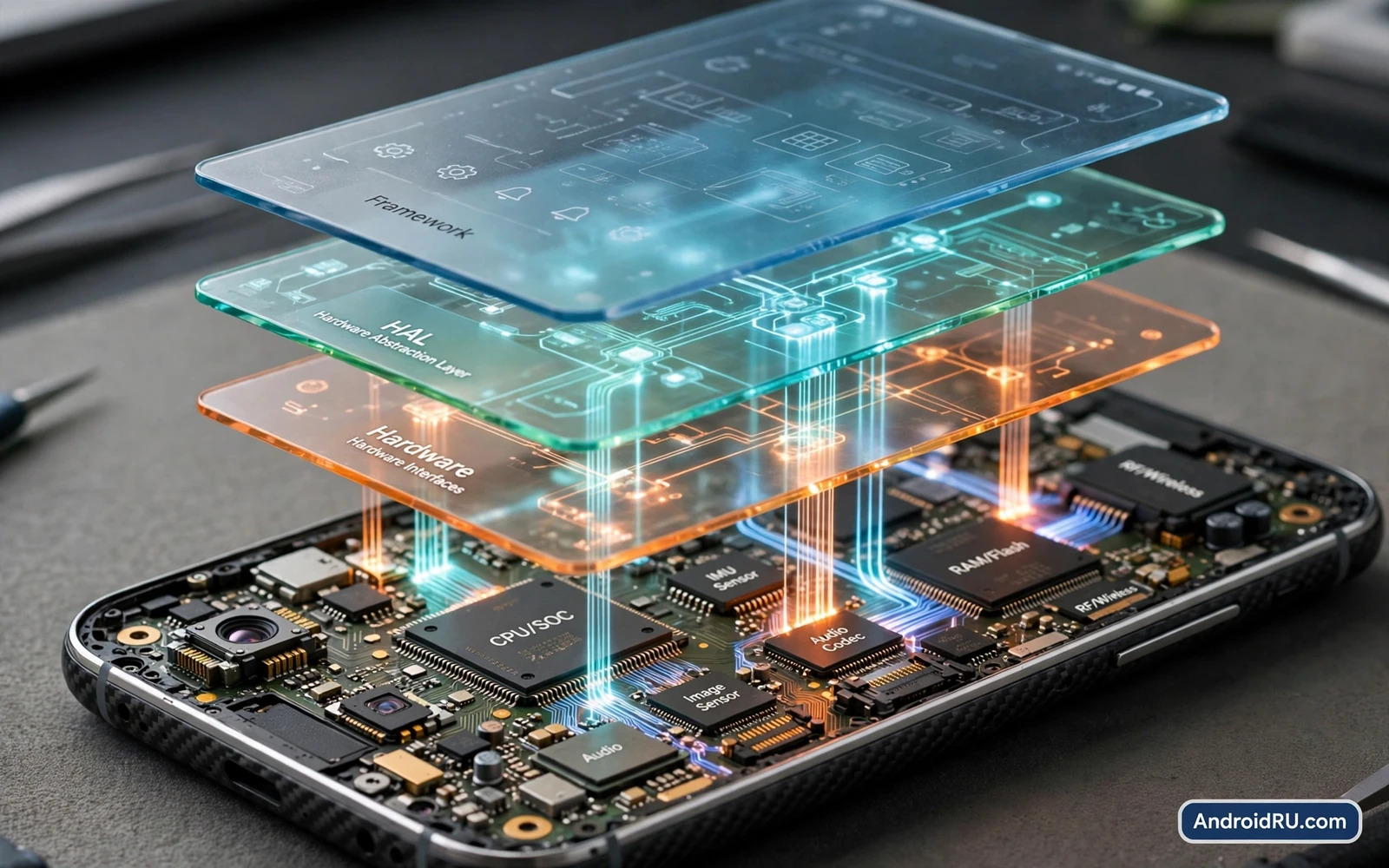
Android runs on thousands of device models with different cameras and sensors and audio chips. The framework cannot contain a driver for every chip. The Hardware Abstraction Layer solves that problem. It defines standard interfaces between the Android framework and vendor hardware implementations. The framework talks to the HAL interface. The vendor implements that interface for specific hardware. This guide explains that architecture layer by layer.
Think of the HAL as a contract. The framework promises to call only the defined interface methods. The vendor promises to implement those methods for its hardware. Neither side needs to know the internal details of the other side. A new camera sensor works with the same framework code when its vendor HAL implements the camera interface. That separation lets Android scale across vendors without framework changes for every device.
The HAL also protects the framework from hardware quirks. A sensor that reports data in a vendor specific format gets normalised inside the HAL implementation. The framework receives data in the standard format it expects. Quirks stay inside the vendor layer where the vendor can fix them. Framework developers work against a stable interface rather than against a shifting set of device behaviours.
// HAL interface concept (simplified)
interface ICameraDevice {
    configureStreams(streams);
    processCaptureRequest(request);
}
Layers above and below the HAL
Above the HAL sits the Android framework with its services and managers. The camera service and the audio service and the sensor service all call HAL interfaces. Application code calls framework APIs and never calls the HAL directly. That rule keeps apps portable across devices. An app that bypassed the framework to reach hardware directly would break on devices with different chips.
Below the HAL sits vendor code and kernel drivers. Vendor code translates HAL calls into hardware commands. Kernel drivers move data between hardware and vendor code. The HAL boundary sits in user space while drivers sit in the kernel. That split keeps hardware details out of the framework and keeps kernel details out of the HAL interface. Each layer owns its own complexity.
Modern Android uses a HAL interface definition language that generates code for both sides of the interface. The framework side and the vendor side share the generated interface. Changes to the interface follow versioning rules that protect compatibility. A framework update can work with an older vendor HAL when the interface version allows it. Versioning is what makes long term device updates feasible.
Camera and audio HAL examples
The camera HAL exposes device capabilities and stream configurations to the camera service. It reports supported resolutions and frame rates and sensor characteristics. The framework uses that information to build capture requests. The vendor implementation translates requests into sensor commands. Readers who study camera behaviour can continue with the piece on how Android camera hooking works and see how framework camera calls flow toward hardware. Hooking at the framework level differs from replacing the HAL itself.
The audio HAL exposes input and output streams to the audio framework. It reports sample rates and channel layouts and latency characteristics. The framework mixes app audio and routes it through the HAL to the output device. Readers who study that framework path can continue with the piece on Android audio framework and HAL interaction and follow audio from app to driver. The HAL is the bridge in that journey.
Sensor HAL implementations expose accelerometers and gyroscopes and other sensors through a standard interface. The framework batches sensor data and delivers it to apps that request it. Vendor code handles power management for the sensor hardware. A sensor HAL that batches efficiently saves battery because the processor can sleep between batches. Efficiency at the HAL level benefits every app that uses sensors.
Treble and vendor separation
Project Treble formalised the separation between framework and vendor code. The framework lives in one partition and vendor code lives in another partition. The HAL interface defines the boundary between them. A framework update can ship without rebuilding vendor code when the interface stays compatible. That separation shortened update times for many devices because vendors no longer needed to rebuild their layer for every framework change.
Vendor test suites verify HAL implementations against the interface. A vendor HAL must pass tests for the interface version it claims. Those tests catch mismatches before devices ship. Developers benefit because a tested HAL behaves predictably from the framework side. A HAL that passes its tests still has vendor quirks but those quirks stay within the tested interface behaviour.
Generic system images rely on this separation. A generic framework image can boot on different devices when each device provides a compatible vendor layer. That portability helps testing and development. It does not mean every device runs identical vendor code. Vendor code still differs but it speaks the same interface language to the framework.
Native audio effects and the HAL
App level audio effects run above the HAL. They shape audio before the framework hands it to the HAL for output. Readers who build such effects can continue with the piece on creating custom audio effects filters in Android NDK and place their filter chain correctly in the pipeline. A filter that runs in the app cannot change HAL behaviour. It can only shape the buffers that reach the HAL.
Latency depends on the whole chain including the HAL and the driver. An app that requests a small buffer still faces HAL buffer sizes and driver latency. Measure end to end latency on real devices rather than assuming the app buffer size equals total latency. A device with a large HAL buffer will show higher latency no matter how small the app buffer becomes. Understanding the chain prevents optimising the wrong layer.
Performance profiling across layers helps locate a bottleneck. Readers who profile audio paths can continue with the piece on testing app performance with profiler tools and separate app CPU use from framework and HAL behaviour. A profiler view that shows app threads idle while audio stalls points below the app layer. That evidence guides the investigation to the right team.
Security and stability at the boundary
The HAL boundary also serves security. Vendor code runs with limited privileges and communicates through defined interfaces. A bug in vendor code has a bounded blast radius when the interface is narrow. Framework code does not trust HAL data blindly. It validates sizes and ranges before using hardware reported values. Validation at the boundary protects the framework from a faulty or malicious vendor implementation.
Stability improves when crashes stay in their layer. A vendor HAL crash can be isolated and restarted by the framework in many cases. The app may see a brief interruption rather than a full system failure. That isolation matters for camera and audio features where users notice a crash at once. Layered design turns a vendor bug into a recoverable event rather than a device failure.
Open source code covers the framework side of the HAL interfaces. Vendor implementations often remain proprietary. Readers who study the open side can explore the interface definitions and the framework services that call them. That open view explains the contract even when a specific vendor implementation stays closed. The contract is the architecture. The implementation is a vendor detail.
Why the HAL matters to app developers
App developers rarely write HAL code but they live with HAL consequences daily. Camera capabilities and audio latency and sensor availability all flow from HAL implementations. A feature that works on one device and fails on another often traces to a HAL difference. Checking capability APIs before using a feature handles those differences gracefully. Never assume a capability exists because it existed on a test device.
Feature detection beats device detection. Query the framework for supported resolutions and sample rates and sensor types. Adapt the interface to the reported capabilities. A device list with special cases grows stale with every new model. Capability queries stay correct across new hardware. The HAL exists precisely so apps can query capabilities instead of memorising devices.
The HAL architecture lets Android grow across hardware generations. New sensors and new audio chips arrive through new HAL interfaces while old interfaces keep working for existing hardware. That evolution keeps the platform stable for developers and flexible for vendors. Understanding the boundary helps developers design features that survive the next hardware generation.
Vendor HAL testing
Vendor HAL testing shapes device quality before launch. Vendors run test suites that check interface compliance for camera and audio and sensors. A HAL that fails a test cannot ship with that interface claim. Developers benefit indirectly because compliant HAL implementations behave predictably from framework code. Predictable HAL behaviour reduces device specific workarounds in apps.
Compatibility across interface versions matters for updates. A new framework version may require a newer HAL interface for new features while keeping old features working on older HAL versions. Feature detection at the framework level handles that mix. An app that queries capabilities benefits automatically because the framework reports only what the current HAL supports. No app code change is needed for a HAL version upgrade.
Debugging a HAL level problem needs logs from several layers. Framework logs show the request. HAL logs show the translation. Driver logs show hardware response. Collecting all three layers takes coordination between teams. A bug report with only app logs may point to the wrong layer. Layered logs shorten the path to the real cause.
Future hardware arrives through new HAL interfaces while old interfaces stay supported. A new sensor type gets a new interface version. Existing apps keep working because old interfaces remain. That evolution path lets Android adopt new hardware without breaking the installed app base. Stability for developers and flexibility for vendors coexist through versioned interfaces.

