

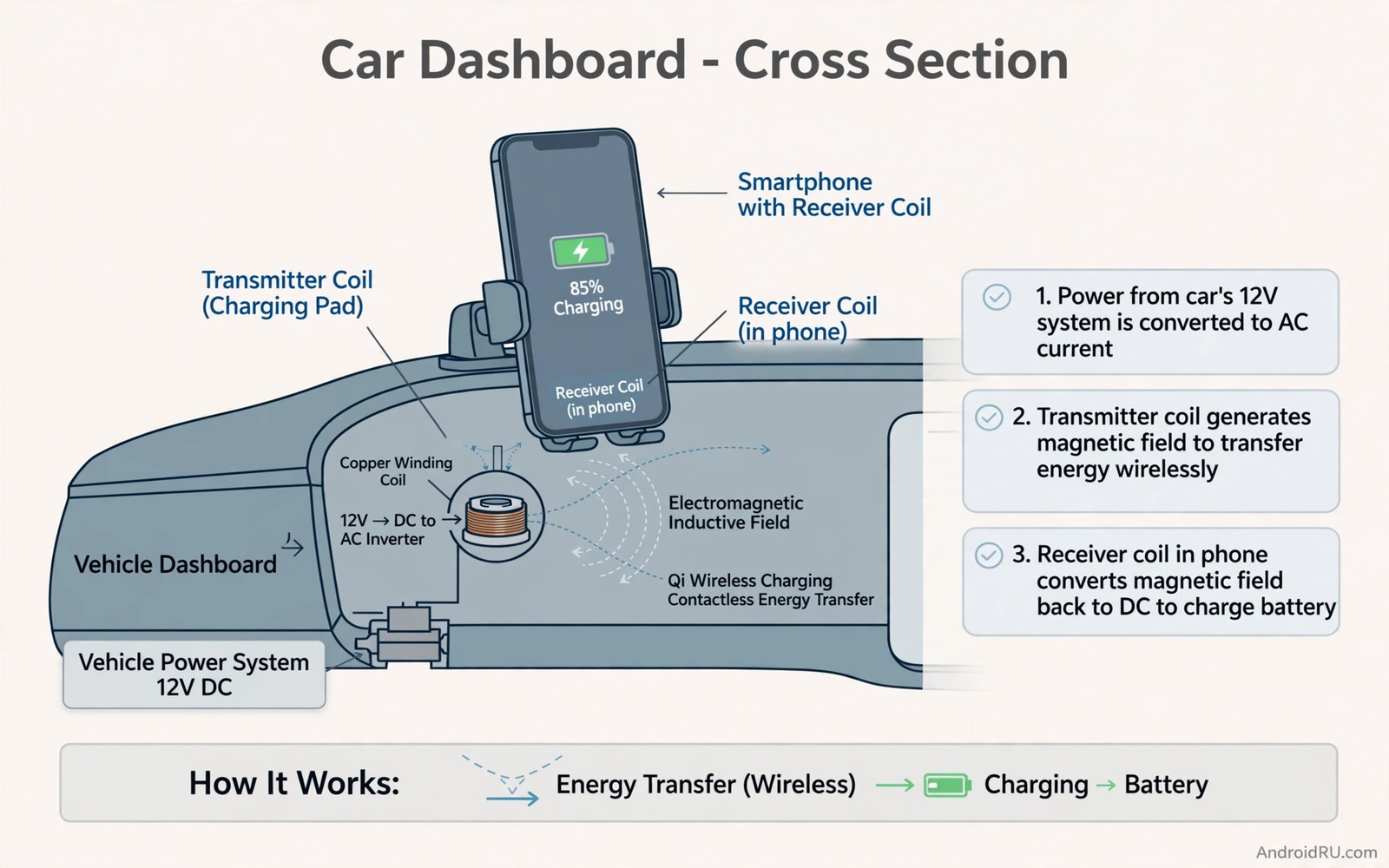
A dedicated wireless charging pad takes space in a car and often slides around during turns. A hidden coil setup can charge a phone wirelessly without a visible pad on the dashboard. The hack uses a small charging coil placed under a suitable surface or inside a mount. That coil creates a wireless charging zone where a pad would normally sit. Understanding coil placement and power routing makes the hack safe and practical.
Wireless charging works through a coil in the charger and a coil in the phone. The coils must align closely for efficient power transfer. A pad is simply a coil in a flat housing. A hidden coil uses the same principle without the bulky housing. Placing a coil under a thin non metal surface can create a clean charging spot. The surface must be thin enough for the magnetic field to pass through. Thick metal surfaces block wireless charging and must be avoided.
Power routing is the second part of the hack because the coil needs a stable power source. A car USB port or a quality car adapter can supply that power. A weak car port may charge slowly or intermittently. A quality adapter with the correct output gives a stable charge. Route the cable neatly to avoid interference with driving controls. A tidy cable route is a safety requirement and not just a cosmetic choice. For wireless heat management see wireless charging pads heat and prevention for cooling guidance.
Choose a coil and a suitable surface
A small wireless charging coil module is the core component for this hack. Choose a module rated for your phone wireless charging standard. Check the output power and the coil size before buying. A coil that is too small may align poorly with the phone coil. A coil that is too large may waste space under a surface. Match the coil size to the phone placement area for reliable alignment.
Suitable surfaces include thin plastic trays and fabric pockets and non metal console lids. A thin plastic surface works well because the field passes through easily. A thick wooden surface may reduce charging efficiency. A metal surface blocks charging and should not be used. Test the surface with a temporary coil placement before permanent fitting. A temporary test reveals alignment and efficiency problems early.
A mount based coil is an easier version of the hack for many drivers. A vent mount or a dashboard mount with a built in coil charges the phone while holding it. That design avoids surface modification and keeps alignment stable. Choose a mount with a strong clamp and a coil aligned to the phone centre. A mount coil gives wireless charging without a separate pad on the dashboard. It also keeps the phone visible for navigation.
Install the coil safely in a vehicle
Place the coil where the phone rests naturally and where it does not block controls. A centre console tray is a common spot for this hack. A door pocket is less suitable because the phone moves during turns. Secure the coil with a non permanent mount first for testing. Use adhesive or a bracket only after the test proves good charging. A secure coil prevents movement that breaks alignment during driving.
Connect the coil to a quality car adapter with a short cable. Route the cable along existing trim gaps to keep it out of the way. Avoid routing cables across airbag areas or steering components. A cable near an airbag can become a hazard in a crash. Keep cables away from pedals and gear controls at all times. Safety routing is more important than a hidden appearance.
Test charging with the phone in its usual case. A thick case can reduce charging efficiency through a hidden coil. A metal case or a magnetic ring in the wrong place can block charging. Test with and without the case to find the difference. If the case blocks charging then use a thinner case for car use. A test with the real case and the real phone gives the true result. For magnetic mount ideas see best magnetic car mounts tested for holder strength.
Check heat and charging speed
Monitor heat during the first long drive with a hidden coil. A well aligned coil should charge with only mild warmth. Excess heat signals poor alignment or a surface that is too thick. Adjust the coil position in small steps to improve alignment. A small shift can change charging speed and heat noticeably. Do not ignore heat because sustained heat ages the battery faster.
Measure charging gain over a thirty minute drive to judge real performance. Note the battery percentage at the start and end of the drive. Compare that gain with a direct cable charge over the same time. A hidden coil will usually charge slower than a cable. That slower rate is acceptable if it keeps the phone topped up during a commute. It is not a fast charging solution for a nearly dead phone.
Use the hidden coil for maintaining charge during navigation rather than for rapid recovery. Navigation uses power continuously and a coil can offset that use. A phone that starts a trip at eighty percent may end at a similar level with coil charging. That maintenance role is valuable for long drives. For rapid charging from a low battery use a cable instead. Matching the tool to the task gives the best car charging experience.
car_wireless_coil_check.txt
Coil surface thin and non metal
Coil aligned with phone centre
Cable routed away from controls
Heat check after 30 minutes normal
Charge gain recorded for commute
The checklist above is an original example written for this guide. It gives you a safety and performance check for a hidden coil setup. Complete it before relying on the coil for daily driving. A passed checklist means the setup is safe and useful.
Inspect the coil and cable monthly for wear and loosening. Vibration in a car can shift a coil over time. Tighten mounts and check cable insulation regularly. A worn cable in a car is a safety risk and should be replaced promptly. Regular inspection keeps a hidden setup safe for years. Small checks prevent a tidy hack from becoming a hazard.
Keep a cable backup in the car
A hidden coil is convenient but it should not be your only car charging option. Keep a quality cable in the glove box as a backup for low battery days. A cable charges faster than a hidden coil through a surface. That speed matters when you start a trip with a nearly dead phone. A backup cable turns a slow coil day into a manageable trip.
Check the backup cable every few months for fraying and connector wear. A damaged backup cable is useless when you need it most. Replace it promptly if the jacket cracks or the connector loosens. A reliable backup cable costs little and gives peace of mind on long drives. That peace of mind is worth a small glove box space.
Common mistakes
The most common mistake is placing a coil under a metal surface that blocks charging. That mistake leads to no charging despite a powered coil. Another mistake is using a weak car USB port that cannot supply stable power. That port causes intermittent charging and heat. A third mistake is routing cables across controls or airbag areas. That routing creates a safety hazard that outweighs any convenience.
People also expect fast charging from a hidden coil. A hidden coil through a surface usually charges slower than a direct pad. Expect maintenance charging rather than rapid recovery. Use a cable for fast charging when the battery is low. That expectation setting prevents disappointment with a well built hidden setup.
A final mistake is fixing a coil permanently before testing alignment. Permanent fitting makes adjustment difficult. Test with a temporary mount first and adjust until charging is stable. Only then fix the coil permanently. A tested permanent fit lasts longer and performs better. For charging station alternatives see best 3-in-1 wireless charging stations for home setups.
FAQ
Will a hidden coil work through any car surface?
No because metal surfaces block wireless charging. Thick surfaces also reduce efficiency significantly. Thin plastic and fabric surfaces work best. Test the surface with a temporary coil before permanent fitting. A test reveals whether the surface allows useful charging. Choose a different spot if the test shows slow charging or excess heat.
A console tray made of thin plastic is often a good spot. A thick wooden trim piece is often a poor spot. A metal tray will not work at all. Surface material decides the result more than coil power. Always test the actual surface in your car before committing to a permanent install.
Is hidden coil charging safe for my phone battery?
Yes if alignment is good and heat stays mild. Poor alignment causes excess heat that can age a battery faster. Monitor heat during early use and adjust alignment if heat is high. Use a quality coil and adapter from a reputable source. A quality setup with good alignment is as safe as a normal wireless pad. Stop using the setup if heat remains high after alignment adjustments.
Remove the phone from the coil if it becomes uncomfortably hot. Let it cool before charging again. Persistent heat may signal a faulty coil or adapter. Replace faulty components rather than continuing to use them. Battery safety matters more than a tidy car setup.
Can I use a hidden coil with a phone case on?
Yes if the case is thin and non metal. A thick rugged case can reduce charging efficiency. A metal case or a poorly placed magnetic ring can block charging. Test with your exact case fitted. If charging is slow then try a thinner case for car use. A case test gives the true result for your setup.
Some cases include a magnetic ring for mounts. That ring must not sit over the charging coil area in a blocking way. Check charging with the ring case before permanent coil fitting. A ring that blocks charging needs repositioning or a different case. Test early to avoid a permanent fit that fails with your daily case.
Conclusion
Hidden coil charging in a vehicle works when surface and alignment and power are correct. A thin non metal surface lets the field reach the phone coil. A quality adapter gives stable power. A mount coil offers an easier path without surface modification. Heat checks and charging gain tests prove whether the setup is useful. Maintenance charging during navigation is the realistic benefit of this hack.
Your concrete next step is to test a temporary coil placement in your centre console tray this week. Record the battery gain over a thirty minute drive with your usual case on. If the gain keeps pace with navigation use then fix the coil securely. If heat is high or gain is low then adjust alignment or choose a mount coil instead.

