

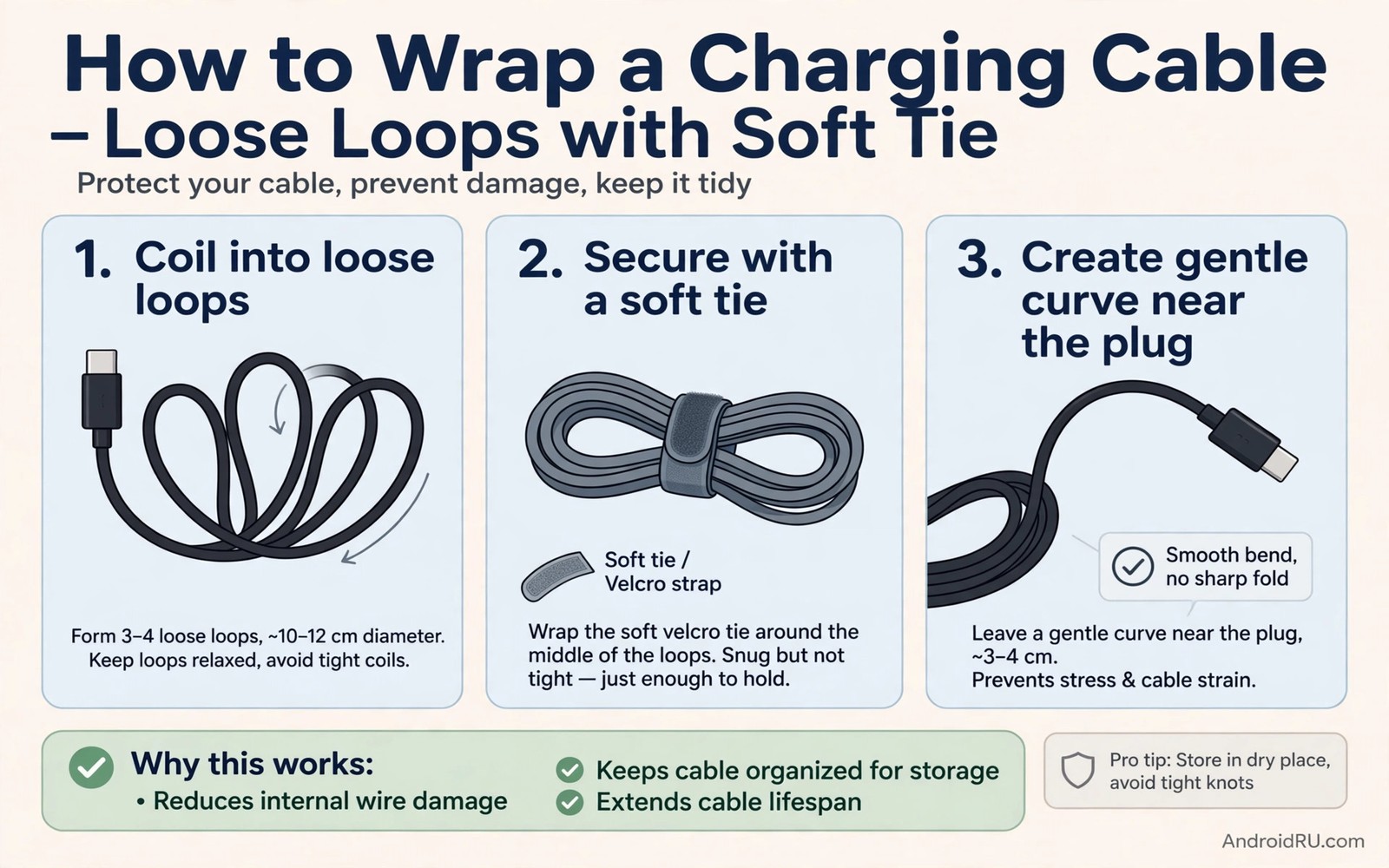
A charging cable rarely dies from old age. It dies from bends at the plug and from tight wraps in a bag. Each sharp bend stresses the wires inside the insulation. The damage builds slowly until one day the cable charges only at a certain angle. A simple wrap hack removes the sharp bends that cause most failures.
The hack is easy to learn and it takes ten seconds. You wrap the cable in loose loops instead of winding it tight around your hand. You leave a gentle curve near each plug. You secure the loops with a soft tie and not with a tight knot. That gentle shape lets the cable rest without stress on the weakest points.
This guide shows the wrap step by step and it shows the storage habits that protect cables for years. It also shows the mistakes that kill cables fast. You do not need a special tool for the basic hack. A soft velcro tie or a simple twist tie is enough. Start with your most used cable today.
Learn The Loose Loop Wrap
Hold one plug in your hand and let the cable hang in a loose loop. Make loops about the width of your hand. Keep each loop relaxed and even. Do not pull the cable tight as you loop it. A tight loop creates a kink that will stay in the cable.
Leave about ten centimetres of straight cable near each plug before the first loop. That straight section protects the strain relief zone. The strain relief zone is the short flexible part beside the plug. It fails first when you bend the cable right at the plug. A gentle curve there saves the cable for months longer.
Secure The Loops Without A Knot
Wrap a soft velcro tie around the middle of the loops. Keep the tie snug but not crushing. A crushing tie can dent the insulation over time. A loose tie lets the loops slide apart in a bag. Test the bundle by shaking it gently. The loops should stay together without a tight squeeze.
Use a cable organiser or a small pouch for travel bundles. A pouch stops the bundle from catching on keys and zips. Keep the pouch in a separate pocket from sharp items. A cable in a pocket with keys will rub and fray even with a perfect wrap. Storage matters as much as the wrap itself.
Unwrap And Plug In Without Yanking
Remove the tie and let the loops fall open on their own. Do not yank the cable straight with a sharp pull. A yank stresses the plug joint in one sudden move. Pull the plug by its hard body and not by the cable. That habit alone can double cable life.
Plug the cable in with a straight push. Avoid bending the cable at a right angle beside the phone. Use a right angle adapter if your setup forces a bend. A right angle adapter moves the bend away from the cable plug. Small adapters cost little and they save many cables. The spring protector idea in how spring protectors extend cable lifespan offers another layer for cables that bend often.
Fix Desk And Bed Cable Habits
A cable that hangs off a desk edge bends at the desk lip all day. Use a cable clip to hold the cable on the desk surface. A clip stops the cable from falling and pulling the plug. Route the cable with a gentle curve from charger to phone. A gentle route looks tidy and it protects the wire.
A bed cable suffers when you roll over it at night. Keep the bed cable short and route it beside the bed. Use a bedside clip to stop the cable from slipping under a pillow. A cable under a pillow can overheat and bend at the same time. A short bed cable with a clip is safer and tidier.
Know When A Cable Must Retire
Retire a cable with exposed wires at once. Exposed wires can short and damage a charger or a phone. Retire a cable that charges only at one angle. That angle fault means internal wires are already broken. Retire a cable with a loose plug that falls out easily. A loose plug can arc and damage the port.
Do not tape over exposed wires as a long term fix. Tape hides damage and it can trap heat. Replace the cable with a rated cable from a trusted seller. Keep the old cable out of use until you dispose of it safely. A retired cable costs less than a damaged phone port.
loop_size = hand_width
straight_near_plug = gentle_curve
tie = soft_velcro_snug
pull = plug_body_not_cable
The snippet above is an original example written for this guide. It shows generic settings that you can adapt to your own device. It does not copy code from any outside source.
Use the example above as a wrap checklist for every cable you own. It is not code to install. Follow each line when you pack a cable for travel. Teach the same wrap to family members who share your cables.
Protect Cables In A Bag Or Backpack
A bag is the harshest place for a cable. Keys and zips and heavy books crush loose cables. A cable pouch separates cables from sharp items. A pouch with individual slots stops cables from tangling together. A dedicated pouch is a small investment that saves many cables.
Pack cables in loose loops inside the pouch. Do not wrap a cable around a power bank for storage. A wrap around a hard object creates sharp bends at the contact points. Loose loops inside a soft pouch rest without stress. That rest preserves the cable for the next use.
Keep the pouch in a consistent pocket of the bag. A consistent pocket means you find cables fast without digging. Digging through a bag bends cables and stresses plugs. A fast find is also a gentle find. Consistency protects cables in a subtle way.
Check bag cables once a month for early fraying signs. Early fraying near a plug is a warning to change habits. A cable that frays early may suffer from a tight bag pocket. Move that cable to a softer pocket or a better pouch. Early checks catch habits before they kill cables.
Teach Good Cable Habits To Family
Family members often share cables and habits spread fast. Show the loose loop wrap once with a real cable. Let each person practise the wrap themselves. A practised habit sticks better than a watched video. A shared habit protects shared cables.
Place a velcro tie with each shared cable. A tie beside the cable invites correct wrapping. A cable without a tie invites a tight knot. Small cues shape habits more than rules. A tie is a cue that works every time.
Agree on a simple rule for shared cables. The rule can be pull by the plug and wrap in loose loops. Write the rule on a small tag near the charging station. A visible rule reminds everyone without nagging. Shared rules work when they are short and visible. Spring protectors add help for shared cables and how spring protectors extend cable lifespan explains that extra layer.
Replace shared cables that already fray before they damage a port. A frayed shared cable risks every phone that uses it. A replacement cable with good habits lasts far longer. Shared care protects every device in the home.
Store Spare Cables For Long Term Use
Spare cables need storage that preserves them for months. A drawer with loose cables tangles spares together. Tangled spares suffer bends when you pull one out. A pouch with separate slots preserves each spare. Separate storage is long term cable care.
Label spare cables by length and rating. A label saves a search when a main cable fails. A search through unlabelled spares wastes time during a failure. Labelled spares turn a failure into a quick swap. Quick swaps matter during work deadlines.
Rotate spare cables occasionally so no cable sits unused for years. An unused cable can still age in a hot drawer. A rotated cable gets tested and stays known good. Rotation also reveals a spare that failed in storage. A known good spare is the only useful spare.
Keep one spare cable at work and one at home. A spare in only one place cannot help in the other place. Two spares cover the two main locations. Location coverage is a simple spare strategy. Magnetic cables offer another spare option and the magnetic cable trick that protects charging ports explains that idea.
Dispose of dead spare cables promptly. A dead cable in a spare pouch can be mistaken for a good spare. Mistaken spares waste time during a failure. Prompt disposal keeps the spare set trustworthy. Trustworthy spares are the point of storage.
A spare cable strategy also protects your main cable from overuse. Rotate two cables weekly so neither cable suffers daily bends alone. Rotation spreads wear across both cables and extends the life of each one. A magnetic adapter can further reduce plug wear and the magnetic cable trick that protects charging ports shows how that adapter works in practice.
If a cable keeps falling out of the phone entirely then fixing loose charging cables falling out of a phone covers that separate fault.
Common Mistakes
The first mistake is winding a cable tight around a charger block. That tight wind bends the cable at the plug every time. The second mistake is yanking the cable out by the wire. A yank breaks the joint inside the plug. The third mistake is knotting a cable to shorten it. A knot creates a permanent kink and a weak point.
Another mistake is leaving a cable hanging off a desk edge all day. Gravity bends the cable at the edge. A further mistake is taping a frayed cable and using it for months. Tape hides a fault that can damage the phone port.
Frequently Asked Questions
Does the wrap hack work for all cable types?
Yes loose loops help USB cables and other small cables. The strain relief zone is weak on most cable types. Keep loops loose and leave a gentle curve near each plug. Thick cables need larger loops than thin cables.
Can a wrap hack fix a cable that already frays?
No a wrap hack cannot repair broken internal wires. It can only slow further damage on a healthy cable. Retire a frayed cable and use the hack on its replacement. A new cable with good habits lasts far longer.
Is a velcro tie better than a rubber band?
Yes a velcro tie spreads pressure and it is easy to adjust. A rubber band can crush insulation and it can snap. A soft tie also lasts longer in a bag. Use a tie that you can open and close many times.
Conclusion
Wrap your most used cable in loose loops today and secure it with a soft tie. Leave a gentle curve near each plug and pull the plug by its body from now on. Test the cable after a week of gentle use and note any change in charging reliability. If the cable feels steadier then apply the same wrap to every cable you own. That single wrap is your concrete next step toward cables that last years.

