

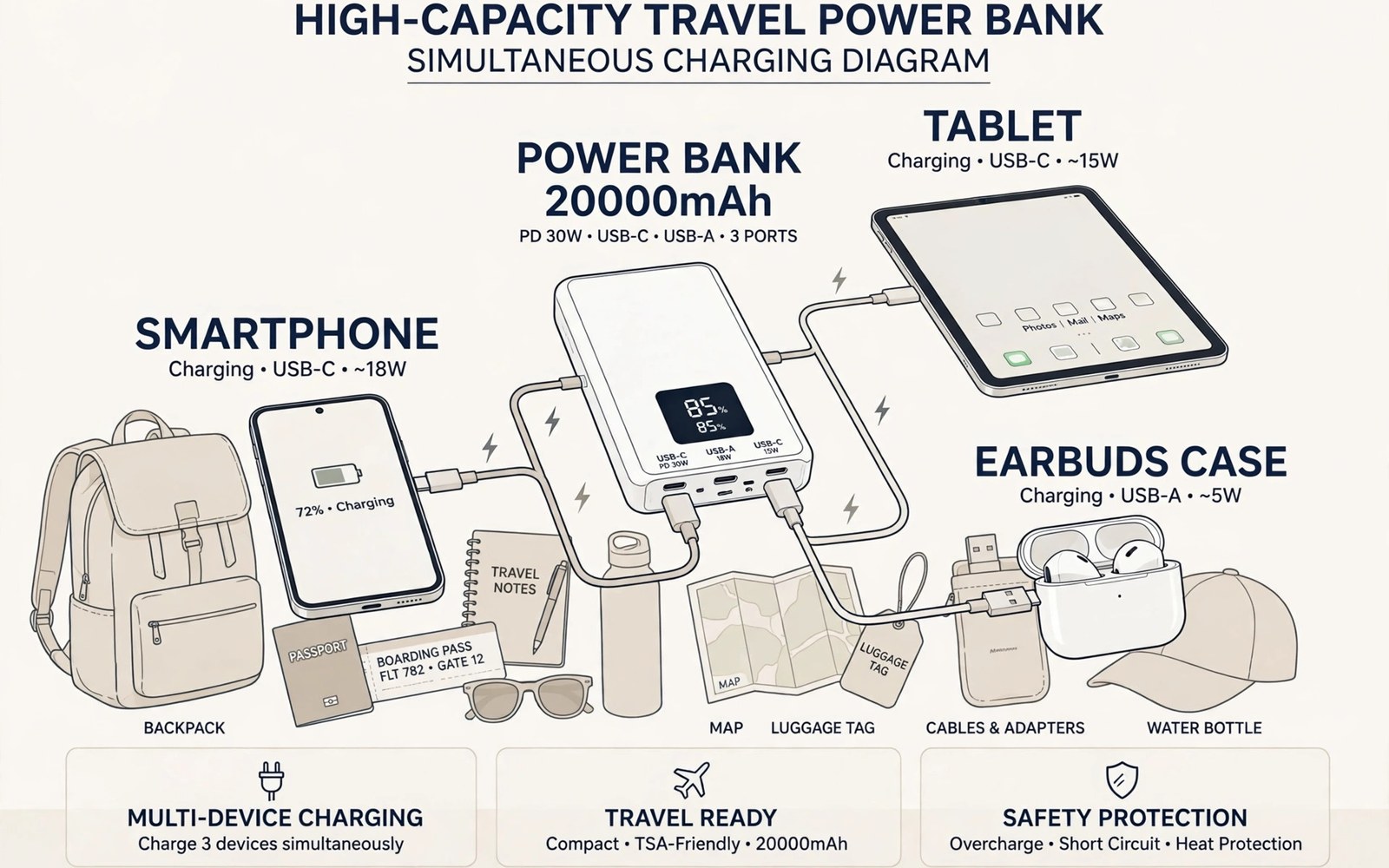
A long trip exposes the limits of a phone battery fast. Maps and photos and video drain power long before the day ends. A high-capacity power bank turns one outlet visit into days of freedom. The right bank charges a phone several times and still serves earbuds. The wrong bank adds weight without adding useful charges. Capacity labels alone do not tell the full story.
Power bank capacity is measured in milliamp hours at the internal cell voltage. Phone batteries run at a different voltage so conversion losses cut the usable total. A bank rated at a large number may deliver far fewer phone charges than the label suggests. Efficiency and output power shape the real result. A bank that wastes energy as heat gives fewer charges per trip. Read real charge counts rather than trusting the headline number alone.
Travel needs go beyond raw capacity. Port count and output power decide how fast devices refill. Weight decides whether the bank stays in the bag or gets left behind. Airline rules cap the size that can fly in cabin bags. This guide balances all of those factors for extended travel. It helps you pick a bank that lasts without breaking rules or backs.
Understanding Real Usable Capacity
Internal cells store energy at a low voltage. Conversion to phone charging voltage loses energy at each step. Cable losses and heat take another small share. A bank may therefore deliver only about two thirds of its labelled capacity as phone charge. That gap surprises buyers who expect a simple division. Divide the bank rating by the phone battery size and then discount for losses.
Phone size changes the maths a lot. A compact phone may charge four times from a large bank. A large phone with a big battery may charge only twice from the same bank. Tablets need far more energy and they can empty a travel bank in one charge. Plan for the largest device in your kit first. A bank that covers the tablet will easily cover the phone too.
- Divide bank rating by phone battery size
- Discount the result for conversion losses
- Test charge counts on a short trip first
Ports Output And Charging Speed
A travel bank should charge the phone at a useful speed. A slow port turns a lunch stop into a trickle charge. Look for a port that matches the phone fast charging standard. Shared ports split power when two devices charge at once. That split can slow both devices during a busy evening. Check shared output rules before buying a multi-port bank.
USB-C ports now carry most travel charging. A bank with two USB-C ports covers a phone and a tablet well. A USB-A port still helps for older earbud cases and cables. Fast input matters too because a large bank takes hours to refill. A bank with fast input can refill overnight from a strong brick. A slow input bank may still be empty after a full night.
Weight Size And Packing
High capacity means real weight in a bag. A very large bank can weigh as much as a small tablet. That weight matters on walking days and on flights with strict cabin limits. Pack the bank where it stays reachable for security checks. Keep cables short to avoid tangles in a crowded bag. A bank with a built-in cable saves a separate cable but it adds a failure point.
Durability matters on rough trips. A bank that survives drops and dust lasts longer than a fragile high capacity model. A sturdy case and protected ports resist travel wear. Avoid banks with loose ports because they fail under cable strain. A simple pouch keeps the bank and cables together in a bag. Good packing turns a heavy bank into a reliable travel tool.
Airline Rules For Large Banks
Airlines limit lithium battery size in cabin luggage. Most large travel banks fall under the common limit but very large models need approval. Always carry power banks in cabin bags and never in checked luggage. Security staff may ask to see the capacity label on the bank. A worn or missing label can cause delays at screening. Keep the bank accessible at the top of the bag for checks.
Check the airline rules before a flight with a very large bank. Rules vary by carrier and by battery size class. Some carriers cap the number of large banks per passenger. A second smaller bank may be easier to fly with than one huge bank. Split capacity across two banks if a single huge bank risks refusal. That split also gives a backup if one bank fails.
Charging Strategy On Long Trips
Charge the phone early rather than waiting for a low battery warning. A top-up during a meal keeps the phone ready for maps later. Charge earbuds during transit when the phone does not need the port. Recharge the bank itself whenever a reliable outlet appears. Hotels and cafes offer the best refill windows on a trip. A half full bank beats an empty bank when the next outlet is far away.
Save bank power by lowering phone drain on travel days. Dim the screen and limit video streaming while out. Download maps offline before leaving wifi coverage. Offline maps cut data use and they cut battery drain a lot. Small savings stretch a bank across an extra day. The bank is a safety net and smart phone habits make that net last longer.
Choosing A Bank For Your Trip Length
A weekend trip needs a medium bank that charges a phone twice. A week-long trip needs a large bank or a nightly refill plan. A remote trip without outlets needs the largest bank the airline allows. Match the bank to the longest gap between outlets on the route. Add one extra phone charge as a safety margin. That margin covers delays and extra photo days.
Test the bank before the trip with a full cycle. Charge the phone from the bank until the bank empties. Note how many full charges it delivered in real use. That test reveals the true capacity better than any label. Keep the test result in mind when packing for the next trip. A tested bank removes guesswork from travel planning.
Power Bank Safety And Certification
Safety certification matters more for large banks than for small ones. Large banks store more energy that can fail dangerously. Certified banks pass tests for overcharge and short circuits. They also pass thermal and drop tests in many schemes. Uncertified banks may skip those tests to cut costs. A bargain large bank without certification is a risk in a bag.
Cell quality separates safe banks from risky ones. Reputable cells come from established makers with consistent quality. Cheap cells vary in capacity and in failure behaviour. A bank with weak cells may swell or overheat under load. Brand reputation and warranty terms hint at cell quality. A maker that hides cell origin deserves scepticism from buyers.
Protection circuits guard against common faults during use. Overvoltage protection stops charging at safe cell limits. Overcurrent protection cuts power during a short circuit. Temperature protection pauses charging when cells get hot. Those circuits should be listed in product notes. Vague safety claims without circuit details are weak evidence.
Physical damage changes safety calculations immediately. A bank dropped hard may suffer hidden cell damage. A bank exposed to water may corrode protection circuits. Inspect banks after drops and after wet trips. Retire a bank that swells or smells unusual at once. Safety checks cost minutes and they prevent bag fires.
Refilling A Large Bank Efficiently
Refilling a large bank takes planning because capacity is huge. A slow input port can need a full day for a complete refill. A fast input port cuts that time dramatically. Check input ratings before buying a large bank. A bank with fast input suits travellers with short outlet windows. A bank with slow input suits home users with overnight windows.
Brick choice shapes refill speed as much as bank input. A weak brick caps refill rate regardless of bank capability. Use a brick rated at or above the bank input rating. A short quality cable also helps maintain input power. Long thin cables lose power during long refill sessions. Match brick and cable to bank input for best results.
Refill timing can use off-peak outlet access well. Start refilling at a hotel check-in rather than at bedtime. That earlier start gives more hours before morning departure. Top up the bank during meals and transit stops too. Frequent partial refills beat a single rushed refill. A bank kept above half full is ready for unexpected needs.
Heat during refill deserves attention like heat during discharge. A bank refilling in a hot room may throttle input power. Place the bank on a hard cool surface during refills. Keep it clear of bedding and direct sunlight. A cool refill finishes faster and stresses cells less. Good refill habits extend bank life across many trips.
Note phone battery size first
Pick a bank with fast USB-C output
Check airline size limits early
Test real charge counts at home
Recharge the bank at every outlet stop
Readers who want more context on portable power can read How Fast Charging Wattage (20W to 120W) Affects Battery Lifespan for a related view on the same topic.
Readers who want more context on portable power can read MagSafe-Style Magnetic Wireless Power Banks for Android Devices for a related view on the same topic.
Readers who want more context on portable power can read Why Bad USB Charging Cables Can Slow Down Charging Speeds for a related view on the same topic.
The steps above follow the approach described in the official developer documentation and standard industry guidance for safe charging practice.
A high-capacity bank earns its weight only when it delivers real charges on the road. Usable capacity and port speed matter more than the headline label. Weight and airline rules set the practical ceiling for travel. A tested bank with a clear refill plan beats a bigger untested bank. Pack for the longest gap between outlets and add a safety margin.
Start with your phone and tablet battery sizes. Pick a bank that covers them with room to spare. Test it once at home before trusting it abroad. That single test prevents most travel charging surprises. The right bank fades into the background and simply keeps devices alive.
Safety and refill planning complete the travel bank picture. Certification and cell quality protect against rare but serious failures. Fast input and strong bricks make large banks practical. A bank that refills slowly frustrates travel schedules badly. Choose safety and refill speed alongside capacity.
Test a new large bank with a full refill cycle at home. Note refill time and heat during the cycle. Note real phone charges delivered on a full bank. Those numbers reveal true travel value. A bank that passes home tests earns trust on the road. Travel power should be boring and reliable rather than exciting.
Travel banks also help during power outages at home. A charged bank keeps phones alive when grid power fails. That home emergency use adds value beyond travel. Keep a travel bank charged between trips for outage readiness. A bank that serves travel and emergencies earns its cost twice. Dual purpose gear justifies larger capacity well.
Groups travelling together can share bank capacity strategically. One large bank can serve several phones across a day. Sharing reduces total weight carried by the group. Assign bank ownership to avoid confusion at charging time. A shared bank plan keeps every phone alive with less gear. Group coordination turns one bank into a team resource.
Bank rental services at airports offer an alternative to ownership. Rental banks suit travellers who fly rarely. Ownership suits frequent travellers better over time. Compare rental costs against purchase price for your travel frequency. Rare travellers may save money by renting. Frequent travellers save more by owning a tested bank.

