

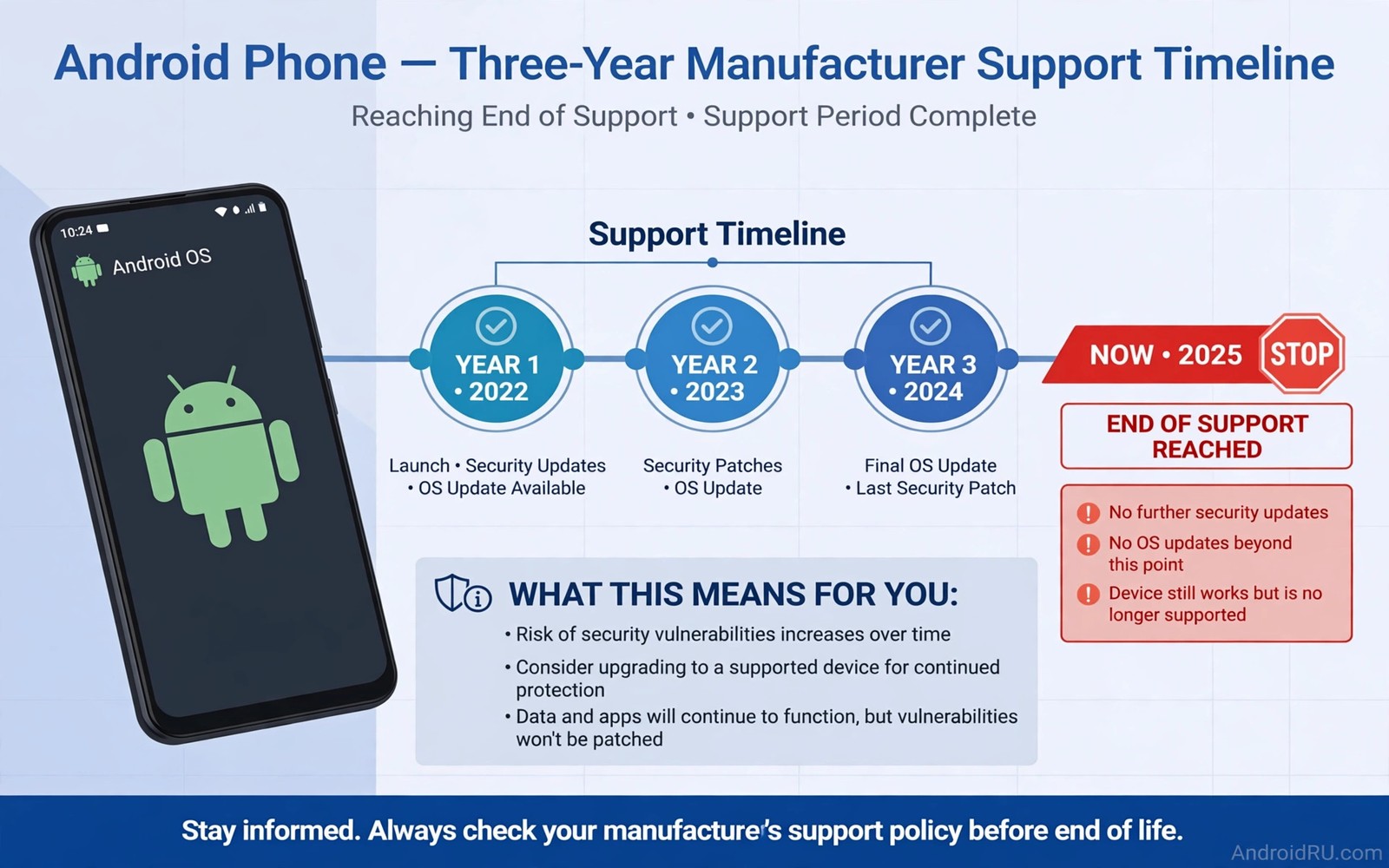
Why manufacturers drop Android update support after three years has several practical causes rather than one simple motive. Testing costs and hardware limits and carrier work all grow as a phone ages. Brands must balance support for old models against development for new models. That balance often ends around three years for many midrange phones.
Longer promises from Pixel and Samsung show that the three year limit is changing for flagships. Budget phones still face the old limit more often. Understanding the causes helps owners choose phones with better long term value. If you want the full timeline context then Android 15 release date and roadmap shows how yearly releases interact with those support windows.
Testing cost grows with age
Each new Android version needs testing on each supported model. Test teams must check calls and cameras and sensors and apps on old hardware. As the model range grows the testing workload grows with it. Dropping an old model frees test resources for newer models that sell in larger numbers.
Old models also need fixes for hardware quirks that newer models do not share. Those quirks consume engineering time disproportionate to the remaining user base. Brands therefore set a support window that matches the expected active life of the model rather than its physical lifespan.
Hardware limits accumulate
New Android versions assume faster processors and more memory and newer security hardware. An old phone may lack the security chip features that a new version expects. It may also lack memory for new system services. Forcing a new version onto weak hardware can make the phone slower and less reliable.
Battery age compounds the problem. An old battery holds less charge and a heavier new system drains it faster. Owners may blame the update for a battery problem that age already caused. Brands avoid that outcome by ending major updates before hardware limits dominate the experience.
Carrier and component supplier limits
Carriers also limit support for old models by deprioritising their testing. Component suppliers may stop providing driver updates for old chips. Without driver updates a brand cannot fully support a new Android version on that hardware. That supplier limit is often invisible to owners but it shapes support decisions strongly.
adb shell getprop ro.product.model
adb shell getprop ro.build.version.release
adb shell getprop ro.build.version.security_patch
These commands follow the approach described in the official Android developer documentation for reading model and patch information from a device.
Regional variants add further cost because each variant needs its own testing and approval. A brand may support a popular global variant longer than a rare regional variant. Owners of rare variants may therefore see support end sooner than owners of the main variant.
Why longer promises are now possible
Longer promises became possible as processors grew more capable and testing became more automated. Brands also face competitive pressure from rivals who extended support first. Once one major brand promised seven years others felt pressure to extend their own promises for flagships.
Longer promises still focus on flagships first because flagships earn more profit to fund testing. Budget phones may follow slowly as hardware improves and costs fall. Reading about which phones will get Android 15 shows how current flagship promises already exceed the old three year pattern.
What owners should do about it
Buyers should check the support promise before purchase and favour longer promises when they plan to keep a phone for many years. Owners of phones near the end of support should keep patches installed and practise safe app habits. A phone without major updates can still serve well with care for a period.
Plan replacement timing around support end rather than waiting for a failure. A planned upgrade avoids rushed decisions and lets you choose a model with a longer promise. Learning how to check for system updates helps you track exactly where your phone stands in its window.
Support windows and the environment
Support windows affect the environment because longer support reduces electronic waste. A phone that receives updates for seven years can stay in use longer than a phone abandoned after three years. Longer use means fewer phones manufactured and fewer phones discarded. Environmental benefits therefore align with owner interests in longer support. Brands that extend support help both customers and sustainability goals at the same time.
Repair support must accompany software support for environmental benefits to materialise. A phone with seven years of software updates but no battery replacement service will still be discarded early. Owners need affordable batteries and screens to keep a phone working for seven years. Brands should therefore pair long software promises with long repair availability. Both promises together decide the true usable life of a phone.
Refurbished markets also depend on support windows. A refurbished phone with remaining support attracts buyers who want a safe second hand device. A refurbished phone without support attracts only bargain hunters willing to accept risk. Longer support therefore strengthens the refurbished market and keeps phones circulating longer. That circulation reduces waste and it makes good phones affordable for more owners.
Regulators in some regions now consider minimum support periods as part of sustainability policy. Rules may require brands to publish support lengths clearly and to provide patches for a minimum period. Those rules push the market toward longer support even for budget phones. Owners benefit from clearer information and longer protection. Regulatory pressure may therefore accelerate the trend that Pixel and Samsung started voluntarily.
What a fair support promise looks like
A fair support promise states major update years and patch years separately and clearly at launch. Vague promises that mention updates without numbers mislead buyers. A fair promise also states whether it applies to all regions and variants or only to some. Owners should reward brands that publish precise promises and hold brands accountable when they miss those promises. Precision at launch prevents disappointment later.
A fair promise also includes timely delivery rather than only total years. A brand that promises four updates but delivers the last update a year late offers less value than the headline suggests. Owners should therefore track delivery timing as well as total years. Review sites and owner forums that track delivery speed help buyers judge fairness beyond the headline promise.
Transparency about end of support dates helps owners plan replacements without surprise. A brand should announce the final update clearly rather than letting owners discover support end through a missing update. Clear end announcements allow owners to back up data and plan purchases calmly. Silence at support end feels like abandonment even when the promise period simply expired.
Fairness also means supporting budget phones better than today even if flagship promises stay longer. Budget owners often keep phones longer because replacement cost matters more to them. Short support for budget phones therefore hits the owners who can least afford frequent replacement. Closing the gap between flagship and budget support would improve fairness across the market. Progress in that direction deserves recognition when brands achieve it.
Support promises and consumer rights
Consumer rights around support promises vary by region and owners should understand their local protections. Some regions require brands to honour advertised support periods. Other regions offer weaker protections that leave owners with little recourse when a promise is missed. Owners who believe a brand broke a promise should check local consumer protection rules. That knowledge helps owners decide whether to pursue a complaint or accept the situation.
Advertising standards also affect support promises because a vague update claim may mislead buyers. A brand that advertises long updates without specifying years may face scrutiny in regions with strict advertising rules. Owners should save launch marketing material that mentions updates. That material can support a complaint if the brand later shortens support. Documentation protects owners in disputes about promises.
Warranty and support are distinct concepts that owners often confuse. Warranty covers hardware defects for a period. Support covers software updates for a period. Those periods may differ sharply for the same phone. A phone out of warranty may still receive software updates. A phone in warranty may still lose software support if the support period ended earlier. Owners should check both periods separately when evaluating a phone.
Consumer advocacy groups track support promises and publish comparisons that help buyers. Those comparisons reveal which brands honour promises consistently. Owners can use advocacy data alongside brand marketing to make informed purchases. Supporting advocacy work through attention and sharing helps the whole market. Transparency driven by advocacy benefits owners who lack time to research every brand themselves.
Common mistakes
A common mistake is blaming a brand for planned obsolescence without considering testing and hardware limits. Another mistake is buying a budget phone and expecting flagship support length. Price tier strongly predicts support length in the current market.
- Blaming support end solely on planned obsolescence ignores testing costs and hardware and supplier limits.
- Buying a budget phone while expecting flagship support length leads to disappointment when updates stop.
- Keeping an unsupported phone for banking without extra caution raises risk as patches stop arriving.
Frequently asked questions
Is three years still the standard?
Three years remains common for many midrange and budget phones. Flagships from leading brands now exceed it with four to seven year promises. The standard depends heavily on price tier and brand.
Will support lengths keep growing?
Competition and stronger hardware suggest gradual growth especially for flagships. Budget support may grow more slowly because testing costs remain high relative to price. Progress will likely stay uneven across tiers.
Does support end mean my phone stops working?
No the phone keeps working with its last version and apps. Security risk rises over time as patches stop. Owners can keep using the phone with care while planning a replacement.
Conclusion
Manufacturers drop support after three years mainly because testing costs and hardware limits and supplier constraints grow with age. Longer promises are changing the flagship market but budget phones still face shorter windows. Understanding those causes helps buyers choose wisely.
Your next step is to check the remaining support years for your current phone today. If the window is closing then plan a replacement with a longer promise. Choose support length as deliberately as you choose camera or battery.

