

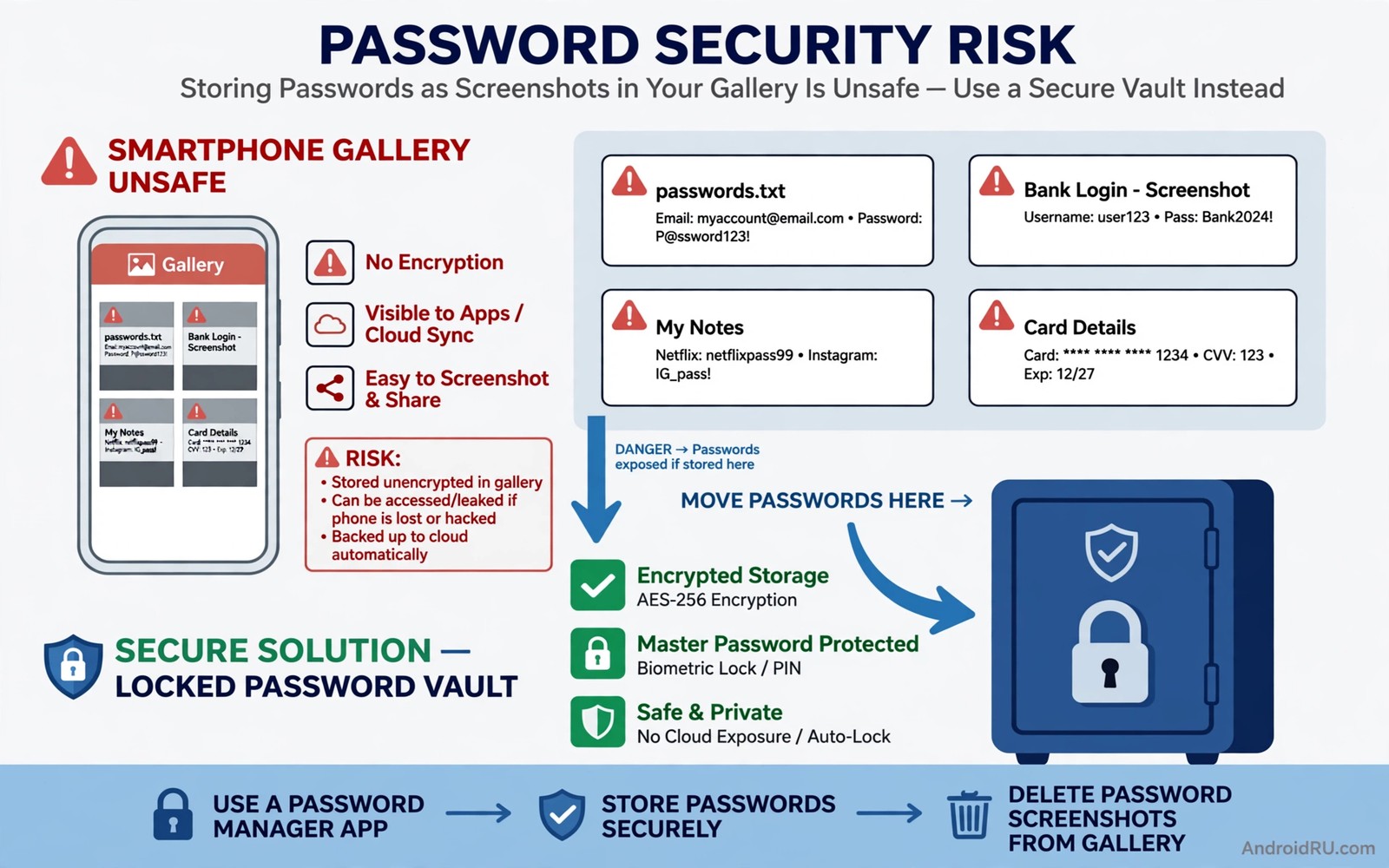
Stop Storing Passwords in Unencrypted Screenshots! Fix It Now
Screenshotting a password feels harmless. The image saves instantly and it stays ready whenever you need it. That convenience hides a serious flaw. Screenshots live in the gallery as ordinary images with no encryption and no access control beyond the lock screen. Any app with photo access and any person holding a phone that is already open can read them. Cloud backup may copy them to servers you never considered. Password screenshots also survive long after you forget them. A screenshot from two years ago still holds a password you may still use. Gallery search makes it easy to find years later. An attacker who gains brief access does not need to search your memory. They search your gallery and the password appears in seconds.
The fix is not to hide screenshots better. The fix is to remove them entirely and store passwords in a tool built for secrets. A password manager encrypts every entry and locks behind one strong master password. Moving passwords there takes an afternoon and it removes a permanent risk. That move also protects you when you face a lost phone and the mistakes to avoid because a lost phone with a manager is far safer than a lost phone with a gallery full of secrets. This guide walks you through the whole fix: finding every password screenshot on your phone, moving the passwords into a manager, verifying each entry, deleting every copy including the cloud copies, turning on two-factor authentication, and building a routine that stops the habit from coming back.
Read this as a job to do today, not a topic to think about. The first password you move should be your banking password, the second should be your main email password, and both can be done in under an hour. Every section below ends with something you can check, so you will know the step worked before you move on. By the end of the afternoon your gallery will hold no secrets at all, and that is a genuinely good feeling.
Why Password Screenshots Are a Security Risk
A screenshot is a plain image file. It has no password of its own, no encryption, and no record of who opened it. Your phone treats it the same way it treats a photo of a sunset. That is the whole problem. A password written in a screenshot is a secret stored in the least protected place on your device, in a folder designed for sharing, syncing, and browsing. People screenshot passwords because it feels fast, and it is fast, but the speed is the trap. The image stays on the phone for years, it gets copied to the cloud, and it can be read by any app you gave photo permission to months ago and forgot about.
The risk is not theoretical. Phones get lost, stolen, repaired, and handed to family members. Apps ask for photo access for good reasons and then keep that access forever. Cloud accounts get breached. A single password screenshot can hand over an email account, and an email account can reset almost every other password you own. The chain from one screenshot to a full account takeover is short, and most people never see it coming because the screenshot felt like a private note. It was never private. It was a file in a shared folder.
Gallery apps and cloud sync copy them everywhere
Gallery apps sync to cloud accounts by default on many phones. A password screenshot backed up to the cloud exists on servers beyond your phone. A breach of that cloud account exposes passwords you thought lived only on the device. Disabling backup for screenshots helps but it does not remove copies already synced. Those copies must be deleted from the cloud as well. On Android, Google Photos backs up the camera and screenshots folders unless you turn it off. On iPhone, iCloud Photos does the same. Check both places: the phone and the cloud. Deleting from one and forgetting the other leaves the secret exactly where it was.
Any app with photo access can read them
Apps with photo permission can read screenshots too. A photo editor or a social app granted full media access can scan the gallery. Most such apps do not steal passwords. A malicious app with the same permission certainly will. Broad photo access turns every screenshot into an open file for any app holding that grant. On Android, go to Settings > Privacy > Permission manager > Photos and videos to see which apps can read your images. On iPhone, go to Settings > Privacy & Security > Photos. Change any app that does not need full access to limited access or to selected photos only. This one check takes two minutes and it closes a door you may not have known was open.
How gallery search makes them easy to find
Modern gallery apps can search images by text inside them. Type “password” into the search box of Google Photos or the iPhone Photos app and it will show you every screenshot containing that word. An attacker with your phone for five minutes can do the same search. That is why a password screenshot is worse than a password written on paper in a drawer: the drawer cannot be searched in seconds, but your gallery can.
What happens when a phone is lost or stolen
A lost phone is bad. A lost phone with password screenshots is much worse, because the person who finds it does not need your memory or your fingerprint. They need the gallery, and the gallery is one tap away once the phone is open. Even a phone that is locked can be a risk if the lock is a weak PIN or if the phone is already signed in to a cloud account on another device. Moving passwords into a manager means a lost phone holds no secrets at all, only an encrypted vault that cannot be opened without the master password.
How to Find Every Password Screenshot on Your Phone
Before you delete anything, find everything. A partial cleanup feels like progress and leaves the risk intact, so this section is a proper search, not a quick glance. Set aside twenty minutes, work through the steps in order, and write down what you find. You are looking for screenshots of passwords, login screens, one-time codes, Wi-Fi passwords, recovery keys, and any image that shows a credential. You are also looking for the copies: trash folders, cloud backups, shared albums, and messaging apps where you sent a screenshot to yourself or to family.
Search your gallery with the right terms
Open your gallery app and use its search box. Try the words “password”, “login”, “code”, “Wi-Fi”, and “account”, one at a time, and review every result. Then open the Screenshots album directly and scroll through it from the newest to the oldest. Search misses images without readable text, so the manual scroll matters. Check the Downloads folder too, because some screenshots end up saved there instead of in the gallery. Look for files with names that suggest a capture, such as “Screenshot” followed by a date. If you find a password image, do not delete it yet. Note which password it holds, because you need that password to move it into the manager first.
Check the trash, cloud copies, and shared albums
Deleting from the gallery alone leaves copies in trash and in cloud backups. Open the gallery trash and look for the same images there. Then open your cloud photo app on the web or on another device and check its trash as well, because cloud trash is a separate folder with its own retention period, often 30 to 60 days. Check shared albums for copies you may have sent to family members. Each copy is a separate exposure that needs its own deletion, and a shared album copy sits on someone else’s device, so you may need to ask them to delete it too. The same care applies to sharing photos without stripping location data because shared images leak more than passwords.
Also check Downloads and messaging apps
Search your messaging apps for the word “password” and review every match. Passwords sent to yourself or to family members in chat are screenshots by another name, and they live in a backup you may not control. Check your mail sent folder for setup messages that include temporary passwords, and check the Downloads folder for exported password files from old managers or browsers. A comma-separated export sitting in Downloads defeats the encryption of the manager it came from. Delete exports after importing them and keep only the encrypted vault.
Move Passwords Into a Password Manager Step by Step
Choose a reputable password manager with a strong master password you will remember. Install it and set up its autofill service so it can fill logins without copying. Then work through your screenshot folder one image at a time. Enter each password into the manager and verify the entry by viewing it once inside the manager. Delete the screenshot only after verification. Change any password that lived in a screenshot for a long time. A password exposed in the gallery for months should be treated as potentially seen. Changing it after moving it to the manager closes the exposure window. Prioritise banking and mail and main account passwords first because those open the door to everything else.
Good managers to consider include Bitwarden, 1Password, and the built-in managers from Google and Apple, all of which encrypt your vault and offer autofill on Android and iPhone. Pick one, learn it properly, and stay with it. Switching managers every few months is worse than keeping one good manager for years. The steps below work with any of them, and each step ends with a check so you know it worked before you go on.
Step 1: pick a manager and set a strong master password
Install your chosen manager from your phone’s app store, create an account, and set a master password that is long, unique, and memorable. A passphrase of four or five random words with a number is stronger than a short password with symbols, and it is easier to remember. Write the master password on paper and keep that paper somewhere safe at home until you have memorised it, then destroy the paper. Never reuse the master password anywhere else, and never store it in a screenshot, a note, or a chat message. Check after this step: open the manager, close it, and open it again with the master password. If you can get in twice without help, the password is one you can remember.
Step 2: turn on autofill so you never need to copy a password again
On Android, go to Settings > Passwords & accounts > Autofill service, or Settings > System > Languages & input > Autofill service on some phones, and select your password manager. On iPhone, go to Settings > Passwords > AutoFill Passwords and turn on your manager. Also turn on the manager’s own autofill and accessibility service if it asks for it. Check after this step: open a login page in your browser, tap the username field, and see whether the manager offers to fill it. If the suggestion appears, autofill works. If it does not, go back and check the setting again, because a manager without autofill is a manager you will stop using.
Step 3: move entries one by one and verify each one
Work through your screenshot folder one image at a time. For each password, create a new entry in the manager with the service name, the username, and the password, exactly as shown in the screenshot. Then verify the entry by signing in to that service using autofill. A successful autofill proves the manager holds the password correctly. Repeat for banking and mail before deleting the last screenshots for those services. Verification before deletion prevents lockouts caused by a mistyped manager entry. If autofill fails, open the entry in the manager, compare it character by character with the screenshot, fix it, and test again. Do not delete the screenshot until the test passes.
Step 4: change the passwords that sat in screenshots
Change any password that lived in a screenshot for a long time, starting with banking, then main email, then social media and shopping accounts. A password exposed in the gallery for months should be treated as potentially seen, and changing it after moving it to the manager closes the exposure window. Let the manager generate the new password for you. A generated password of 16 or more characters, unique to that service, is far stronger than anything a person invents, and you never have to remember it because autofill handles it. Check after this step: sign in once with the new password through autofill, then sign out and sign in again. If both work, the change is complete and the old password is dead.
Which passwords to move first
Move them in this order: banking and payment apps first, then your main email account, then the email accounts used for password resets, then social media, then shopping and everything else. Banking and email are the keys to your digital life. If someone controls your email, they can reset almost every other password you own, so those two deserve the first hour of your time.
What to check after each entry
After each entry, check three things: the username is correct, the password fills in through autofill on the real login page, and the screenshot is still there until the check passes. Only when all three are true should you delete the screenshot. That order protects access while removing exposure, and it is the single most important rule in this whole guide.
Delete Password Screenshots From Every Copy
Once an entry is verified in the manager, delete the screenshot. Then delete it again from everywhere else it lives. Deleting from the gallery alone leaves copies in trash and in cloud backups, and a secret deleted in one place but kept in another is not deleted. Work through the copies in order: gallery, gallery trash, cloud trash, shared albums, and any device that received the image. This takes longer than the gallery deletion itself, and it is the step most people skip. Do not skip it. The whole point of this guide is that no copy survives.
Gallery trash and cloud trash
After deleting password screenshots from the gallery, open the trash folder and empty it. On Android, open Google Photos, tap Library, then Trash, and delete the items permanently. On iPhone, open Photos, tap Albums, scroll to Recently Deleted, and delete the items permanently. Then open the cloud trash as well and delete them there. Google Photos trash keeps items for 30 days, iCloud keeps them for 30 days, and both keep counting from the day you deleted the original, so an image you deleted last week may still be recoverable. Empty the trash now and the copy is gone today, not next month. Check after this step: search the gallery for the word “password” again. If no password image appears, the gallery is clean.
Shared albums and family copies
Check shared albums for copies you may have sent to family members. Each copy is a separate exposure that needs its own deletion, and a shared album copy sits on another person’s device. Remove the image from the shared album, then ask the family member to delete it from their own gallery and trash. This is also the moment to teach them the rule. A relative who screenshots a shared Wi-Fi password creates a copy on another device, and that copy has the same risk as yours. Share passwords through the manager sharing feature instead. Manager sharing keeps the secret encrypted in transit and revocable when sharing ends, which a screenshot can never do.
Turn On Two-Factor Authentication After the Move
Enable two-factor authentication on the manager account itself and on your most important services. Two-factor authentication means a stolen password alone no longer grants access. That extra layer converts a past screenshot exposure from a disaster into a contained incident. It is the single highest-value security step most owners can take. That extra layer also helps with red flags that an app is stealing money because money traps exploit weak credentials, and a second factor blocks most of them even when the password is known.
On the manager itself first
Open your manager’s settings and turn on two-factor authentication for the manager account. Use an authenticator app such as Google Authenticator, Microsoft Authenticator, or the manager’s own built-in authenticator, and save the recovery codes on paper in a safe place at home. Do not save the recovery codes as a screenshot. Check after this step: sign out of the manager and sign back in. You should be asked for the second factor. If you are not asked, the setting did not save, so go back and check it again.
On banking and email next
Turn on two-factor authentication for your bank, your main email, and your cloud account, in that order. For each one, go to the account security settings on the web, choose authenticator app as the method where it is offered, and save the backup codes on paper. SMS codes are better than nothing but weaker than an authenticator app, because a SIM swap can intercept them. Check after this step: sign in to each service from a fresh browser session and confirm the second-factor prompt appears. That prompt is the proof the protection is live.
Stop Creating New Password Screenshots for Good
Cleaning up old screenshots solves yesterday’s problem. Stopping new ones solves tomorrow’s. Break the habit at the source by saving new passwords directly into the manager. When a service offers to save a password let the manager capture it. When you create a password manually type it into the manager first and let autofill handle the signup. That workflow removes the moment when a screenshot feels necessary. The first week is the hardest, because the old habit is automatic. After that, the manager becomes the automatic choice, and the screenshot habit fades on its own.
Let the manager capture passwords at signup
When you create a new account, let the manager generate the password and save it in the same step. Most managers offer to generate and save a password right inside the signup form, and the entry is there before you even finish creating the account. If a site does not trigger the manager, create the entry by hand first, then paste the password into the signup form from the manager. The rule is simple: no password exists outside the manager, even for a minute. A password that never touches the gallery can never leak from it.
Safe ways to handle temporary codes
For temporary codes use the manager notes or a secure note with an expiry plan rather than a screenshot. A code that must live somewhere temporarily should live encrypted. Delete temporary notes after use. Temporary secrets kept permanently become permanent risks. If you must share a code with someone, send it through the manager sharing feature or a message that you delete after it is used, and never send it as a screenshot, because a screenshot of a code is saved to the gallery on both phones at once.
Teach the rule to family members
Teach family members the same rule because shared households share risk. Show them how to save a password in the manager and how to share it through the manager instead of a screenshot. Help them move their own banking and email passwords first, the same way you did yours. A household where everyone uses a manager is far safer than a household where one person is careful and everyone else screenshots passwords into a shared family album.
A Quarterly Gallery Audit Routine for Hidden Secrets
Audit the gallery for secrets quarterly alongside permission reviews. Search for screenshots containing text and review them for passwords and codes and personal documents. Delete secrets and move any you still need into the manager. A quarterly audit catches new screenshots before they age into forgotten exposures. Put a repeating reminder in your calendar for the first weekend of each quarter, and treat it like a smoke alarm check: quick, boring, and worth doing. The first run is the longest and every later run is short, usually under fifteen minutes.
- Search the gallery for the words “password”, “login”, “code”, and “account”, and review every result.
- Enter each password you still need into the manager and verify it with an autofill test.
- Delete the screenshot from the gallery, then empty the gallery trash and the cloud trash.
- Delete cloud copies and shared copies, and ask family members to delete their copies too.
- Check Downloads, messaging apps, mail drafts, and clipboard history for other copies of the same secrets.
The routine above turns screenshot cleanup into a repeatable process. It pairs every deletion with verification so you never lose access while improving security. Run it once fully and then quarterly for new captures.
What to search for each quarter
Each quarter, search for more than passwords. Look for screenshots of identity documents, boarding passes, bank cards, QR codes for logins, and recovery keys. All of these are secrets in the same sense, and all of them belong in an encrypted tool or nowhere at all. If you find an identity document in the gallery, move it to an encrypted vault or delete it and keep the original paper document instead.
Other secret stores: clipboard, mail drafts, exports
Gallery screenshots are the most visible secret store but they are not the only one. Messaging apps hold passwords sent to yourself or to family members. Mail drafts hold credentials typed during setup. Clipboard history can retain a copied password long after pasting. Audit each of those stores during the same cleanup session. Search messaging apps for the word “password” and review every match. Delete messages that contain credentials and change those passwords after moving them to the manager. Check mail sent folders for setup messages that include temporary passwords. Change temporary passwords at once because temporary credentials kept for years are permanent exposures.
Clearing clipboard history
Clear clipboard history after copying any secret. Some keyboards store clipboard entries for days by default. On Android, open your keyboard settings and look for clipboard history, then clear it and turn off automatic saving if the option exists. On iPhone, the clipboard clears when you copy something else, so copy a harmless word after pasting a password. A clipboard that forgets quickly protects secrets that screenshots once exposed slowly.
Deleting old password exports
Review Downloads for exported password files from old managers or browsers. A comma-separated values file sitting in Downloads is a plain-text list of every password you own, and it defeats the encryption of the manager it came from. Delete exports after importing them and keep only the encrypted vault. An export kept for convenience is a vault without a lock, and it is one of the easiest files for malware to find.
Common Mistakes When Cleaning Up Password Screenshots
The biggest mistake is deleting screenshots before verifying manager entries. A mistyped entry plus a deleted screenshot equals a lockout. Verify with autofill first and delete second. That order protects access while removing exposure. Another mistake is forgetting cloud copies after gallery deletion. Cloud trash and shared albums preserve deleted images for weeks. Delete from every copy location in the same session. People also replace screenshots with unencrypted notes apps. A notes app without encryption is a screenshot in another format. Secrets belong only in encrypted tools built for them. A plain note with a password is barely safer than the image it replaced. Finally avoid using one weak master password for the manager. The manager protects everything so its master password must be long and unique. A weak master password turns the manager into a single point of failure. Choose a passphrase you can remember and never reuse it elsewhere.
Deleting before verifying
Verify with autofill first and delete second, every time, without exception. The temptation is to delete the screenshot the moment the entry exists in the manager, because it feels like the job is done. It is not done until the entry has signed you in successfully. Test the entry, then delete. If the test fails, fix the entry and test again. The screenshot is your safety net until the test passes, and a safety net you throw away early is no safety net at all.
Forgetting cloud copies
Cloud trash and shared albums preserve deleted images for weeks, so gallery deletion alone is not a cleanup. Make a habit of emptying the gallery trash and the cloud trash in the same session, and check shared albums before you call the job done. If you use more than one cloud service, check each one. A password screenshot synced to two clouds needs two deletions, and forgetting the second one leaves the exposure open.
Replacing screenshots with plain notes
A notes app without encryption is a screenshot in another format, and it is often worse, because notes sync to the cloud by default and are searchable by any app with access. If you catch yourself moving a password from a screenshot into a plain note, stop and put it in the manager instead. The manager is the only place on your phone designed to hold secrets, and it is the only place that encrypts them, locks them behind authentication, and lets you share them safely.
Frequently Asked Questions About Password Screenshots
Are password managers really safer than screenshots?
Yes, by a wide margin. Managers encrypt entries and require authentication before revealing them. Screenshots sit as plain images readable by any app with photo access. A manager also generates strong unique passwords that screenshots never can, it fills them in without showing them on screen, and it warns you when a password appears in a known breach. A screenshot does none of that. The comparison is not close.
What if I forget my master password?
Most managers offer recovery options such as emergency contacts or recovery keys. Set up recovery during initial setup while you still remember the password. Losing the master password without recovery can lock you out of every stored entry, so the recovery setup matters as much as the password itself. Write the recovery key on paper, keep it somewhere safe at home, and never store it as a screenshot. That paper is your last resort, and it should live offline.
Should I store Wi-Fi passwords in a manager too?
Yes. Wi-Fi passwords grant network access that can expose other devices. Storing them in a manager keeps them encrypted and shareable safely. A screenshot of a Wi-Fi password in the gallery is just as risky as any other password image, and it is one of the most commonly shared screenshots in family chats. Share the Wi-Fi password through the manager sharing feature instead, or read it from the manager and type it in by hand on the guest’s phone.
How do I delete a screenshot from cloud backup?
Delete the image from the gallery, then empty the gallery trash, then open the cloud service on the web or in its app and empty the cloud trash as well. In Google Photos, go to Library, then Trash, and delete permanently. In iCloud, go to Photos, then Albums, then Recently Deleted, and delete permanently. Both services keep deleted items for about 30 days unless you empty the trash yourself, so emptying it is the step that makes the deletion real. Check the cloud trash a day later to confirm the image is gone.
Password screenshots are unencrypted secrets sitting in the most accessible folder on your phone. Gallery sync and photo permissions and casual sharing all expose them. A password manager with verified entries and deleted originals removes that exposure completely. Your concrete next step is to open your gallery today and move your banking password into a manager and delete its screenshot from gallery and cloud trash. That one password is the highest-value move you can make tonight. Then repeat the move for your mail password tomorrow so the two keys to your digital life are both secured. After that, run the quarterly audit, keep two-factor authentication turned on, and never let a password touch your gallery again. The habit takes an afternoon to build and it protects you for years.

