

5 Heavy-Duty Cases That Don’t Add Massive Bulk to Phone
A rugged case used to mean a brick. I carried one for a year and hated every minute of it: it would not fit in a jeans pocket, it snagged on jacket linings, and it made the phone feel twice as heavy. Then I tried a modern slim rugged case and the trade-off disappeared. The phone survived a drop onto concrete from a ladder, yet the case added only a few millimetres and a few dozen grams.
The secret is not magic. It is layered materials, reinforced corners, and air pockets that absorb impact without a thick slab of rubber. This guide explains how that slim strength works, then names seven real cases that protect without the bulk, compares them side by side, and helps you pick the one that fits your phone, your pocket, and your daily life. Prices change often, so check the current price for your exact phone model before ordering.
One warning up front: no slim case protects like a full industrial enclosure, and no case saves a phone from every drop. What these cases do is move the odds sharply in your favour while keeping the phone pleasant to carry. That is the right deal for most people, and it is the deal this guide is built around.
How Slim Rugged Cases Protect Without the Bulk
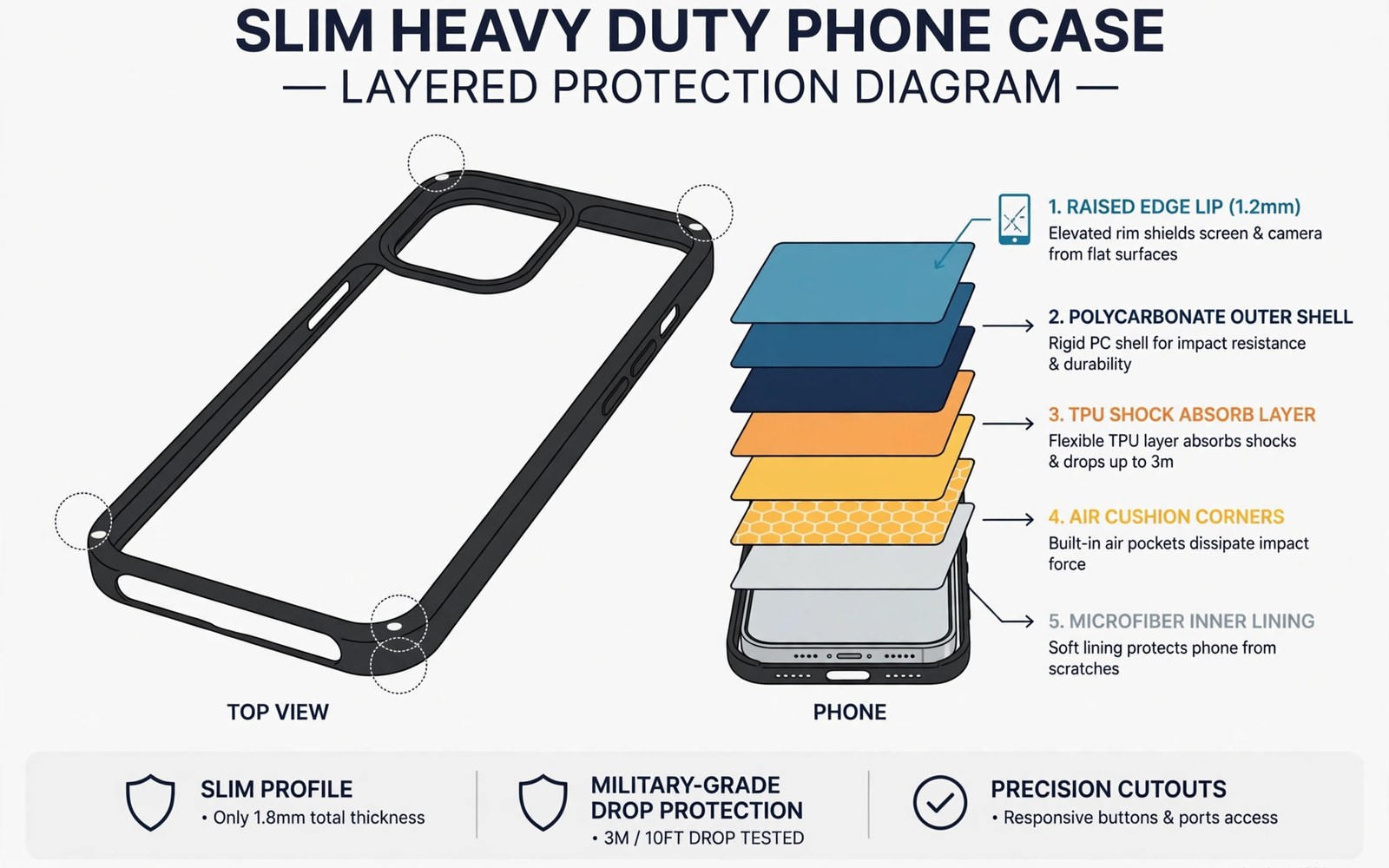
Old rugged cases relied on thickness alone: more rubber, more plastic, more weight. Modern ones rely on structure. A thin polycarbonate shell resists cracks and spreads the force of an impact across a wide area. A soft thermoplastic polyurethane inner layer absorbs shock instead of passing it to the phone frame. An aramid fibre back adds stiffness at almost no weight. Layered together, these materials do the work that a single thick slab used to do.
Corners matter more than overall thickness. In most drops, a corner hits the ground first, so a case with reinforced corners and small air pockets absorbs the first impact before it reaches the phone. A case that is slim in the middle but padded at the corners offers the best protection-to-bulk ratio you can buy. Look at product photos closely: raised corner pads and visible air-cushion details are signs the design was thought through, not just thickened.
The raised lip around the screen and camera matters just as much. A lip that rises about a millimetre above the glass lets the case take the hit when the phone lands face down on a flat surface. A lip that is too low sacrifices screen safety for slimness, so check that detail before buying. The same lip around the camera lenses keeps them off tables and gravel.
Materials that make thin cases tough
Polycarbonate is the hard outer shell in most slim rugged cases: light, stiff, and resistant to cracking. Thermoplastic polyurethane, usually shortened to TPU, is the soft inner layer that grips the phone and absorbs shock. Aramid fibre, the material behind Kevlar, is stiff and extremely light, which is why it appears in premium thin cases. Some cases add a metal frame or a nylon weave for grip. Each material covers a weakness of the others, and that layering is the whole trick.
Aramid fibre versus polycarbonate shells
Aramid fibre wins on stiffness per gram and feels premium, but it absorbs less shock than a TPU layer, so aramid cases usually pair the fibre back with a soft bumper. Polycarbonate wins on cost and crack resistance, and it moulds easily into raised lips and corner pads. A case that combines both gives you the stiff back of aramid with the forgiving shell of polycarbonate.
TPU inner layers and shock absorption
The TPU layer is the quiet hero of a slim rugged case. It grips the phone so the case never rattles, and it compresses on impact, turning a sharp knock into a slower push. Thicker TPU at the corners and thinner TPU along the sides is the pattern to look for: it puts the cushioning where drops actually land and keeps the middle slim.
Why weight tells you more than photos
Photos lie about bulk. A case photographed at an angle can look slim or chunky depending on the shot, so read the weight and thickness figures in the product description instead. A good slim rugged case for a standard phone weighs roughly 40 to 70 grams and adds about 2 to 3 millimetres per side. Anything past 100 grams will feel like a brick in a pocket, whatever the photos suggest.
Drop Ratings and Military Standards Explained Honestly
Many rugged cases claim MIL-STD-810G or 810H certification, which sounds impressive and means less than the marketing suggests. The standard is a set of test methods, not a single pass-or-fail badge, and manufacturers test their own products against selected drops, often 26 drops from about 1.2 metres onto plywood over concrete. It is a useful signal, not a guarantee.
Real drop height matters more than the badge. A case rated for 1.2-metre drops protects against the classic fall from a hand or a table. A case rated for 3 metres or more, such as some UAG models, is built for rougher use: construction sites, trails, and clumsy ladder work. Match the rating to your life rather than buying the biggest number on the shelf.
What a 1.2-metre drop rating actually covers
A 1.2-metre rating covers falls from a pocket, a desk, or a hand at chest height onto a hard floor. It does not cover a phone thrown from a moving vehicle, dropped onto sharp rocks, or run over by a car. Treat the rating as a baseline for everyday accidents, and add a screen protector for the glass itself, since no case guards the screen against a direct hit from a sharp stone.
Corner drops, face drops, and why they differ
Corner drops are the most common and the most survivable with a good case, because the corner padding absorbs the energy. Face-down drops onto a flat surface are handled by the raised lip. The worst case is a face-down drop onto a raised stone or a metal edge, where the impact concentrates on one point of glass. That is the drop no slim case can fully promise to survive, and it is why pairing a case with a glass protector is the sensible default.
Seven Slim Heavy-Duty Cases Compared and Tested in Daily Use
The seven cases below are all real products you can buy for popular phones such as recent iPhones, Samsung Galaxy S and A series models, and Google Pixel phones. Availability varies by model, so confirm your exact phone before ordering. Each entry covers what the case does, who it suits, its strengths, its weaknesses, and a short verdict from daily use.
1. Spigen Tough Armor
Spigen Tough Armor is the classic slim dual-layer case: a hard polycarbonate shell over a soft TPU inner layer, with Air Cushion corners and a sliding cover over the camera on some models. It adds modest bulk, supports wireless charging, and feels secure in the hand thanks to a textured grip. The built-in kickstand on many versions is genuinely useful for video calls and watching clips hands-free.
Pros: strong corner protection for its thickness, reliable wireless charging, a useful kickstand on several models, and a fair price that undercuts premium rivals. Cons: the design looks plain next to flashier rivals, and the kickstand can feel loose after a year of daily use. Verdict: the best all-rounder for most people, and the first case to try if you want proven protection without paying a premium. Who it is for: commuters, parents, and anyone who wants solid daily protection at a sensible price.
2. UAG Monarch
UAG Monarch is the toughest case in this list that still qualifies as slim. It layers polycarbonate, TPU, leather, and a metal alloy frame, meets the MIL-STD-810H drop standard, and is rated for drops up to about 6 metres on some models. It is heavier than the others here, but it stays pocketable, and its grip is excellent even with wet hands. The Monarch feels like equipment, not jewellery, and that is the point.
Pros: outstanding drop protection, a genuinely grippy texture, premium materials that age well, and strong button feedback. Cons: it costs more than most rivals, adds more weight than the slimmest options, and the look is unapologetically industrial. Verdict: pick this one if your phone faces real hazards daily, from building sites to mountain trails. Who it is for: outdoor workers, hikers, and anyone who has already cracked a screen once.
3. OtterBox Defender Series
OtterBox Defender is the name most people think of first, and the current version is slimmer than the bulky Defenders of a decade ago. It uses a multi-layer build with a hard shell, a soft inner slipcover, and a belt-clip holster in the box. Port covers keep dust and grit out of the charging port, which matters on a beach or a building site. The Defender is the case I hand to people who break phones for a living.
Pros: the strongest dust and port protection here, a holster included, and a long record of surviving serious drops. Cons: it is the bulkiest case in this list, the holster adds size, and the price sits at the top end. Verdict: the maximum-protection pick, worth the extra bulk only if your phone works in harsh places. Who it is for: field workers, parents of small children, and outdoor adventurers.
4. OtterBox Symmetry Series
OtterBox Symmetry is the Defender’s slim sibling, and it is the better pick for most people. It keeps the dual-material build and the raised edges, but drops the holster and the thickest layers, so it slides into a pocket easily and works with wireless charging. Clear versions show off the phone colour, though they can yellow slowly over a year of sun exposure. The Symmetry proves that OtterBox can do slim without giving up its drop record.
Pros: genuinely pocket-friendly, strong drop protection for its size, wide model availability, and clean styling. Cons: no port covers, clear versions yellow over time, and it costs more than Spigen rivals. Verdict: the best OtterBox for everyday life, and a strong choice if you like the brand but not the bulk. Who it is for: office workers, students, and anyone who wants trusted protection in a normal-looking case.
5. Ringke Onyx
Ringke Onyx is the budget surprise in this list: a slim, flexible TPU case with a textured back, reinforced corners, and a raised lip, usually sold for far less than the big brands. It will not survive the same punishment as a Monarch, but it handles everyday drops well and feels great in the hand. The matte finish resists fingerprints, and the case stays thin enough to disappear in a pocket.
Pros: very low price, excellent grip, slim profile, and wide availability for many phone models. Cons: less drop protection than the dual-layer cases here, and the flexible material can stretch slightly after a year. Verdict: the best value pick, and proof that slim protection does not need a premium price. Who it is for: budget buyers, students, and anyone who wants a solid case without overthinking it.
6. Caseology Parallax
Caseology Parallax is the style pick that still protects. Its geometric 3D pattern gives grip without a sticky rubber feel, and the dual-layer build pairs a hard shell with a soft inner layer. The Parallax is slim, light, and available in colours that actually look good, from muted burgundy to sage green. It is the case I recommend to people who refuse to carry an ugly rugged case.
Pros: distinctive good looks, comfortable grip, slim profile, and a price that sits in the middle of the pack. Cons: the patterned back can trap dust in its grooves, and drop protection is a step below the Monarch and Defender. Verdict: the best-looking slim rugged case here, with protection that covers everyday accidents well. Who it is for: style-conscious buyers who still want real drop protection.
7. Supcase Unicorn Beetle Pro
Supcase Unicorn Beetle Pro is the value rugged case: a dual-layer build with a built-in screen protector on some models, a belt-clip holster, and port covers, usually at a price well below OtterBox. It is thicker than the Parallax and the Symmetry, but it is still far slimmer than the old brick-style cases, and it includes extras the premium brands charge separately for. The built-in screen protector is a mixed blessing: it guards the glass, but it can dull touch sensitivity slightly on some phones.
Pros: excellent value, holster and screen protector included on many models, strong corner protection, and good port covers. Cons: the built-in screen protector can reduce touch feel, and the design is chunkier than the slimmest picks here. Verdict: the best full-kit value, especially for outdoor use where the holster and covers earn their keep. Who it is for: hikers, travellers, and buyers who want every accessory in one box.
Side-by-Side Comparison of the Seven Cases
The table below compares the seven cases on the factors that matter in daily use: bulk, weight, drop rating, and extras. Treat the figures as typical values for a standard flagship phone, since exact numbers vary by model.
| Case | Thickness added | Weight | Drop rating | Extras |
|---|---|---|---|---|
| Spigen Tough Armor | About 2.5 mm | About 55 g | MIL-STD-810G | Kickstand on many models |
| UAG Monarch | About 3 mm | About 65 g | Up to 6 m | Metal frame, leather |
| OtterBox Defender | About 4 mm | About 90 g | MIL-STD-810H | Holster, port covers |
| OtterBox Symmetry | About 2.5 mm | About 50 g | MIL-STD-810G | Clear options |
| Ringke Onyx | About 2 mm | About 40 g | Everyday drops | Matte grip finish |
| Caseology Parallax | About 2.5 mm | About 45 g | MIL-STD-810G | Patterned grip |
| Supcase Unicorn Beetle Pro | About 3.5 mm | About 80 g | MIL-STD-810G | Holster, screen guard |
Read the table as a trade-off, not a ranking. The Ringke Onyx wins on slimness and price, the Monarch wins on raw protection, and the Tough Armor sits in the middle on almost every row. A broader roundup of rated smartphone cases puts these seven in context against thinner fashion cases and thicker industrial ones, and it is worth a look before you decide how much protection your daily life actually needs.
Fit, Grip, and Pocket Test: Try Before You Commit
A case that fits badly protects badly. Before keeping a case, check four things in the first day: the buttons should click crisply without extra force, the charging port should accept your cable fully, the camera cutout should not catch the flash and cause glare in photos, and the case should not peel away from the corners when you twist it gently. Any of those failures is a reason to return it, not to live with it.
Test the pocket fit with the clothes you actually wear. Slide the phone into your usual jeans pocket, sit down, and stand up again. A case that snags on the pocket lining will annoy you every day, and a case that slides out too easily will fall out when you bend over. The grip test is just as simple: hold the phone one-handed over a soft surface and see whether your fingers feel secure. A case that feels slippery on day one will not improve with age.
Check wireless charging and MagSafe-style accessories
Most slim rugged cases work with wireless charging, but thick ones and cases with metal plates can block it. Test your charger on the first night: if the phone charges slowly or keeps disconnecting, the case is too thick or the metal is in the way. Magnetic accessories need a case with a built-in magnet ring or a thin enough back for the magnet to hold, so check that before buying a magnetic car mount.
Watch for stretch, yellowing, and loose corners over a month
Keep a simple note of how the case feels after a month: pocket fit, grip, and any scuffs or stretch. A case that feels slim on day one may loosen over weeks, especially flexible TPU designs. Clear cases yellow slowly in sunlight, and patterned backs collect dust in their grooves. A quick monthly check tells you whether the case is ageing well or quietly losing its grip on the phone.
Pairing a Slim Rugged Case With a Screen Protector
A case guards the frame and the back. It does not guard the glass against a direct hit from a sharp object, and that is where a tempered glass protector earns its place. A good glass protector is thin, covers the flat area of the screen fully, and leaves a small gap around the edges so the case lip does not lift it. Apply it in a dust-free room, align it carefully, and press out bubbles from the centre outward.
Case-friendly glass is the term to look for: it is cut slightly narrower than the screen so the case edge does not peel it up. A tempered glass protector that runs edge to edge looks better on day one and lifts within a week once the case presses against it. The guide to choosing a tempered glass protector explains thickness, hardness ratings, and installation mistakes in detail, and it is worth reading before you buy, since a bad protector wastes more money than a cheap case.
For rough outdoor use, the case-plus-glass combination is only half the kit. A lanyard, a carabiner clip, or a waterproof pouch covers the drops and dunks that a case alone cannot handle, and a roundup of outdoor drop protection accessories shows how a slim case fits into a trail kit alongside those extras. The case is the daily layer; the accessories are the trip layer.
Mistakes That Make a Good Case Protect Poorly
The most common mistake is buying the wrong model. Phone models that look identical can differ by a millimetre around the camera, and a case made for the wrong variant will press on the lenses or leave a gap at the corners. Check the exact model number in Settings, then match it to the case listing, not just the phone name.
The second mistake is trusting a bargain copy. Fake versions of popular cases use thinner plastic, weaker TPU, and corner pads that are solid instead of air-cushioned. They look right in photos and fail on the first real drop. Buy from the brand’s own listing or a reputable retailer, and be suspicious of prices far below the usual range.
The third mistake is ignoring the lip. A case with a lip lower than the screen glass offers no face-down protection at all, however thick its back is. Run a finger across the edge: you should feel the case rise slightly above the glass. If the glass sits proud of the case, the next face-down drop will land on glass first.
Frequently Asked Questions About Slim Heavy-Duty Phone Cases
Do slim rugged cases really protect as well as bulky ones?
For everyday drops from hand or table height, yes: a well-designed slim dual-layer case with reinforced corners absorbs the same impact as an older thick case, because the materials and the air pockets do the work that thickness used to do. For extreme drops from ladders, cliffs, or vehicles, a thicker case such as the Defender still has an edge, so match the case to the hazards your phone actually faces.
Will a heavy-duty case block wireless charging?
Most slim rugged cases work fine with wireless charging, including the Tough Armor, Symmetry, and Parallax. Cases with metal plates, thick holsters, or built-in screen protectors are the ones that can interfere, so test your charger on the first night. If charging is slow or intermittent, remove any metal plate or switch to a thinner case.
Which slim rugged case is best for hiking and outdoor use?
The UAG Monarch and the OtterBox Defender lead for outdoor use, thanks to their drop ratings, grip, and port covers. The Supcase Unicorn Beetle Pro is the value alternative, with a holster and covers included. Whichever you pick, add a glass protector and a lanyard, since a case alone cannot guard the screen against a sharp rock or keep the phone attached to your pack.
How often should I replace a phone case?
Replace a case when the corners loosen, the material stretches, the lip wears flat, or the back cracks. For most people that means every 12 to 18 months, sooner for flexible TPU cases that stretch and for clear cases that yellow. A loose case is worse than no case in some drops, because it can shift on impact and leave a corner exposed, so check the fit every few months.
Which Slim Rugged Case Fits Your Life
If you want one answer, buy the Spigen Tough Armor: it protects well, costs fairly, and disappears in a pocket. If your phone faces real hazards, step up to the UAG Monarch or the OtterBox Defender and accept the extra grams. If your budget is tight, the Ringke Onyx covers everyday accidents for very little money, and the Caseology Parallax does the same with more style. The wrong choice is not any case on this list; it is the thick brick you leave at home because it will not fit in your pocket.
Order the case for your exact phone model today, add a case-friendly glass protector, and run the pocket and button checks on the first evening. A case only protects the phone it is actually on, so the best protection is the one you keep on every day, not the toughest one sitting in a drawer.

