

Major Carriers vs MVNOs: Are Cheap Cell Phone Plans Worth It?
A cheaper phone plan is worth considering when your bill pays for benefits you rarely use. It becomes a bad bargain when the saving disappears into renewal prices, weak coverage at home, or hotspot restrictions that interrupt your work.
This comparison uses the US market, where names such as Verizon, AT&T, T-Mobile, Mint Mobile, Visible, and US Mobile make the choice familiar. Prices and terms were checked for this November 5, 2026 review, but promotions can change. I would compare the actual plan and network combination, then test it where I use my phone, rather than choose on the assumption that a major brand is always faster or a budget brand is always equivalent.
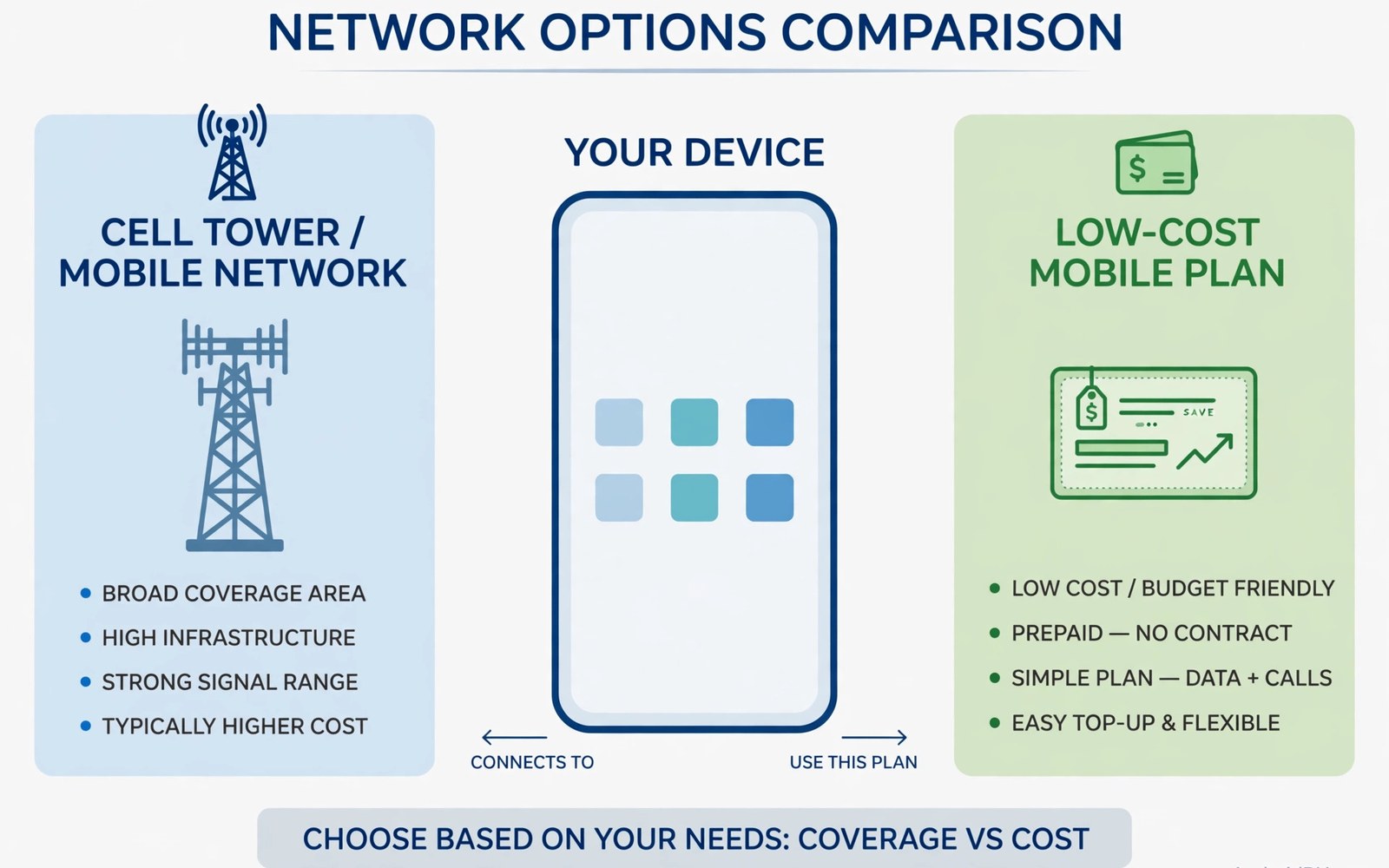
Major carriers vs MVNOs: what changes behind the brand
A mobile network operator runs the radio network. An MVNO buys access to another operator’s infrastructure and sells service under its own terms. Some discount brands are owned by a major operator; others are independent. Ownership, network access, and the customer service experience are related questions, but they are not the same question.
An MVNO coverage comparison starts with the host network. After that, check domestic roaming, supported bands, device approval, data priority, and feature availability. Sharing towers does not guarantee that two plans include identical roaming arrangements or management rules.
| Comparison point | Major carrier plans | MVNOs and discount brands |
|---|---|---|
| Radio network | Service sold directly by a network operator | Access through one or more host networks |
| Price structure | May favor several lines or device bundles | Often competitive for a single line or prepaid service |
| Congestion priority | Varies by plan and usage rules | Varies by brand, plan, and network option |
| Hotspot allowance | May include a separate high-speed bucket | May have a bucket, speed limit, or other restriction |
| International service | Passes or included benefits depend on the plan | May use add-ons, native roaming, or separate data eSIMs |
| Support channel | Often includes physical stores | Frequently emphasizes remote support |
| Phone promotions | Often depend on installments and ongoing credits | Frequently oriented toward bringing your own device |
| Best value calculation | All lines, useful benefits, and financing obligations | Renewal cost, access terms, and prepaid commitment |
Do not infer priority from the word “unlimited.” It describes neither a universal speed nor identical treatment at a crowded tower. Read how the particular plan handles congestion and what happens after any high-speed allowance.
When a major carrier plan earns its higher price
A major carrier plan for a heavy data user can make sense when it includes the priority, hotspot allowance, and international service that person actually needs. Store support can also be valuable when a user wants help transferring a phone or replacing a physical SIM.
Family pricing changes the comparison. A single expensive line is not a fair stand-in for the per-line cost of a four-line account. At the same time, splitting a family can remove discounts from the remaining lines, so calculate the bill after the change rather than multiplying today’s advertised per-line rate.
Pros:
- Physical support locations can make device changes and troubleshooting easier for people who prefer in-person help.
- Some plans combine substantial hotspot use, travel benefits, and prioritized data in one account.
- Multi-line pricing and a useful device promotion can reduce the effective total for an eligible household.
Cons:
- A single-line customer may pay for bundled benefits that provide little personal value.
- Device credits can depend on keeping an eligible plan, making an early switch more expensive than expected.
Who it is for: households that benefit from the full bundle, travelers with suitable roaming inclusions, and users who regularly need support or specific data treatment. My verdict is to keep the higher-priced service when the useful benefits survive a written cost comparison.
Device financing is a separate commitment
A “free” phone offer may use recurring bill credits against installment charges. Paying off or leaving the account can change those credits under the offer’s terms. Record the remaining balance, the credit schedule, and the switching conditions before judging a cheaper service plan.
Compare service cost without disguising the phone price
Write the monthly service charge, device installment, device credit, and optional protection charge on separate lines. This makes it possible to compare an existing financed phone with a bring-your-own-device plan without pretending the hardware obligation vanished.
Count only benefits you would otherwise buy
A streaming subscription is worth its avoided cost only if you would pay for that service independently. A bundle you ignore contributes no savings. The same applies to cloud storage, travel passes, and upgrade privileges.
When an MVNO or discount plan offers better value
A cheap cell phone plan for light users works well when most data traffic happens on trusted Wi-Fi and the chosen host network is reliable on the user’s normal route. Removing unwanted extras can cut the bill without changing the basic tasks of calling, messaging, and navigation.
Budget service is not one uniform category. Visible emphasizes a Verizon-based service, Mint Mobile uses multi-month payment structures, and US Mobile offers multiple network choices with plan-specific differences. Those are useful starting distinctions, not a reason to skip the current plan details.
Pros:
- Single-line and bring-your-own-phone pricing can be attractive without a large family account.
- Prepaid options can make spending easier to control when add-ons and renewal terms are understood.
- A simpler service bundle can avoid paying for subscriptions or upgrade programs you do not need.
Cons:
- Support may be concentrated in chat or phone channels rather than nearby stores.
- A low introductory equivalent may require an upfront commitment and renew at a different price.
Who it is for: independent users with a compatible phone, predictable usage, and confidence in the host network. My verdict is favorable when a short trial confirms both routine coverage and busy-hour usability.
As a concrete price reference, Visible’s base plan lists $25 per month or $275 per year, with taxes and fees included under its advertised terms. Mint’s displayed entry offer includes a three-month 6GB plan at a $15 monthly equivalent, requiring $45 upfront, with taxes and fees extra. These are different payment structures, so compare renewal terms and allowances before choosing.
Deprioritization vs throttling: why cheap plans can feel slower
Data deprioritization during congestion means traffic can receive lower scheduling priority when capacity is scarce. A speed cap is a limit applied under the plan’s rules. Throttling after a high-speed allowance is another restriction. A plan can involve more than one of these behaviors.
At an uncongested tower, two plans with different priorities may feel similar. At a busy commuter station, a lower-priority connection may become noticeably less responsive. The effect varies by location and time, and there is no honest universal percentage describing how much slower every MVNO will be.
Priority belongs to the exact plan and network
Direct carrier service is not automatically the highest-priority option. T-Mobile distinguishes traffic priority among its own plans and brands. US Mobile likewise documents different priority levels across network and plan combinations. Compare those current terms rather than repeating a blanket “MVNOs are always last” rule.
For a mobile hotspot plan comparison, inspect the hotspot speed separately from phone data. Unlimited hotspot usage can still have a speed cap. A modest cap may be enough for email and documents while being frustrating for large transfers or several video calls.
Video streaming limits on unlimited plans can also make a speed-test result misleading. A general download test may look quick while streaming quality is managed differently. Test the actual service you care about, within the provider’s terms, rather than treating one large number as the whole experience.
How to compare total phone plan cost over twelve months
Annual phone plan cost should include the service you will actually receive after any promotion. Add activation charges, provider fees, applicable taxes, needed add-ons, and the cost of losing a useful bundle. Note whether the price assumes an eligible autopay method.
For an illustrative calculation, suppose one plan costs $60 per month and another costs $25, with every required recurring fee already included in both figures. The difference is $35 per month, or $420 over twelve months. If switching costs $120 in one-time obligations, the first-year saving becomes $300. Those are sample numbers, not quotes for a named carrier.
A prepaid annual plan refund policy matters because the effective monthly rate can conceal a large payment today. Ask what happens if coverage disappoints after the return window. A cheaper equivalent is less flexible when the unused months cannot be recovered.
Read the Broadband Facts label and its linked terms
For US plans, the Broadband Facts information helps organize price, additional charges, data allowances, and typical performance. Review its network-management detail as well. Keep a copy of the offer you accept so a future billing question has a clear reference.
For a family cell phone plan comparison, include every affected line in the worksheet. Families considering shared family data plans should distinguish a shared pool from individual allowances. One heavy user can change the value of the entire arrangement.
Cheap international roaming plans also need destination-specific checking. Included international calls from home are not the same as roaming while abroad. A data-only travel eSIM may not provide the same phone-number access as the home line. Review international roaming on dual SIM phones before assuming a travel add-on replaces all existing functions.
How to test an MVNO before transferring your number
A prepaid network trial is most useful on the phone you intend to keep. Device band support, network approval, and eSIM compatibility can change the outcome. Check the exact model or IMEI through the provider’s compatibility process rather than relying on the product name alone.
- Inspect your current account’s data use over several billing cycles, including hotspot usage if reported separately.
- Confirm the proposed host network, phone compatibility, and carrier-lock status before buying a trial.
- Activate a temporary line or supported trial while your main number remains on its existing service.
- Test calls, messages, and web access at home, work, and the places where you regularly wait or travel.
- Repeat a few ordinary tasks during busy hours and quiet hours, recording whether they remain usable.
- Try hotspot, Wi-Fi calling, and any essential account verification workflow supported by the trial.
- Review the renewal price and support process before making the final transfer decision.
Use testing signal strength accurately to avoid confusing a single fluctuating measurement with reliable coverage. Match location and device conditions where possible, and remember that speed tests can consume substantial data.
Coverage testing at home should include the room where you normally take calls, not just the driveway. A network can perform well outdoors and poorly behind your building’s walls. If Wi-Fi calling is important, check its setup and behavior rather than assuming host-network access guarantees the feature on every phone.
Switching carriers without losing your number or account access
Keep the old line active until the number transfer completes. Obtain the account number and the specific port-out or transfer PIN required by the old provider; this may differ from a normal account PIN. Check for number locks and any remaining device obligation.
Submit the transfer through the new provider, using the account details exactly. A delay can result from a mismatch, an account lock, or incomplete authorization. Ask support which field failed instead of repeatedly resubmitting different guesses.
After activation, test incoming and outgoing calls, SMS, voicemail, and essential verification messages. Do not make an emergency test call for a routine plan comparison. Review how the service handles emergency-address information for Wi-Fi calling when that setting is required.
Number portability also has account consequences: moving one line may affect a family discount or leave other subscriptions active. Confirm the old account’s final bill and remaining services after the transfer. Porting one number does not necessarily close every product on an account.
Major carrier and MVNO questions before you commit
Will a cheap plan get exactly the same coverage?
It may use the same underlying radio network, but roaming access, device support, and service features can differ. Compare the exact coverage terms and test your routine locations. A copied-looking map is not proof that every practical detail is identical.
Can a budget plan have prioritized data?
Yes, some plan and network combinations offer higher-priority access to mobile data. Check the provider’s current description and any usage threshold. The price category alone does not identify the scheduling priority.
Is an annual prepaid plan always the cheapest choice?
No. It may have a lower equivalent rate, but a monthly plan can be better when you expect to move, change usage, or need the freedom to leave quickly. Include refund rules and the value of keeping your cash available.
A fair verdict on whether cheap cell phone plans are worth it
An MVNO or discount brand can offer excellent value for a compatible phone on a dependable host network. A major carrier can justify its price through a useful family arrangement, suitable data treatment, travel benefits, or support. Neither category wins every household’s calculation.
Today, write down your renewal price, essential features, and actual usage. Then trial one alternative before transferring your number. The useful comparison is total ownership cost plus dependable service in your own life, rather than the smallest number in an advertisement.

