

Best Phone Deals of the Season: Top Android Discounts
Phone prices move in cycles across the year, and the difference between a great deal and a bad one is rarely the size of the discount on the poster. New models launch at full price, older models drop as new models arrive, holiday sales cut prices further, and carrier offers add trade-in value and bill credits that look generous until you read the fine print. I have watched the same phone sell for three different prices in a single month, and the buyers who paid the least were not the ones who shopped hardest. They were the ones who knew their target price before the sale started.
This guide explains the timing and the traps, names the seven Android phones with the strongest discounts to watch this season, and gives you a checklist that takes five minutes and saves costly returns. It helps you buy at a real low rather than at a fake sale price, and it shows you how to tell the difference in about ten minutes of checking. Patience and price tracking beat impulse buying every time, and the proof is in the numbers below: the same flagship that cost $1,399 on its launch page sold for $979 during an October sale event, and last Black Friday’s Pixel 10 sold for $599 against a $799 list price.
Who this is for: anyone buying an Android phone in the next few weeks, whether you need a flagship, a mid-range phone under $500, or a budget phone under $300. The advice works in the United States and the same logic applies anywhere, though exact prices and carrier rules differ by country, so treat every dollar figure here as a price to beat and check the current price in your own store before you pay.
When Phone Prices Actually Drop: The 2026 Sale Calendar
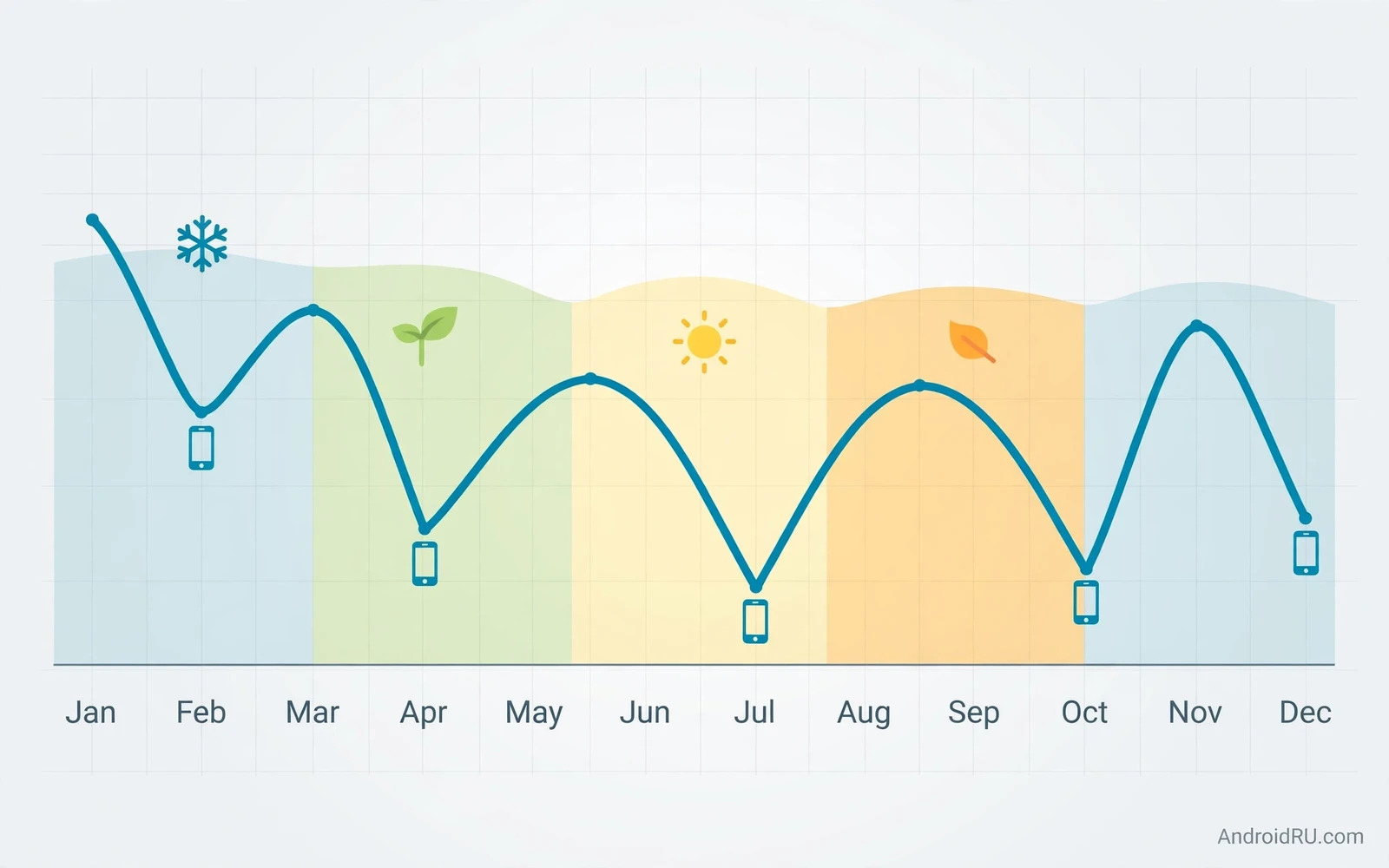
Major sales events cluster around holidays and launch seasons, and each window favours a different buyer. Black Friday 2026 falls on Friday, November 27, with Cyber Monday on November 30, and that week is the deepest discount window of the year for Android phones: previous-generation flagships often drop 30 to 50 percent, and mid-range phones drop through retailer competition. Best Buy runs early Black Friday deals from November 6 and ten days of Black Friday deals from November 19, while Walmart runs sale events from November 12 to 15 and again from November 23 to 29. If you can wait until that week, wait.
The rest of the year has its own windows. Amazon’s Prime Day in July cuts Android prices, especially Samsung and Google models, and the October Prime Big Deal Days event already produced some of the best prices of the autumn: the Galaxy S26 Ultra dropped $420 to $979, the Pixel 11 Pro XL dropped $300, and the Galaxy Z Fold 8 Ultra dropped $400. Back-to-school sales in late summer help students and families. New model launches push previous models down in price, which is why the weeks after a launch are the best time to buy the outgoing model: Samsung launches its Galaxy S series in January or February, and Google launches Pixel phones in October, so January and October are clearance months for the previous generation.
Timing also depends on the model age. A phone launched months ago may drop modestly. A phone near replacement may drop sharply. A brand new flagship rarely drops much in its first weeks, and a mid-range phone may drop sooner through retailer competition. Watch the launch calendar for the brand you want, but do not let a launch rumour delay a needed purchase for months. A confirmed launch date can justify a short wait; a rumour cannot. The best time to buy a phone in 2026 is the week your target model hits your target price, and the calendar only tells you when that week is most likely to arrive.
The 7 Best Android Phone Deals to Watch This Season
The table below gives the prices to beat for each pick: the list price, the lowest price seen in the October sale events, and the best buyer for each phone. A Black Friday price at or below the “price to beat” column is a real deal. A price above it is a discount on paper only, and you should keep waiting.
| Phone | List price | Price to beat | Best for |
|---|---|---|---|
| Samsung Galaxy S26 Ultra | $1,399 | $979 | Power users and camera fans |
| Samsung Galaxy S26 | $999 | $724 | Compact flagship buyers |
| Google Pixel 11 Pro XL | $1,299 | $999 | Clean software and AI features |
| Google Pixel 11 | $899 | $749 | Balanced mainstream buyers |
| Google Pixel 10a | $599 | $524 | Budget Pixel buyers |
| Samsung Galaxy A57 | $549 | $399 | Reliable everyday use |
| OnePlus 13 | $899 | $699 | Fast charging and value flagships |
Samsung Galaxy S26 Ultra: the flagship deal to beat
The Galaxy S26 Ultra is the phone to watch this Black Friday, because it combines the biggest list price with the biggest real cut. The list price is $1,399 for the 256 GB model, and the October sale price of $979 is the number to beat: a genuine $420 cut on a SIM-free phone with no plan attached. Samsung raised every Galaxy S26 model by at least $100 in early October, which makes that $979 figure even more meaningful, because the discount is measured against a higher list price than last year’s models carried. The phone itself is built for power users: a 200 MP main camera, a large battery, a big bright display, and Samsung’s long software support, with seven years of updates promised on its recent flagships.
Pros: the strongest camera system in this list, with a 200 MP main sensor and long zoom; a large battery that comfortably lasts a full day of heavy use; seven years of software updates, which makes a discounted price even better value over time. Cons: it is large and heavy, so one-handed use is a stretch; the list price is the highest here, so a weak deal still costs a lot; Samsung’s software is feature-rich but busy, and some buyers prefer a cleaner Android. Verdict: buy it SIM-free at $979 or below. Above $1,100, wait for the next sale round or look at the regular S26 instead.
Samsung Galaxy S26: the compact flagship sweet spot
The regular Galaxy S26 is the better buy for most flagship shoppers, because it keeps the flagship chip and camera quality in a smaller body at a much lower price. List price is $999 for 256 GB, and the October price to beat is $724, a $275 cut with no strings attached. It suits buyers who want a top-tier Android phone without the size, weight, and cost of the Ultra, and it is the phone I would point a friend toward if they asked for one recommendation and did not want to think about it further.
Pros: flagship performance in a pocket-friendly size; a camera system that handles everyday photos, portraits, and night shots well; the same long update support as the Ultra. Cons: battery life is a step behind the Ultra on heavy days; charging is slower than the fastest rivals in this list; the price still sits above most mid-range phones even after the discount. Verdict: a real deal at $724 or below, and the best balance of price and power in the flagship tier.
Google Pixel 11 Pro XL: the best Pixel deal of the season
The Pixel 11 Pro XL is Google’s big-screen flagship, and its October price of $999 against a $1,299 list price makes it the strongest Pixel discount of the season so far. Pixel phones win on software: clean Android, fast updates straight from Google, and camera processing that makes ordinary photos look good without effort. The Pro XL adds the larger display and battery that the regular Pixel 11 does not have, and it is the Pixel to buy if you keep a phone for three years or more, because Google’s update promise covers that span comfortably.
Pros: the cleanest Android experience you can buy, with updates on day one; excellent computational photography, especially in low light and for portraits; useful AI features built into the camera, recorder, and call screening. Cons: charging speeds lag behind OnePlus and Samsung; the Tensor chip runs warm under sustained gaming; the list price is high, so only a real discount makes it competitive. Verdict: buy at $999 or below. At list price, the regular Pixel 11 is the smarter spend.
Google Pixel 11: the balanced mainstream pick
The regular Pixel 11 is the phone most people should buy. List price $899, price to beat $749, and it delivers the same clean software and camera quality as the Pro XL in a smaller body with a smaller battery. Last Black Friday, the previous Pixel 10 sold for $599 against a $799 list price, and the Pixel 11 is following the same pattern: a solid discount in its first sale season, with deeper cuts likely once the next Pixel arrives. For buyers who want a great camera, clean software, and no carrier lock-in, this is the default answer.
Pros: the same camera and software experience as the Pro models for $150 less at deal prices; a comfortable size for one-handed use; fast security updates and a long support window. Cons: battery life is good but not class-leading; no telephoto zoom like the Pro XL; storage upgrades cost more than they should. Verdict: a genuine deal at $749 or below, and the best phone in this list for buyers who want simplicity over specs.
Google Pixel 10a: the budget Pixel with a catch
The Pixel 10a is the cheapest way into the Pixel experience, but it carries a warning label this year: Google raised its list price from $499 to $599, so a discount that looks large may only return the phone to its old price. The October price to beat is $524, which is only $75 off the new list price and $25 above the old one. Judge this deal by the final price, not the dollars off. At $524 or below it is still a good budget buy, with the Pixel camera, clean Android, and long updates in a phone that costs half a flagship.
Pros: the Pixel camera and clean software at the lowest price in the Pixel line; long software support for a budget phone; a simple, reliable daily experience. Cons: the price rise to $599 makes the deal weaker than it looks; charging is slow and there is no wireless charging speed to brag about; the chip is a generation behind the Pixel 11. Verdict: buy only at $524 or below, and compare it with the Galaxy A57 before you decide, because the A57’s deal price is lower.
Samsung Galaxy A57: the best value deal under $400
The Galaxy A57 is the quiet winner of this season. List price $549, price to beat $399, and it does the everyday job — calls, messaging, photos, video, banking apps — without drama. It is not a flagship and it does not pretend to be one, but for buyers who want a reliable phone and would rather keep $500 in their pocket, it is the strongest value in this list. Samsung’s update support on the A series has improved steadily, so a $399 A57 stays useful for years rather than months.
Pros: the lowest deal price of any phone here, at $399; a solid camera and bright display for the price; long update support for a mid-range phone. Cons: performance is fine for daily use but not for heavy gaming; charging is slower than the flagships; the plastic frame feels cheaper than the metal flagships. Verdict: the best deal in this list for budget buyers, and the phone to buy if you want value rather than a discount label.
OnePlus 13: the fast-charging value flagship
The OnePlus 13 is the previous-generation flagship that refuses to go away, and that is exactly why it is a deal. List price $899, and last Black Friday it sold for $699 at major retailers, a $200 cut with no trade-in required. It suits buyers who charge fast, game hard, and want flagship speed without the flagship price. OnePlus phones have a loyal following for a reason: the charging is genuinely fast, the display is smooth, and the software stays close to stock Android with a few useful extras.
Pros: very fast wired charging that fills the battery in well under an hour; flagship performance for demanding games and multitasking; a clean, fast software experience. Cons: camera quality is a step behind Pixel and Samsung at the same price; update support is shorter than Samsung’s or Google’s; carrier deals for OnePlus are thinner than for the big two brands. Verdict: a real deal at $699 or below. Above $750, the Pixel 11 is the better buy for most people.
How to Spot a Real Discount vs a Fake Sale Price
A real deal beats the normal price by a clear margin, includes the full warranty and the standard return policy, and includes the same storage and colour options without hidden limits. It shows the total cost including any required plan or trade-in, and it survives a ten-minute check across three sellers. A fake deal hides costs in a long contract, limits the offer to a rare colour or storage size, or pairs the phone with unwanted accessories at inflated prices. The difference is not subtle once you know what to check, and the check takes less time than the regret of a bad purchase.
Start by setting a target price before any sale begins. Pick the exact model you want, note its normal price across several sellers, and note the price history if a tracker shows it. A target price stops a flashy discount from misleading you, because a seller can raise a price before a sale and then cut it back, and the cut looks large while the final price matches the normal price. Your own price notes expose that trick fast. This is how to check if a phone deal is real: compare the sale price with the price the phone sold for last month, not with the crossed-out price on the poster. If the sale price beats your target price, buy with confidence. If it does not, wait for the next cycle, because sale cycles repeat across the year and a missed deal this month often returns next month in some form.
Compare the deal against several trusted sellers. Check the maker store price, check large retailers and carrier stores, and check refurbished prices for the same model. A deal that only beats one inflated seller is not a deal, and a deal that beats most sellers by a solid margin is worth action. Keep screenshots of prices and terms, because screenshots help if a seller changes terms after checkout, and they also help you judge the next sale cycle. A genuine deal survives a ten-minute check. A fake deal relies on you skipping that check.
Carrier Trade-In and Bundle Traps That Eat Your Savings
Trade-in offers can add real value when the terms are fair, and they can erase the saving entirely when they are not. A high trade-in value may require a premium plan for two or three years, and that plan cost can erase the phone saving several times over. The headline discounts on Black Friday come mostly from carriers and depend on a trade-in and a three-year plan, while the clean SIM-free cuts are smaller but simpler. That is the central trade-off of the season: the biggest number on the poster usually comes with the longest commitment.
Calculate the total cost over the full term before you celebrate. Take the monthly plan price, multiply it by 24 or 36 months, add any upfront payment, and subtract the trade-in credit. Then compare that total against a cheaper plan with a direct phone discount. A saving that locks you in for three years may cost more than it saves, and a direct discount with no strings often wins for flexible buyers. Carrier deals suit buyers who already plan to stay with that carrier and buyers who need a new line anyway. They suit less the buyers who value freedom to switch, because a SIM-free phone bought outright keeps full freedom and avoids long contract terms.
Bundles hide cost the same way. A free accessory has value only when you would buy it anyway; otherwise the bundle price is just a higher phone price with a gift you did not want. Read the full terms before you celebrate a discount, and check whether the trade-in credit arrives as bill credits spread over 36 months, because bill credits vanish if you leave early, while a direct discount stays yours. The question to ask about every carrier deal is simple: what is my total cost over the whole term, and what happens if I leave after a year? If the seller cannot answer that clearly, walk away.
Best Deal Strategy by Budget: Under $300, Under $500, and Flagship
Seasonal shopping rewards buyers who compare tiers rather than brands alone. A discounted flagship may still cost more than a strong value phone at full price, and the best deal is the lowest total cost for the phone you actually need. Shoppers who review best value phones under 500 dollars before a sale can judge discounts against a solid baseline, instead of judging them against a poster. The three budgets below each have a different winning move.
Under $300: buy last year’s mid-range, not this year’s cheapest
Budget buyers gain most from previous-generation models. A last-year mid-range phone often drops to a very low price during Black Friday, and it still handles daily tasks well and still gets security updates for a useful span. Check support length before buying an older model: a very old model may lose support soon, while a one-year-old model usually keeps support for years. That balance gives strong value without new-model risk. The Galaxy A57 at its $399 deal price sits just above this tier, and a further cut or a refurbished unit can bring it under $300, which is where the best budget Android phone under 300 dollars is usually found.
What to check on a sub-$300 phone
Confirm the exact model and storage, confirm the update promise in years rather than vibes, and confirm the battery is new rather than a refurbished unit sold as new. A cheap phone with two years of updates left beats a cheaper phone with six months left, and the difference is worth $50 without hesitation.
Under $500: the value sweet spot of the season
The under-$500 tier is where the best phone deals of the season cluster. The Pixel 10a at $524 and the Galaxy A57 at $399 are the two names to watch, and the Pixel 9a at last year’s $349 Black Friday price shows how deep this tier can go once a newer model arrives. A mid-range phone at full price may still be the smarter spend than a discounted flagship, because the mid-range phone was designed for value while the flagship was designed for headlines. A comparison of flagship cost against mid-range value can reset expectations during a sale: a discounted flagship is still a flagship price, and the money saved by choosing the mid-range phone buys a case, a charger, and a year of peace of mind.
How to choose between the A57 and the Pixel 10a
Pick the A57 if you want the lower price and Samsung’s ecosystem, and pick the Pixel 10a if you want the Pixel camera and clean software. Both are good phones; the wrong choice is buying the flagship because the discount looked bigger, when the mid-range phone already does everything you need.
Flagship: time the launch, then use the trade-in
Premium buyers gain most from launch timing and trade-in windows. A flagship discount near a new launch can be large, and a trade-in bonus during a holiday event can add more value. Combine a real price cut with a fair trade-in for the best result, but do not chase every small discount on a flagship you need now. Time and frustration have value too, and a good deal now beats a perfect deal that never arrives. The Galaxy S26 Ultra at $979 and the Pixel 11 Pro XL at $999 are the two flagship prices to beat this season, and either one at or below its number is a genuine deal.
Refurbished vs New: When a Used Phone Is the Smarter Buy
Refurbished stock grows after launch season, as trade-ins flow back and retailers clear returned units, and a certified refurbished phone can save 30 to 40 percent against a new one. The question is not whether refurbished is cheaper. It is whether the saving is worth the shorter warranty and the unknown history, and the answer depends on who sells it and what the warranty covers.
Shoppers who review refurbished phone risks against new phone warranty before buying used can judge the trade-off with the same care they give a new phone. A refurbished phone from the maker or a major retailer, with a one-year warranty and a clear return policy, is a different purchase from a used phone sold by a stranger with no warranty at all. The first is a deal. The second is a gamble, and the price should reflect that.
What to check before buying refurbished
Confirm the warranty length and who honours it, confirm the return policy for opened phones, and confirm the battery health if the seller reports it. A refurbished phone with a new battery and a one-year warranty is close to a new phone in daily use. A refurbished phone with an old battery and a 30-day warranty is a phone you will replace sooner than you planned, and the saving evaporates. Check whether the phone is SIM-free or tied to a carrier, and check the exact model number, because a refurbished listing for the wrong storage size or the wrong region is a common and expensive mistake.
Battery health and warranty: the two numbers that matter
Ask for the battery health percentage in writing, and prefer a seller that guarantees at least 85 percent or fits a new battery. Ask for the warranty in writing too, with the start date and the return address. A seller who answers both questions clearly is a seller you can trust; a seller who dodges either one is telling you everything you need to know.
Price Tracking Tools and Habits That Save Real Money
Price tracking turns guesswork into a clear buying signal. Note the normal price for your target model across three sellers, check prices weekly during the month before a sale, and set an alert for your target price rather than for any discount. A real discount stands out against that baseline, while a fake discount blends into it. Tracking takes only minutes each week and it saves far more money than impulse buying ever saves, because the tracker remembers what your memory forgets: what the phone actually cost last month.
A simple notebook or spreadsheet works well for tracking, and that is what I recommend for most buyers. Write the model, the storage, the colour, the seller, the price, and the date, one line per check. Price history tools add charts and alerts on top of that, and they are worth using for a phone you plan to buy in a big sale, because they show whether today’s price is a genuine low or a routine dip. Set the alert for your target price only. An alert for a small cut creates noise and temptation, while an alert for your target price creates action only when value appears. Ignore flash sales that miss your target, and wait for the next cycle with patience.
Compare prices across channels before checkout, because each channel carries different terms. Maker stores may offer warranty perks. Retailers may offer bundle value. Carriers may offer trade-in bonuses. Online marketplaces may offer the lowest cash price, and each channel carries different return terms. The lowest price with poor return terms can cost more after a fault, so balance price and protection rather than chasing price alone. Your price history notes are the baseline that makes all of this possible: without them, every discount looks like a bargain, and with them, the real bargains stand out on their own.
Checkout Checklist Before You Pay
Use a short checklist on every deal, because a checklist stops excitement from skipping a key term and it takes minutes while saving costly returns. Run through it in order, and do not pay until every line is answered.
- Confirm the exact model, storage, and colour, because a deal on the wrong storage size is not a deal on the phone you wanted.
- Confirm the warranty length, who honours it, and whether it is the maker warranty or a seller warranty.
- Confirm the return policy: how many days, whether opened phones can be returned, and whether a restocking fee applies.
- Confirm the total cost including plan terms, trade-in conditions, and any monthly bill credits.
- Confirm the seller identity, especially on marketplaces, and prefer sellers with a long history and clear contact details.
- Confirm delivery time and condition, and for refurbished units confirm battery health and what is included in the box.
- Confirm the payment method, and prefer a card or platform payment with a clear dispute path over a bank transfer.
Return policies decide whether a deal stays safe after delivery. A clear return window lets you test the phone fully, while a restocking fee reduces the value of a return, so check the fee before checkout. Some sellers refuse returns on opened phones, and that refusal turns a deal into a gamble, so prefer sellers with fair opened-box returns. Buyer protection differs across payment methods: card payments often add dispute protection, platform payments add marketplace protection, and bank transfers often add little protection. Keep receipts and tracking numbers safe, inspect the box seal on arrival, photograph any damage before opening, test the phone within the first day, and report faults at once in writing. Early reports strengthen refund claims, and late reports weaken them.
Avoiding impulse and pressure tactics is the last part of the checklist, and it is the part most buyers skip. Countdown timers and low stock warnings push fast decisions, and while some warnings reflect real scarcity, many reflect marketing pressure. Step back when a timer creates anxiety, check your target price notes, and check the checklist for warranty and return terms. Social media hype can push impulse purchases too: an influencer may praise a deal without checking total cost, ignore plan terms, or receive the phone free for promotion. Treat hype as a lead rather than as proof, verify the deal yourself across sellers, and verify the terms yourself in writing. A cooling-off rule helps every seasonal shopper: wait one night before any purchase above your normal budget. A deal that still looks strong after sleep deserves action, and a deal that looks weak after sleep was impulse rather than value.
Frequently Asked Questions About Phone Deals
When is the best time to buy an Android phone?
Black Friday week in late November is the deepest discount window, with previous-generation flagships often dropping 30 to 50 percent. Prime Day in July and the weeks after a new model launch are the next best windows, with solid 20 to 40 percent discounts. Avoid March through June, when prices sit near full list price after the winter launches. The best time for you personally is the week your target model hits your target price, so track the price for a few weeks before the big sale and buy when the number matches.
Are carrier trade-in deals actually worth it?
Sometimes, and the maths decides. Add up the full plan cost over 24 or 36 months, add any upfront payment, and subtract the trade-in credit. If that total beats a SIM-free phone plus a cheaper plan, the carrier deal wins. If the premium plan costs more than the phone saving, it does not. Carrier deals suit buyers who already plan to stay with that carrier and need a new line anyway, and they suit less the buyers who value the freedom to switch.
Should I buy a refurbished phone instead of a new one?
Buy refurbished when the seller is the maker or a major retailer, the warranty is at least a year, the battery health is stated in writing, and the saving is at least 25 percent against the new price. Skip it when the warranty is short, the battery is unknown, or the seller cannot answer basic questions in writing. A certified refurbished phone with a new battery is close to a new phone in daily use, while a cheap used phone with no warranty is a gamble priced as a deal.
How much should I pay for a flagship phone in 2026?
Pay the price to beat, not the list price. This season that means $979 or below for the Galaxy S26 Ultra, $999 or below for the Pixel 11 Pro XL, $749 or below for the Pixel 11, and $724 or below for the Galaxy S26. If the phone you want has not reached its price to beat, wait for the next sale round, because flagship prices fall in steps across the season and the next step is usually only weeks away. A good deal now beats a perfect deal that never arrives, but a list-price flagship bought the week before Black Friday is the most expensive mistake in this guide.
Your Next Step Before the Next Sale
The best season to buy depends on your model and your patience. Holiday sales suit most buyers with flexible timing, launch season suits buyers who want previous models cheap, and carrier events suit buyers who need a new line. Any season suits a buyer with a clear target price and a trusted seller, and that buyer is the one who walks away with the real discount while everyone else argues about the poster.
Your concrete next step is to pick one phone from the seven above, write down its list price and its price to beat, and set a price alert for the target number today. Then plan your buying window: mark the earliest date you must buy and the latest date you can wait, track prices inside that window only, and run the checkout checklist before you pay. A deal outside your window cannot help you, and a deal inside your window deserves a fast checklist check. Track the price, trust your notes, and buy when the number matches — that is the whole skill, and it works every season.

