

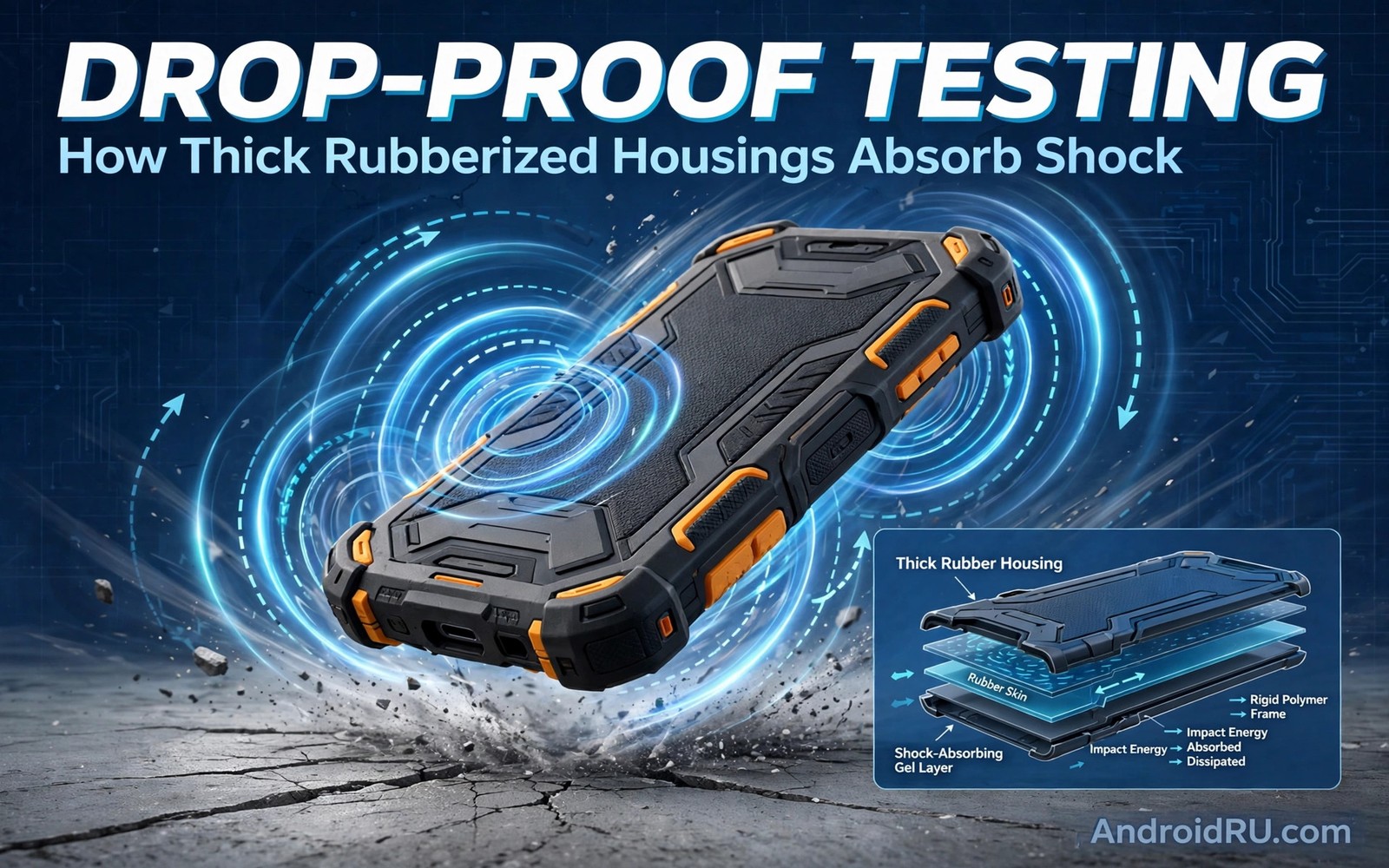
Drop-Proof Testing: How Thick Rubberized Housings Absorb Shock
A rugged phone does not survive a fall because it is tough in some vague, general way. It survives because its housing buys time.
That is the whole idea behind a thick rubberized housing, and why two phones that look equally rugged can behave very differently on concrete. Thickness matters, but so does the material, the shape of the corners, the lip around the screen, and the way the parts inside are mounted.
You do not need a lab to judge a housing well. Press a corner with your thumb, run a finger around the screen lip, flex the body gently and listen.
Impact Physics: Energy, Stopping Time and Peak Force
Think of a drop as an energy problem. A phone falling from chest height — roughly 1.2 to 1.5 metres — gains speed as it falls and arrives at the ground carrying kinetic energy that has to go somewhere.
The relationship is simple even if the numbers are not. Double the stopping time and you roughly halve the peak force, all else being equal.
Why Stopping Time Matters More Than Hardness
A very hard housing feels solid in the hand, but hardness alone does not protect a phone. A hard shell stops the phone quickly and passes the shock through, almost like dropping the bare phone.
That balance is why thickness is not a vanity number. A 1 mm rubber skin can absorb a small knock and look fine doing it, but it has almost no travel to offer on a corner drop from chest height.
How Much Energy a Chest-Height Drop Really Carries
A typical phone weighs 200 to 250 grams. Dropped from 1.5 metres, it reaches the ground at roughly 5 metres per second and carries a few joules of kinetic energy — a small number on paper, and a destructive one when it is delivered to a single point in under a millisecond.
Surface matters just as much as height. Concrete and tile barely give at all, so the housing must do all the work.
Peak Force, Contact Area and Why Corners Are the Worst Case
Force spread over a wide area is survivable. The same force concentrated on a tiny point is not.
TPU, Silicone and Polycarbonate: What Each Material Actually Does
Most rubberized housings are not one material. They are a system: a soft outer layer that grips and starts the compression, a tougher inner layer that stops the compression before the frame hits the ground, and a rigid skeleton — usually polycarbonate — that holds the shape and spreads the remaining load.
Thermoplastic polyurethane, or TPU, is the workhorse. It is elastic, it springs back after compression, it resists abrasion, and it can be moulded into complex corner shapes with ribs and air pockets.
Silicone is softer and grippier than TPU, and it damps vibration well, but it tears more easily on rough stone and it attracts dust. It works well as a thin grip layer or a seal, and less well as the main structural bumper on a phone that will be dragged across concrete.
Two-Layer Design: Soft Outside, Hard Inside
The best housings pair a soft TPU outer skin with a harder inner frame. The outer layer takes the first impact, starts compressing, and grips the surface so the phone does not slide and hit a second edge.
Shore Hardness and What the Number Means for a Buyer
Why Some Rubber Feels Sticky and Some Feels Dry
Surface finish changes grip and ageing more than most buyers realise. A slightly textured, matte TPU grips wet gloves and dusty hands far better than a smooth, shiny one, and it hides scuffs instead of showing every mark.
Corner Bumpers: Where Most Drops Are Won or Lost
A phone that falls from a pocket usually lands on a corner first. A phone knocked off a table usually lands on an edge.
Check corner thickness with your fingers before you buy. A corner that sticks out by 2 mm or more beyond the glass gives real protection, because the bumper hits first and the glass never touches the ground on a flat surface.
Raised Screen Lips, Frames and Edge Protection
A raised lip around the screen is the simplest protection in the whole housing, and one of the most effective. When a phone lands face down on a flat floor, the lip touches first and the glass never contacts the surface.
The lip does not help on rough stone, where a sharp point can reach past it, and it does not help if the lip is uneven. Run your finger around the lip all the way around the display.
Inside the Housing: Mounts, Battery Pads and Camera Protection
Outer rubber is only half the story. The parts inside the phone need protection too, and they get it from mounts, not from the housing wall.
Camera modules need special care. Lens elements can shift after a hard drop, and optical stabilisation mechanisms are delicate by design.
How Internal Mounts Turn One Hard Hit Into Two Soft Ones
Think of the housing and the internal mount as two springs in series. The housing spring takes the first part of the impact and the mount spring takes what is left, so the board inside experiences a lower peak than either spring could deliver alone.
Connectors, Solder Joints and the Failures You Cannot See
The most common hidden drop damage is not a cracked screen. It is a cracked solder joint or a loosened connector, and it shows up days later as a camera that sometimes fails, a speaker that crackles, or a phone that reboots when you set it down firmly.
MIL-STD-810H Lab Testing Explained for Buyers
When a phone claims military-grade toughness, the claim usually points to MIL-STD-810H, the US military test standard for environmental durability. The drop part of that standard is Method 516.8, which describes shock testing: dropping the device onto a hard surface from a defined height, in defined orientations, a defined number of times, and then checking that it still works.
The key detail is the test condition, not the badge. A phone tested with 26 drops from 1.2 metres onto plywood over concrete has proved something real. For a plain-language walkthrough of the standard and the way makers use it, read our guide to military durability standards explained for buyers before you compare two rugged models.
What Method 516.8 Actually Tests
Method 516.8 covers shock from drops, bumps, and transit handling. In a typical phone test the device is dropped onto each face, edge, and corner from a set height — often 1.2 metres, sometimes 1.5 or 1.8 for tougher models — and then inspected and powered on after each set.
Other parts of 810H cover dust, water, humidity, temperature, and vibration, and a phone can pass the drop test while failing another part. A drop rating on its own does not mean the phone is waterproof, and a waterproof rating on its own does not mean it survives drops.
What Lab Results Cannot Tell You
Lab tests drop phones onto defined surfaces from defined heights, and they repeat the same drop many times. That gives comparable numbers across models, which is genuinely useful.
A phone with a strong lab result and strong owner reports is a safe bet. A phone with a strong lab result but weak owner reports may have a design flaw the lab misses — a lip that dips at one corner, a camera mount that loosens, a bumper that tears at a seam.
Lab Results Versus Real Drops on Site
Site drops are messier than lab drops in every way that matters. The surface is unknown, the height is unknown, the orientation is random, and the phone often hits twice — once on an edge, once on a face — before it stops.
| Drop situation | Lab test covers it | What usually decides the outcome |
|---|---|---|
| Flat face drop onto concrete, 1.2 m | Yes, directly | Screen lip height and back thickness |
| Corner drop onto concrete, 1.5 m | Yes, if corners are tested | Corner bumper thickness and ribs |
| Edge hit on a step, then bounce to gravel | Partly | Wrap-around bumper and internal mounts |
| Drop from a ladder onto sharp stone | Rarely | Peak force at one point; no housing is safe |
| Repeated small drops over a year | Only in multi-drop tests | Rubber ageing and seam strength |
| Drop while wet or with gloves | Almost never | Grip texture and screen usability |
Wet and gloved handling deserves a note of its own. A drop you avoid is better than a drop you survive, and grip is the first line of defence. Our guide to screens that work with gloves and rain explains which screen types handle that use case and what to check before you buy.
Rubber Ageing, Grip and Maintenance
Rubber ages with sun, heat, and chemicals. It hardens, it cracks, and it loses the elasticity that made it protective in the first place.
Keep the phone out of prolonged direct sun when you can, and do not leave it on a hot dashboard. Clean rubber with mild soap and water, and avoid solvents, strong cleaners, and insect repellent, all of which dry rubber faster.
When Grip Wears Down, Drops Go Up
Grip is a safety feature in itself, and it fades before protection does. A textured surface wears smooth, a soft compound hardens, and a phone that once sat securely in a gloved hand starts to slip.
Crew phones add one more factor: speed of use. A phone that needs two hands and full attention to answer is a phone that gets dropped while the user is juggling tools. That is part of why outdoor phones often carry dedicated hardware keys — our guide to push to talk buttons for fast crew calls covers the button designs that let a crew answer and talk without looking at the screen, which keeps the phone in the hand rather than on the ground.
Built-In Rugged Housing Versus a Heavy Case
A heavy case on a normal phone can mimic a rugged housing. It adds rubber, corner bumpers, and a screen lip, and for moderate risks it is often enough.
Weight is the surprise in this comparison. A heavy case plus a normal phone often ends up weighing about the same as a rugged phone, and sometimes more, because you are carrying two housings instead of one. Our rugged phone versus heavy case weight comparison walks through the totals model by model, and the numbers are closer than most buyers expect.
| Factor | Built-in rugged housing | Normal phone plus heavy case |
|---|---|---|
| Corner protection | Thick bumpers, tuned to the frame | Good, if the case fits tightly |
| Screen lip | Designed with the display | Depends on case lip height |
| Internal mounts | Rubber-mounted board and battery | Not changed by the case |
| Port sealing | Sealed by design | Open unless the case covers ports |
| Replacement cost | Service repair, slower | New case in minutes |
| Weight and thickness | One housing, often similar total | Two housings, often similar total |
Choose the Case Route When Your Risks Are Moderate
Choose a heavy case when your phone is already good, your drops are mostly from pocket and table height, and you value the freedom to remove the bulk at the weekend. Pick a case with thick corners, a lip that stands proud of the screen, and a tight fit that does not trap grit between the case and the phone — trapped grit scratches the back and hides a loose fit that lets the phone move inside the case during a drop.
Choose a Built-In Rugged Phone When Drops Are Daily
Choose a built-in rugged phone when drops, dust, and water are daily facts of work rather than occasional accidents. The sealed ports, the internal mounts, and the tuned bumpers pay off over a year of site use in a way a case cannot match, and the total weight is often no worse.
Avoid a Hard Decorative Shell Over a Rugged Housing
A hard shell fitted over a rugged housing can make protection worse, not better. It can transmit shock straight through the soft bumpers, cover the screen lip, and trap heat.
Frequently Asked Questions About Drop-Proof Housings
Does thick rubber make a phone fully drop-proof?
No housing makes a phone fully drop-proof. Thick rubber greatly reduces damage from common drops by extending stopping time and spreading force, but an extreme drop onto sharp stone, a fall from several metres, or a direct hit on a protruding point can still break glass or boards.
Are corner bumpers more important than back thickness?
Yes, for most drops. Corners focus force onto a tiny area, so thick corner bumpers address the worst case directly.
How often should I inspect a rubber housing?
Inspect it monthly when you work outdoors or on site, and every few months for normal use. Look for tears, hard spots, flattening, and loose edges, and run the thumb test on each corner: a good bumper compresses slightly and springs back, while a hardened one feels flat and unyielding.
Can I test a housing at home without breaking my phone?
Yes, and you should. Press each corner with your thumb, check the seam between housing layers with a fingernail, run a finger around the screen lip, and flex the phone gently to listen for creaks.
The physics is simple, and the buying check is simpler still. Rubber extends stopping time and spreads force away from glass and boards, and corners, screen lips, and internal mounts decide how well that physics protects your phone in real use.
Your concrete next step takes five minutes in a shop. Hold a shortlisted phone, press each corner with your thumb, check the screen lip height all the way around, and ask the seller for the drop test conditions: height, surface, orientations, and number of drops.

