

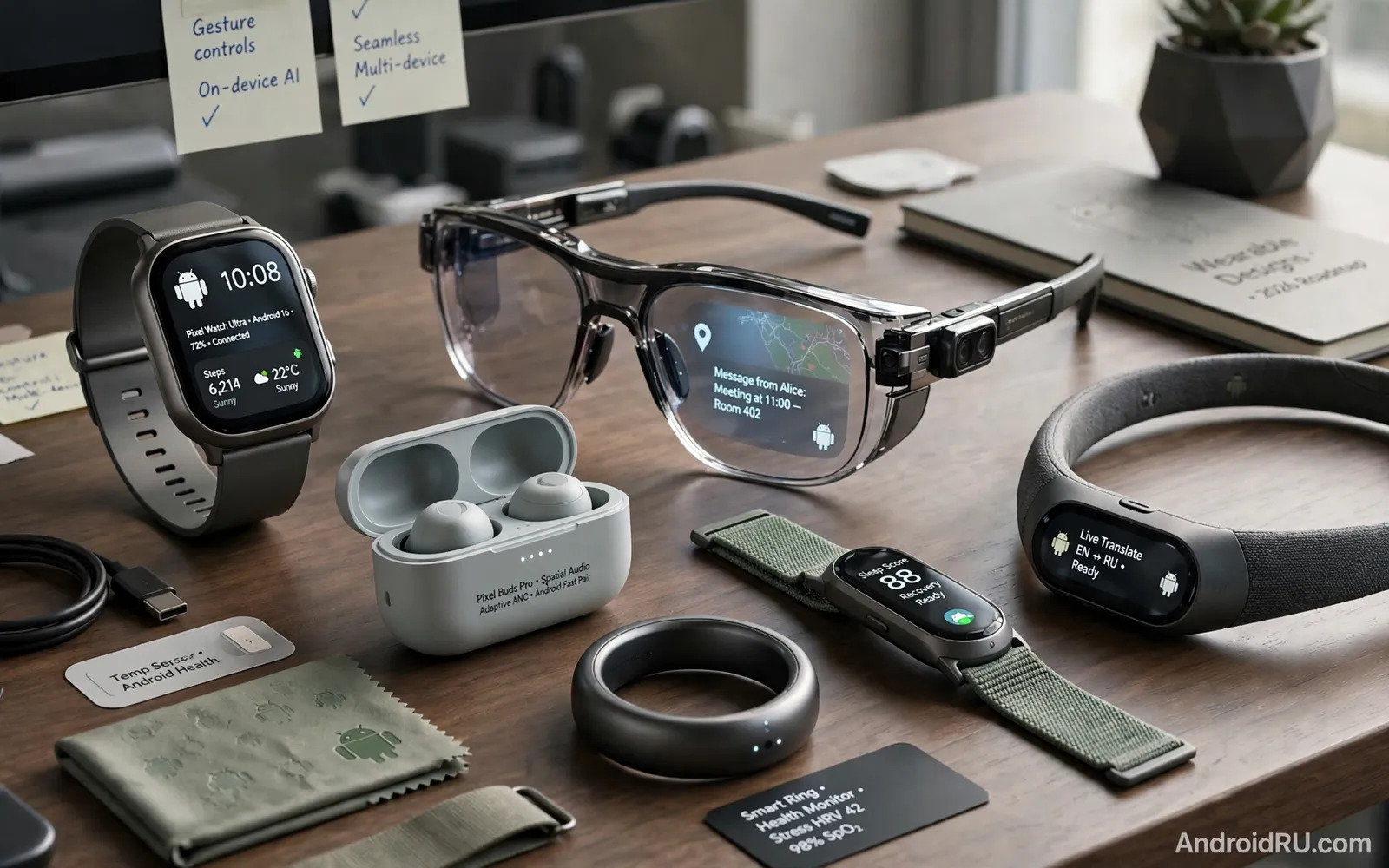
Wearables Beyond The Watch
Smartwatches introduced millions of people to wearable technology but future accessories may spread sensing and interaction across several small devices. Rings can track sleep and activity discreetly. Glasses can display directions and notifications in the field of view. Earbuds can add health sensing and translation. Patches and bands can monitor specific health signals continuously. An Android phone may coordinate these devices into one personal system where each accessory handles the task it does best. The watch remains a hub for many users while specialised accessories cover niches that a wrist device handles poorly.
The promise lies in continuity. A ring tracks sleep without a bulky watch disturbing rest. Glasses show navigation without forcing a glance at a phone in traffic. Earbuds translate a conversation without a separate device. Each accessory adds a small capability and the phone unifies the data into health trends and notifications and controls. Readers tracking how Android itself may evolve can explore the future of Android predictions for the next five years for the platform context behind wearable ideas. Hardware imagination must meet software coordination to succeed.
Rings Bands And Health Sensing Frontiers
Smart rings appeal because they disappear on the finger while tracking sleep and activity and recovery signals. Their small size limits battery life and display options but it suits continuous wear better than a watch for many sleepers. Smart bands offer a middle path with a small screen and longer battery life and lower cost. Future bands may add more sensors without growing into full watches. Accuracy remains a challenge because small sensors on moving fingers and wrists face motion artefacts. Software filtering and multi-sensor fusion help but no wearable replaces clinical measurement for diagnosis.
Health features raise expectations that makers must manage carefully. Sleep staging and stress scores and recovery estimates are models based on sensor patterns rather than direct medical measurements. They can reveal useful trends across weeks while misleading on a single night. Users should treat wearable health data as a guide for habits and conversations with clinicians rather than as a diagnosis. Readers comparing current wearables can review smartwatches compatible with Android phones to see how present devices already balance sensing and battery and comfort.
Glasses Earbuds And Ambient Interaction
Smart glasses promise hands-free information in the field of view for navigation and translation and notifications. The challenge lies in battery life and weight and display brightness and social acceptance. A heavy pair of glasses with a short battery frustrates daily use no matter how impressive a demonstration looks. A light pair with a dim display frustrates outdoor use. Future designs must balance those trade-offs while respecting privacy because cameras on glasses raise concerns for bystanders. Clear recording indicators and social norms will shape acceptance as much as technology does.
Earbuds may evolve into health and translation hubs that sit discreetly in the ear. Heart sensing through the ear canal and temperature sensing and live translation could turn earbuds into multi-purpose wearables. Battery life and comfort limit how much sensing earbuds can sustain. A pair worn all day must remain light and comfortable and must charge easily. Readers following connectivity frontiers can explore the impact of satellite connectivity on future Android phones for how phones may stay connected when wearables roam far from networks. Ambient interaction works only when devices fade into daily life rather than demanding constant attention.
- Smart rings for discreet sleep and activity tracking
- Smart bands as a light middle path with longer battery
- Glasses for hands-free navigation and notifications
- Earbuds as health sensing and translation hubs
- Phone as coordinator unifying wearable data and controls
Ecosystem Integration And Open Standards
An Android ecosystem advantage could come from openness because many makers can build accessories that work with many phones. Open standards for health data and notifications and device pairing would let users mix a ring from one maker with a watch from another and glasses from a third. Closed ecosystems lock users into one brand family and simplify setup at the cost of choice. Android users value choice historically and future wearable success may depend on how well accessories interoperate rather than on any single device alone. Data portability matters because health history loses value when it cannot move with the user.
Battery and charging fragmentation threatens that vision because every accessory with its own charger adds clutter. Shared charging standards and longer battery life would help wearables disappear into routines. Software updates matter too because a wearable abandoned by its maker becomes electronic waste even when hardware still functions. Buyers should consider maker track records for updates before investing in a new accessory category. A vibrant ecosystem needs longevity as much as novelty.
Privacy Security And Social Questions
Wearables collect intimate data about location and health and conversations and daily routines. Future accessories will collect even more as sensors improve. Strong on-device processing can reduce data exposure by analysing signals locally and sharing only summaries. Clear controls should let users decide what leaves the device and what stays private. Biometric locks and account protections become more important as wearables store health history. Users should review permissions for every wearable app with the same care they apply to phone apps.
Social acceptance shapes wearable futures in quiet ways. A device that records surroundings without clear signals may face resistance in workplaces and schools and private spaces. A device that constantly interrupts with notifications may annoy wearers and companions alike. Successful wearables will respect attention and privacy by delivering information at the right moment and staying silent otherwise. Technology that demands constant attention fails as a wearable even when it succeeds as a gadget.
A Practical Way To Follow Wearable Futures
Follow future wearables with curiosity and patience rather than early adoption of every concept. Wait for real battery life reports and comfort reports and update histories before buying a new category. Buy accessories that solve a current problem well rather than accessories that promise a future feature vaguely. A ring that tracks sleep reliably today beats a concept device that promises everything tomorrow. Keep data portable where possible and keep expectations grounded in physics because batteries and sensors improve gradually rather than magically.
The Android wearable future likely looks less like a single revolutionary device and more like a quiet collection of specialised accessories coordinated by a phone. Rings for sleep and glasses for navigation and earbuds for sound and translation and watches for daily interaction may each find a place. Users who choose interoperable and well supported accessories will benefit most as that collection matures into a genuinely helpful personal system.
- Wait for real battery and comfort reports before early adoption
- Prefer interoperable accessories over single-brand lock-in
- Keep health data portable and permissions reviewed
- Buy for a current problem not a vague future promise
Wearable Futures And The Role Of The Phone
The phone may remain the centre of wearable futures even as accessories multiply because the phone holds accounts and connectivity and processing power that small wearables cannot match. A ring or glasses or earbuds can sense and display but the phone can coordinate and store and analyse. That division suggests a future where phones become less visible as interaction moves to wearables while phones remain essential behind the scenes. Users may glance at a phone less often while relying on it more deeply as a hub. Designers should preserve that hub role without forcing constant phone attention.
Artificial intelligence on devices may change wearable interaction by summarising notifications and health trends locally. A watch that summarises a day rather than buzzing for every event respects attention far better. Glasses that show only the next turn rather than a full map reduce distraction. Earbuds that translate only when asked preserve conversation flow. Intelligence should filter rather than amplify because wearables sit close to the body and the senses. A calm wearable future depends on software restraint as much as on sensor advances.
Sustainability will shape wearable futures because small devices with sealed batteries create waste when they fail. Repairable designs and replaceable batteries and long software support would reduce that waste dramatically. Makers that design for longevity will earn trust as wearables multiply in number. Users can support sustainability by choosing well supported accessories and by using devices for their full useful life rather than upgrading annually for marginal gains. A wearable future with dozens of disposable devices per person would be an environmental failure no matter how clever the sensors become.
- Keep the phone as coordinator while wearables handle sensing
- Prefer wearables that summarise rather than buzz constantly
- Demand repairable designs and long software support
- Use wearables for full useful life instead of annual upgrades
- Choose calm filtering interaction over constant interruption
Wearable Battery Life And Charging Realities
Battery life remains the hardest wearable constraint because small devices cannot hold large batteries. Rings last days while watches last days to weeks depending on features and glasses last hours in current designs. Future improvements will come gradually through efficient chips and better batteries rather than through sudden breakthroughs. Users should judge wearables by real battery reports from daily use rather than by laboratory figures that assume minimal features. A wearable that dies midday fails no matter how clever its sensors may be.
Charging habits shape wearable satisfaction because every additional charger adds friction. A ring that charges on a small case and a watch that charges on a puck and glasses that charge on a cable create a nightly ritual of many plugs. Shared charging standards would reduce that friction dramatically. Until standards improve users should keep chargers in one place and charge wearables during existing routines such as morning preparation. A charging routine that fits daily life keeps wearables ready while a scattered charging setup leaves devices dead when needed most.
- Judge wearables by real daily battery reports not lab figures
- Expect gradual battery gains from efficient chips not breakthroughs
- Keep all wearable chargers in one routine location
- Charge wearables during existing morning routines

