

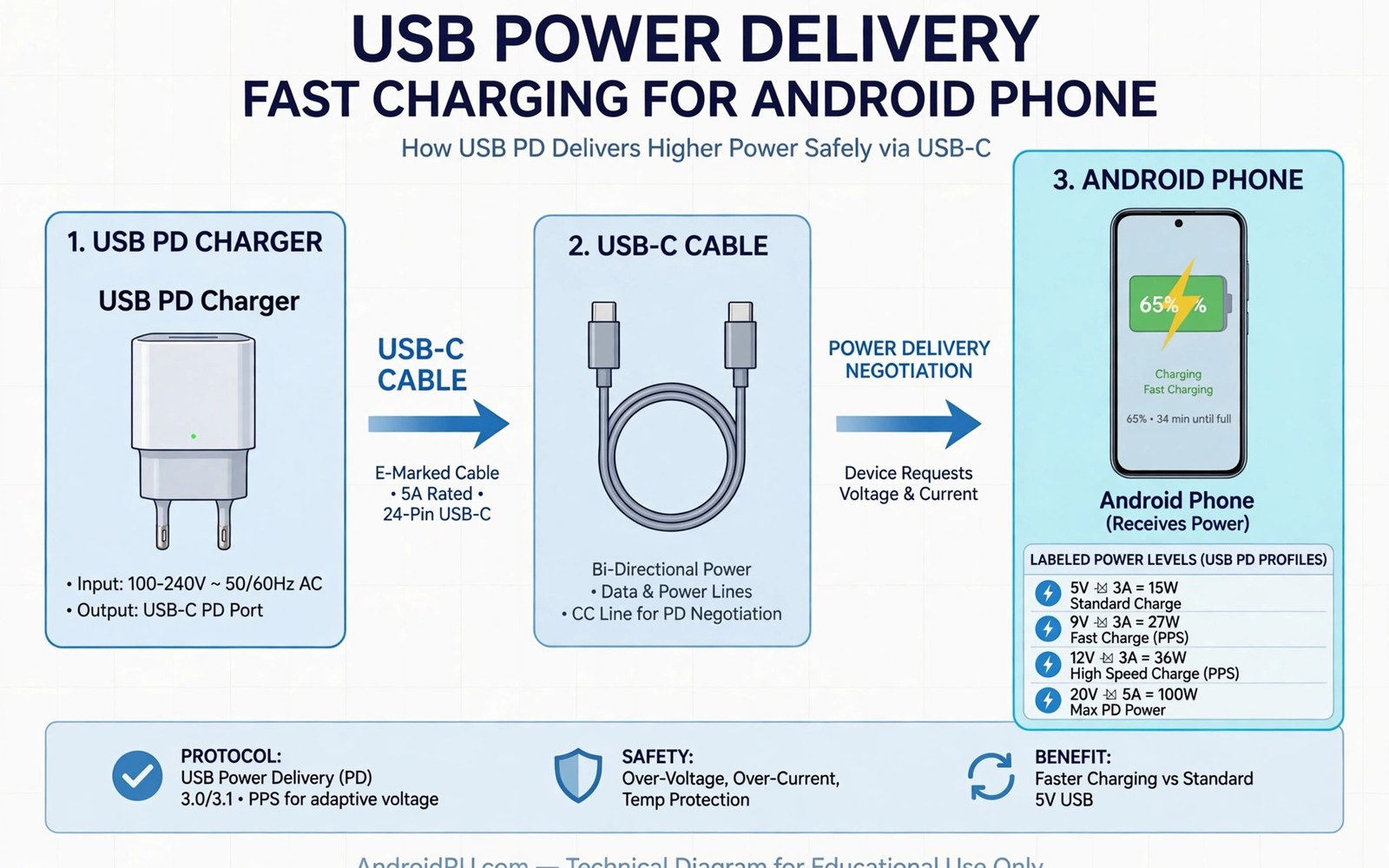
Fast charging looks simple on a box. The label promises a big watt number and a short charging time. The reality is more mixed because phones and chargers must agree on a shared language first. That language decides the voltage and the current that flow into the battery. When the two sides speak different languages the charger falls back to a slow safe mode. That fallback explains why the same charger can feel fast on one phone and slow on another.
USB Power Delivery is the open standard that most modern Android phones support. It lets a charger and a phone negotiate a safe power level step by step. The phone asks for what it can accept and the charger supplies only that level. This negotiation protects the battery and it keeps heat under control during a charge. It also means that one good charger can serve many devices in a home. That flexibility is the main reason the standard has spread so widely.
Proprietary standards take a different path. A phone maker designs a charging method for its own phones and its own chargers. The result can be very fast because every part of the chain is tuned together. The cost is lock-in because the top speed often needs the matching charger and cable. A generic charger may still work but it will charge at a lower rate. Buyers should weigh that trade-off before they pay extra for a headline watt number.
How USB Power Delivery Negotiates Power
USB Power Delivery starts every session with a short handshake. The charger lists the voltage and current levels it can supply. The phone picks the highest level that its battery system can handle safely. This choice can change during the session as the battery fills up. Early in a charge the phone can accept more power because the battery is empty. Later the system lowers power to protect the cells near full charge.
This staged approach is why a charging curve matters more than a peak number. A charger that holds a strong rate for a long time can beat a charger with a brief peak. Heat also shapes the curve because a hot phone will slow charging to stay safe. A cool room and a case-free phone can therefore change the result. Users who test chargers should compare full charging times rather than the first ten minutes alone.
- Check the charger output list on its label
- Match the phone input rating before buying
- Use a USB-C cable rated for the power level
Why Phone Makers Built Their Own Standards
Phone makers wanted faster charging before open standards could deliver it. They tuned chargers and batteries as one system to push power higher. Some designs split the battery into two cells so each cell charges at a lower stress level. Other designs raised current while keeping voltage modest to limit heat. These tricks produced real gains in charging time for their own phones. They also created a market where the best speed needed the full branded set.
That approach has a clear downside for households with mixed devices. A drawer full of brand-specific chargers helps nobody when guests visit. A universal charger is easier to share and easier to replace on a trip. Makers have started to close this gap by adding open standard support alongside their own methods. Many new phones now accept USB Power Delivery as a solid fallback. The top branded speed may still need the branded charger but everyday charging is less locked in than before.
Speed In Daily Use
Daily charging is rarely a race from zero to full. Most people top up during a commute or while they work at a desk. A charger that adds a useful amount in twenty minutes can matter more than a full charge record. Wireless pads and car chargers often serve this top-up role. A standard charger that works everywhere can be more useful than a faster charger left at home. Think about where you actually charge before you chase the highest number.
Cables shape daily speed just as much as chargers do. A thin or damaged cable can limit current and trigger a slow mode. A certified cable with the right rating keeps the negotiated power stable. Length also matters because very long cables lose more energy as heat. A short quality cable is the safer choice for a desk or a bedside table. Keep a spare cable in a bag so a failing cable never forces a slow day.
Compatibility And Travel
Travel rewards the universal approach. One USB Power Delivery charger can charge a phone and a tablet and a pair of earbuds. That single brick saves space and it reduces the number of cables in a bag. A proprietary charger may still be needed for the fastest top speed on one phone. Pack it only when that speed matters for the trip. For most trips the universal charger plus a good cable is enough.
Airports and hotels add another reason to carry a standard charger. Shared outlets and public chargers rarely match a proprietary system. A universal charger works with the outlets that travellers actually find. It also charges a borrowed device without a hunt for a special brick. Keep the charger in hand luggage so it stays available during delays. A small multi-port model can serve two devices from one outlet at once.
Battery Care And Heat
High power always creates heat and heat ages batteries over time. Good charging systems watch temperature and lower power when the phone gets warm. Charging overnight at a slow rate can be gentler than a daily fast top-up. Some phones offer a battery care mode that limits the charge to a lower level. That mode suits people who charge overnight and do not need a full battery at dawn. It trades a little range for a longer battery life.
Users can help by keeping the phone cool while it charges. Remove a thick case during a fast charge if the phone feels warm. Avoid charging on a bed or under a pillow where heat builds up. Direct sunlight on a dashboard can push a phone into thermal limits fast. A shaded spot and good airflow keep the charging curve strong. Small habits like these protect the battery more than any single charger choice.
Choosing The Right Charger
Start with the phone manual or the settings screen to find the supported standards. Note the highest open standard rate and the proprietary rate separately. Buy a charger that covers the open rate well even if it cannot reach the branded peak. Check that the charger has safety marks and a clear output list. A cheap charger with a vague label is a risk to the phone and to the battery.
Test the new charger with a full charge from a low level. Note the time to half full and the time to full separately. Compare those times with the old charger under similar conditions. A good upgrade should improve at least one of those times clearly. Keep the receipt until the test is done so a weak charger can go back. The best charger is the one that stays fast and cool across many phones.
USB Power Delivery Power Rules And PPS
Programmable power supply is an extension of USB Power Delivery. It lets a phone request voltage in very fine steps. That fine control keeps power close to the battery ideal at each moment. Heat falls because power does not jump in large blocks. Phones with this support charge more smoothly than phones without it. A charger that supports this extension suits modern phones best.
Check charger specifications for programmable supply support before buying. A charger may support basic power delivery without the programmable extension. That charger still works but it charges less smoothly. The phone falls back to fixed voltage steps in that case. Charging still completes safely but thermal peaks may be higher. A charger with the extension gives the phone more control.
Voltage steps also affect cable choice. A cable must carry the negotiated voltage and current safely. A cable rated for basic power may fail at higher programmable levels. Read cable ratings for both voltage and current before use. A cable with a clear high rating protects the whole session. Cheap unrated cables undermine even the best charger design.
Travel kits benefit most from programmable support. One charger can serve phones with different ideal voltages. Each phone requests its own fine-tuned level from the same brick. That flexibility reduces the number of chargers in a bag. It also future-proofs the kit for the next phone purchase. A single versatile charger beats several single-purpose bricks.
Real World Charger Testing At Home
Home testing reveals charger quality better than box claims. Start with a phone at a low battery level for a fair test. Charge for thirty minutes with the screen off and the phone idle. Note the battery gain and any heat on the charger case. Repeat the test with a second charger under similar conditions. A clear gain difference points to the better charger.
Test across a full charge for a complete picture. Note the time to half full and the time to full separately. A charger may start fast and throttle early as heat builds. That early throttle shows up only in a full charge test. A steady charger may finish sooner despite a lower peak. Full charge times matter more than first minute readings.
Test with different cables too because cables shape results. A charger tested with a weak cable looks worse than it is. Use the same quality cable for every charger comparison. That control isolates charger quality from cable quality. Keep room temperature similar across tests as well. Heat differences can skew results between test days.
Keep simple notes on each charger tested. Note peak feel and full time and heat level. Those notes guide future purchases without repeat testing. A charger that stays cool and steady earns a place in the travel kit. A charger that runs hot or throttles early should stay home. Home testing turns marketing claims into personal evidence.
Check the charger label for USB-PD output
Match the phone input rating first
Use a certified USB-C cable
Test the charge rate after ten minutes
Replace any cable that feels hot
Readers who want more context on portable power can read How GaN (Gallium Nitride) Chargers Offer High Power in Compact Sizes for a related view on the same topic.
Readers who want more context on portable power can read Wireless Charging Efficiency: Heat Loss, Speed, and Alignment Tips for a related view on the same topic.
Readers who want more context on portable power can read Reverse Wireless Charging: How to Power Earbuds from Your Phone for a related view on the same topic.
The steps above follow the approach described in the official developer documentation and standard industry guidance for safe charging practice.
USB Power Delivery wins on flexibility and on sharing across devices. Proprietary charging wins on peak speed for one phone family. Most buyers will be happy with a strong universal charger and a quality cable. Add a branded charger only when its top speed matters every day. That balanced setup keeps costs down and keeps every device charged.
Check your phone support list before you buy anything new. A few minutes of research can prevent a disappointing charger purchase. The right choice is rarely the biggest number on the shelf. It is the charger that matches your phone and your daily routine. Buy for that match and charging stays simple.
USB Power Delivery rewards buyers who check standards rather than watt numbers alone. A charger with programmable support and a rated cable serves many phones well. Home testing confirms those benefits before a trip exposes weaknesses. That preparation prevents slow charging surprises on the road. The best charger is the one proven in your own tests.
Proprietary speed still has a place for one phone family used daily. A branded charger can top up that phone fastest at home. A universal charger covers every other device in the house. Owning both covers speed and flexibility without excess cost. Choose based on daily routine rather than advertising. That routine-based choice stays satisfying long after purchase.

