

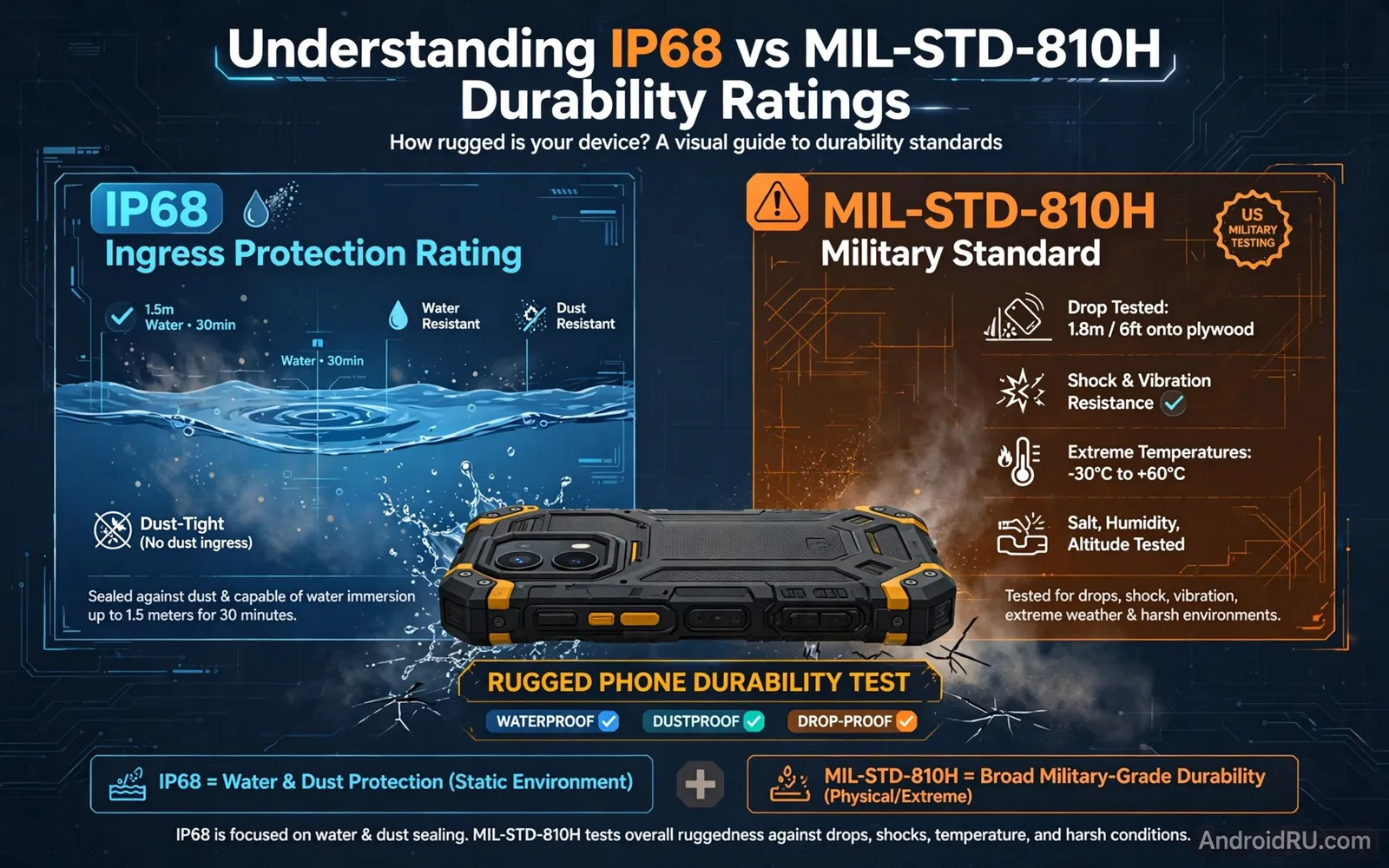
Two Ratings That Answer Different Questions
IP68 and MIL-STD-810H appear together on rugged phone marketing so buyers naturally assume that they measure the same toughness. They do not. IP68 describes ingress protection against dust and water under specific laboratory conditions. MIL-STD-810H describes a broad military test method covering many environmental stresses including drops and vibration and temperature and humidity and altitude. A phone can pass one set of tests without passing the other. Understanding the distinction prevents the costly mistake of assuming that a water resistant phone is also drop proof or that a drop tested phone is also safe underwater.
IP codes use two digits after the letters IP. The first digit rates solids protection and the second digit rates liquids protection. Higher digits generally mean stronger protection but the digits describe specific test conditions rather than unlimited real world immunity. MIL-STD-810H is a method standard rather than a single pass or fail grade. Manufacturers select which test methods apply and which severities they test. That selection matters enormously because two phones can both claim MIL-STD-810H compliance while testing very different stresses. Readers wanting the wider IP background can explore smartphone IP ratings explaining waterproof versus water resistant before comparing the two systems in detail.
IP68 In Plain Language
The digit six in IP68 means dust tight protection under test conditions so dust should not enter the device in harmful quantities. The digit eight means protection against continuous immersion under conditions specified by the manufacturer. Those manufacturer conditions include depth and duration and water type. Fresh still water in a laboratory differs from salt water at a beach and from soapy water in a bath and from a chlorinated pool. A rating earned in fresh water does not promise safety in every liquid. Age also matters because seals wear and a phone that passed a lab test when new may resist less well after years of use and drops and repairs.
Water resistance should be treated as protection against accidents rather than permission for deliberate underwater use. A phone that survives a rain shower or a brief drop in a puddle has done its job. A phone used repeatedly as an underwater camera faces cumulative seal stress and pressure changes that lab tests may not replicate. Warranty terms often exclude water damage even on IP68 phones because manufacturers cannot verify the conditions of an incident. Buyers should read warranty language carefully and should not rely on a rating as a guarantee of free repair after water exposure.
MIL-STD-810H In Plain Language
MIL-STD-810H originated as a United States military test method for equipment durability. It contains many test methods for shock and vibration and thermal shock and humidity and sand and dust and altitude and other stresses. A phone maker may test a subset relevant to its design and may test at severities below the maximum described in the standard. Marketing that simply says MIL-STD-810H tested therefore tells only part of the story. The useful detail lies in which methods were tested and at what levels and by whom. Independent laboratory testing carries more weight than an internal claim without published detail.
Drop testing illustrates the variability clearly. One maker may test drops onto plywood from a modest height while another tests drops onto concrete from a greater height. Both may describe their product with the same standard name while offering very different real protection. Vibration testing varies similarly by frequency and duration. Temperature testing varies by range and cycle count. Buyers should ask for the specific test methods and severities when a rugged claim influences a purchase. When that detail is unavailable treat the claim as a general durability hint rather than as a precise promise.
- IP first digit rates dust protection under lab conditions
- IP second digit rates water protection at stated depth and time
- MIL-STD-810H covers many stresses not only drops
- Manufacturers choose which MIL methods and severities to test
- Warranty may exclude water damage even on rated phones
Comparing The Two Side By Side
IP68 answers a narrow question about dust and water entry under stated conditions. MIL-STD-810H answers a broad question about survival across environmental stresses chosen by the maker. Neither rating alone describes a fully rugged phone. A phone with IP68 but no drop testing may break on first impact with rock. A phone with drop testing but no IP rating may survive falls yet fail in rain. The strongest rugged phones combine meaningful IP protection with documented drop and vibration testing and a protective design that supports both. Look for both kinds of evidence rather than celebrating one rating in isolation.
Real world use adds stresses that lab tests simplify. A phone in a pocket during a hike faces repeated small impacts and dust and sweat and temperature swings together. A phone on a construction site faces vibration and dust and drops in combination. Lab tests usually isolate one stress at a time. That isolation helps comparison but it cannot replicate every combined real world assault. A rugged case and a screen protector add a practical layer that lab ratings alone cannot provide. Readers choosing heavy protection can explore heavy-duty protective cases for extreme drop protection for case options that complement rated hardware.
What Buyers Should Check Before Trusting A Claim
Check the exact IP code rather than a vague waterproof label. Check the stated immersion depth and duration for IP68 because manufacturer conditions define the claim. Check which MIL-STD-810H methods were tested and whether testing was independent. Check warranty terms for water and drop damage because warranty language reveals how much confidence the maker places in its own rating. Check repair history and seal condition on used rugged phones because a previous repair can compromise water resistance even when the model originally carried a strong rating.
Consider your dominant risk before choosing between ratings. A beach and boating user should prioritise genuine water and dust protection and a sealed design. A construction or trail user should prioritise drop and vibration evidence and a grippy protective case. A user facing both risks needs both kinds of evidence and should accept a heavier device as the price of broader protection. Readers exploring rugged hardware broadly can review rugged smartphones and the best heavy-duty Android phones to see how ratings combine in real models. Match the rating evidence to the risk you actually face.
Care That Preserves Rated Protection
Rated protection degrades without care. Inspect seals and port covers regularly for grit and damage. Rinse a phone exposed to salt water with fresh water only when the maker advises that practice and dry it fully before charging. Avoid charging a wet phone because moisture in a port can cause corrosion and short circuits. Replace a cracked screen promptly because a crack breaks the sealed design that ratings depend on. Use a case that does not trap grit against the phone because trapped grit can scratch seals and screens during movement.
After a significant drop inspect the phone even when it still works because internal seal damage may not show immediately. Test buttons and ports and speakers after an impact. If water resistance matters for future use then professional inspection after a hard drop is wise. A rating describes a new device under test conditions. Care and inspection keep that protection meaningful through years of real use rather than letting it fade silently after the first accident.
A Clear Verdict For Shoppers
IP68 tells you about dust and water entry under stated lab conditions. MIL-STD-810H tells you about a chosen set of environmental stresses tested at chosen severities. Together with warranty terms and independent test detail they form a useful picture. Alone either rating can mislead. The wise buyer reads the specific conditions behind each claim and matches them to real risks and adds a good case and sensible care habits. That approach turns confusing marketing into a practical durability decision.
Choose protection for the accidents you actually expect. Water users need IP evidence. Drop users need drop evidence. Outdoor workers need both. A phone that matches its ratings to your life will survive the days that break lesser devices while a phone chosen on a single impressive label may disappoint at the worst possible moment.
- Read exact IP depth and duration conditions not only the code
- Ask which MIL methods and severities were actually tested
- Check warranty exclusions for water and drop damage
- Add a case and inspect seals after drops and water exposure
Rugged Phone Ownership Costs And Long-Term Value
Rugged phone ownership costs extend beyond the purchase price because accessories and repairs and replacements shape total value over years. A rugged phone with a good case and a screen protector may cost more initially yet cost less over time than a fragile phone replaced after one bad drop. Screen repairs and water damage repairs quickly exceed accessory costs. Buyers should compare total ownership cost across an expected lifespan rather than comparing sticker prices alone. A phone that survives three years of hard use delivers better value than a cheaper phone replaced twice in the same period.
Software support affects rugged value as well because a durable phone with short update support becomes insecure before its hardware fails. Check update promises before buying a rugged model because a phone that lasts physically but loses security updates forces an early replacement anyway. Battery replacement availability matters similarly because a sealed rugged phone with no battery service loses usefulness when the battery ages. Durable hardware deserves durable software and service support to realise its full lifespan. Buyers should weigh all three together.
Trade-in and resale values reflect rugged reputation because buyers trust a model known for surviving hard use. Keep the phone in a case from day one and keep the original packaging and accessories when resale matters. Document any repairs because a transparent repair history builds buyer confidence. A well maintained rugged phone with a documented history sells faster and for more than a battered phone with unknown damage. Careful ownership protects both daily use and eventual resale value.
- Compare total ownership cost across expected lifespan not sticker price
- Check software update promises before buying a durable model
- Confirm battery service availability for sealed rugged phones
- Keep case protection from day one for resale value
- Document repairs transparently for future buyers

