

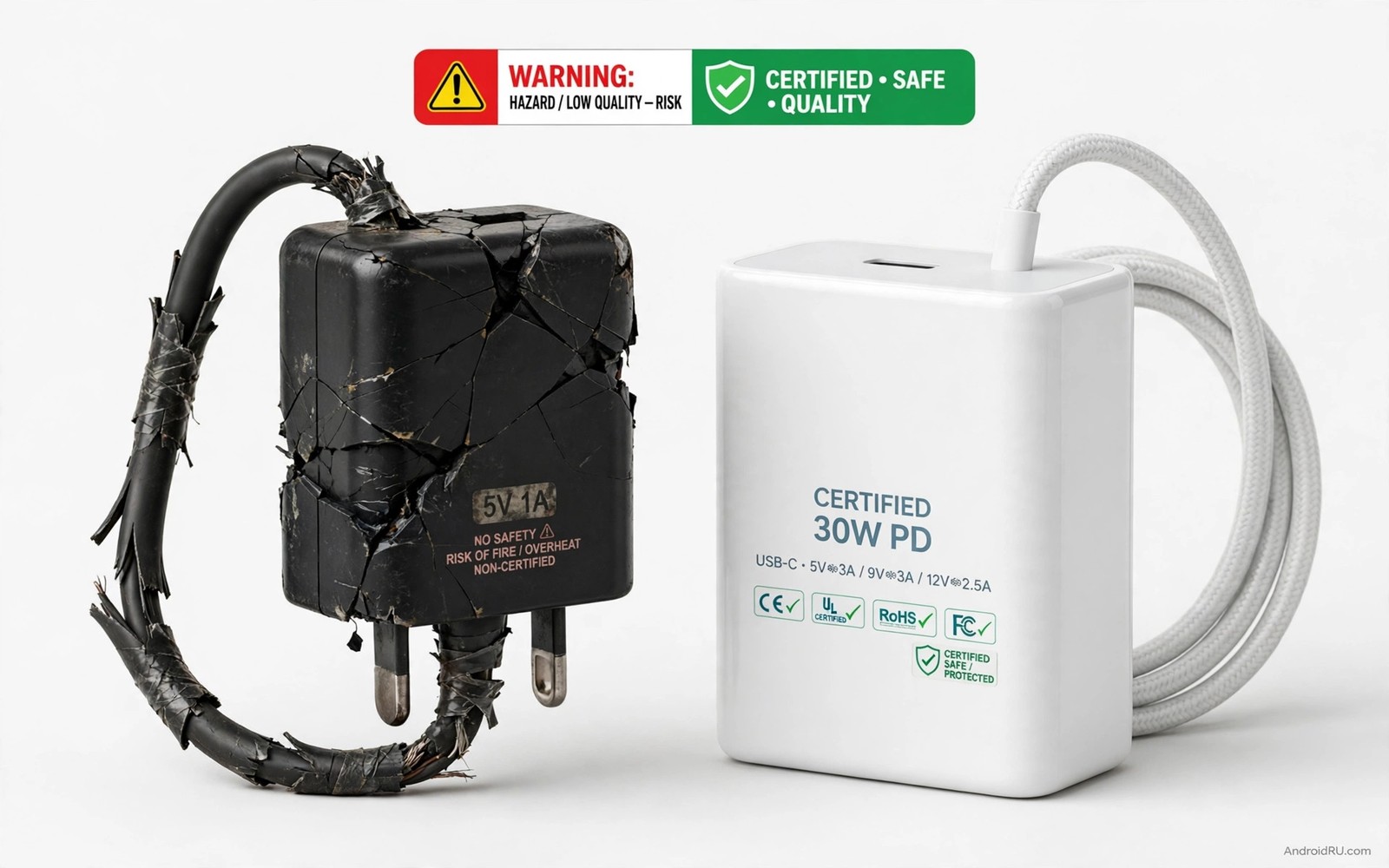
Stop Buying Cheap Chargers: The Hidden Risk to Your Device
A charger at a market stall costs a few dollars. A branded one costs five times more. The cheap one looks identical. It claims the same wattage on the box. It feels like a bargain, and for the first week it behaves like one. Your phone charges. The battery icon fills. Nothing smells wrong. That quiet first week is exactly why cheap charger damage to phone battery health goes unnoticed for so long. The harm does not arrive as a single dramatic failure. It arrives as heat, a little at a time, and as voltage that wobbles a little more each month.
I have tested budget bricks side by side with certified ones on the same phone, and the difference shows up in the numbers a casual user never sees. The cheap unit ran hotter. It took longer to reach 80 percent. The phone stayed warm for an hour after I unplugged it. None of that proves a charger is dangerous on its own. Put together, though, those signals point to the same story: is a cheap charger bad for your phone? Often, yes, and not because of the price tag. The price is only a clue. What matters is what the maker left out of the brick to hit that price.
This guide walks through the hidden mechanisms, the warning signs you can check without any tools, and how to pick a charger that will not age your phone before its time. It is written for anyone who charges an Android phone every day, which is nearly everyone reading this.
What a Safe Charger Actually Does Inside the Brick
A wall charger has one job that sounds simple and is not: turn 220-volt mains power into stable 5-volt power your phone can use, and do it thousands of times without drifting out of spec. Charger voltage regulation problems are the most common hidden fault in cheap bricks, and they start here, in the regulation stage. A safe design handles this with four layers of engineering that you never see. It regulates voltage tightly, it limits current when the phone asks for too much, it isolates mains voltage from the output side, and it shuts itself down when something goes wrong. Each layer costs money in parts and in testing. A charger that sells for two dollars did not pay for all four.
Voltage regulation is the first layer. Your phone expects a steady voltage, and its charging circuit is built around that promise. When voltage drifts up and down, the phone works harder to smooth it out. That extra work becomes heat inside the phone, and heat is the enemy of every lithium cell. Good chargers hold voltage within a tight band even as the load changes. Bad chargers let it wander. You cannot see that wander from outside. You can only feel its result: a phone that runs warmer than it should while it charges.
Voltage regulation and ripple: the two numbers that matter
Ripple is the small, rapid fluctuation that rides on top of the charger’s output voltage. Every switching charger has some ripple. A well-designed one filters it down to a level the phone barely notices. A cheap one, built with undersized capacitors or none at all, lets ripple through at levels that stress the charging circuit with every cycle. Charger ripple damage to the battery is not a single event. It is thousands of tiny stresses that add up across months of daily charging, like a road full of small potholes wearing out a car’s suspension.
Capacitors are the parts that filter ripple, and they are also one of the first things a corner-cutting maker shrinks. A quality capacitor costs cents more than a poor one, and across a production run of a million units those cents become real money. So the cheap brick gets the smaller, shorter-lived capacitor. It works fine for a month. Six months later it dries out, ripple climbs, and your phone starts charging a little slower and a little hotter. That drift is the signature of a charger that was built to a price, not to a standard.
Isolation: the wall between mains power and your phone
Isolation is the physical and electrical separation between the high-voltage side of the charger and the low-voltage side that touches your phone. In a proper design, a transformer and a carefully laid-out circuit board keep mains voltage far away from the USB output. If a component fails on the high-voltage side, isolation is what stops that failure from reaching your hand and your phone. This is the layer you most want to exist and can least afford to lose.
Cheap designs shrink the isolation gap to save space and copper. Some use a transformer with thin insulation. Some crowd high-voltage and low-voltage traces close together on the board. The charger still works. It still charges your phone. But the margin of safety is gone, and a single failed component can turn into overvoltage at the USB port. Phone protection circuits usually catch that, yet they have limits, and a severe failure can overwhelm them.
What happens when isolation fails
When isolation fails, mains voltage can reach the output side. Overvoltage charger damage is the outcome isolation exists to prevent, and it is the most serious risk a cheap brick carries. In mild cases the phone’s own protection trips and charging stops. In serious cases the charging circuit dies, the port is damaged, or the phone never turns on again. These failures are rare, which is part of the problem: rarity makes people feel safe. A one-in-ten-thousand failure sounds small until you remember that millions of these bricks are sold every month. Certification exists precisely because you cannot inspect isolation yourself. A certified charger passed independent tests that prove the isolation gap is real. An uncertified one passed no test at all.
How Cheap Chargers Damage Your Battery Over Time
Battery damage from a bad charger comes mainly through two channels: heat and unstable power. Heat speeds up the chemical reactions that age a lithium cell. Unstable power forces the charging circuit to work harder, which makes more heat. The two channels feed each other, and the result is a battery that loses capacity faster than it should. A phone charged daily with a bad charger can sit 10 percent lower in capacity after two years than the same phone charged with a good one. That gap matters most in year three, when a phone at 80 percent capacity still feels fine and a phone at 70 percent starts dying before dinner.
Phone battery health after two years is the number that decides whether you keep a phone or replace it early. Most people blame the battery. Often they should blame the brick. The battery did exactly what physics said it would do when fed hot, wobbly power every night. Does fast charging damage battery life on its own? A good fast charger, used occasionally, costs very little capacity. A bad fast charger, used daily, costs far more, because the heat and the unstable power compound each other. In the worst cases, heat and poor regulation also raise the cheap charger battery swelling risk, and a swollen battery is a safety fault, not a wear item: stop using the charger and the phone until it is checked.
Heat: the slow battery killer
Lithium cells age fastest when they are hot and full at the same time. Charging already warms a phone. A bad charger adds its own heat on top, because its inefficient conversion wastes energy as warmth, and its unstable output makes the phone’s charging circuit work overtime. That is why a phone on a cheap brick can feel hot to the touch at 60 percent charge, while the same phone on a quality brick feels only warm. Cheap charger overheating phone complaints almost always trace back to this stack of small heat sources, and the lithium cell inside pays the price for every one of them.
Heat damage is cumulative and one-way. You cannot cool a battery back to its younger self. Every hot charging session takes a little capacity you never get back. This is also why charging habits matter as much as charger choice. A quality slow charger overnight, keeping the phone cool, does more for long-term battery health than any single purchase.
Why charging past 40 degrees costs you capacity
Above roughly 40 degrees Celsius, the chemical aging inside a lithium cell speeds up sharply. A phone that regularly charges at that temperature can lose capacity twice as fast as one that charges near room temperature. You do not need a thermometer to check this. If the phone feels hot rather than warm while charging, it is already past the range you want. Move it off the bed, out of its thick case, and away from sunlight, and check whether the charger is part of the problem by testing with a known good one.
Ripple and micro stress on the charging circuit
Ripple does its damage quietly. Each small voltage swing forces the phone’s charging circuit to adjust, and those adjustments generate tiny amounts of extra heat and wear. Over a single charge the effect is trivial. Over a thousand charges it is not. Phones charged with high-ripple bricks tend to show two symptoms first: charge times that slowly get longer, and a battery percentage that drops faster in the last 20 percent. Both point to a charging circuit and a cell that have been worked harder than they needed to be.
The fix is not exotic. A charger with proper filtering, built by a maker that publishes real test results, keeps ripple low for the life of the product. That is what you are paying for when you pay more: not the logo, but the filter that keeps working in year two.
Fake Wattage Claims and Broken Fast Charging Negotiation
Cheap chargers often lie about wattage, and the lie is easy to get away with because most people never measure it. A brick labelled 65 watts may deliver 20 watts stably and hit 65 watts only for a few seconds before it overheats. Or it may deliver 65 watts into a test load in a lab and never manage it in a real phone. The label is a claim, not a measurement. A charger that claims very high wattage at a very low price should make you suspicious, because quality components that can safely move that much power cost real money.
Is 65W cheap charger safe to use every day? Only if the 65 watts are real and the design behind them is sound. A genuine 65-watt charger from a reputable maker has the transformer, the cooling, and the protection circuits to sustain that output. A two-dollar brick with the same label has the label. That gap is where the risk lives.
Fast charging with a cheap charger is the worst routine combination. Fast charging already generates heat by design. A bad fast charger adds unstable power on top of that heat. Cheap fast charger risks cluster around exactly this moment: the negotiation step, where the phone and the brick agree on power levels and the brick then fails to hold its side of the bargain. The phone and charger negotiate power levels constantly during a fast charge, stepping current up and down as the battery fills. A bad negotiator can push too much current at the wrong moment, and the result is a hot cable, a hot port, and a battery that ages faster with every session.
USB Power Delivery negotiation and why cheap bricks get it wrong
USB Power Delivery is a conversation. The phone tells the charger what voltage and current it wants. The charger answers with what it can safely provide. They agree, and charging proceeds at the agreed level. A good charger answers honestly and holds the agreed level steady. A cheap charger may agree to a level it cannot hold, then sag under load, then surge back. Each sag and surge is a small shock to the phone’s charging circuit.
USB Power Delivery charger safety depends on that conversation staying honest. When it breaks down, the phone usually protects itself by dropping to slow charging. That is why a phone that charges slowly with a cheap cable or brick is often not broken at all: it is protecting itself from a charger it does not trust. The slow charge is a symptom, not the disease.
| What the box claims | What a cheap brick often does | What a quality brick does |
|---|---|---|
| 65W fast charging | Hits 65W briefly, then overheats and throttles to 15-20W | Holds the agreed wattage steadily until the phone tapers the request |
| USB Power Delivery | Negotiates, then sags or surges under load | Negotiates honestly and keeps voltage stable |
| Works with all phones | Charges some phones slowly, others erratically | Steps down cleanly to each phone’s limit |
| Built-in protection | One thin layer, or none at all | Overvoltage, overcurrent, and overtemperature cut-offs |
The table above describes typical patterns, not any single product. Use it as a lens for judging the brick in your drawer, not as a review of a brand.
Cheap Charger Port Damage: Loose Plugs, Arcing, and Heat
Ports suffer from poor connector design long before the battery shows any damage. A cheap charger plug may fit loosely in the USB-C port. A loose fit causes arcing, which is tiny sparking at the contact points each time the connection shifts. Arcing pits the metal contacts. Pitted contacts increase resistance. Higher resistance generates heat right at the port. Heat degrades the port further. A phone that only charges when the cable sits at a certain angle almost always has port damage, and that damage often started with a poor plug.
Charger port damage from loose plug fit is expensive to repair and easy to prevent. A port repair costs far more than a quality cable. A snug plug, checked once when new, is the whole prevention plan.
How a loose plug pits your USB-C port
A USB-C plug should slide in with a firm click and sit still. If it wobbles side to side, the contacts inside are making and breaking connection dozens of times a minute. Each break is a tiny arc. Each arc leaves a pit. Pits grow, resistance climbs, and the port gets hotter with every charge. The process takes months, which is why people blame the phone’s age instead of the plug that caused it.
Test every new charger the day you buy it. Plug it in and gently try to wiggle it. A good plug stays put. A loose one goes back to the seller. This test takes ten seconds and saves a repair bill.
Thin cables, resistance, and the melting risk
Cheap cables share the same problem as cheap bricks: thin wires inside have high resistance. Cable resistance and charging heat rise together, because the thinner the wire, the more energy turns to warmth instead of reaching the phone. Under fast charging, high-resistance wire heats up and drops voltage along its length, so the phone receives less than intended and may request more current to compensate. More current heats the thin wire more. The charger cable melting risk is real in extreme cases, when that loop runs long enough to soften insulation. Usually it just degrades charging reliability, slowly and silently. A phone charging slowly with cheap cable attached is often protecting itself from a cable it cannot trust, not failing on its own.
Cable length matters too. A very long cheap cable adds resistance on top of thin wire. A one-metre quality cable beats a three-metre cheap cable for daily charging, every time. Keep cables straight where you can. Sharp bends break internal wires, and a broken wire becomes a hot spot at the bend. Feel along the cable during charging once a month. A warm spot near a bend is a cable asking to be replaced.
How to Spot a Dangerous Charger Before You Plug It In
You cannot see inside a charger, but you can read a surprising amount from the outside. How to tell if a charger is safe starts with the label, the weight, and the seller, and it ends with a week of careful use. How to spot a fake charger comes down to the same checks: printing, weight, plug quality, and the seller’s history. No single check proves a charger is good. Several checks together catch most bad ones. Charger overheating warning signs are worth learning before you buy, not after: a brick that stays hot long after unplugging, a smell of warm plastic, or a phone that charges slower each week all point the same way.
Start with the marks on the brick. Look for USB-IF certification on USB chargers and for the regional safety mark that applies where you live. A genuine mark means the design passed independent tests. A fake mark means nothing, and fake marks are common on the cheapest bricks, so check the mark against the seller’s reputation rather than trusting the plastic alone. Buy from reputable sellers with a track record, and be wary of marketplace listings with no history and a price far below the market.
Counterfeit charger warning signs are usually visible if you know where to look. The printing is blurry or misspelled. The plug pins feel rough or uneven. The brick is suspiciously light for its claimed wattage, because it is missing the transformer and filtering that heavy, honest power needs. The packaging promises everything and the seller answers nothing. Any two of those signs together are enough to walk away.
Check reviews for heat complaints before you buy. A charger that many owners call hot is a warning, not a coincidence. And remember the price test: a 65-watt quality charger cannot cost two dollars. USB-C charger safety tips all start with the plug: it should click in firmly and sit still, because a wobbling plug is the first sign of a port problem waiting to happen. Price alone does not prove quality, but a price far below the market proves corners were cut somewhere. Your job is to figure out whether the corner was the packaging or the protection circuit.
The five-minute hands-on test for any new charger
How to test a new charger without any tools is simple: charge with it for a week and watch three things: how the phone feels, how long a charge takes, and how the plug fits. A good charger keeps the phone warm, not hot. It charges in the time you expect. It fits snugly, with no wobble. A bad charger leaves the phone hot, charges erratically, or fits loosely. Replace it at the first warning sign. Do not wait for damage to confirm your suspicion. A charger is a consumable, and replacing it early is the cheapest repair you will ever make.
Keep the receipt and the warranty. Reputable brands honour warranties, and unknown sellers disappear. Warranty support is part of safety. It shows the maker stands behind the design instead of behind a stall that moves every week.
Choosing a Safe Charger for Your Android Phone
Match the charger to the phone, not to the biggest number on the shelf. A phone that supports 25-watt charging does not need a 120-watt brick. A higher-wattage charger will negotiate down to the phone’s limit, and that is safe with a good charger, but it is not a reason to buy the cheapest high-wattage unit you can find. Buy a charger rated near your phone’s needs with a little headroom. A 30-watt quality charger suits most Android phones. It charges fast enough, and it stays cooler than a maxed-out cheap unit working at its limit.
The best safe charger for Android phone use is usually a mid-range unit from a reputable brand, with USB-IF certification and a wattage close to what your phone actually accepts. Gallium nitride, or GaN, chargers are worth a look here: GaN charger safety is generally good because the material runs cooler and more efficiently than older silicon designs, which lets makers build smaller bricks that stay within safe temperatures. That said, GaN is not magic. A GaN brick from an unknown maker with no certification is still a gamble. The technology helps honest makers. It does not fix dishonest ones.
Certification marks worth trusting
USB-IF certification is the mark that matters most for USB chargers. It means the charger passed tests for the USB specification it claims, including power delivery behaviour. A USB-IF certified charger is one whose maker paid for independent testing rather than printing a claim on the box. Regional safety marks cover the mains side: the design was tested for isolation, fire risk, and fault behaviour. Certified charger vs uncertified charger is not a debate about logos; it is a debate about tested protection versus a promise on plastic. A charger that carries both marks is a charger whose maker paid for testing twice. That is a good sign. A charger that carries neither, yet claims the highest wattage on the shelf, is a charger whose maker paid for neither.
Check certification claims where you can. The USB-IF publishes a list of certified products. A quick search of the model number takes a minute and settles the question better than any packaging claim.
Matching wattage to your phone without overspending
Charger wattage matching phone needs is simple once you know your phone’s limit. Check the phone’s specifications or the charger that came in the box. If your phone accepts 25 watts, a 30-watt charger gives you full speed with a little headroom. If it accepts 45 watts, a 45 or 65-watt charger is the right buy. The advice to buy charger from reputable brand makers is not about the logo: it is about buying from a seller with a history you can check and a warranty you can claim. Buying far above the limit wastes money and tempts you toward cheap high-wattage bricks, which are the riskiest category of all.
Keep a slow charger for overnight use. A 10-watt quality charger is ideal for the night: it generates minimal heat, it puts minimal stress on the cell, and it finishes long before morning anyway. Slow overnight charging benefits your battery more than any fast-charging feature. Two chargers for two purposes beat one cheap charger for everything.
| Phone charging limit | Sensible charger choice | Overnight choice |
|---|---|---|
| 15-18W | 20W certified USB-C charger | 10W quality charger |
| 25W | 30W certified charger with USB Power Delivery | 10W quality charger |
| 45W | 45W or 65W certified charger | 10-15W quality charger |
| 65W and above | Certified charger at the phone’s rated wattage | 10-15W quality charger |
A Monthly Charger Inspection Routine That Takes Five Minutes
Inspect chargers and cables monthly. A charger inspection routine monthly is the habit that catches drift before it becomes damage, and it takes five minutes. Look for fraying near the plugs. Look for discoloration from heat. Look for plugs that have started to wobble. Smell for burnt plastic after charging, because a burnt smell is a stop signal, not a quirk. Stop using that charger at once. Check the port for lint and damage, and clean lint gently with a wooden tool, never metal.
Watch charge-time trends as well. A charger that suddenly charges much slower may be failing inside. A phone that suddenly heats more may be reacting to a failing charger. Those trends are early warnings, and they are free. Act on them. Replace the suspect unit, test with a known good charger, and if the symptoms disappear, the old charger was the cause. That test is simple and conclusive.
The three-signal log: warmth, time, fit
Record three signals once a month: how the phone feels during charging, how long 20 to 80 percent takes, and how snugly the plug fits. Warmth catches heat problems. Time catches power problems. Fit catches port problems. A charger that drifts toward hot, slow, or loose needs replacement. A stable log means a stable charger. Keep the log simple, because simplicity is what makes you actually do it every month.
A simple log you can keep in your notes app
Charger check log
Charger: brand 30W, cable 1m quality
Phone feel during charge: warm, not hot
Charge time 20 to 80 percent: 52 min
Plug fit: snug, no wobble
Decision: keep, recheck in one month
The log above follows a simple inspection pattern used by many Android power users to judge a charger without any paid tool. It records only feel and time and fit, and those three signals catch most bad chargers. Compare trends month to month rather than judging one reading in isolation. A single slow charge could be a hot day. Three slow months in a row is a dying charger.
Common Mistakes That Turn a Cheap Charger Into a Repair Bill
Many owners buy the cheapest charger with the highest wattage claim. That combination is the riskiest purchase in this whole guide. Many owners keep a frayed cable because it still works, but fraying signals internal damage, and internal damage is exactly the kind that fails without warning. Many owners charge with a phone in a thick case on a hot charger, so heat stacks from both sources at once. Many owners ignore a hot port, treating it as a quirk when it is a warning. Many owners use a charger from an unknown brand for years without inspection, and age degrades cheap components faster than good ones.
The most common mistake is assuming a charger that works is a charger that is safe. Safety failures are silent until they are not. Certification and inspection are the only guards you have, and both are cheap compared with a repair. Another mistake is using a cheap charger for fast charging every day, which combines two stresses at once. Use a quality slow charger for daily use and reserve fast charging for quality gear and urgent moments. Pair charger choice with correct charging routines that protect the cell and with fixes for slow charging that do not involve cheap gear. Good habits plus good gear give the safest result. Either alone leaves risk, and together they protect battery and port for years.
- Buying the highest wattage at the lowest price: that combination is where the worst designs live, so buy near your phone’s real limit from a brand with a track record.
- Keeping a frayed cable: fraying means broken wires inside, and broken wires become hot spots, so replace the cable before it damages the port.
- Charging in a thick case on a hot day: heat from the case and heat from the charger add up, so take the case off for long charging sessions.
- Ignoring a hot port: a port that feels hot is warning you about resistance and arcing, so test it with a known good charger and cable before it gets worse.
- Never inspecting an old charger: cheap components age faster, so a monthly check catches drift before it becomes damage.
Frequently Asked Questions About Cheap Chargers
Are all cheap chargers dangerous?
No. Some low-cost chargers from reputable brands are safe, because a big brand can build a simple, honest charger at a low price and still pay for certification. Danger comes from uncertified designs with poor regulation and thin protection, not from the price tag alone. The warning sign is the combination of a very low price, no certification, and a wattage claim that looks too good. One of those alone is not proof. All three together are a strong reason to choose something else.
Can a cheap charger kill my phone battery?
It can shorten the battery’s useful life noticeably over two or three years through heat and ripple, and in a failure it can damage the charging circuit. A battery that would have lasted three years at 85 percent capacity might reach 70 percent in the same time on a bad charger. That is not a dead battery on day one. It is a phone that needs replacing a year early, which is a slower and more expensive kind of damage.
Is a branded charger always safe?
Branded chargers from reputable makers are far safer, but counterfeit branded chargers exist and they are common. A fake copy of a famous brand is still a cheap charger inside, with the same missing protections. Buy from authorized sellers, check the packaging and the certification carefully, and be suspicious of a famous brand at a price far below its normal retail. If the deal looks impossible, the charger probably is not what the box claims.
Why does my phone get hot while charging with a cheap charger?
Why does my phone get hot while charging with a cheap charger? Because the brick is wasting energy as heat, its voltage is wandering, and your phone’s charging circuit is working overtime to cope with both. A quality charger delivers steady power and stays cool, so the phone stays warm rather than hot. If your phone cools down noticeably when you switch to a known good charger, you have found the cause, and the fix is a new charger rather than a phone repair.
What to Do Tonight: Check the Charger You Already Own
Cheap charger risks hide in voltage regulation and protection, and they show up as heat, ripple, loose plugs, and fake wattage claims. Heat and ripple age batteries. Poor plugs damage ports. Overvoltage can kill circuits. None of that requires a lab to detect. It requires a certified charger from a reputable seller, a wattage matched to your phone, slow quality charging overnight, and a five-minute inspection once a month.
Check your current charger tonight. Plug it in, feel the phone after twenty minutes, note the charge time, and wiggle the plug gently. Replace the charger if any warning appears. That single check protects your phone for years, and it works even better alongside protection against sun and room heat damage, because heat and bad power together age cells fastest. A good charger is the cheapest insurance your phone will ever get.

