

Our Acer beTouch E101 Review: Value for Money, Performance and Detailed Specs
This Acer beTouch E101 review and full specifications guide looks at a phone from a very different era of mobile design. The Acer beTouch E101, also known as the Acer E1, arrived in October 2009 as a compact touch phone built for people who lived on the social networks of the period. It ran Microsoft Windows Mobile 6.5 Professional, it carried a 3.2-inch resistive touch screen, and it sold at a price of about 170 euros. That timing matters, because every judgement in this guide is made against 2009 expectations, not against the phones of today. If you are looking at a used example, a boxed collector piece, or a forgotten handset in a drawer, this guide will help you decide what it can still do, what it cannot do, and what to check before you pay.
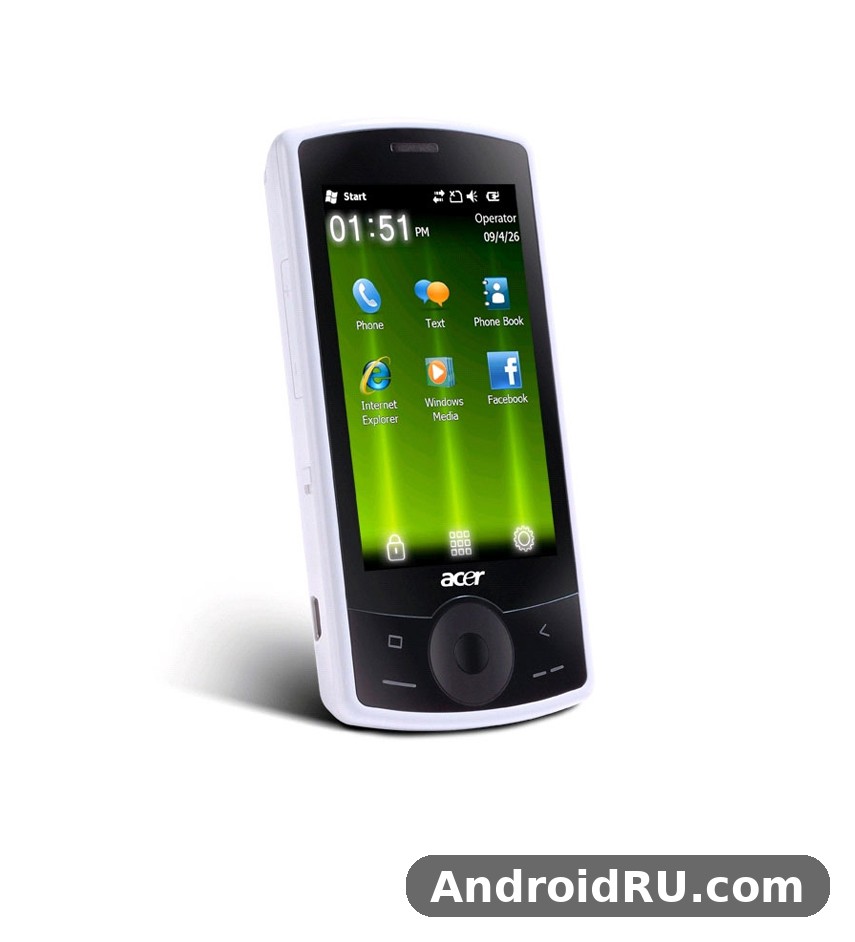
The short version is simple. The Acer beTouch E101 review picture is one of a light, pocket-sized Windows Mobile phone with a usable camera for its class, a small but clear screen, and a removable battery. Its limits are just as clear: 256MB of RAM, a single-core 528 MHz processor, EDGE data only with no HSDPA and no Wi-Fi, and software that no longer receives support. Read the sections below before you buy, and you will know exactly where this classic phone fits.
Overview: A 2009 Windows Mobile Classic
An Acer beTouch E101 Windows Mobile 6.5 phone review has to start with context. In October 2009, Acer was building a broad range of Windows Mobile handsets, and the beTouch line was aimed at people who wanted messaging, email and social networking in a pocket-sized device. The E101 sat at the friendly end of that range. It was not the flagship neoTouch, and it was not a business slider with a keyboard. It offered a 3.2-inch touch screen, a 2 megapixel camera, GPS, and a light 118 gram body, all at a price that undercut many of its stablemates.
Any Acer beTouch E101 vs Acer beTouch E100 comparison starts with mobile data, because that is the one real difference between the two handsets. The E100 shipped with HSDPA for faster mobile internet, while the E101 was EDGE only, aimed at buyers who spent their time on social networks over slower connections and did not want to pay for 3G speed. The bodies, the screens, the cameras, the processors and the batteries of the two phones are identical, so a buyer who finds either model is really choosing between HSDPA and a lower price. The Acer beTouch E101 EDGE only no HSDPA mobile data setup is the fact to remember when you compare the two, and it explains why the E101 cost less at launch.
The Acer beTouch E101 release date October 2009 price story is useful for collectors and second-hand buyers. Because the phone was announced and released in October 2009 at about 170 euros, a fair second-hand price today depends far more on condition, box, charger and battery health than on that original price. A clean working example with its screen, camera and battery in good order is worth more than a scratched unit with a dead cell, even if both carry the same model name. Check the screen response, the camera, and the battery before you agree a price.
What kind of phone was the E101?
The E101 was a messaging and social phone first, and a media phone second. Its Acer beTouch E101 software was built around Windows Mobile 6.5 Professional, with Acer shortcuts on top, Pocket Office for documents, email, calendar and contacts, and quick access to the social services of the period. The Acer beTouch E101 features list covers calls, text messages, email, a music player, a 2 megapixel camera, GPS with A-GPS, Bluetooth 2.0, and a microSD slot, all in a handset that slipped easily into a jacket pocket. That was a practical package in 2009, when a phone that kept you in touch with friends and email was the point, and a large screen or a fast chip was not yet the measure of a handset.
For many buyers in 2009, the appeal was simple value. You could write messages on a touch screen, check a map with GPS, take a usable photo in daylight, and carry the phone all day without noticing its weight. The phone did not try to be a games machine or a video player, and that focus kept its size and price in check. That is the lens to use when you read the rest of this Acer beTouch E101 review.
Who is this guide for?
This guide is for three kinds of reader. The first is a collector who wants an Acer beTouch E101 discontinued classic smartphone buying guide, with the facts needed to spot a complete, working example. The second is a curious reader who wants to understand how a 2009 Windows Mobile phone worked, and how far phones have moved since then. The third is someone who has found an E101 at home and wants to know if it can still be used for calls, texts, photos, or as a spare handset. All three will find the same answer in different words: it is a piece of history that still works for basic tasks, but it is not a daily phone for modern life.
Design and Display
The Acer beTouch E101 design is a plain, pocket-sized touch phone. The front is dominated by the 3.2-inch screen, with a call key, an end key and a small navigation area below it, and the back is a smooth black shell with the camera lens near the top. The Acer beTouch E101 dimensions 113 x 56 x 12.8 mm and its 118 gram weight make it one of the lighter Windows Mobile phones of its year, and the narrow 56 mm width helps one-handed use. The Acer E101 design keeps the front clean, with no slide-out keyboard and no extra bulk, so the phone feels more like a small media player than a business handset.
The Acer beTouch E101 display is a 3.2-inch TFT panel with 65K colours. The Acer beTouch E101 3.2 inch TFT display resolution is 240 x 400 pixels, about 146 pixels per inch, which was normal for a mid-range touch phone in 2009. An Acer beTouch E101 240 x 400 pixels screen sharpness review finds text readable at this size and menus clear, though web pages need a lot of scrolling and small text can look rough. Photos look pleasant on the small panel, and the home screen tiles are large enough to tap with a fingertip.
The Acer beTouch E101 65K colours TFT screen viewing angles are narrow, and the panel can wash out in bright sunlight, so you may need to tilt the phone to read it clearly outdoors. Indoors, it is fine for calls, messages, calendar entries and short browsing sessions. Do not expect the bright, sharp screen of a later phone. Expect a small, practical screen that matches the rest of the hardware.
Screen quality in daily use
An Acer beTouch E101 resistive touchscreen stylus input review would note that the screen responds to a fingertip or a stylus, and a stylus helps a lot for small on-screen buttons, for handwriting input, and for the older Windows Mobile menus that were designed with a pen in mind. The larger home screen tiles are easy to tap with a finger, while the deeper settings screens still reward the precision of a stylus. If you buy a used E101, check that a stylus is included, because it is a small part that is often lost, and it makes the phone far easier to use.
Outdoors, the TFT panel can wash out in bright light, and the resistive layer can feel less responsive than a modern capacitive screen, especially with cold or dry fingers. A light press works better than a hard one, and a clean screen responds better than a scratched one. For a collector, those quirks are part of the experience of a 2009 touch phone, not faults to be fixed.
Build, buttons and handling
The Acer beTouch E101 black colour design and build quality are modest but tidy. The body is plastic, with a plain front, a call and end key, and a small navigation area below the screen. There is no front camera, and there is no fingerprint reader or face unlock, because those features did not exist on phones of this class in 2009. The phone feels well put together for its price, and the slim 12.8 mm profile helps it slip into a pocket without a bulge. A used example should be checked for cracks around the battery cover, wear on the keys, and scratches on the screen, because those are the parts that show age first.
Colours and size
The E101 was sold in black, and that single colour suits the plain design. Black hides wear better than a light colour, and it gives the small handset a neat, finished look. At 113 x 56 x 12.8 mm and 118 grams, the phone is compact enough to slip into a shirt pocket, and the narrow width helps one-handed use. There is no choice of colour to agonise over, so choose on condition rather than colour alone, and favour a clean screen and a tight battery cover over any cosmetic detail.
Performance and Software
The Acer beTouch E101 performance is set by its Qualcomm MSM7225 Snapdragon S1 chip and its 528 MHz ARM 11 processor. The Acer beTouch E101 Qualcomm MSM7225 Snapdragon S1 processor was a common choice for mid-range Windows Mobile phones of the period, and it was paired with 256MB of RAM and 512MB of ROM. The Acer beTouch E101 256MB RAM 512MB ROM performance picture is clear: the phone can handle calls, messages, email, calendar, contacts and light apps, but it slows down if you open several apps at once, and it is not suited to heavy multitasking or demanding games.
There is no dedicated graphics chip listed for this model, which fits its role as a messaging and social phone. Menus move at a steady pace, the touch screen keeps up with normal typing, and the camera app opens without a long wait, but web pages with many images can take time to load, and you should close apps you are not using. The E101 Snapdragon S1 platform is best judged on the tasks it was built for, and on those tasks it is adequate rather than fast. The E101 Windows Mobile system runs on that chip, and the 256MB of RAM and 512MB of ROM work with it to handle the basic tasks of the period.
Windows Mobile 6.5 in practice
The Acer beTouch E101 Windows Mobile 6.5 Professional software experience is a reminder of how different phone software used to be. The home screen uses large, finger-friendly tiles and widgets, while deeper menus still use the older Windows Mobile style, with small text and stylus-friendly controls. The system lets you change the layout, add shortcuts, and pick a theme, but the system underneath remains Windows Mobile 6.5, with its strengths and its quirks.
Pocket Office is the most useful part of the software. The Acer beTouch E101 Pocket Office email and calendar features cover Word, Excel and PowerPoint files, email with attachments, calendar, tasks and contacts, and synchronisation with a computer of the period. That made the E101 a sensible choice for office use in 2009, and a friendly one for social use too. Today, those same features still work offline for viewing old documents, but modern email services, modern web security, and modern file formats will not work as they did then. Treat the software as a closed, offline system, not as a live connected platform.
Memory and expandable memory
The Acer beTouch E101 memory is split between 256MB of RAM for running apps and 512MB of ROM for the system and built-in files. That is a small amount by any later standard, and it is the main reason the phone feels limited today. The Acer beTouch E101 microSD card slot expandable memory helps, because a microSD card can hold photos, music and documents, and it can be swapped without opening the whole phone. A card of a few gigabytes is more than enough for this hardware, and a larger card is unlikely to add any benefit.
To keep the phone responsive, keep the number of installed apps low, store photos and music on the card, and restart the phone from time to time. If you plan to use it as a collector piece, a clean reset and a small set of period apps will give the best experience. The Acer beTouch E101 features list is long on paper, but the memory is the limit that shapes how many of those features you can use at once.
What the processor can and cannot do
On the plus side, the 528 MHz single-core chip is efficient for its time, and it works well with the small screen and the light operating system. Calls are clear, the GPS can fix a position for maps, and the camera can save a photo without a long delay. On the minus side, video playback is limited, web browsing is slow on complex pages, and there is no support for the apps and services that define a modern phone. That is not a fault in the chip. It is the gap between 2009 and today, and any honest Acer beTouch E101 specs discussion should make that gap clear.
Camera
The beTouch E101 camera is a 2 megapixel rear camera, and it can save photos at up to 1600 x 1200 pixels. The Acer beTouch E101 camera is a 2 megapixel unit with video recording, and it sits alone on the back of the phone, with no flash and no front camera. An Acer beTouch E101 2 megapixel camera review and samples from the period point to the same verdict: daylight photos are usable for small prints, messages and records, with reasonable colour and detail when the light is good. In low light, photos become noisy and soft, and the lack of a flash limits what you can capture indoors or at night.
The camera app is simple. You frame a shot on the 3.2-inch screen, tap to capture, and save the photo to internal memory or to a microSD card. The screen is large enough to frame a shot comfortably, and the shutter response is quick enough for a still subject. Video is basic, with low resolution by later standards, and it is best used for short clips rather than for anything you plan to watch on a large screen. There is no front camera, so self-portraits and video calls of the modern kind are not part of this phone.
Photo quality and limits
The Acer beTouch E101 camera photo quality in daylight conditions is decent for its class. It is not a match for a later phone camera, but it is fair for a 170 euro handset from 2009, and it gives the E101 a real reason to be chosen over a cheaper fixed-focus phone of the same year. The Acer beTouch E101 vs Acer beTouch E100 comparison makes this clear: the cameras match, the bodies match, and only the data connection differs, so a buyer who cares about photos loses nothing by choosing the cheaper E101.
When you test a used E101, take a photo in daylight and one indoors, look at the saved file on a computer, and check that the camera app opens and saves without crashing. A hazy lens or a camera app that fails will tell you more than any spec sheet. Clean the lens gently, use the microSD card for photo files, and keep expectations in line with 2009 hardware.
Battery and Connectivity
The beTouch E101 battery is a removable Li-Ion cell rated at 1140 mAh. An Acer beTouch E101 1140mAh removable battery life test today would depend more on the age of the cell than on any original claim, so treat old figures with care and test the phone yourself. A new or lightly used battery can still give a useful day of light use, while an old battery may last only a few hours. Because the battery is removable, you can carry a spare, and you can replace a tired cell without tools.
That removable design is a real advantage for collectors. The Acer beTouch E101 battery is easy to reach under the back cover, and the same cover gives access to the SIM and microSD slots. An Acer beTouch E101 battery replacement guide for classic phones starts with the back cover: remove it, lift out the old 1140mAh cell, and fit a compatible replacement in the same position. If you buy a used phone, ask about the battery, check for swelling, and test the phone on a call before you pay. A swollen battery should be replaced and recycled safely, not used.
Connectivity and missing features
The Acer beTouch E101 connectivity covers GSM 850, 900, 1800 and 1900, with EDGE for mobile data. The Acer beTouch E101 SIM card GSM 850 900 1800 1900 detail matters if you plan to insert a SIM: the phone uses a standard SIM of the period, and it needs a network that still supports 2G in your area. Many networks have closed those services, so check coverage before you buy for use rather than for display.
The Acer beTouch E101 Bluetooth 2.0 GPS A-GPS features include Bluetooth 2.0 with A2DP for headsets and file transfer, GPS with A-GPS for maps, and a miniUSB 2.0 port for charging and data. The Acer beTouch E101 no Wi-Fi connectivity limitations explained in plain terms: this model has no Wi-Fi, so it cannot join a home wireless network, and it has no FM radio either, so it cannot tune in to broadcast stations. The Acer beTouch E101 miniUSB port charging and data role is simple: one port handles charging and file transfer, and audio needs a compatible adapter or a Bluetooth headset. That was common on Windows Mobile phones of the period, but it is a clear limit today. If you want a phone for music over wireless internet, this is not the model to choose.
Full Specifications
The Acer beTouch E101 specs below are the full list for this model, also known as the Acer E1. The Acer beTouch E101 also known as Acer E1 specs are the same under either name, because the two names refer to the same handset. An Acer E1 review reaches the same verdict as an E101 review, and any Acer beTouch review of this family should be read with that shared identity in mind. The Acer beTouch specs in this table are the reference to use when you compare a used example, and the beTouch E101 specs in this table cover the hardware, the screen, the camera, the battery and the connections. Check the phone itself against the table, because a replaced battery, a missing stylus, or a non-original charger will not show up in a spec list.
| Feature | Detail |
|---|---|
| Model | Acer beTouch E101, also known as Acer E1 |
| Announced | October 2009 |
| Released | October 2009 |
| Status | Discontinued |
| Operating system | Microsoft Windows Mobile 6.5 Professional |
| Chipset | Qualcomm MSM7225 Snapdragon S1 |
| CPU | 528 MHz ARM 11, single core |
| RAM | 256MB |
| ROM | 512MB |
| Memory card | microSD, expandable |
| Display | 3.2-inch TFT resistive touchscreen, 65K colours, 240 x 400 pixels, about 146 ppi |
| Rear camera | 2 MP, 1600 x 1200 pixels, video recording |
| Front camera | No |
| Battery | Removable Li-Ion 1140 mAh |
| Dimensions | 113 x 56 x 12.8 mm |
| Weight | 118 g |
| Colours | Black |
| Network | GSM 850 / 900 / 1800 / 1900, EDGE |
| HSDPA | No |
| Wi-Fi | No |
| Bluetooth | 2.0 with A2DP |
| GPS | Yes, with A-GPS |
| USB | miniUSB 2.0 |
| FM radio | No |
| Input | Resistive touchscreen, stylus support |
| Price at launch | About 170 euros |
| SAR | Check the label on the handset and the manual for the SAR value for this model |
The Acer beTouch E101 SAR value radiation safety information note above is deliberate. SAR figures vary by region and by test method, and the safest source is the label on the phone you hold and the manual that came with it, not a copied figure from another listing. The same care applies to the whole table: the core facts are stable across sources, but a used phone can differ in battery, card, charger and accessories.
Pros and Cons
The Acer beTouch E101 pros and cons are easy to sum up once you accept that this is a 2009 phone. Its strengths are the light body, the usable camera for its class, the removable battery, and the low launch price. Its weaknesses are the small memory, the slow processor, the low-resolution screen, and the lack of HSDPA, Wi-Fi and modern software support. Neither side is a surprise, and both sides should shape your decision.
Pros
Light and compact body at 113 x 56 x 12.8 mm and 118 grams, easy to carry all day. 2MP camera that is usable in daylight for its class. Removable 1140mAh battery that is easy to replace. Large 3.2-inch touch screen for its price, with stylus support. GPS with A-GPS and Bluetooth 2.0 with A2DP. microSD expansion for photos and documents. Windows Mobile 6.5 Professional with Pocket Office for email, calendar and documents. Low launch price of about 170 euros.
Cons
Only 256MB of RAM and a 528 MHz single-core processor, so multitasking is limited. Low-resolution 240 x 400 TFT screen with narrow viewing angles. EDGE data only, with no HSDPA and no Wi-Fi. No front camera, no flash, and basic video recording. No FM radio and no 3.5mm headphone jack in the standard spec. Old software with no modern app support and no security updates. 2G networks are closing in many areas, which limits live use. Battery life on an old cell can be far below the original claim.
Frequently Asked Questions
When was the Acer beTouch E101 released?
The Acer beTouch E101 release date was October 2009. It was announced in October 2009 and released in October 2009. The Acer beTouch E101 price was about 170 euros at launch. The phone is now discontinued, and it is also known as the Acer E1. The Acer E1 price at launch was the same, because the Acer E1 is the same handset under a different name.
Is the Acer beTouch E101 still worth buying in 2026?
The short answer to is Acer beTouch E101 still worth buying in 2026 is: for a collector, for a display piece, or for a study of Windows Mobile history, a clean working example is worth buying at a modest price. For daily use as a main phone, it is not worth buying, because the software, the memory, the screen and the network support are all far behind modern needs. Buy it for what it is, not for what you wish it was.
What chipset does the Acer beTouch E101 use?
The Acer beTouch E101 uses the Qualcomm MSM7225 Snapdragon S1 chipset, with a 528 MHz ARM 11 processor. That is the correct chipset for this model, and it is the figure used in this guide and in the full specifications table above. The E101 Windows Mobile system runs on that chip, and the 256MB of RAM and 512MB of ROM work with it to handle the basic tasks of the period.
Does the Acer beTouch E101 have Wi-Fi?
No. The E101 has no Wi-Fi. It connects through GSM and EDGE mobile data, Bluetooth 2.0, GPS with A-GPS, and a miniUSB 2.0 port. If you need wireless internet at home, a modern phone is a better choice. This is one of the clearest limits of the E101, and it should be checked before any purchase for live use.
How do I replace the battery and memory card?
Learning how to replace Acer beTouch E101 battery microSD card parts is simple. Remove the back cover, lift out the old 1140mAh battery, and fit a compatible replacement in the same position. The SIM and microSD slots sit under the same cover, so you can swap a card at the same time. Use a battery made for this model, check for swelling on the old cell, and recycle the old battery safely. If the phone will sit on display, remove the battery for long-term care.
Final Verdict
The Acer beTouch E101 is a clear, honest example of a 2009 Windows Mobile phone built for value. Its light body, its usable camera, its removable battery and its low price made sense in its year, and those same features make it an interesting collector piece today. Its small memory, its slow chip, its low-resolution screen and its lack of HSDPA and Wi-Fi make it unsuitable as a daily phone now. That contrast is the whole story of this handset.
If you find a clean example, test the screen, the camera, the GPS and the battery, and check that the SIM, microSD and miniUSB parts are present and working. The Acer E101 phone is worth a modest price in that condition, and it is worth far less if the screen or battery has failed. The Acer beTouch E101 collector guide vintage Windows Mobile phone angle is the right way to think about it: buy a piece of mobile history, keep it working, and enjoy it for what it was built to do.
Related reading: Acer beTouch E100 Review and Full Specifications: Everything You Should Know, Acer DX650 Review and Specifications: Form Factor, Everyday Performance and the Verdict, Buying the Acer beTouch E200? Read This Review and Specs Guide First, Is the Acer M900 Worth It? Review, Specs and Verdict, and Acer neoTouch Review and Detailed Specs: Features and Screen Quality Covered. Those five guides cover the closest Acer handsets from the same period, and they help place the E101 in its family. A short buyer check is useful here: screen, camera, GPS and battery first, then accessories. A second collector note is that a boxed example with its manual and charger is rarer than a bare handset. A third honest summary is that the E101 rewards a careful buyer and disappoints anyone who expects a modern phone in an old body.
For a final note on value, the Acer E101 price today is set by condition, not by its 170 euro launch price. A working phone with a good battery and a responsive screen is a fair buy for a collector. A faulty phone is a parts donor, not a bargain. Keep that in mind, and this 2009 handset will give you exactly what it promises: a light, pocket-sized Windows Mobile phone, with a clear place in the history of Acer handsets.

