

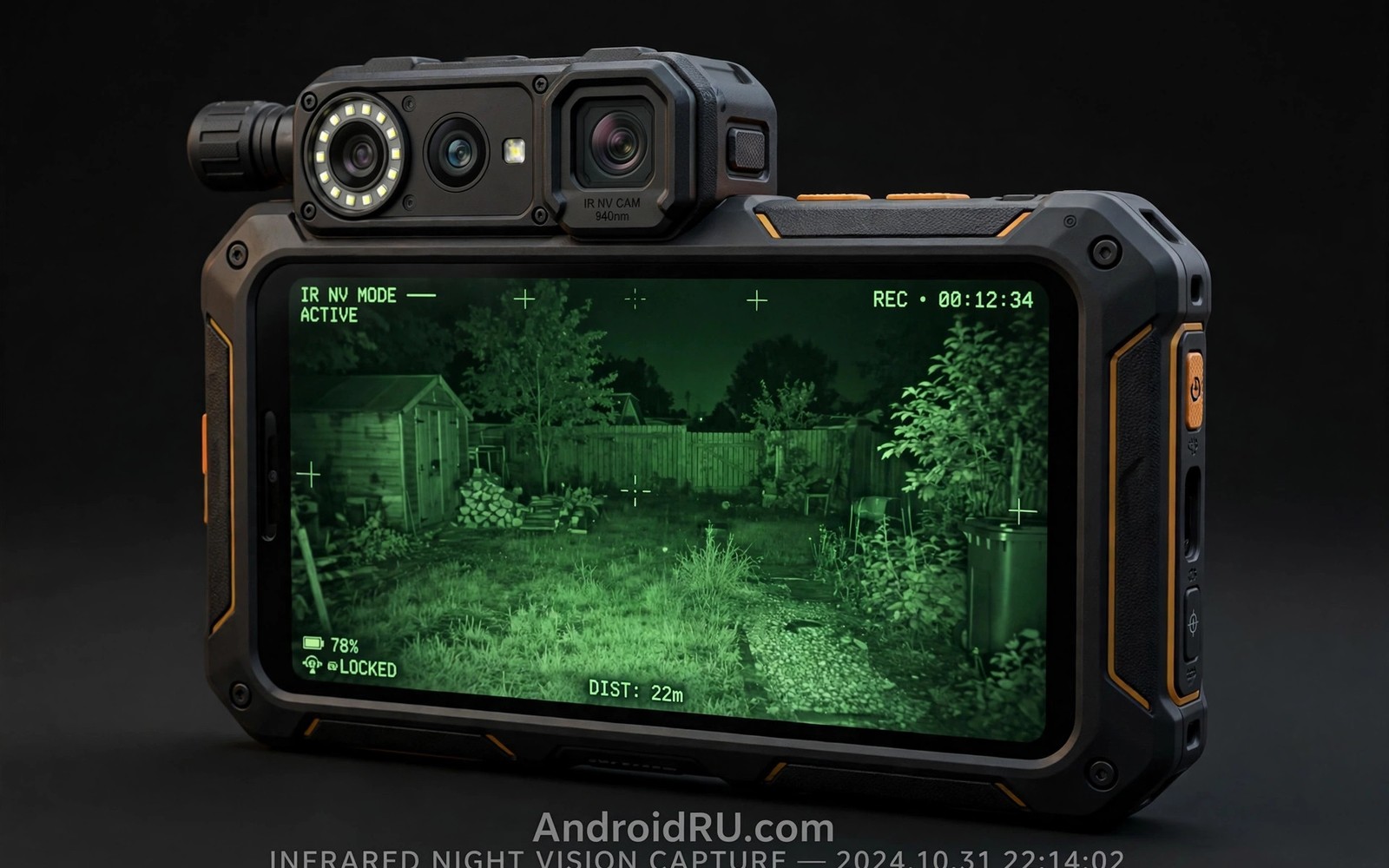
How Night Vision Infrared Cameras Work on Specialized Phones
On a dark night in the countryside, I stood in a garden with a rugged phone in my hand and watched a hedgerow appear on the screen in pale grey, clear enough to pick out a fence post twenty metres away. My eyes saw nothing but black. The phone saw the garden, because it carried its own invisible light. That is the trick behind night vision infrared cameras on specialized phones: they do not wait for light, they bring their own, in a colour no human eye can see.
This guide explains how night vision infrared cameras work on specialized phones, from the infrared LEDs and the sensor behind them to the rugged handsets that carry them, such as Ulefone, Blackview, Doogee, and AGM models. You will learn the difference between 850 nm and 940 nm light, how night vision differs from thermal imaging, how far a phone can really see in the dark, and how to test one before you spend your money. You will also learn the limits, because a tool you understand is a tool you can trust.
Night vision also helps inspectors check dark spaces without disturbing the people or animals inside them. A building inspector can scan a dark attic without a bright torch. A pest controller can check a dark roof void quietly. A farmer can check a dark barn without waking livestock. Quiet inspection is less disruptive and often more thorough, because the inspector can focus on the image rather than on managing a torch beam.
How Infrared Night Vision Works on a Phone Camera
A normal camera needs light to form an image, and in darkness it has nothing to work with. An infrared night vision camera solves that by shining infrared light, which sits just beyond red light in the spectrum, onto the scene. Human eyes cannot see infrared light, yet a camera sensor can detect it when its filters allow it. The phone shines infrared LEDs like an invisible torch, and its sensor reads the reflected light and builds a monochrome image from it.
The chain has four links: the infrared LEDs that light the scene, the lens that gathers the reflected light, the sensor that reads it, and the software that turns the sensor data into a picture you can recognise. A weak link limits the whole result. Strong LEDs cannot rescue a poor lens, and a good sensor cannot rescue software that smears the image with noise reduction. Checking each link in turn gives a fair picture of a phone, and it explains why two phones with the same megapixel count can see so differently in the dark.
What the infrared sensor sees that your eyes cannot
Infrared light behaves like visible light in most ways: it reflects off surfaces, it is absorbed by dark materials, and it is scattered by fog and dust. A pale wall reflects a lot of infrared and looks bright on screen, while dark clothing absorbs it and looks dim. A reflective safety jacket bounces it straight back and can look almost white, even at a distance where a person in a black coat is barely visible. That difference is not a fault, it is the physics of reflection, and learning to read it is part of using the tool well.
The image is monochrome because the sensor reads only brightness, not colour. There is no red, green, and blue information to build a colour picture from, so the phone shows shades of grey, sometimes tinted green by software to echo old military displays. Detail is enough to recognise a person, an animal, or a vehicle, while fine text and facial features may stay unclear at distance. Move closer for identification shots, and hold the phone steady, because night exposures run longer than daylight ones.
Why the night camera is separate from the main camera
Normal phone cameras block infrared light with a filter, and that filter keeps daylight colours accurate. A night vision phone uses a sensor without that filter, or with a switchable filter, so the sensor sees infrared clearly. Daylight images from such a sensor would look odd in colour, with green leaves turning pale and skin tones turning strange, so makers handle this by fitting a separate night sensor. The main camera stays normal for daylight, and the night camera handles darkness.
That separation is why night vision phones are usually rugged phones with room for extra hardware. A slim flagship has no space for a second sensor, a ring of infrared LEDs, and the battery to power them. A rugged phone such as the Ulefone Armor 24 has a thick body, a large battery, and space for a dedicated 64 megapixel night vision camera beside the main camera. The extra bulk is the price of a real night tool rather than a software trick.
850nm vs 940nm Infrared LEDs Glow Range and Stealth
An infrared LED emits light near 850 or 940 nanometres, and the choice between the two shapes everything about a night vision phone. Light at 850 nanometres may show a faint red glow to sharp eyes in a dark room, because the very edge of human vision reaches that far. Light at 940 nanometres is fully invisible to human eyes, so a phone using it gives away no position at all. The trade off is that sensors detect 940 nanometre light slightly less efficiently, so range drops a little for the same power.
Most night vision phones use 940 nanometre LEDs for stealth, and that choice suits security work, wildlife watching, and any job where a red glow would give you away. A few models use 850 nanometre LEDs for extra range, and they suit inspection work where a faint glow does not matter and a brighter image does. Neither choice is wrong; the right one depends on whether you need to stay hidden or need to see further.
When 850nm light gives you more range
Light at 850 nanometres travels efficiently and sensors detect it well, so for the same battery drain you get a brighter image and a few extra metres of range. In open ground on a clear night, an 850 nanometre system can reach past 20 metres on a reflective target, while a 940 nanometre system at the same power may stop nearer 15 metres. That gap matters on a large site, where a fence line or a gate sits far from the patrol path, and where the faint red glow of the LEDs is no problem at all.
One caution: the glow is visible to other people and to many animals, and it can be caught on another camera. If you work near a road or a neighbour, test the glow yourself on a dark night before you rely on the phone for a discreet check. Stand ten metres away and ask a friend whether they can see the red dots on the phone. That simple test tells you more than any spec sheet.
When 940nm light keeps you hidden
Light at 940 nanometres stays fully invisible to human eyes, which is why security guards and wildlife watchers prefer it. A guard can scan a dark perimeter without revealing position to an intruder who watches for torch beams, and a watcher can photograph a nocturnal animal without startling it. The cost is a small loss of range and brightness, and a slightly higher battery drain if the phone raises LED power to compensate.
Most animals cannot see 940 nanometre light either, though a few species, including some snakes and insects, sense infrared in other ways. For the mammals and birds that most watchers follow, a 940 nanometre phone is effectively silent light. That is why the Ulefone Armor 24 and the Doogee S98 Pro both use 940 nanometre illumination: their makers chose stealth over maximum range, and for patrol and wildlife work that is the right call.
Night Vision vs Thermal Imaging Two Different Dark Tools
People often mix up night vision and thermal imaging, yet they work in opposite ways. Night vision reads reflected infrared light from its own LEDs, so it shows shapes and surface detail, like a photograph taken with invisible light. Thermal imaging reads heat emitted by objects themselves, so it shows temperature patterns, with a warm body glowing bright against cold ground. A person hiding behind a bush is visible to a thermal camera through the leaves, yet invisible to a night vision camera that needs a clear line of sight.
The thermal imaging cameras on smartphones work differently because they read heat rather than reflected light. Night vision needs its own light source, while thermal vision needs none. That difference decides which tool suits each dark job: night vision for recognising what something is, thermal for finding where something warm is hiding.
| Aspect | Infrared Night Vision | Thermal Imaging |
|---|---|---|
| Light source | Needs its own infrared LEDs to light the scene | Needs no light; reads heat emitted by objects |
| What it detects | Reflected infrared light from surfaces | Temperature differences between objects |
| Image type | Detailed monochrome photo with shapes and texture | Heat map with warm and cold areas, little surface detail |
| Useful range | About 10 to 20 metres on a phone | Can spot a warm body past 30 metres, with less detail |
| Through glass | Poor; glass reflects infrared back at the camera | Poor; glass blocks the heat signal too |
| Through fog and rain | Weak; droplets scatter the infrared beam | Stronger; heat passes through light fog better |
| Best job | Recognising people, animals and objects in the dark | Finding people, animals and heat leaks in the dark |
Which dark tool fits your job
Choose night vision when you need to recognise what you are looking at: a person at a gate, an animal near a tent, a broken fence line, a vehicle registration plate at close range. Choose thermal when you need to find something warm that is hidden or far away: a missing person in a field, a heat leak in a wall, an overheating cable in a dark plant room. Many rescue teams and security teams carry both, because the two tools answer different questions, and the rugged phones that offer both, such as the AGM G2 Guardian with its thermal camera, are built for exactly that kind of mixed work.
Rugged Phones With Night Vision Infrared Cameras in 2026
Night vision lives on rugged phones, because only rugged phones have the space, the battery, and the audience for it. The makers below have shipped night vision models across several generations, and each one takes a slightly different approach to the same idea. Check the current spec sheet before you buy, since makers change sensors and LED layouts between models, and a name that had night vision last year may not carry it this year.
Ulefone Armor night vision phones
Ulefone has made night vision a signature feature of its Armor line. The Ulefone Armor 24 pairs a 64 megapixel night vision camera with infrared LEDs and a 22000 mAh battery, which is large enough for long night patrols without a power bank. The Ulefone Armor 17 Pro takes a smaller approach, with a dedicated night vision camera in a slimmer body and a lower price, and it suits buyers who want the feature without carrying a brick. Newer models in the Armor 28 series keep the night vision camera beside a main camera and a thermal option on some versions, so check each listing carefully to see which dark tool that exact model carries.
Ulefone phones are easy to find and easy to repair, with spare parts and accessories sold widely, and their night vision app is simple: open the camera, switch to night vision mode, and the infrared LEDs come on. That simplicity matters on a cold night when you wear gloves and you need the tool to work on the first tap.
Doogee night vision phones
Doogee built its night vision reputation on the S96 Pro, which shipped with a 20 megapixel Sony IMX350 night vision camera and four infrared LEDs, and it could photograph a person at 15 metres in total darkness. The Doogee S98 Pro kept the same idea with a 20 megapixel night vision camera, a 6000 mAh battery, and a rear display, and it became a favourite among security guards who wanted a tough phone with a real night tool. Later Doogee models in the S100 and V series kept night vision on selected versions, so the model number and the exact listing matter more than the brand name alone.
Doogee night vision images tend to be bright and a little soft, which suits recognition at medium range better than fine detail at long range. Hold the phone steady, move closer for a face or a plate, and the results are honest and usable as evidence with a time stamp.
Blackview and AGM night vision and thermal options
Blackview and AGM take different paths to the same dark. Blackview has shipped night vision on selected BV series models, while its best known dark tool is the FLIR thermal camera on the BV9800 Pro, which reads heat rather than reflected light. AGM, meanwhile, built its reputation on thermal imaging, with the AGM G2 Guardian carrying a thermal camera alongside a rugged body and a loud speaker, and the Glory G1S offering thermal imaging for inspection work.
If you want pure night vision, Ulefone and Doogee are the safer bets, because the feature is central to their line. If you want thermal imaging, or a phone that carries both tools, look at AGM and at the higher Ulefone Armor models. Either way, rugged phones share one more trait that matters on a noisy site: they are built loud, and reading about loud speakers for noisy work areas helps you judge whether a candidate phone will still be heard over machinery when the night shift calls.
What to check on a rugged phone listing before you order
Check that the listing names a night vision camera with a megapixel count, not just a night mode, because a software night mode is not the same as an infrared camera. Check the LED wavelength, 850 or 940 nanometres, and the stated range in metres. Check the battery size in mAh, since infrared LEDs drain power during long use. Check the water and drop ratings, usually IP68 and MIL-STD-810H, so the phone survives the same rough ground you work on.
Night Vision Range Image Quality and Battery Drain
Infrared range depends on LED power, lens quality, and the scene itself. Most phone night cameras reach 10 to 20 metres in open darkness, which covers a garden, a yard, a warehouse aisle, or a fence line. Reflective objects appear bright at longer range, while dark clothing absorbs infrared and appears dimmer. Fog and rain scatter infrared light and cut range sharply, and a clear night gives the best results by a wide margin.
Image quality is monochrome and softer than daylight photos, yet detail is enough to recognise a person, an animal, or a vehicle. Fine text and facial detail may stay unclear at distance, so move closer for identification shots. Hold the phone steady because night exposures run longer, and a small tripod or a rested hand improves sharpness a great deal. A cheap phone tripod in the patrol kit costs little and turns shaky night shots into usable evidence.
How far can a phone night camera really see
On a clear night with no moon, a good phone night camera shows a person clearly at 10 metres and recognisably at 20 metres, while a reflective jacket or a vehicle number plate can be read further still. A white wall at 20 metres looks bright and sharp, while a person in a black coat at the same distance may be only a grey shape. That gap is normal, and it is why guards test range on a person, not on a wall.
Range also falls with distance in a predictable way: double the distance and the reflected light falls to a quarter, so every extra metre costs more power than the last. Makers who quote 20 metres usually mean a bright, reflective target in clear air, so treat the headline number as a best case and test the real number yourself in the place where you will use the phone.
Why reflective jackets look bright and dark clothing looks dim
Reflective tape is designed to bounce light straight back to its source, and it does the same for infrared as it does for a car headlight, so a worker in a high visibility jacket can look almost white on screen. Dark cotton absorbs infrared and returns little, so the same person without the jacket looks like a faint shadow. This is useful rather than confusing: a bright jacket at distance tells you a worker is there, and a dim shape tells you to move closer before you decide what it is.
Infrared illuminator power and battery trade offs
Infrared LED power decides night vision range directly. Stronger LEDs reach further but drain the battery faster, while weaker LEDs save power but limit range to a few metres. Most phone night systems balance power for a 15 metre useful range, which suits patrols and inspections well. Longer range needs a separate infrared torch accessory, and a clip on infrared torch can extend range without draining the phone as fast, while also spreading heat away from the phone body.
Battery planning matters on a long night. A 22000 mAh battery in a phone such as the Ulefone Armor 24 can run night vision for hours, while a 6000 mAh battery in a slimmer rugged phone may last a single long patrol. Carry a power bank in the patrol kit, turn the infrared LEDs off between checks rather than leaving them on, and lower the screen brightness, since the screen is often the bigger drain while you review photos. A phone that dies at 3 a.m. is worse than a phone with a shorter range.
Security Inspection Farming and Wildlife Uses
Night vision phones earn their keep in jobs where a visible torch is a problem. A torch reveals position, wakes animals, disturbs occupants, and blinds the user to anything outside its beam. Infrared light does none of those things, and that quiet advantage is why guards, inspectors, farmers, and wildlife watchers keep buying these phones.
Night patrols and perimeter checks
Security guards use night vision phones to check dark perimeters without a visible torch. A visible torch reveals the guard position to anyone watching, while infrared light stays hidden from intruders. Guards can photograph a fence breach or an open gate in darkness, and the photo serves as evidence with a time stamp. Site managers use the same tool to check dark plant rooms and roof spaces, and a worker can inspect a dark corridor without carrying a separate torch, while the phone records the inspection in one device.
That convenience saves time on night rounds, yet it does not replace a proper torch for walking safety. Use a visible torch for footing on uneven ground and the phone for inspection photos once you stand safely. The two tools together give the safest patrol, and a guard who tries to walk by night vision alone will learn quickly that depth perception in a monochrome image is weaker than in daylight.
Wildlife watching without startling animals
Wildlife watchers use infrared phones to observe animals without startling them. Visible light scares many species, while infrared light passes unnoticed by most animals, so a watcher can photograph a nocturnal animal at a feeding site and keep a behaviour record that would be impossible with a torch. Campers use the same trick to check sounds outside a tent: a quick infrared scan shows whether an animal is near, and it avoids shining a bright torch into the dark.
Farmers use night vision to check fences and livestock after dark. A broken fence line shows as a gap in the infrared view, and a missing animal stands out against cold ground. Night checks without bright lights keep animals calm, and calm animals are easier to count and move. Rescue teams use night vision to search dark structures after incidents, where infrared scans reveal shapes and obstacles in voids, while thermal imaging suits body heat detection better, so teams often carry both tools for different search tasks.
Outdoor work also means working far from signal, and that is where a rugged phone earns its keep in more than one way. Reading about satellite SOS for areas without signal helps you judge whether a candidate phone can still call for help when the night shift takes you beyond the last tower.
Night Vision Limits Glass Fog Rain and Privacy Rules
Night vision is a strong tool with firm limits, and knowing them keeps you from trusting a picture that cannot be trusted. The three hard limits are glass, weather, and depth perception, and each one has a simple workaround once you know it exists.
Glass fog rain and dust block infrared light
Infrared light cannot pass through glass well. A window reflects infrared back at the camera, so night vision through a closed window gives a bright glare image with almost nothing behind it. Open the window or step outside for a clear view. Fog and heavy rain also block infrared range, because droplets scatter the beam and create a hazy glow that hides the scene behind it. Dust in the air does the same on a smaller scale, and a dusty barn or a building site can cut range in half on a dry night.
Depth perception is the quiet limit. A monochrome image flattens the scene, so a ditch, a step, or a low wall can be hard to judge at a glance. Walk with a visible torch, scan with the phone when you stop, and never trust a night vision image to judge footing on rough ground. That habit keeps the tool useful and keeps you safe.
Privacy rules apply to night vision cameras too
Privacy rules apply to night vision just as they apply to normal cameras. Do not use infrared cameras to view private spaces or neighbours, and respect local laws on recording people in public and private places. Infrared cannot see through walls or clothing in the way films suggest; it reads surface reflections only, so the film myth of seeing through a solid wall is false, and anyone who claims otherwise is selling a fantasy.
A tool for security becomes a liability when used without consent, so keep your night vision use to your own property, your own site, and public spaces where recording is allowed. Tell your team what the phone can and cannot see, and keep the photos you take as evidence in a safe place rather than sharing them casually.
How to Choose and Test a Night Vision Phone Before You Buy
Choosing a night vision phone well starts with five checks, and each one takes only a few minutes. Skip any of them and you risk buying a phone with a night mode that is only software, or a night camera that cannot see far enough for your job.
Five checks before you pay
First, check the infrared wavelength and the stated range: a 940 nanometre system suits stealth work, while an 850 nanometre system may reach slightly further. Second, check whether the phone has a dedicated night sensor or a shared sensor, because dedicated sensors give cleaner night images. Third, check sample night photos from owners rather than maker renders, since real photos show the true range and noise. Fourth, check the battery size and the LED power, because infrared LEDs drain power during long night use. Fifth, check the price against the job: a phone that costs twice as much for two extra metres of range is only worth it when those two metres decide whether you see the gate.
A 10 minute dark car park test
Test night mode in real darkness before you rely on it, and a car park at night gives a fair test ground for range and detail. Photograph a person at 10 metres and at 20 metres, and judge whether the detail meets your patrol or wildlife needs before you buy. Photograph a reflective jacket and a dark coat at the same distance, and note how differently they appear. Photograph a fence line and a vehicle plate, and check whether the text is readable. Ten minutes in a dark car park tells you more than ten reviews.
Also test the phone in your own garden or yard before field use. Learn the range and the image character in familiar darkness, because familiar practice makes field use fast and confident, and a practised user captures better evidence than a first time user. Keep a note of the range you measured, so you can compare it honestly when the next model tempts you.
Night Vision Infrared Camera FAQ
These are the questions readers ask most after learning how the technology works, and each answer adds a practical detail the sections above did not cover.
Can night vision phones see in total darkness?
Yes, when the infrared LEDs are on. The LEDs supply the light that the sensor reads, so a sealed dark room is no problem at all. Without the LEDs, the sensor still needs some ambient infrared, and in a sealed dark room there is none, so the image goes black. Keep the LEDs on for any real dark work, and carry a spare power source for long sessions.
Is infrared night vision the same as thermal imaging?
No. Night vision reads reflected infrared light from its own LEDs and shows shapes and surface detail, while thermal imaging reads heat emitted by objects and shows temperature patterns. Night vision suits recognising a person or an object, thermal suits finding a warm body that is hidden or far away. Many rugged phones offer one or the other, and a few offer both, so check the listing before you assume.
Does infrared light harm your eyes?
Phone infrared LEDs use low power and they are safe for normal use. Do not stare directly into the LEDs at very close range for long periods, just as you would not stare into any bright light, yet normal patrol and photo use poses no known eye risk. The faint red glow of 850 nanometre LEDs is the only visible sign, and it is far dimmer than a phone torch.
Which rugged phone has the best night vision camera?
The best night vision camera depends on your job, not on a single ranking. The Ulefone Armor 24 suits long patrols with its large battery and 64 megapixel night camera, the Doogee S98 Pro suits guards who want a tough phone with a proven 20 megapixel night camera, and the Ulefone Armor 17 Pro suits buyers who want the feature at a lower price. Test the finalists in a dark car park, compare the photos side by side, and pick the one that sees far enough for your ground.
Your Next Step Test Night Vision in Real Darkness
Night vision infrared cameras on phones turn darkness into usable images without visible light. Infrared illuminator LEDs and a sensitive sensor work together to reveal yards, warehouses, and trails at night, and a dedicated night vision sensor keeps daylight photos honest by leaving the main camera alone. The range and monochrome limits are real, yet the tool remains powerful for security, inspection, farming, and wildlife work when you use it inside those limits.
Your concrete next step is to test a candidate phone in a dark car park this week. Photograph a person at 10 metres and at 20 metres, judge whether the detail meets your needs, and check the battery after an hour of night use. If the phone passes that test, it will pass the real job too, and you will have bought a tool you understand rather than a feature you hoped for. A 940 nanometre LED system that you have tested yourself beats an untested promise every time.

