

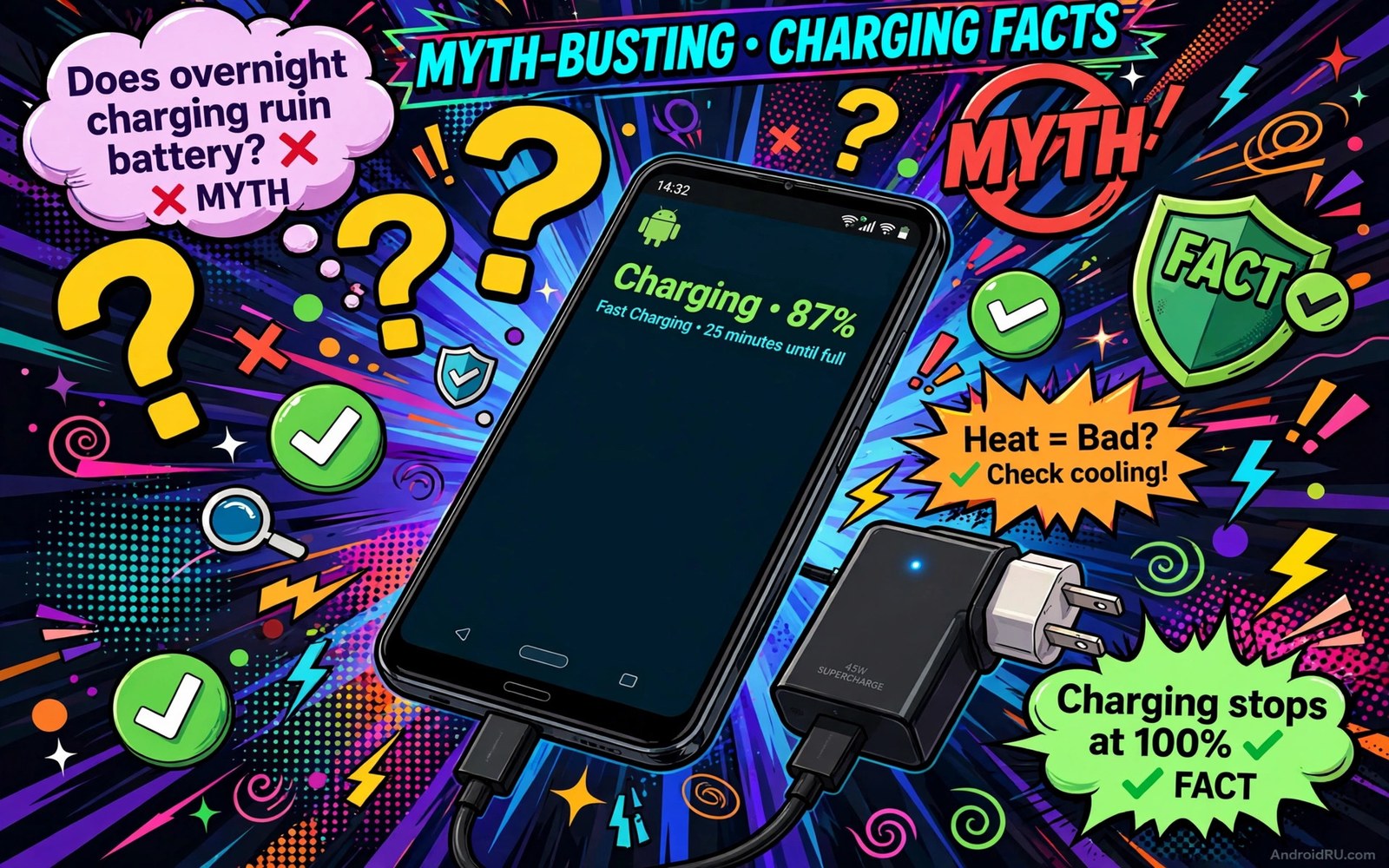
Charging advice has not kept up with modern phones. Old rules from the flip phone era still circulate as fact. Friends repeat them. Videos repeat them. Some of them were true twenty years ago. Almost none of them fit a modern lithium battery with smart charging. Believing them can waste your time and even harm your battery. This article busts five stubborn myths with clear facts.
Modern phones manage charging with smart controllers. They slow down near full charge. They limit heat when possible. They track battery health over time. Those systems changed what good charging looks like. Old habits like full drains and overnight fear no longer match the hardware. New habits matter more. Heat control and charge range and charger quality now decide battery life. Myth busting clears the way for those habits.
Each myth below gets a clear verdict and a practical replacement habit. You will learn why the myth started. You will learn what modern batteries actually do. You will learn what to do instead. No myth needs a new purchase to fix. Every replacement uses settings and habits you already control. Read through all five before you change anything. One myth alone rarely explains a weak battery.
Myth One: You Must Drain To Zero Before Charging
Old nickel batteries suffered memory effect. A partial charge could reduce their usable capacity. Users learned to drain fully before charging. Modern lithium batteries have no memory effect. Deep drains actually stress them more than partial charges do. A lithium battery prefers shallow cycles in the middle of its range. Draining to zero repeatedly ages it faster than topping up often.
The smart habit is to charge when convenient. Plug in at 30 percent or 40 percent without guilt. Top up to 70 or 80 percent for daily use. Save full charges for days when you truly need maximum life. Shallow cycles keep the chemistry calmer. They also keep you away from the stressful low end where the phone may shut down unexpectedly. A phone that never hits zero lasts longer than one drained daily.
Occasional calibration is a separate issue. A battery meter can drift over months. A single full cycle can help the meter relearn the true range. That occasional cycle is not a daily habit. Do it rarely if your meter looks inaccurate. Daily deep drains are never needed for calibration. They only add wear for no benefit.
Myth Two: Overnight Charging Ruins Your Battery
Old chargers kept pushing current after full charge. Modern phones stop charging at full and then top up only as needed. The phone does not cook all night at maximum current. It rests near full and sips tiny top-ups. That behaviour is far safer than old overnight charging. Overnight charging is not free of cost. Time spent near full charge still ages cells slowly. But it does not ruin a battery in weeks or months.
The smarter overnight habit uses a slow charger and a charge limit when available. A slow charger creates less heat. A charge limit stops the battery below full. Many phones offer an overnight mode that finishes charging just before you wake. Turn that mode on when your phone offers it. The phone then spends most of the night at a mid level. It reaches full only near wake time. That pattern cuts the aging cost of overnight charging sharply.
Heat matters more than overnight duration. A phone under a pillow overnight traps heat all night. A phone on a hard bedside table stays cooler. Move the phone to a ventilated spot for overnight charging. Remove a thick case if the phone feels warm. Those simple steps matter more than unplugging at midnight. For the long term value of charge limits see why 80 percent charge limits save battery longevity because limits and overnight habits work toward the same goal.
Myth Three: Only The Original Charger Is Safe
The original charger is a safe choice but it is not the only safe choice. Certified chargers from reputable makers meet the same safety standards. The key is certification and correct power delivery for your model. A certified charger negotiates power safely with the phone. It delivers only what the phone requests. A cheap uncertified charger may deliver unstable voltage. That instability creates heat and risks damage. The danger is poor quality not non original branding.
Check for certification marks and buy from reputable sellers. Avoid chargers with no brand and no safety marks. Check the cable too because a thin damaged cable heats up at high current. Replace frayed cables at once. A good third party charger plus a good cable is safe for daily use. An original charger with a damaged cable is not safe. Quality of the whole setup matters more than the logo on the brick.
Wattage matching also matters. A charger rated higher than your phone needs will not force extra power into the phone. The phone controls how much power it accepts. A 120W charger on a phone that accepts 25W delivers 25W. The risk comes from a charger that lies about its capability or lacks proper negotiation. Certified chargers negotiate honestly. Uncertified chargers may not. Buy certified and the wattage number on the box matters far less.
Myth Four: Fast Charging Destroys Batteries Instantly
Fast charging does increase wear but it does not destroy a battery instantly. The wear accumulates over hundreds of cycles. Heat drives most of it. Occasional fast charging costs little. Daily fast charging with heat costs more. The myth exaggerates a real effect into instant doom. That exaggeration makes users either fear fast charging entirely or ignore it entirely. Both reactions miss the balanced truth.
The balanced habit uses fast charging when speed matters. Use it before a trip or when you have only minutes to charge. Use slow charging for routine desk and overnight charging. That split keeps the speed benefit while cutting most extra wear. Keep the phone cool during fast charging. Do not game during a fast charge. Those two habits cut the heat that drives wear. For the full year long picture see how fast chargers wear batteries over 12 months and use that timeline to judge your own pattern.
Phone makers also protect fast charging with charge curves. The phone charges fastest at low levels and slows near full. Dual cell designs split the load. Cooling systems shed heat during the fast phase. Those protections reduce wear a lot compared with raw fast charging. They do not remove wear entirely. Your habits still decide how much extra wear accumulates. Cool and occasional fast charging stays close to slow charging in total wear.
Myth Five: Closing Apps And Charging Tricks Save Huge Power
Many users believe force closing apps saves large battery amounts. Android already manages background apps efficiently. Force closing an app often causes it to restart later. That restart costs more power than leaving it sleeping. The system suspends unused apps well on its own. Manual closing helps only for a misbehaving app that drains visibly. Daily mass closing wastes effort and can cost power instead of saving it.
Charging tricks like freezing a battery or charging in a fridge are dangerous myths. Extreme cold damages lithium cells. A frozen battery can crack or fail. Never put a phone in a freezer to revive it. Heat and cold both stress cells. Room temperature charging is the safe zone. Any trick that pushes the phone to an extreme temperature harms the battery it claims to save.
Real savings come from boring habits. Lower brightness. Limit background sync for heavy apps. Keep the phone cool. Use a charge range in the middle. Those habits save far more than any trick. They also protect the battery over years not just for a day. For a daily plan built on those habits see the daily battery optimization checklist and follow its plain steps instead of chasing tricks.
Charging myth replacements
Myth: Drain to zero first
Truth: Top up in the middle range often
Myth: Overnight charging ruins batteries
Truth: Slow charger plus limit beats fear
Myth: Only original chargers are safe
Truth: Certified quality matters most
Myth: Fast charging destroys instantly
Truth: Heat and frequency drive wear
Myth: Tricks and closing apps save huge power
Truth: Boring habits save the most
The summary above was written for this article as a plain list of myth verdicts and replacements. It uses no new purchase and no risky trick. Keep it as a note for the next time someone shares an old charging rule. A calm fact beats a scary myth every time.
Common mistakes
Many users drain to zero daily because an old rule told them to. Deep drains stress modern lithium cells. Top up often in the middle range instead. A shallow cycle habit adds months of useful life over years of use.
Another mistake is buying the cheapest charger on offer. Uncertified chargers can deliver unstable power. That instability creates heat and risks the phone. Spend a little more on a certified charger and a good cable. Quality here protects a far more expensive phone.
Some users fear fast charging so much they avoid it even in emergencies. Fast charging is a tool for urgent moments. Use it when speed matters and slow charging the rest of the time. An all or nothing rule wastes the tool or abuses it. Balance is the correct approach.
A final mistake is chasing tricks instead of habits. Freezer tricks and mass app closing waste time and can harm the battery. Brightness and background control and cool charging save real power daily. Boring habits beat exciting tricks every time.
FAQ
Should I unplug at 80 percent every time?
Unplugging near 80 percent helps long term health when you do not need full charge. It is not a strict rule for every charge. Use 80 percent as a daily target. Charge to full when you face a long day without a charger. A flexible target beats a rigid rule you abandon.
Is it bad to charge my phone twice a day?
Charging twice a day is fine when each charge stays shallow. Two top-ups in the middle range stress the battery less than one deep drain and full refill. Watch total heat and avoid fast charging both times. A calm twice daily pattern is healthy for modern batteries.
Do wireless chargers harm batteries more?
Wireless charging creates a little more heat than wired charging. That extra heat can add wear over time. A cool wireless pad with good airflow limits the extra cost. A hot pad under a case adds more wear. Use wired charging for routine use when heat is a concern.
Conclusion
Five myths still shape how many people charge. Deep drains do not help modern batteries. Overnight charging does not ruin them instantly. Certified third party chargers can be safe. Fast charging wears batteries gradually not instantly. Tricks and mass closing save little compared with boring habits. Heat and charge range and charger quality are the real levers. Use them calmly and your battery will last longer.
Your concrete next step is to pick one myth to retire today. Stop draining to zero and top up at 40 percent instead. Or switch overnight charging to a slow charger with a limit. Track your end of day battery for a week and see how little you lose by dropping the old rule.

