

Foldable Phone Cases: How Protection Works on Two-Piece Hinge Designs
A foldable phone is two phones joined by a hinge, and that simple fact changes everything about how a case has to work. A normal slab phone sits inside one rigid shell. A foldable opens and closes hundreds of times a month, its two halves move on a precise pivot, and a thin flexible screen bends along a crease every single time. A case that ignores that movement will fight the phone. It will jam the fold, rub the crease, trap grit near the hinge, or peel off one half at the worst moment.
I learned this the slow way, by trying four different cases on the same folding phone over six months. The cheapest one looked fine in photos and felt fine for a day, then started to catch halfway through the fold. The second one protected the corners well but left the hinge bare, and a small stone chip on a train platform found that exact spot. The third one was bulky enough to survive a drop down concrete stairs, yet it made the phone too wide for my jacket pocket. The case I still use is not the toughest or the prettiest. It is the one that treats the hinge as the main event and the two shells as its supporting cast.
This guide explains how two-piece hinge designs actually protect a foldable, where they fail, and how to pick one for the way you really use your phone. You will get a clear picture of hinge covers, shell materials, drop behaviour, cold weather, dust, and the fitting checks that catch a bad case before it damages anything. If you own a Galaxy Z Fold, a Z Flip, a Pixel Fold, or any other folding phone, the same ideas apply, because the physics of a hinge does not change with the brand on the back.
How a Two-Piece Foldable Case Actually Works
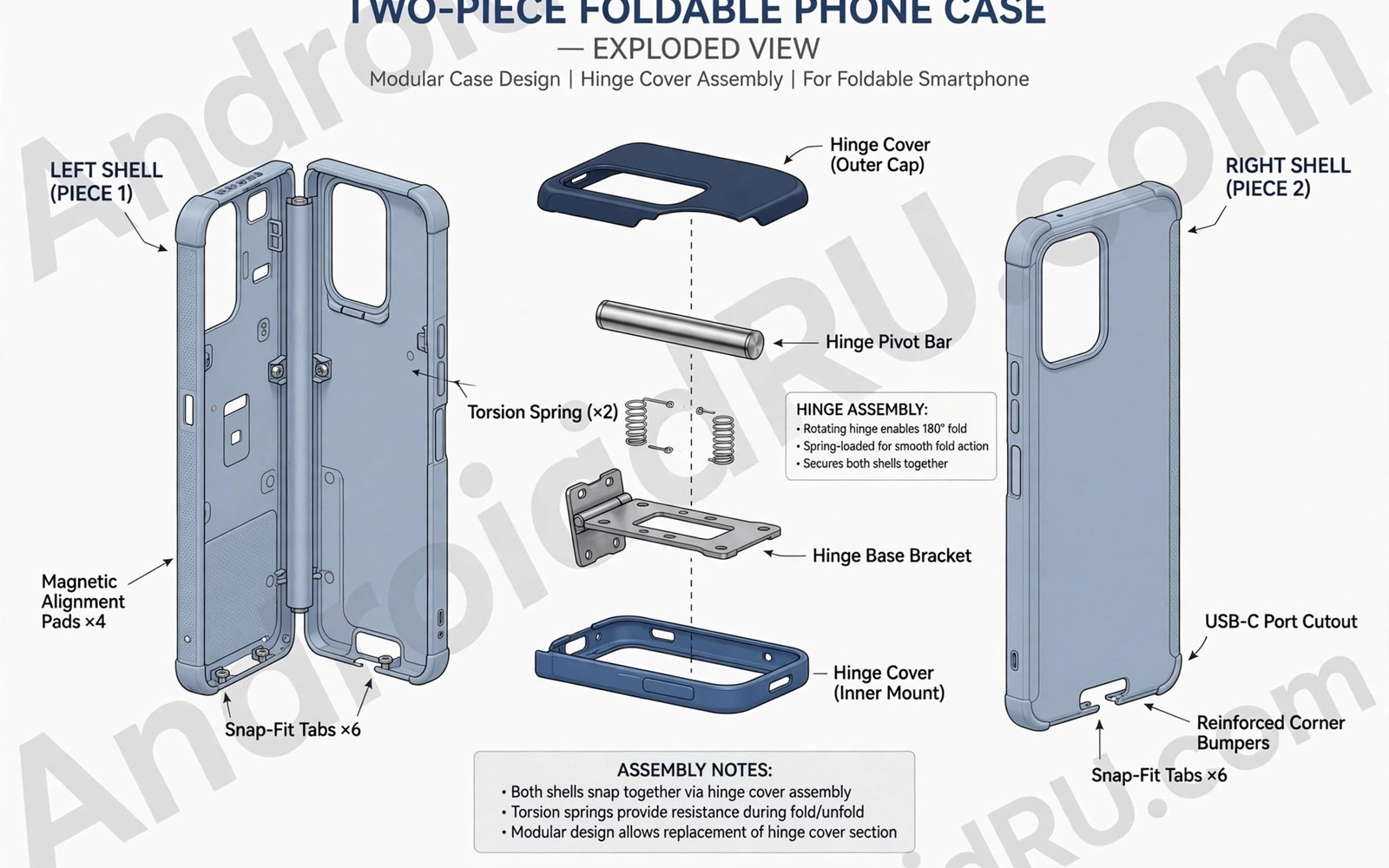
A two-piece case is exactly what it sounds like: two separate shells, one for each half of the phone, joined by a flexible bridge that covers the hinge. The top shell guards the half with the main cameras and the cover screen. The bottom shell guards the half with the battery and the charging port. When you open the phone, the bridge stretches, slides, or folds with the hinge. When you close it, the bridge tucks itself away without bunching up or pushing the halves apart.
That sounds simple, and it is simple to describe, but it is hard to build well. The two shells must stay fixed to their halves through thousands of folds. The bridge must move freely without pulling on either shell. The whole assembly must add as little thickness as possible, because a foldable is already thick when closed. A good design balances all three demands at once. A bad design solves one and breaks the other two.
The two shells and what each one guards
Each shell has a different job, because the two halves of a foldable are not identical. The camera half usually carries the largest camera bump on the phone, so its shell needs a raised ring around the lenses. Without that ring, the lenses touch every table the phone rests on. The other half often carries the fingerprint sensor in the power button on the side, so its shell needs a precise cutout that leaves the button free while still covering the edge around it.
Raised edges matter on both halves. A lip of about one millimetre around the cover screen stops the glass touching a flat surface when the phone lies face down. The same lip around the inner screen is harder to build, because the inner screen sits close to the crease, and a lip that is too tall will stop the phone closing flat. Case makers who get this right test the lip height against the exact fold angle of each model. Case makers who get it wrong ship a case that leaves a visible gap when the phone is closed.
Cutouts are the other place where quality shows. Buttons, speaker grilles, microphones, and the USB-C port all need openings that line up exactly. A cutout that is half a millimetre off will muffle a speaker or force you to push a cable in at an angle. I check cutouts before anything else when a new case arrives, because a misaligned port cutout is a sign that the rest of the fit will be sloppy too.
The hinge bridge in the middle
The bridge is the part that makes a two-piece case different from two unrelated shells. It sits over the hinge and moves with it. Some bridges are made from a stretchy band of thermoplastic polyurethane, often called TPU, that flexes every time the phone opens. Others use a sliding plate that shifts position as the hinge rotates. A few use a segmented spine, a row of small rigid pieces linked together like armour, that curls around the hinge when the phone closes.
A bridge has to do two jobs that pull in opposite directions. It must cover the hinge well enough to stop dust, grit, and direct knocks reaching the mechanism, and it must move so freely that you never feel it while opening the phone. A bridge that is too stiff will resist the fold and wear out the hinge motor or spring over time. A bridge that is too loose will flap, catch on pockets, and let grit slip underneath. The best bridges feel like nothing at all when you open the phone, and that is the hardest feeling to engineer.
Sliding plates versus flexible bands
Sliding plates give the strongest direct protection for the hinge itself. A thin metal or hard plastic plate sits over the hinge and slides a few millimetres as the phone folds, so it always covers the mechanism. The trade-off is thickness and weight. A plate adds a visible spine to the back of the phone, and on some designs it clicks faintly when it moves. Flexible bands are slimmer and quieter. A TPU band stretches across the hinge zone and follows the fold without any moving parts of its own. The trade-off is that a band can stretch out of shape after a year of daily folding, and it offers less protection against a sharp knock landing squarely on the hinge.
Adhesive strips versus clip shells
Shells attach to the phone in two main ways. Adhesive strips use a thin layer of reusable tape on the inside of the shell. They hold the shell tight against the phone, which keeps the fit slim and stops dust getting between the shell and the glass. The downside is that removing the shell for cleaning takes patience, and the adhesive loses grip after several removals. Clip shells use small hooks or a snap fit around the edges. They come off in seconds for cleaning, but they can loosen over months of use, and a loose clip shell rattles and lets grit in at the edges. If you clean your phone weekly, clips suit you. If you fit a case once and leave it alone for months, adhesive suits you better.
Hinge Cover Designs Compared: Plates, Bands and Open Hinges
Not every foldable case covers the hinge, and the choice is not a small detail. An open hinge design leaves the mechanism exposed so the phone folds as freely as it does with no case at all. A covered hinge design adds a layer between the mechanism and the world. Both approaches have real users and real reasons behind them, and the right one depends on where your phone actually spends its day.
I used an open hinge case for three months while working mostly at a desk, and it was fine. The phone folded smoothly, the case stayed slim, and nothing bad happened. Then I took the same phone on a beach weekend, and fine sand found the hinge within a day. The fold developed a faint gritty feeling that took a careful clean to remove. That weekend taught me that hinge coverage is not about drops. It is about everything small and hard that lives in pockets, bags, and outdoor air.
Sliding hinge plates
A sliding plate is the most protective hinge cover you can buy for a foldable. The plate is usually made from polycarbonate or a thin aluminium alloy, and it mounts to one shell while sliding over the other as the phone folds. Because the plate is rigid, it spreads the force of a knock across a wide area instead of letting it concentrate on one hinge tooth. If your phone falls hinge-first onto concrete, a plate is the cover most likely to save the mechanism.
The price of that protection is bulk and a different feel. A plated case adds two to three millimetres of thickness at the spine, and the phone no longer sits flat on a table when open. Some plates also interfere with wireless charging if they contain metal, so check the product notes before you buy a metal-plated case for a phone you charge on a pad every night. For people who work on building sites, ride motorbikes, or carry a phone in a tool bag, the trade is worth it. For office use, it often is not.
Flexible hinge bands
A flexible band is the middle ground, and it is the most common hinge cover on the market. The band is a strip of soft TPU or silicone that stretches when the phone opens and relaxes when it closes. It keeps dust and rain spray off the hinge, adds almost no thickness, and never clicks or rattles. Most owners will never notice it is there, which is exactly the point.
Bands do wear out. After a year of opening and closing a phone fifty times a day, a TPU band can lose its spring and start to sag. A sagging band can bunch up when the phone closes and stop it closing fully flat. The fix is simple: replace the case, or replace the band if the maker sells spares. Treat a band case as a consumable with a twelve to eighteen month life, and check the band every month by closing the phone slowly and watching whether the band folds flat or bunches.
Leaving the hinge exposed
Some owners prefer no hinge cover at all, and that choice is defensible if you understand the risk. An open hinge keeps the phone as slim as the maker intended, keeps wireless charging simple, and lets the hinge move with zero added resistance. It also means the hinge is the first thing to touch the ground in a bad drop, and the first place dust settles when the phone sits in a pocket full of lint.
If you choose an open hinge case, commit to cleaning the hinge properly. Once a week, open the phone fully, hold it hinge-down, and use a soft brush to sweep lint away from the mechanism. Never use compressed air at close range, because it can drive grit deeper into the hinge instead of out of it. Never pick at the hinge with a metal tool. A five-minute weekly clean does more for an exposed hinge than any case accessory can.
Drop Protection Realities for Foldable Phones
Cases reduce drop damage, but no case makes a foldable drop-proof, and honest makers do not claim otherwise. A foldable has more ways to break than a slab phone: the outer screen can crack, the inner screen can crack along the crease, the hinge can bend, and the two halves can shift out of alignment so the phone no longer closes flat. A case can only guard against the kinds of damage its shape actually covers.
Drop tests help, but read them with care. A maker that drops a phone from 1.2 metres onto plywood twenty-six times has tested a gentle scenario. A phone that falls from a coat pocket onto concrete is a harsher test, and a phone that falls hinge-first onto a kerb is harsher still. Military standard labels such as MIL-STD-810H describe a test method, not a guarantee, and two cases with the same label can behave very differently in real falls. Look for independent drop videos of your exact phone model and case, and watch what happens to the hinge, not just the screens.
Corner drops and hinge alignment
Corners are where most drop damage starts, because a phone tumbling through the air usually lands on a corner first. A good case puts extra material at the corners: thicker TPU, small air pockets, or a raised bumper that compresses on impact and springs back. That cushioning matters more on a foldable than on a slab phone, because a hard corner hit can twist the two halves relative to each other and bend the hinge out of true.
Hinge alignment is the damage most owners miss until it is too late. After a corner drop, open and close the phone slowly and watch the gap between the two halves. It should stay even along the whole edge. If one end closes tight while the other end shows a gap, the hinge has shifted. If the phone resists the last few degrees of closing, stop forcing it and get the hinge checked. Forcing a bent hinge closed can crack the inner screen along the crease, and that repair costs far more than the hinge check would have.
Raised lips, air pockets and inner linings
A raised lip around each screen is the cheapest protection a case offers, and it works. When a phone lands face down on a flat surface, the lip touches first and holds the glass a millimetre above the ground. That millimetre is often the difference between a scuffed case and a cracked screen. Check the lip by placing the cased phone face down on a table and sliding a thin card under the edge. If the card slides under the glass without touching the lip, the lip is too low.
Air pockets at the corners work like the crumple zone on a car. A small hollow chamber in the TPU compresses on impact, spreads the force over a longer time, and then returns to shape. Inner linings do a quieter job: a soft microfibre or foam layer inside the shell stops the hard shell scratching the phone, and it absorbs tiny vibrations that would otherwise wear the finish. A case without a lining will mark a glossy phone within weeks, especially around the camera ring and the edges of the cover screen.
Materials That Matter: Polycarbonate, TPU, Aramid Fibre and Leather
Case materials are a set of trade-offs, and every material gives something up to gain something else. Polycarbonate is hard, light, and good at spreading impact force, but it is slippery and it cracks rather than bends under a sharp hit. TPU is soft, grippy, and good at absorbing shock, but it yellows with sun exposure and stretches over time. Aramid fibre is very strong for its weight and feels dry and grippy, but it costs more and it blocks some wireless signals if the weave is too dense. Leather feels warm and ages with character, but it stains, absorbs water, and offers the least drop protection of the four.
Most good foldable cases mix materials instead of betting on one, and a hard shell with a soft bumper is the most common recipe. A common recipe is a hard polycarbonate back plate for structure, a TPU bumper around the edges for shock absorption, and a soft lining inside for the phone itself. That combination is heavier than a single-material case, but it protects better in the drops that actually happen: corner hits, face-down slaps onto tables, and hinge-first falls onto hard floors.
Hard shells versus soft shells
Hard shells keep their shape, which matters for a foldable. A shell that flexes will let the phone shift inside it, and a shifting phone rubs its own finish against the shell. Hard shells also protect better against sharp objects in a bag, such as keys and coins. The weakness of a hard shell is that it transmits shock straight to the phone when it lands on a corner, unless a soft bumper sits between the shell and the ground.
Soft shells absorb shock better and grip better in the hand, which means fewer drops in the first place. The weakness is fit: a soft shell stretches, and a stretched shell lets dust in at the edges. If you choose a soft case, check the fit monthly by pressing the shell against the phone and feeling for movement. If the shell slides, it is time to replace it, because a loose soft shell protects less than a tight hard one.
Grip, weight and pocket fit
A foldable is already a heavy phone, and a case adds 40 to 90 grams depending on the design. That weight matters more than most buyers expect, because it changes how the phone feels after an hour of reading. A case with a textured side grip can make a heavy phone feel secure, while a smooth glossy case makes the same phone feel like it wants to escape your hand. I test grip by holding the cased phone one-handed over a bed and reading for ten minutes. If my fingers ache or the phone shifts, the grip is wrong for me.
Pocket fit is the other daily test. A foldable in a case is thick when closed, and a case with a wide hinge plate can catch on a jeans pocket every time you sit down. Try the cased phone in the pocket you actually use, with the clothes you actually wear, before the return window closes. A case that survives a drop test but never leaves the house because it will not fit in a pocket is a bad case for that owner.
Cold Weather, Dust and Daily Wear on Foldable Hinges
Weather and dust wear a hinge down slowly, and the damage shows up as stiffness, noise, or a fold that no longer feels smooth. Cold is the most surprising enemy. Flexible screens and the adhesives that hold them become stiffer as the temperature falls, and a phone that folds happily at 20 degrees can feel reluctant at minus 5. The screen itself is the sensitive part: bending a cold flexible panel puts more stress on the crease than bending the same panel at room temperature.
That is why it pays to read about cold weather effects on flexible screens before your first winter with a foldable. The practical lesson is simple: keep the phone in an inside pocket close to your body when you are outside in the cold, and let it warm up for a few minutes indoors before you open and close it repeatedly. Do not force a stiff fold. If the hinge feels tight in the cold, wait. A minute of patience costs nothing, and a cracked crease costs a screen replacement.
Dust is the slow enemy, and it works all year. Pocket lint, sand, and fine grit collect around the hinge and get dragged into the mechanism every time the phone folds. A hinge cover helps, but it does not make the phone dust-proof. The best defence is a weekly clean and a case that fits tightly enough that grit cannot slip between the shell and the phone. If you work in a dusty place, choose a case with a full hinge cover and sealed edges, and accept the extra bulk as the price of a working hinge.
Why grit is the hinge’s worst enemy
Grit damages a hinge by grinding. Each fold drags tiny hard particles across the hinge surfaces, and over months that grinding wears the precise surfaces that keep the fold smooth. The first sign is a faint sandy feeling when you open the phone. The second sign is a click or a catch at one point in the fold. By the time the fold feels rough all the way through, the wear is already done.
Prevention beats repair here by a wide margin, because hinge repairs are among the most expensive phone repairs there are. Keep the phone out of sandy pockets, brush the hinge weekly, and replace a case the moment its hinge cover starts to gap. A case that lets grit in is worse than no case at all, because it traps the grit against the hinge and holds it there while you fold the phone again and again.
Choosing a Case for Galaxy Z Fold, Z Flip and Other Foldables
Foldable cases are model-specific in a way slab cases are not. A case for a Galaxy Z Fold 5 will not fit a Z Fold 6, even though the phones look similar, because the hinge shape, the camera bump, and the button positions all shift by a millimetre or two between generations. Buying a case for the wrong model is the most common mistake in this category, and it is also the most avoidable: check the exact model name in your phone settings before you order, and check it again on the product page.
Flip phones and book-style foldables need different cases for different reasons. A flip phone folds into a small square, so its case must protect the outer cover screen and the hinge while staying pocketable. A book-style foldable opens into a small tablet, so its case must protect a large inner screen and a wide hinge, and it often adds a stand or a pen holder. A case designed for one shape will never suit the other, so do not buy a generic foldable case that claims to fit both.
Price is a poor guide to quality here. I have used a 25-dollar case that outlasted a 70-dollar one, because the cheaper case had a better hinge band and a tighter clip fit. What matters is the fit on your exact model, the hinge cover design, and the material mix. Read reviews from owners of your exact phone model, not from owners of a different foldable that happens to share the brand name.
What to check before you buy
Before you buy, run through a short checklist. First, confirm the exact model and generation. Second, decide whether you need a full hinge cover or can live with an open hinge, based on where the phone spends its days. Third, check wireless charging and any pen or stand you use, because some cases block one or both. Fourth, look at the weight and the closed thickness, and compare them with the phone you carry today. Fifth, check the return policy, because fit is something you can only judge with the phone in your hand.
Think about resale too. A phone that arrives at trade-in time with a clean hinge, an unscratched crease, and a straight frame is worth noticeably more than the same phone with a gritty hinge and a scuffed frame. That is the practical side of resale value and market adoption: buyers pay for a hinge that still feels new, and a good case is the cheapest way to keep it feeling new. A case costs a fraction of the value it preserves.
It also helps to look ahead. Folding phones are changing fast, and the next designs may fold in two places or roll out instead of folding at all. Reading about rollable and tri-fold concepts shows where the hardware is heading, and it explains why hinge protection will matter even more: a tri-fold phone has two hinges to guard, and a rollable phone has a screen that slides instead of folding. The two-piece case idea will have to grow with those designs, but the core lesson stays the same, which is to guard the moving parts first.
Fitting, Cleaning and Replacing Your Case
Fitting a two-piece case is a two-minute job, and doing it right saves months of trouble. Start with clean hands and a clean phone. Wipe the phone with a soft dry cloth, and brush any lint out of the hinge. Fit the camera half first, pressing gently until the clips or adhesive seat evenly. Then fit the other half the same way. Finally, open and close the phone slowly three times and watch the hinge bridge. It should move without bunching, clicking, or pulling on either shell.
Cleaning is a weekly habit, not a monthly chore. Remove both shells, wipe the inside of each shell with a damp cloth, and let them dry fully before refitting. Brush the hinge with a soft dry brush while the phone is open and hinge-down. Check the adhesive strips if your case uses them: if they have picked up lint, wash them gently with water and let them dry, or replace them with the spares most makers include in the box. A clean case grips better and lets less grit in, so the five minutes pays for itself.
Step-by-step fitting check
After fitting, run a simple check. Open the phone fully and confirm it lies flat without rocking. Close it slowly and confirm the two halves meet evenly with no gap at one end. Press each corner of the case and confirm nothing moves or clicks. Plug in a charging cable and confirm it seats fully. Test the fingerprint sensor and the volume buttons. If any one of those checks fails, remove the case and refit it. If it still fails, the case is the wrong size or a bad copy, and you should return it rather than live with it.
The slow open-close test
The slow open-close test is the single most useful check you can do. Open the phone over five seconds instead of one, and feel for any point where the resistance changes. A good case feels exactly like the bare phone, with the same smooth resistance all the way through. A bad case adds a catch, a click, or a tight spot, usually near the fully open or fully closed position. That catch is the hinge bridge fighting the hinge, and it will wear the hinge out over time. Do this test on day one and again after a month, because bands stretch and clips loosen, and a case that passed on day one can fail by day thirty.
When to replace a case
Replace a case when the fit loosens, the hinge band sags, a clip cracks, or the shell shows a crack of its own. A cracked shell no longer spreads impact force the way it should, and a cracked clip can scratch the phone. Most two-piece cases last twelve to eighteen months of daily use. Heavy users who fold the phone a hundred times a day may need a replacement sooner. Treat the case as a consumable, like a screen protector, and budget for a new one each year. The phone it protects costs twenty times as much.
Frequently Asked Questions About Foldable Phone Cases
What makes a two-piece foldable case different from a normal phone case?
A normal case wraps one rigid body. A two-piece case guards two halves that move, so it uses two shells joined by a flexible bridge over the hinge. The bridge must protect the hinge without blocking the fold, which is a problem a slab case never has to solve. That is why foldable cases are model-specific and why a generic case that claims to fit every foldable is a warning sign, not a bargain.
How do I know if a hinge cover will damage my phone?
Fit the case, then open and close the phone slowly five times. If the fold feels exactly like the bare phone, the cover is fine. If you feel a catch, hear a click, or see the phone stop short of fully closed, remove the case at once. A cover that fights the fold will wear the hinge and can crack the inner screen along the crease. Check again after a month, because a band that stretches can start to bunch and cause the same problem later.
Can a foldable case protect the inner screen from cracking?
A case helps, but it cannot guarantee the inner screen. It protects the edges and corners, keeps the phone from landing directly on the screen, and guards the hinge that holds the two halves in alignment. It cannot stop a sharp object pressing on the crease, and it cannot stop damage from forcing a stiff fold in cold weather. Keep the phone in an inside pocket in winter, avoid pressing hard on the crease, and use a screen protector made for the inner display as well as a case.
Why does my foldable case feel loose after a few months?
Soft materials stretch and clips wear, especially on a phone that folds fifty times a day. Heat makes it worse: a phone left in a hot car will soften TPU and loosen adhesive. Clean the case weekly, keep it out of heat, and replace it when the shells move against the phone. A loose case traps grit and protects less than a tight one, so replacement is protection, not waste.
A Sensible Next Step for Your Foldable
Pick the case that matches your real days, not the toughest case on the shelf. If you work outdoors or carry the phone in a bag full of hard objects, choose a full hinge cover with a sliding plate and a hard shell. If you work at a desk and the phone lives in a clean pocket, a slim band case with a tight clip fit will serve you better and feel better in the hand. Either way, confirm the exact model, run the slow open-close test on day one, and clean the hinge every week.
Do one thing today: take your phone out of its current case, brush the hinge, check the fit of both shells, and open and close the phone slowly. If anything catches, feels loose, or leaves a gap, you have your answer, and a replacement case is the cheapest repair you will ever buy for a foldable phone.

