

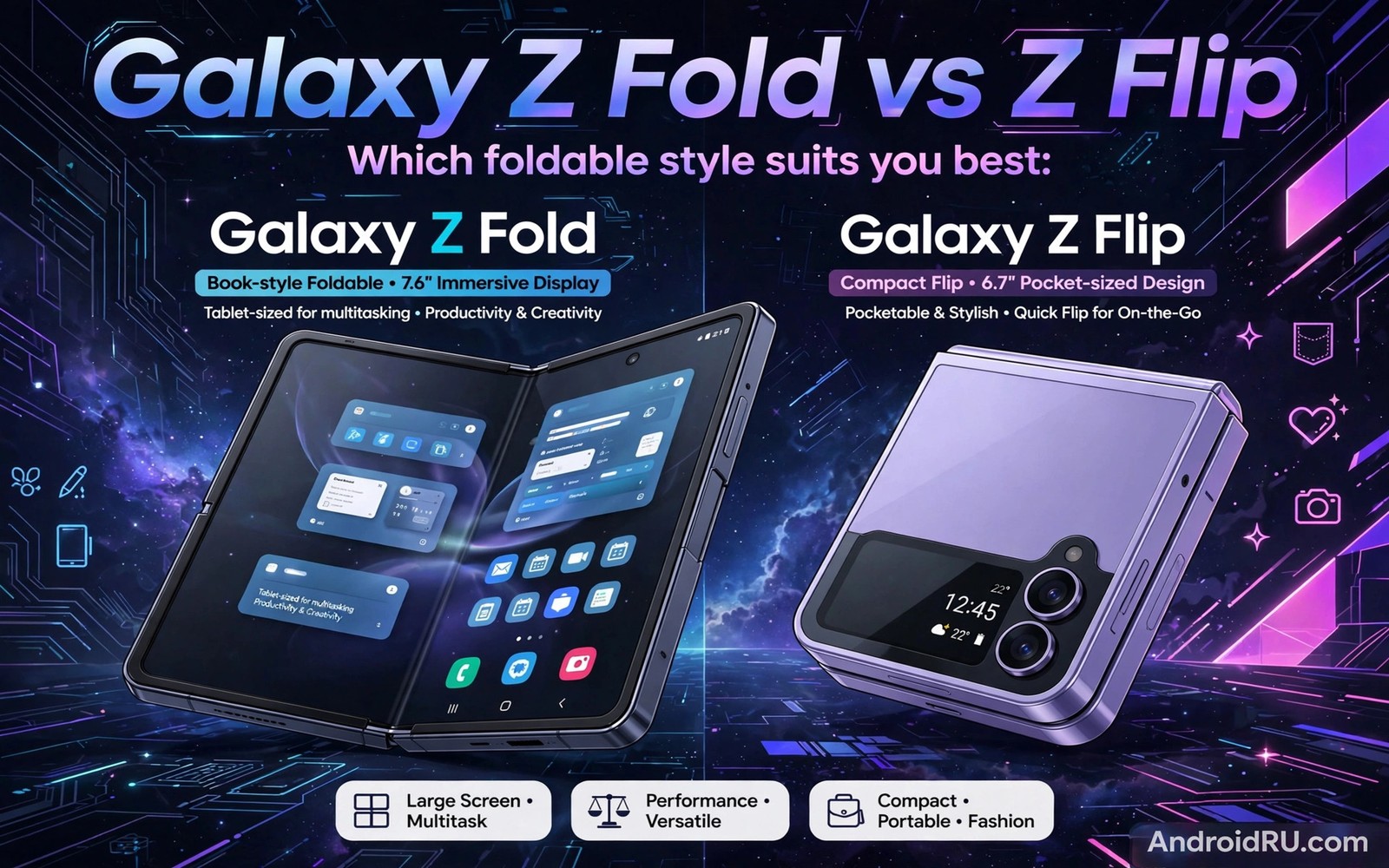
Galaxy Z Fold vs Z Flip: Which Foldable Style Suits You Best?
Both Samsung foldables fold, both run the same software, and both turn heads, yet they are built for very different days. I spent time with both shapes before choosing, and the decision came down to one honest question about my own routine: do I spend hours reading, comparing apps side by side, and working on a big screen, or do I mostly message, snap photos, scroll feeds, and want a phone that disappears into a small pocket? The Fold opens into a tablet for work and media. The Flip folds small for style and pocket comfort. Your daily routine picks the winner faster than any spec chart.
This comparison walks through both phones the way you will actually live with them: screens, multitasking, cameras, battery, price, and the small daily habits that matter more than a launch-day headline. You will find a head-to-head table, a fair look at each side with real pros and cons, and a verdict for each type of owner, because the right foldable is the one that fits your hands, your bag, and your day.
Keep your own phone nearby while you read. Compare each point against the phone in your hand and the way you spend your screen time. If tablet apps fill your day, the Fold will keep calling to you. If compact carry matters more than a big canvas, the Flip will feel like the obvious pick. Either way, test both in a shop with your own apps and pockets before you pay, because a foldable is a shape you live with, not just a screen you look at.
What the Galaxy Z Fold Is Built For
The Fold targets people who want a tablet without carrying a second device. Its inner screen, around 7.6 inches on recent generations, handles documents, spreadsheets, and video calls with room to spare. Multitasking feels natural because two apps can sit side by side at readable sizes, and a third can float above them when you need it. The outer cover screen, around 6.2 to 6.3 inches, works for calls and quick replies while you walk. It is a work tool that happens to fold, and it earns its price when it replaces both a phone and a tablet in your bag.
Galaxy Z Fold pros
- Large inner display turns the phone into a small tablet for reading, editing, and split-screen work, so documents and video calls feel relaxed instead of cramped.
- True multitasking with two or three apps on screen at once, which suits professionals, students, and anyone who compares sources while they work.
- Big preview screen for framing photos and reviewing shots large right after you take them, which helps when detail matters.
- Strong productivity software, including a taskbar and drag-and-drop between apps, that makes the big screen feel like a real workspace.
Galaxy Z Fold cons
- Heavy and thick when folded, so one-hand use is tiring and the phone feels bulky in a trouser pocket.
- High price at the top of the phone market, which only makes sense if you use the big screen daily and it replaces another device.
- Camera hardware still trails the best slab flagships in low light, despite good software processing for social sharing.
Who the Fold fits best
The Fold fits readers, students, and professionals who annotate documents, juggle email and notes, and watch video on a big screen every day. If your phone is your office for part of the day, the Fold pays for itself in comfort. If you mostly use the outer screen and never open the big one, you are paying a premium for space you rarely use, and the Flip will serve you better.
What the Galaxy Z Flip Is Built For
The Flip targets people who want a normal phone in a smaller package. It unfolds into a full tall screen, around 6.7 inches, for everyday apps and video, and it folds into a compact square that fits tiny pockets and evening bags. The cover screen has grown more useful with each generation, handling music, alerts, widgets, and camera previews without opening the phone. It is a lifestyle phone that happens to fold, and its charm is the way it disappears when you are done with it.
Galaxy Z Flip pros
- Compact folded shape fits small pockets, small bags, and jacket pockets with ease, so it is easy to carry everywhere.
- Cover screen saves time across dozens of tiny checks a day, from music controls to notifications and quick replies.
- Rear cameras face you when folded, so selfies use the better main cameras with the cover screen as a finder.
- Lower price than the Fold, closer to flagship slab phones, which makes it a gentler first step into foldables.
Galaxy Z Flip cons
- Smaller battery than the Fold, so heavy video days may need a late-afternoon top-up.
- No tablet-size canvas, so split-screen work feels cramped and long reading sessions are no better than on a slab phone.
- Cover screen is handy but limited, and most serious tasks still need you to unfold the phone.
Who the Flip fits best
The Flip fits fashion-conscious buyers, small-pocket owners, and first-time foldable buyers who want lower risk. It suits people who live in quick bursts: messages, photos, music, and short videos, with the phone folded away between them. If your day is a series of short checks rather than long work sessions, the Flip is the more comfortable companion.
Galaxy Z Fold vs Z Flip Comparison Table
The table below compares the two shapes on the criteria that decide daily life, not just launch-day specs. Prices move with deals and generations, so treat the price row as a range and check the current price before you buy. Screen sizes are for recent generations and vary slightly by model year.
| Criteria | Galaxy Z Fold | Galaxy Z Flip |
|---|---|---|
| Inner screen size | About 7.6 inches when open, tablet-like | About 6.7 inches when open, standard phone size |
| Cover screen | About 6.2 to 6.3 inches, full phone use | About 3.4 to 4.1 inches, widgets and previews |
| Multitasking | Two or three apps side by side at readable sizes | Split screen possible but cramped |
| Price range | Top of the market, often roughly double the Flip | Closer to flagship slab phones |
| Cameras | Versatile set, large preview, trails slab flagships in low light | Strong daylight and selfie quality using rear cameras |
| Battery life | Larger cell, swings with inner screen use | Smaller cell, light days fine, heavy days need a top-up |
| Portability | Heavy and thick folded, needs a larger pocket or bag | Compact square folded, fits tiny pockets and small bags |
| Best for | Work, reading, multitasking, media on a big screen | Style, compact carry, quick checks, selfies |
Read the table as a trade-off, not a scoreboard. The Fold wins on screen space and multitasking, the Flip wins on portability and price, and neither wins on everything. That said, the row that matters most is the last one: the best phone is the one whose strengths match the hours you actually spend on your phone.
How to read the price row honestly
Fold prices sit at the top of the phone market, and the cost makes sense if the phone replaces a tablet and a phone in your bag. Flip prices sit closer to flagship slab phones, and the cost buys compact design and fun rather than extra screen space. Both phones lose value like other flagships in year one, and trade-in deals often beat a private sale for hassle. Wait for a deal if either price feels steep for your habits, because Samsung foldables are discounted often, and a patient buyer can save a real amount.
Screens, Crease and Ultra-Thin Glass in Daily Use
Fold inner screens measure close to tablet size when open, so reading feels relaxed because lines stay wide and text stays large. Split screen keeps both apps usable instead of cramped, and the crease that crosses the middle fades from attention during reading, even if you can still feel it under a finger. Brightness and colour quality now match flagship slab phones in normal light, and how ultra-thin glass works explains why the inner screen can bend without shattering: a thin layer of glass flexes with a protective plastic layer above it, and that stack is the reason foldables feel like glass yet fold like paper.
Does the crease still matter after months of use?
The crease is visible at an angle and faint head-on, and most owners stop noticing it within a week of regular use. It matters more for video and reading in bright light, where a reflection can catch the fold, and less for messaging and scrolling, where your eyes follow the content. If crease worries hold you back, read about screen crease durability over time before you rule either phone out, because hinge design, screen protectors, and daily care all change how the crease ages. In practice, a crease that bothers you in the shop will bother you at home, so test it under the lighting you use most.
Cover screen habits that save time every day
Flip owners learn to live on the cover screen for small jobs: checking the time, skipping a song, reading a message preview, and framing a selfie. Fold owners live on the outer screen for calls and quick replies, saving the inner screen for tasks that need it. Both habits save battery and wear, because every job done on the small screen is a fold you did not need to open.
Apps that make the big inner display worth it
A big screen is only worth the price if your apps use it. Reading apps, note-taking apps, browsers with tabs, and video apps all gain real space on the Fold, while messaging apps gain little. The apps built for large inner displays guide lists the apps that are tuned for that canvas, and it is worth checking before you buy, because a Fold with unoptimised apps is just a heavy phone. Split-screen multitasking is the Fold feature that owners miss most when they switch back to a slab phone, and it is the clearest test of whether the big screen earns its keep in your day.
Flip inner screens match a standard phone once unfolded, so scrolling and video feel exactly like a slab phone experience. That familiarity is a strength for first-time foldable buyers, because nothing about daily use needs relearning. The trade-off is that the Flip never gives you a tablet moment, and if you buy it hoping for one, you will be disappointed. Buy the Flip for what it is, a compact phone, not for what the Fold does.
Cameras, Battery Life and Charging Compared
Fold cameras benefit from a huge preview screen for framing shots, and you can review photos large right after you take them. The main sensors still lag behind top slab flagships in low light, and software processing closes much of the gap for social sharing, but serious night photographers should test sample shots before committing. Flip cameras shine for selfies because the rear cameras face you when folded, and the cover screen acts as a finder so you see yourself clearly. Video creators love hands-free shooting with the phone half folded like a camcorder, and main camera quality sits close to flagship level for daylight shots.
Battery life in real daily use
Fold battery life swings with inner screen use. A day of light outer screen use leaves plenty of charge at night, while a day of heavy tablet use with video and multitasking drains faster, so most owners learn to mix screens and save the big screen for tasks that need it. Flip battery life reflects its smaller cell and smaller body. Light days with cover screen checks end comfortably, heavy video days may need a late afternoon charge, and wireless charging plus fast wired charging cover most top-ups. Carry a small power bank on travel days if video calls fill your schedule, because a small top-up beats a dead phone at the gate.
Charging habits that suit each shape
Both phones charge well overnight on a slow charger, which is kinder to the battery, and both take a fast charger for brief top-ups before travel. Keep one charger at home and one at work to avoid cable stress, and label chargers so family members use the right one. The Fold benefits from a short overnight charge routine because its larger cell takes longer to fill, while the Flip benefits from a small top-up habit because its smaller cell is quicker to refill.
Low light is the honest gap for both phones. Neither foldable matches the very best slab camera phones after dark, and the Fold trails a little more because its camera module is thinner to fit the folding body. That gap matters if night photography is your main hobby, and it matters little if most of your photos are daylight, food, friends, and travel. Test both in a shop at dusk if you can, because a sample shot in your own hands tells you more than a spec sheet.
Price, Value and Who Should Buy Which Foldable
Price is where the two shapes split most sharply. The Fold costs roughly double the Flip at launch in many markets, and that gap only makes sense when the big screen replaces another device or earns its keep every day. Students and professionals who read and annotate daily gain the most value, because the Fold can replace a small tablet and the bag space that goes with it. Casual users pay a premium for screen space they may rarely use, and for them the Flip is the better value.
Verdict by use case: who should pick the Fold?
Pick the Fold if tablet work fills your day, if you read for hours, if you compare documents side by side, or if one device must do the work of a phone and a tablet. Pick it if you travel light and want one screen for email, notes, and video calls. Do not pick it for prestige alone, because buying the Fold and then using only the outer screen wastes the big screen you paid for. Track your screen time for a week before you buy, and if tablet apps fill your day, the Fold earns its price.
Verdict by use case: who should pick the Flip?
Pick the Flip if compact carry matters more than tablet power, if you live in small pockets and small bags, if your phone time is mostly messages, photos, music, and short video, or if this is your first foldable and you want lower risk. Pick it if style and comfort matter to you, because the Flip is the phone you notice least in your pocket and most in your hand. Do not pick it expecting a tablet, because the Flip never gives you one, and that expectation is the most common source of disappointment.
There is no single winner for everyone, and that is the point of this comparison. The right foldable is the one that fits your day, not the one with the bigger screen or the lower price. A heavy reader who buys the Flip will miss the big canvas within a month. A light user who buys the Fold will feel the weight and the price every day. Match the shape to the routine, test both in a shop, and let your own hands and pockets decide.
Care, Accessories and Travel Habits for Foldable Phones
Weekly care for both foldables works best when it becomes a Sunday habit. Remove the case and wipe the shells and the phone body separately, inspect case edges for cracks that could press into the hinge, and clean the pockets or bags that carry lint toward the phone. A tidy carrying routine protects folding parts without extra cost, and it takes five minutes. Check battery habits during the same session, review which apps used the most power in the past seven days, and limit background work for apps that drained power without benefit.
Accessories that help most foldable owners
Accessories should start with a hinge-aware case and a spare screen protector, because those two items prevent most common damage for little money. A compact power bank covers heavy travel days without bulk, and a soft sleeve guards the phone inside larger bags. Buy quality basics before novelty gadgets, and keep one charger at home and one at work. A slow charger suits overnight charging and battery health, while a fast charger suits brief top-ups before travel.
Travel habits that suit folding phones
Airport and station routines benefit from cover screen boarding passes, so show tickets without unfolding in queues. Keep the phone folded while moving through crowds for grip safety, unfold at gates for booking changes and long reads, and back up the day photos over hotel Wi-Fi in the evening. A folded phone also survives bumps better than an open one, and charging slowly overnight in a ventilated spot means the morning starts with a full phone.
Children and guests should use foldables under clear ground rules. Explain hinge care and screen fragility before handing the phone over, use guest modes or app pins for shared use, and supervise young users during their first folding sessions. Public use also calls for awareness of both screens at once, because an open foldable shows more content to nearby strangers, so angle the large screen away from crowds during sensitive work and fold shut when conversations turn private.
Frequently Asked Questions About Galaxy Foldables
Is the Fold too heavy for daily use?
The Fold feels heavy at first next to a slab phone, and most owners adapt within a week of regular use. Two-hand use becomes normal for reading and video, and the weight fades into the background. If one-hand use dominates your day, though, the Flip feels far easier, and that difference will not fade with time.
Can the Flip survive in a small bag?
The folded Flip fits small bags and jacket pockets with ease, but it still needs a case to guard the hinge and screens. Keep keys and coins away from it in the same pocket, and a sleeve adds cheap insurance on busy days. The compact shape helps, but it does not make the phone immune to grit and drops.
Which foldable holds its value better?
Both phones lose value like other flagships in year one, and neither holds value dramatically better than the other. Limited colours and clean condition help resale later, and a documented battery and screen history also helps buyers trust your listing. Trade-in deals often beat private sale hassle, so compare both before you sell.
Which foldable is better for multitasking?
The Fold is better for multitasking by a wide margin, because two apps sit side by side at readable sizes and a third can float above them. The Flip can split its screen, but the result is cramped and suits only short checks, not real work. If multitasking is a daily need, the Fold is the only honest pick of the two.
Choose the Fold when tablet work fills your day and one device must do it all. Choose the Flip when compact carry and style matter most. Test both in a shop with your own apps and pockets, set up multitasking on day one if you pick the Fold, and set up the cover screen widgets on day one if you pick the Flip, so your new foldable feels great from the start. Share the most useful tip here with a friend who owns a foldable, because teaching a tip forces you to understand it more deeply, and your friend may share a habit that improves your routine too.

