

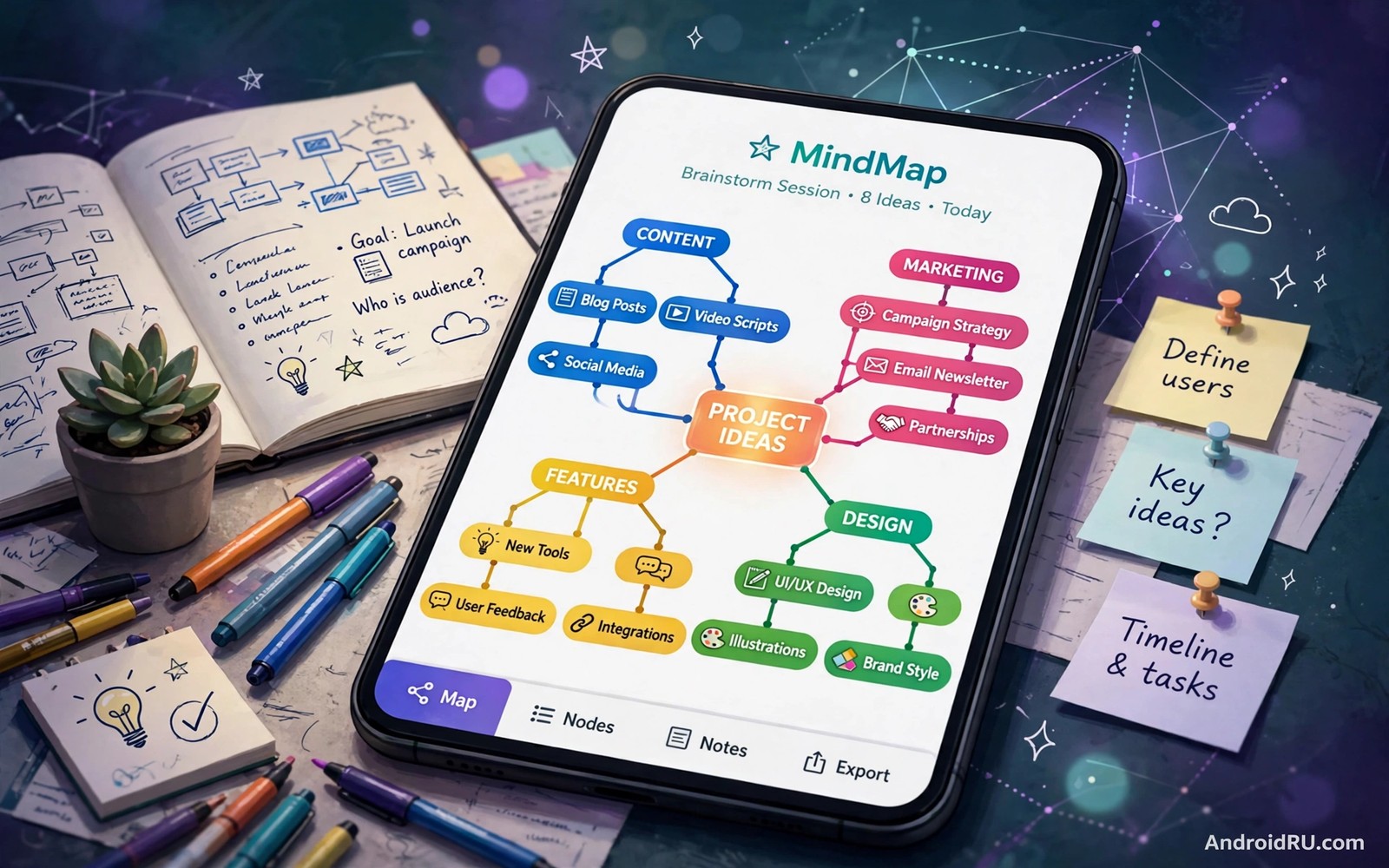
Top mind-mapping apps for Android turn messy thoughts into a visible structure. A mind map starts with one centre idea and grows branches for topics and subtopics. This article shows how to brainstorm on a phone without a map turning into clutter.
Many people brainstorm in lists and then lose the connections between ideas. A list hides which ideas belong together and which ideas conflict. A map shows connections at a glance and it reveals gaps that a list would hide.
Start with one clear question at the centre of the map. A question such as how to launch a project gives branches a purpose. A vague centre such as ideas will grow branches in every direction and help nobody. A closer look at email client apps can help you compare daily tools before you commit to one setup.
What matters most
A centre node must name the problem in a few words. A long centre label will dominate the screen and leave little room for branches. A short centre label keeps the map readable on a small phone screen.
Branches should hold one idea each rather than a paragraph of text. A branch with a paragraph becomes a note and it hides the map structure. Move detail into a note attached to the branch and keep the branch label short.
Colour and icons help when they mark status or priority consistently. A colour for done and a colour for waiting can show progress at a glance. Random colours without a legend will confuse rather than clarify a map.
How to choose the right setup
A phone mind map app needs pinch zoom and pan that feel smooth. A map that lags during zoom will frustrate brainstorming at the moment ideas flow. Test zoom and pan with a map of fifty nodes before you commit to an app.
Export matters because a map often becomes a document or a presentation. A map that exports to image or PDF or outline will travel well to a team. A map trapped inside one app will lose value when sharing time arrives.
Collaboration suits team brainstorming when many people add branches at once. A shared map needs a clear owner who tidies branches after a session. A map with many editors and no owner will grow messy within days.
A practical daily routine
Start a brainstorm by writing the centre question and setting a timer for ten minutes. Add branches fast without judging ideas during the timer. Judgement during brainstorming will stop ideas before they reach the map. A related look at voice recorder apps can show how a second tool fits the same workday without adding clutter.
After the timer sort branches into groups and delete duplicates and weak ideas. Grouping turns a raw brainstorm into a structure that can guide work. A sorted map feels calm and it shows the next steps clearly.
End the session by turning top branches into tasks with owners and dates. A map that never becomes tasks is decoration rather than planning. Tasks linked to branches keep the map connected to real work.
Costs and privacy and limits
Free mind map apps often limit maps or nodes or export options. A free plan may suit personal brainstorming with small maps. Team maps and large exports usually need a paid plan.
A mind map can hold project plans and personal ideas that deserve care. Check whether the app stores maps on its servers or only on the device. Sensitive project maps suit local storage or a trusted cloud with clear controls.
The cost of a map tool is time spent styling branches instead of thinking. A beautiful map with weak ideas helps nobody. Spend time on ideas first and style the map only when sharing time arrives.
A useful example
A mind map starts as a centre node with branches that grow outward. The script below draws a simple node and one branch as an image. Use the same centre and branch idea inside a mind map app and a messy topic will gain structure fast.
from PIL import Image, ImageDraw
im = Image.new("RGB", (800, 600), "white")
d = ImageDraw.Draw(im)
d.ellipse([350, 250, 450, 350], outline="black", width=3)
d.line([450, 300, 600, 200], fill="black", width=2)
im.save("mindmap-test.png")
print("Saved mindmap-test.png")
This simple drawing pattern follows the approach described in the official Pillow documentation for creating images and shapes. The same documentation explains how basic shapes can sketch a map node and a branch.
What to check after a week
After a week check whether maps still feel readable on a phone screen. A map with hundreds of nodes needs collapsing and filtering to stay useful. Collapse branches that are done and focus on active branches only.
After a week check export by sharing a map as an image and as an outline. A map that exports cleanly will serve a team well. A map that exports as a blurry image needs a different app or a simpler layout. A practical look at clipboard manager apps can help you judge whether your current setup still earns its place on your phone.
After a week check whether maps turned into tasks or stayed as decoration. A map habit that never creates tasks will fade within a month. Link at least one branch to a task after every brainstorm.
Deeper checks for careful users
Outlines and maps complement each other because outlines suit ordered steps and maps suit connections. A map can become an outline for writing and an outline can become a map for brainstorming. Use both views when an app offers them.
Templates for project planning and essay planning can speed the first map. A template with ready branches gives a new topic a starting shape. Customise a template after use rather than accepting its branches blindly.
A map review each week can prune branches that no longer matter. Pruning keeps a long project map readable over months. A map that never gets pruned will grow until nobody opens it.
Making the choice stick
A mind map habit sticks when the first map solves a real question in ten minutes. Choose a question that matters this week rather than a practice topic. A real question gives the map a purpose and a deadline. A practice map feels like homework and it will not stick. Use the map result in a real decision to prove its value.
A map review each week should prune branches that no longer matter. Open each active map and collapse done branches and delete dead ideas. A pruned map stays readable and inviting. A map that never gets pruned will grow until nobody opens it. A weekly prune takes ten minutes and it keeps maps alive for months.
A map and a task list together beat either tool alone for project work. Turn top branches into tasks with owners and dates after each brainstorm. A map without tasks is a picture and a task list without a map loses context. A linked pair keeps context and action together. Review the link weekly to ensure tasks still match map branches.
Colour in a map needs a legend that every reader can understand. Write the legend on the map itself or in a shared note beside it. A colour without a legend will confuse a team reader. A legend with three colours for status will clarify progress at a glance. Keep the legend stable across maps so readers learn it once.
A map export needs a test before sharing with a team or a client. Export as an image and as an outline and check readability on a phone. An export that looks blurry on a phone will fail in a meeting. A clean export will serve the team well even without the map app. Fix layout problems before sharing rather than after feedback.
A map tool earns a permanent place when maps turn into decisions and tasks repeatedly. Count maps that led to a task or a decision each month. A tool with many maps but no decisions is decoration. A tool with fewer maps and many decisions is working well. Keep the tool that drives action rather than the tool that makes pretty pictures.
A week of practice
Day one of practice should map a real question with a ten minute timer. Add branches fast without judging ideas during the timer. A fast brainstorm proves the app zoom and pan feel smooth. A laggy brainstorm shows an app problem to fix early. Note any moment when the app slowed idea flow.
Day three of practice should sort the day one map into groups and delete duplicates. Turn top branches into tasks with owners and dates. A sorted map that becomes tasks proves the workflow works. A map that stays as a picture shows a missing task step. Link at least one branch to a task after every brainstorm.
Day five of practice should export the map as an image and as an outline. Check readability on a phone and on a computer. A clean export proves the map can serve a team. A blurry export shows a layout problem to fix before sharing. Simplify the layout if export quality suffers.
Day seven of practice should review the week and count maps that led to a decision or a task. A map habit that drives decisions deserves a permanent place. A map habit that only makes pictures needs a task link fix. Decide on evidence and keep the tool that drives action.
A second week of practice should revisit the first map and check whether branches still match reality. Update any branch that changed and delete branches that no longer matter. A map updated in week two will stay useful for the project duration. A map left unchanged will slowly drift from real work. Review the map again at the end of week two and turn any new top branch into a task at once.
Common mistakes
Most mind maps fail because they grow without structure or purpose. The list below names the mistakes that turn maps into clutter fastest.
- Starting with a vague centre that grows branches in every direction.
- Putting paragraphs on branches instead of short idea labels.
- Using random colours with no legend for status or priority.
- Brainstorming without a timer or a later sorting step.
- Keeping maps as decoration that never become tasks.
- Letting a long map grow without collapsing done branches.
Each mistake above is easy to avoid with a clear centre question and short branch labels. A map that stays readable will invite more brainstorming. Keep maps small and turn top branches into tasks after every session.
Frequently asked questions
Are mind-mapping apps useful on a small phone screen?
Mind-mapping apps work on phones when maps stay small and zoom feels smooth. Large maps need collapsing and filtering to stay readable. Use a tablet or computer for very large project maps.
Can I export a mind map to a document?
Many mind map apps export to image or PDF or outline formats. Export quality varies by app and by map size. Test export with a real map before sharing it with a team.
How is a mind map better than a list?
A mind map shows connections and groups that a list hides. Lists suit ordered steps while maps suit brainstorming and planning. Use a map to explore ideas and a list to execute steps.
Conclusion and next step
A mind map works when the centre is clear and branches stay short and tasks follow brainstorming. A map that grows without pruning will become clutter. Small readable maps will guide real work better than huge beautiful maps.
Your concrete next step is to map one real question today with a ten minute timer and sort branches after the timer ends. Turn the top three branches into tasks before you close the app. A map linked to tasks will earn daily use.

