

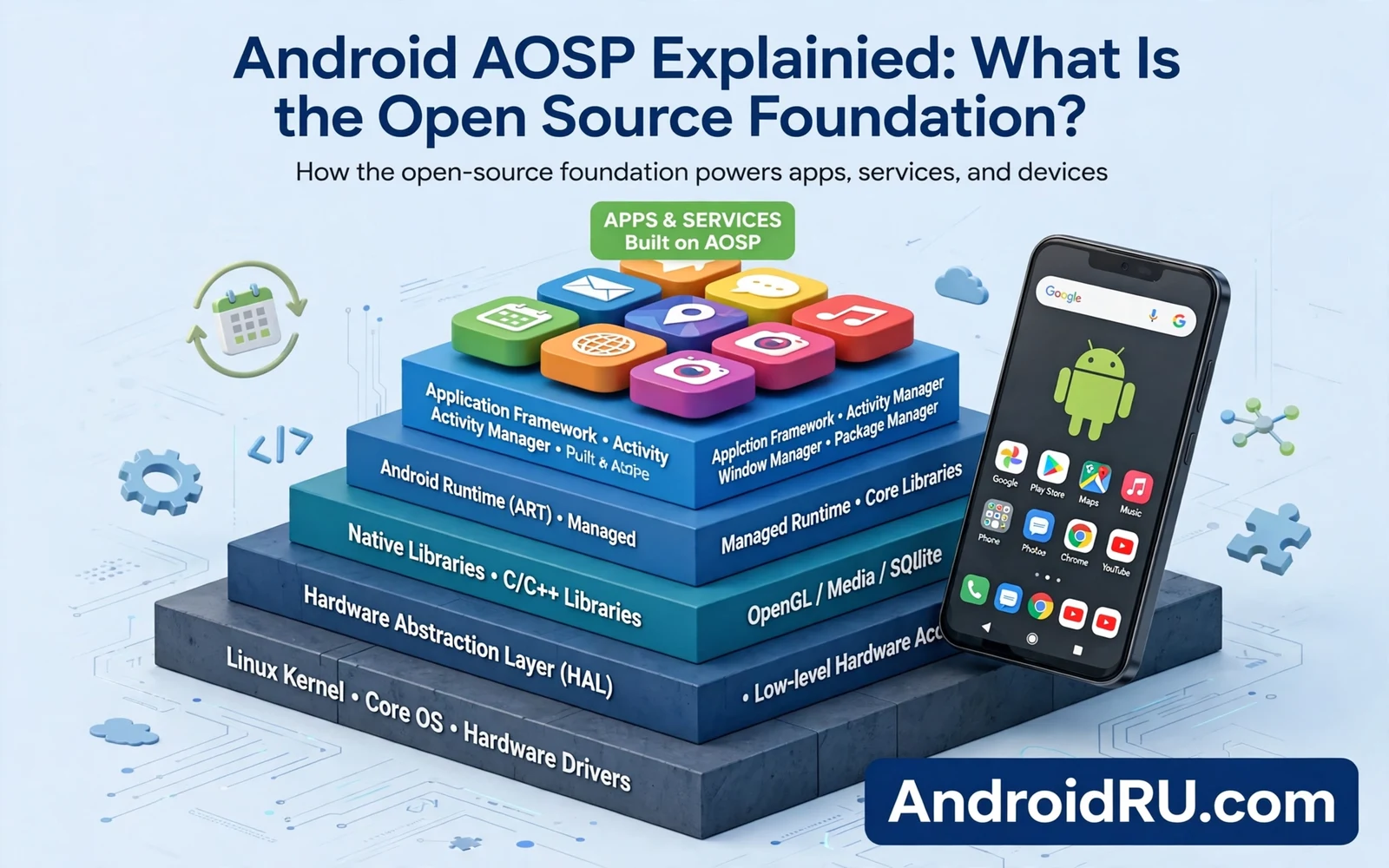
Android Open Source Project is the open foundation under Android. The short name is AOSP. AOSP contains the core system code that anyone can read and use under an open license. Phone makers take AOSP and add drivers and apps and their own layers. Google takes AOSP and adds Google services for Pixel phones and licensed devices. A custom ROM project takes AOSP and builds a lean system for a specific model. One open base supports many different Android experiences.
AOSP is not the same as the Android on a store phone. A store phone adds licensed Google apps and maker apps and hardware drivers. AOSP alone lacks those licensed parts. AOSP alone also lacks the full Google service layer. A user who installs pure AOSP would miss maps and store and many everyday apps. AOSP is a foundation rather than a finished consumer product. That distinction explains many debates about open Android.
This guide explains AOSP in plain language. It explains what AOSP contains and what it leaves out. It explains who uses AOSP and why. It explains how AOSP relates to updates and custom ROMs and app development. It also explains limits that users often misunderstand. A clear view of AOSP helps you judge claims about open phones and open software with less confusion.
What AOSP Contains
AOSP contains the kernel based system core and the runtime that runs apps. AOSP contains the framework that gives apps access to sensors and storage and network tools. AOSP contains core system apps like a basic phone app and messaging app and settings app. AOSP contains the build tools that let a maker compile the system for hardware. These parts form a working system that can boot and run apps on supported hardware.
AOSP contains the permission system that controls app access. AOSP contains the sandbox that separates apps from each other. AOSP contains the media framework that plays audio and video. AOSP contains the graphics system that draws the interface. A user may never see these parts directly. A user feels them every time an app opens smoothly and stays inside its own data space.
AOSP contains the source for the interface framework that makers customize. A maker can change colors and icons and menus on top of AOSP. A maker can add its own launcher and settings style. A maker can keep the AOSP look for a lean experience. The framework gives makers freedom within a common base. Freedom within a common base is why Android phones can look so different yet run the same apps.
AOSP evolves with each Android version. New versions add new framework features and new permission rules and new media tools. Developers can read the new source and learn the new behavior. Makers can adapt the new source for their hardware. AOSP evolution is public in a way that a closed system evolution is not. Public evolution lets independent developers follow changes without a private briefing.
What AOSP Leaves Out
AOSP leaves out Google mobile services. Google mobile services include the store and maps and account sync and push messaging tools. These services need a license from Google. A maker that wants those services must pass compatibility tests. A maker that skips the license can ship AOSP without Google services. That phone can still run many apps. That phone cannot run apps that depend on Google services without an extra step.
AOSP leaves out hardware drivers for most store phones. Drivers come from chip makers and phone makers. A driver controls the modem and camera sensor and display panel. AOSP cannot include every driver for every phone. A custom ROM project must reuse drivers from stock software for a model. Driver reuse explains why camera quality can drop on a custom ROM even when the core system is new.
AOSP leaves out maker apps and maker layers. Samsung One UI is not part of AOSP. Pixel features that depend on Google services are not part of AOSP. A maker layer can add value for users of that maker ecosystem. A maker layer can also add duplicate apps and extra services. AOSP alone is leaner than any store phone system. Leaner is not always better for a user who wants maker tools.
AOSP leaves out a finished update service. AOSP source alone does not push updates to your phone. A maker or a ROM project must build and test and deliver updates. A user who runs AOSP through a ROM project depends on that project for patches. A user who runs a store phone depends on the maker for patches. Open source gives you the code. Open source does not give you an automatic update promise by itself.
Who Uses AOSP And Why
Phone makers use AOSP as the starting point for every Android phone. A maker adds drivers for its hardware. A maker adds its own apps and settings style. A maker adds carrier features when needed. A maker then tests the result on its models. Without AOSP each maker would need to build a whole system from scratch. AOSP saves makers years of work and gives users a common app platform.
Custom ROM projects use AOSP to keep old phones alive. A project takes AOSP for a new version and adapts it for an old model. A project reuses drivers from stock software where possible. A project tests camera and modem and sensors on that model. A successful project gives an old phone a newer system and newer patches. A project with weak driver support may break camera or modem features. Model support quality varies by project and by maintainer.
Developers use AOSP to learn how Android works. A developer can read framework source to understand a permission rule. A developer can read media source to understand a playback limit. A developer can test an app against AOSP behavior before testing on store phones. AOSP reading helps developers write apps that behave well across makers. AOSP reading does not replace testing on real store phones with maker layers.
Companies that build non phone devices use AOSP too. A television maker can build a system on AOSP. A car system maker can build on AOSP. A kiosk maker can build on AOSP. A common base lets different device types share app tools and security ideas. A common base also lets developers reuse skills across device types. AOSP reaches far beyond phones even though phones made it famous.
AOSP And App Compatibility
Apps written for Android use framework interfaces from AOSP. An app that uses only those interfaces can run on many makers. An app that uses a maker specific feature may run only on that maker. Developers prefer common interfaces when they can. Common interfaces give an app a wider audience. Maker features give an app a special ability on one brand at a cost in reach.
Google service interfaces sit beside AOSP interfaces. Many popular apps use Google service interfaces for maps and sign in and push messages. An AOSP phone without Google services may fail to run those apps fully. A user can add Google services through an official licensed path on a supported device. A user cannot add Google services safely through a random file on any device. Random files can hide harmful code and break updates.
Compatibility tests protect app developers and users. A licensed Android device must pass tests that check framework behavior. Tests check that apps behave the same on different makers. Tests check that permissions work as documented. Tests check that core features work as expected. A device that passes tests gives developers confidence. A device that fails tests may run apps in strange ways.
Version targeting links AOSP to app behavior. An app can target a newer framework version for new features. An app that targets a newer version faces stricter permission rules. An app that targets an older version may face compatibility limits on new phones. Developers balance new features against audience reach. Users benefit when developers target modern versions because modern rules protect privacy better.
AOSP Custom ROMs And Daily Use
A custom ROM built on AOSP can feel clean and fast. A clean system leaves more memory for your apps. A clean system leaves more storage for your files. A clean system gives you control over themes and features. A clean system also needs maintenance from you. You must track ROM updates and known issues. You must keep a backup before each flash. You must accept that banking apps may refuse a modified system.
Driver quality decides whether a custom ROM feels good daily. A ROM with full camera tuning can take strong photos. A ROM with partial camera tuning can take weaker photos. A ROM with full modem support can hold calls and data reliably. A ROM with partial modem support can drop calls in weak areas. Check camera and modem reports for your exact model before you flash. A ROM that works well on one model may work poorly on another model.
Security on a custom ROM depends on update speed and maintainer care. A well maintained ROM delivers patches promptly. A well maintained ROM documents known issues clearly. A poorly maintained ROM may lag on patches for months. A poorly maintained ROM may leave driver flaws open even when the core system looks new. Judge a ROM by its update history rather than by its feature list alone.
Root access often accompanies custom ROM use but it is not the same as AOSP. AOSP does not require root. Root gives apps deeper system access on a modified phone. Root can enable powerful tools and customization. Root can also let a careless grant cause deeper harm. Grant root only to apps that you trust and that need it for a clear job. Review root grants regularly on any rooted phone.
AOSP And Updates
AOSP releases follow Android version releases. Each version brings new source for makers and ROM projects. Makers adapt the new source for their models. ROM projects adapt the new source for supported models. Adaptation takes time and testing. A new AOSP version does not mean that your phone updates at once. Your phone updates when your maker or ROM project finishes adaptation.
Module updates build on AOSP in a modern way. Core parts of AOSP can now update as modules on supported phones. Module updates bring media and network and permission fixes faster than full releases. Module updates still depend on maker support for delivery. AOSP gives the shared code. Module delivery gives the faster path for some of that code. Both parts matter for update speed.
Security patches for AOSP parts reach users through makers and ROM projects. A flaw found in AOSP code can be fixed in source. A fix in source does not update your phone by itself. Your maker or ROM project must build a patch that includes the fix. Your phone must install that patch. Check patch dates rather than assuming that a public fix already protects you.
Long term support for AOSP based projects depends on volunteers and makers. A popular model may attract a strong ROM community for years. An unpopular model may attract little ROM support. A flagship maker may support a model for many years. A budget maker may support a model for a short time. Community strength and maker policy together decide how long an AOSP based phone stays current.
Common Misunderstandings About AOSP
One misunderstanding is that AOSP means free of Google entirely in daily use. AOSP source is open. A store Android phone still uses Google services under license. A custom ROM user may add Google services separately. A user who wants no Google services can run AOSP without them and accept app limits. Open source and Google services are separate questions. Answer each question on its own terms.
Another misunderstanding is that open source means fully secure by itself. Open code lets many eyes review it. Open code also lets attackers read it. Security comes from review and patching and testing together. A flaw in open code can still harm users until a patch reaches phones. Openness helps security when patches flow fast. Openness alone does not close a flaw.
Another misunderstanding is that AOSP phones always update faster. AOSP phones through a strong ROM project can update faster than a slow maker. AOSP phones through a weak project can update slower than a good maker. Update speed depends on the team that builds and delivers updates. AOSP is the starting material. The delivery team decides the speed.
Design and privacy grew era by era across Android history from Cupcake to Android 15 on top of that open base. Each era added framework features that makers and developers could share. A shared base let the whole platform grow faster than any single maker could grow alone. A user who knows that growth can judge new versions with less hype.
Core AOSP parts now update as modules because how Project Mainline is changing Android updates uses common code across makers for media and network and permission areas. A common module makes faster fixes possible for many phones at once. Faster fixes help users who never think about modules at all. Faster fixes also help developers trust core behavior more widely.
Performance and camera quality and patch speed all shift when a maker layer is replaced by an AOSP based ROM and Android stock versus custom ROM performance weighs those shifts in daily use. A user who understands AOSP can judge that trade with clearer eyes than a user who only hears the word open. Camera tuning often decides the trade more than raw speed. Patch history often decides the trade more than a feature list.
Quick Checklist
- Learn what AOSP contains before judging an open phone
- Check driver support for camera and modem on your model
- Check ROM update history before flashing
- Back up before any system change
- Test banking and work apps on a modified system
- Review root grants on a rooted phone
- Check patch dates rather than assuming a fix arrived
- Compare maker support length before buying

