

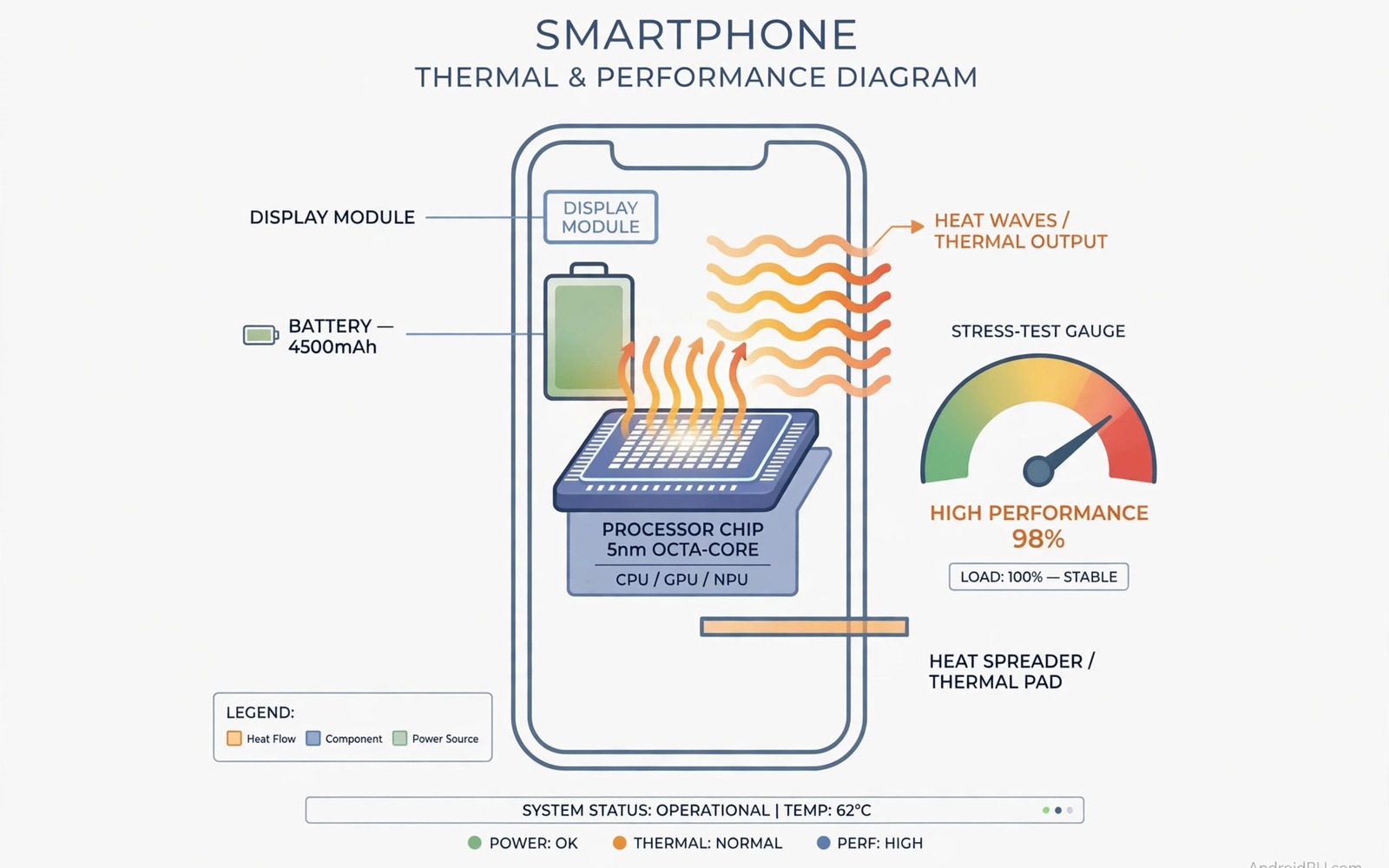
Some Android games push hardware harder than any benchmark app. They combine large open worlds with dense crowds and complex lighting. They demand a fast processor and a strong graphics chip and plenty of memory at once. This guide picks seven heavy games that will stress test any chip. It also shows you how to use them as a test without damaging your phone. A stress test is a diagnostic tool. It is not a contest to overheat a device.
Start with a cool phone and a full battery for a fair test. A hot phone will throttle and give a low result. A low battery can trigger power saving and give a low result. Charge the phone and let it cool. Close other apps before the test. A clean start gives a repeatable result. Run the same test scene each time. A repeatable scene makes comparisons meaningful across phones and across updates.
Choose a test scene that stresses the game fully. A quiet menu does not stress hardware. A busy city street with traffic and crowds does. A large battle with many effects does. A fast drive through a detailed world does. Use the busiest scene you can find in each game. A busy scene reveals frame drops and heat problems that a quiet scene hides. Note the scene name so you can repeat it later. Why thermal throttling kills gaming FPS explains why a phone that starts fast can slow down during a long heavy test.
Seven Heavy Games That Stress Any Chip
The first game is a large open world title with a living city. Traffic and pedestrians fill the streets. Weather and lighting change dynamically. The second game is a fantasy role playing title with huge landscapes and detailed character models. Long draw distances stress the graphics chip. The third game is a team shooter with large maps and many players. Fast action and effects stress both processor and graphics. The fourth game is a racing game with detailed cars and tracks. Reflections and shadows add to the load.
The fifth game is a strategy game with hundreds of units on screen. The processor must track each unit and its path. The sixth game is a survival game with a large map and building systems. Player built structures add to the rendering load over time. The seventh game is a flight or space title with vast distances and detailed ships. It stresses memory with large textures and long views. Together these seven cover city and fantasy and shooter and racing and strategy and survival and flight play. A phone that handles all seven smoothly is a strong gaming phone.
Test each game at its default high settings first. Default high settings are a fair baseline. Do not max every setting on the first test. A maxed test can overheat a phone quickly and give a misleading result. A default high test shows real world performance. After the baseline test you can raise one setting and test again. A stepwise climb shows where the phone limit truly lies.
Run A Safe Stress Test
Limit each heavy test to fifteen minutes. Fifteen minutes is long enough to reveal throttling. It is short enough to avoid extreme heat. Watch temperature during the test. If the phone becomes uncomfortably hot then stop the test. Let it cool before the next game. A test that damages a phone is a failed test. Safety matters more than a number. Use a room with normal airflow. Do not test under a blanket or a pillow.
Record frame rate and temperature at three points. Record at the start and at five minutes and at fifteen minutes. A phone that holds frame rate across all three points is stable. A phone that drops sharply after five minutes is throttling. A phone that drops gradually may be heat limited. A phone that drops instantly may be settings limited. Three points turn a vague feeling into a clear pattern. Write the numbers down for comparison.
Test with a case off for one run and with a case on for another run. A thick case can trap heat and worsen throttling. A thin case may have little effect. Knowing the case effect helps you choose a case for long sessions. A gaming case with ventilation can help. A fashion case with thick insulation can hurt. Test the exact case you use daily. A lab result without your case is less useful.
Read Stress Test Results Correctly
test_duration = 15_min
settings = high_default
case = off
battery_start = 100
record_points = start_5_15
The snippet above is an original example written for this guide. It shows generic settings that you can adapt to your own device. It does not copy code from any outside source.
Use the test plan above as a standard for all seven games. It uses fifteen minutes and default high settings and a case off start and a full battery. It records at start and five minutes and fifteen minutes. A standard plan makes results comparable. A different plan for each game makes comparison meaningless. Standardise the test before you compare phones or settings. A standard test is a fair test.
Compare Phones Fairly With Heavy Games
Compare phones with the same game version and the same settings. An update can change performance sharply. A phone tested on an old version cannot be compared fairly with a phone tested on a new version. Note the game version in your results. Note the phone system version as well. A system update can change throttling behaviour. Fair comparison needs matching versions.
Compare results across games rather than relying on one title. A phone can excel in a shooter and struggle in a strategy game. A single game result can mislead. A set of seven results gives a fuller picture. Look for a phone that is consistently strong across genres. A phone that is strong in only one genre may have a narrow strength. A balanced phone is better for a varied library.
Do not judge a phone only by peak frame rate. Sustained frame rate matters more. A phone that peaks at 120 frames and drops to 30 frames after ten minutes will feel worse than a phone that holds 60 frames steadily. Sustained performance is the real gaming experience. Peak numbers look good in marketing. Sustained numbers feel good in play. Choose sustained performance when you buy. Cheap thermal cooling hacks for hot phones can help a throttling phone hold a steadier rate.
Use Heavy Games To Find Your Phone Limit
A heavy game can reveal the best settings for your phone. Start at high settings and lower one setting if frames drop. Lower shadows first because shadows cost a lot for a modest visual gain. Lower reflections next. Keep texture quality high if memory allows because textures affect looks more than shadows. A tuned setting that holds steady frames is your personal limit for that game. Save it per game.
Use heavy games to test a new phone before the return window closes. A return window is short. A heavy test in the first week can reveal a throttling problem early. Test all seven games in that week if possible. A problem found early can be returned or exchanged. A problem found after the window closes is yours to live with. Early testing protects a purchase.
Do not run heavy tests daily just for numbers. Daily stress tests wear a battery and generate heat for no benefit. Test when you need to compare a setting or a phone. Test after a major update. Otherwise just play games normally and enjoy them. A phone is a tool for play rather than a lab instrument. Use tests sparingly and purposefully. Optimising RAM allocation for heavy mobile games helps heavy games run smoother without extreme settings.
Test heavy games with different network conditions if they are online titles. A weak network can cause stutter that looks like hardware weakness. Test an online heavy game on a strong Wi-Fi connection first. Then test it on a weaker connection. If performance drops only on the weak connection then network is the cause. A hardware test needs a stable network to be fair. A fair test separates network problems from chip problems.
Keep a spreadsheet of heavy game results if you test many phones. Columns for phone model and game and settings and frame rate at three points make comparison easy. A spreadsheet can reveal patterns across phones. A phone that throttles in every game has a cooling problem. A phone that struggles in only one genre has a narrow weakness. Patterns guide a smarter purchase than a single score.
Use these extra checks before you publish a test result.
Common Mistakes
One mistake is to test with a hot phone and blame the game. Heat alone can ruin a test. Another mistake is to max all settings on the first run. A maxed run can overheat quickly and mislead. A third mistake is to judge a phone by one game only. A balanced result needs several genres. A fourth mistake is to ignore battery level. Low battery can trigger a cap that looks like weak hardware.
Do not run a stress test under a blanket or in a hot car. Poor airflow can cause extreme heat. Extreme heat can damage a battery over time. Test in a normal room with airflow. Safety is more important than a test number. A safe test gives a useful result. An unsafe test risks hardware for no benefit.
Why One Heavy Game Cannot Judge a Whole Chip
Different heavy games stress different parts of a phone, so a single title can flatter or condemn a chip unfairly. A large open-world game leans hard on graphics and memory bandwidth as it streams a detailed city, while a dense strategy game leans on the processor for unit logic and pathfinding, and a fast shooter leans on sustained frame pacing and input response. A chip that handles one of those loads comfortably may still struggle with another.
Sustained performance matters more than the first few minutes. A phone that opens at a high frame rate can still throttle once heat builds inside a thick case or in a warm room. Repeat the same busy scene at the start and after five and fifteen minutes. Those three readings reveal whether the phone holds its speed or merely starts fast and fades.
Use a small set of games across genres. Keep the same graphics settings and resolution for every phone you compare and record frame rate and heat and battery drain together. A fair comparison is not one spectacular score but a consistent picture across several demanding scenes, and that picture is far more useful when you choose a phone for daily gaming rather than for a single benchmark run.
Frequently Asked Questions
Will heavy games damage my Android phone?
No normal play will not damage a healthy phone. Phones throttle to protect themselves from heat. Limit stress tests to fifteen minutes. Stop if the phone becomes uncomfortably hot. Test in a room with airflow. Avoid testing under a blanket.
Why does my phone slow down during a heavy game?
Heat causes throttling. A processor reduces speed to cool down. That reduction drops frame rate. A cooler phone holds speed longer. Remove a thick case and play in a cool room. Lower shadows first to reduce load.
Which heavy game is best for testing a new phone?
Use several games across genres rather than one title. An open world game tests graphics. A strategy game tests processor load. A shooter tests fast action. A set of results gives a fairer picture than a single game score.
Conclusion
Pick one heavy game from this guide today and run a fifteen minute test with a cool phone and default high settings. Record frame rate at start and five minutes and fifteen minutes. That simple record will show whether your phone holds steady or throttles under load.

