

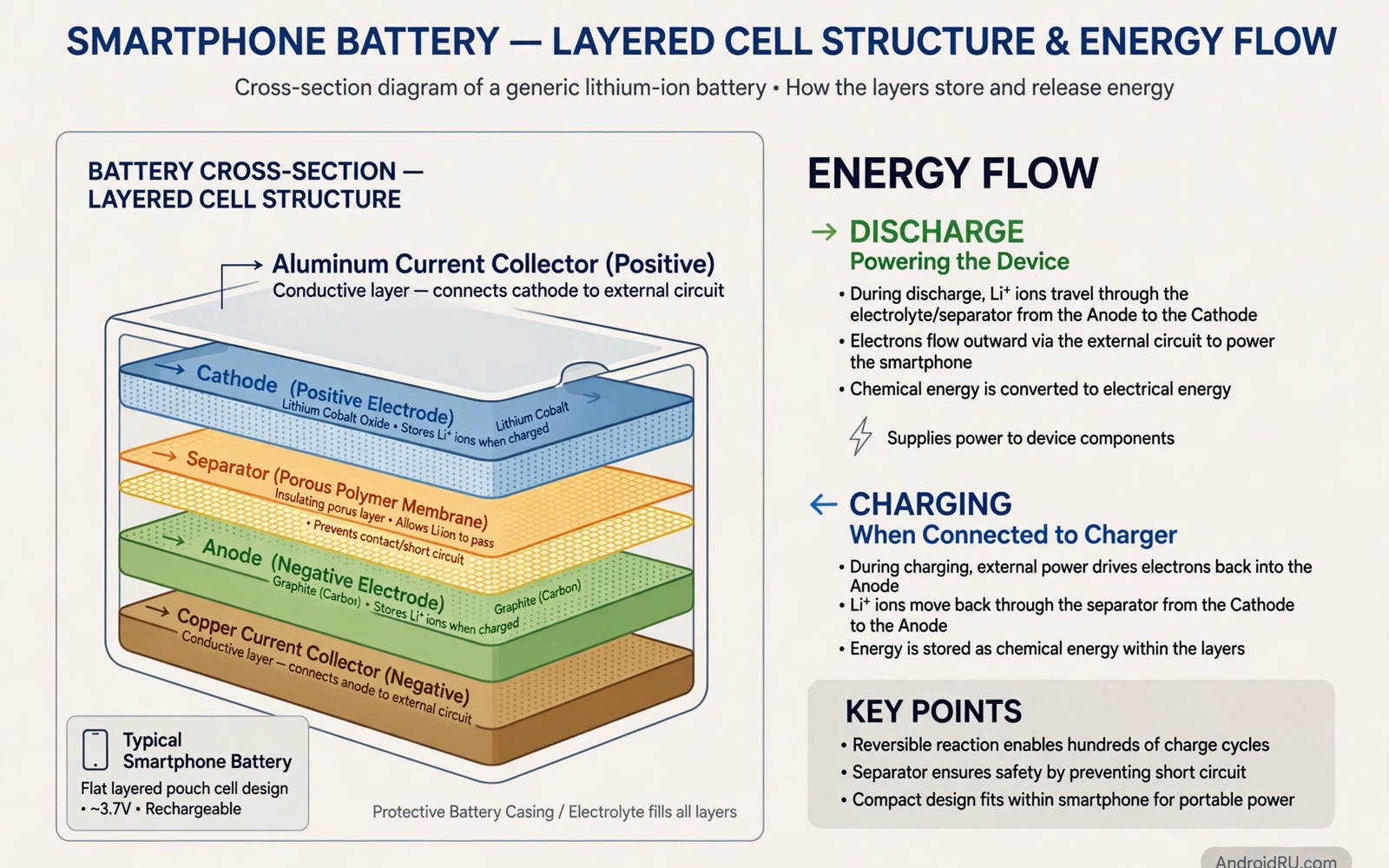
Battery life has improved slowly for years. Phones got faster and brighter and more capable. Battery capacity grew only a little because the chemistry inside stayed largely the same. That long plateau is now ending. New materials and new charging designs and smarter software are arriving together.
The most important change is the anode material. Traditional graphite anodes store a limited amount of lithium. Silicon can store far more lithium in the same space. Silicon carbon designs mix silicon with a stable structure to control swelling. The result is more energy in a similar size. A phone can last longer without becoming thicker or heavier.
Charging is changing too. Higher power charging is becoming safer through better heat control and staged charging curves. Software now learns your routine and slows charging near full when you do not need speed. Together these changes could give users both longer days and longer battery lifespans. The details matter more than the headline watt number.
Silicon Carbon Cells Explained Simply
A battery cell has an anode and a cathode and an electrolyte between them. Lithium ions move between the anode and the cathode during charge and discharge. Graphite has been the standard anode because it is stable and cheap. Its capacity is limited by its structure. Silicon can hold many more ions but it swells as it absorbs them.
Silicon carbon cells solve swelling by using silicon in small particles inside a carbon scaffold. The scaffold gives room for expansion without cracking the cell. This design keeps capacity high while it improves cycle life. Early versions had trade offs in cost and heat. Newer versions balance those factors better for mass production.
For a user the benefit is straightforward. A phone with the same physical battery size can hold ten to twenty percent more energy in practical designs. That gain can turn into an extra few hours of screen time. It can also allow a thinner phone with the same battery life as before. Manufacturers will choose different balances for different models.
Faster Charging Without Faster Damage
Fast charging once meant high heat and faster wear. New designs split a battery into two cells that charge in parallel. Each cell sees less stress than a single cell at the same total power. Cooling paths move heat away from the cells faster. Charging curves slow down near full where damage risk is highest.
Software adds another layer. A phone can learn that you usually unplug at seven in the morning. It can charge quickly to eighty percent and then finish slowly before wake time. This reduces time spent at high voltage and high heat. The phone still feels fast when you need a quick top up. It simply avoids unnecessary stress during a long overnight charge.
Wireless charging is also improving. Better coil alignment and cooling reduce wasted energy as heat. Over the air concepts remain early and inefficient for phones. They may suit small accessories first. For a main phone a cable or a well designed pad remains the practical fast option. This progress mirrors the future of charging with very high speeds and wireless power where headline numbers matter less than heat and lifespan.
Smarter Power Management
Hardware gains mean little if software wastes energy. Modern power management learns which apps you use and when you use them. It can delay background refresh for apps you rarely open. It can lower refresh rate on static screens. It can dim the display in a smart way without making text hard to read.
Display technology helps too. Newer panels use less power at high brightness. Variable refresh rates drop to a low rate when nothing moves. Processors use efficient cores for light tasks and powerful cores only for heavy work. These small savings add up across a day. A battery gain of ten percent from chemistry plus ten percent from efficiency can feel like a major upgrade.
Users can support this system with simple habits. Keep brightness on auto in most cases. Limit background use for apps that do not need instant alerts. Avoid gaming while charging at high power. These habits do not replace better chemistry. They simply let the new hardware reach its full potential.
What to Check Before You Buy for Battery
Do not judge a phone by milliamp hours alone. A larger number on a spec sheet does not guarantee longer real use. Screen size and brightness and processor efficiency change the result. Look for independent battery tests that match your use. A video playback test and a mixed use test tell different stories.
Check charging claims carefully. A claim of full charge in twenty minutes may apply only with a specific charger and a cool phone. A claim may also slow down after many cycles. Ask whether the phone supports a charge limit for daily use. A limit at eighty percent can extend lifespan for users who do not need full range every day.
Check 1: Battery capacity in mAh
Check 2: Charger power and charger in the box
Check 3: Charge limit setting for daily use
Check 4: Heat during a 30 minute charge test
Check 5: Screen on time in mixed real use
The checklist above is an original example written for this guide. It is not copied from a vendor document and it does not require a special app or a paid tool. Use it to compare phones on equal terms rather than on headline numbers alone.
Common mistakes
One mistake is to chase the highest watt number. Very high charging creates heat that can shorten lifespan if cooling is poor. A well cooled sixty watt system can be kinder than a poorly cooled one hundred watt system. Judge the full system rather than one number.
Another mistake is to keep a phone at one hundred percent all day on a charger. High voltage and heat accelerate wear. If you work at a desk then use a charge limit or unplug once full. Small changes in daily routine can add months to useful battery life.
A third mistake is to assume that a new battery chemistry fixes bad software habits. A social app that refreshes constantly can still drain a larger battery. Review background permissions and notification settings after you buy a new phone. Hardware gains should not excuse wasteful settings.
A final mistake is to buy a cheap charger with no safety certification. A poor charger can deliver unstable power and excess heat. Use a charger that matches the phone maker guidance for power and protocol. Saving a small amount on a charger is not worth risking a battery.
Frequently Asked Questions
Will silicon carbon batteries last longer than current batteries?
They can last longer when the design controls swelling well. Cycle life depends on chemistry and heat and charging habits. A good design plus a charge limit gives the best long term result.
Is fast charging safe for daily use?
Yes when the system manages heat and slows near full. Occasional fast charging is fine. Daily fast charging at high heat is less kind than slower charging. Use fast charging when you need speed and slower charging when you have time.
Can I replace a silicon carbon battery later?
Replacement depends on the phone design and parts availability. Many modern phones use glued batteries that need professional service. Check repair options before you buy if long term ownership matters to you.
How Battery Upgrades Change Phone Design
Better battery chemistry gives designers new choices. They can keep the same thickness and offer longer life. They can make a phone thinner while they keep the same life. They can also add a larger screen or a stronger processor without shortening the day. Each choice serves a different buyer.
Thinner phones are not automatically better. A very thin phone can feel fragile and can heat faster during charging. A phone with the same thickness and a larger battery often serves users better. Makers should explain which choice they made and why. A buyer who values endurance should not have to guess from a spec sheet.
Repair also changes with new chemistry. A battery that lasts longer reduces the need for early replacement. When replacement is finally needed the process should still be affordable. A long lasting battery locked behind an expensive repair is a weaker benefit. Design for longevity must include design for service.
Battery Myths That New Chemistry Will Not Fix
New battery chemistry will not fix the myth that a battery can be restored to new condition by fully draining it. Modern lithium batteries do not need a full drain cycle. Deep drains actually accelerate wear. A phone battery meter may need calibration in rare cases. That calibration does not restore lost capacity. It only improves the accuracy of the percentage display.
Another myth is that a larger battery always means a longer lasting phone. A larger battery in a phone with a power hungry screen and processor may last less than a smaller battery in an efficient phone. Software optimisation and display efficiency matter as much as capacity. Judge a phone by real screen on time in mixed use rather than by milliamp hours alone.
A third myth is that wireless charging always damages batteries more than wired charging. Poorly designed wireless charging with excess heat does damage batteries. Well designed wireless charging with good alignment and cooling is comparable to wired charging at similar power. Heat is the real factor in both cases. A cool charge is kind regardless of the method used.
Charging Habits for a New Battery Phone
Overnight charging should use a slow charger and a charge limit when possible. A slow overnight charge creates less heat than a fast charge. A limit at eighty percent reduces time at high voltage. Together these habits protect a new battery from its first weeks of use.
Travel charging should use fast charging only when time is short. A quick top up before a flight is a good use of fast charging. A full fast charge at a hotel overnight is unnecessary. Use the slower hotel charger and let the phone finish gently.
Heat management should guide every charging decision. If a phone feels hot during charging then remove the case and move it to a cooler spot. If heat persists then switch to a slower charger. A cool phone charges more safely than a hot phone at any speed.
Case choice also affects charging heat. A thick case can trap heat during fast charging. A thin case or no case during charging allows heat to escape. Remove a thick case for a fast charge and replace it afterwards.
A monthly battery check keeps habits honest. Note screen on time and heat during charging and any sudden drops in endurance. A gradual decline is normal. A sudden drop may signal a faulty charger or a rogue app. Early detection prevents a small problem from becoming a battery failure.
Conclusion
Smartphone battery technology is about to improve in a real and measurable way. Silicon carbon cells offer more energy in a similar size. Better charging designs and smarter software protect that energy from heat and waste. The result should be longer days and longer lifespans rather than only thinner phones.
Your concrete next step is to test your current phone for one week with a charge limit and background review. Note your screen on time and your heat during charging. That baseline will show whether a new battery phone solves your actual problem. For wider platform context read about whether desktop mode can replace laptops and industry trends that show where mobile tech is heading to see how battery gains fit into the larger future.

