

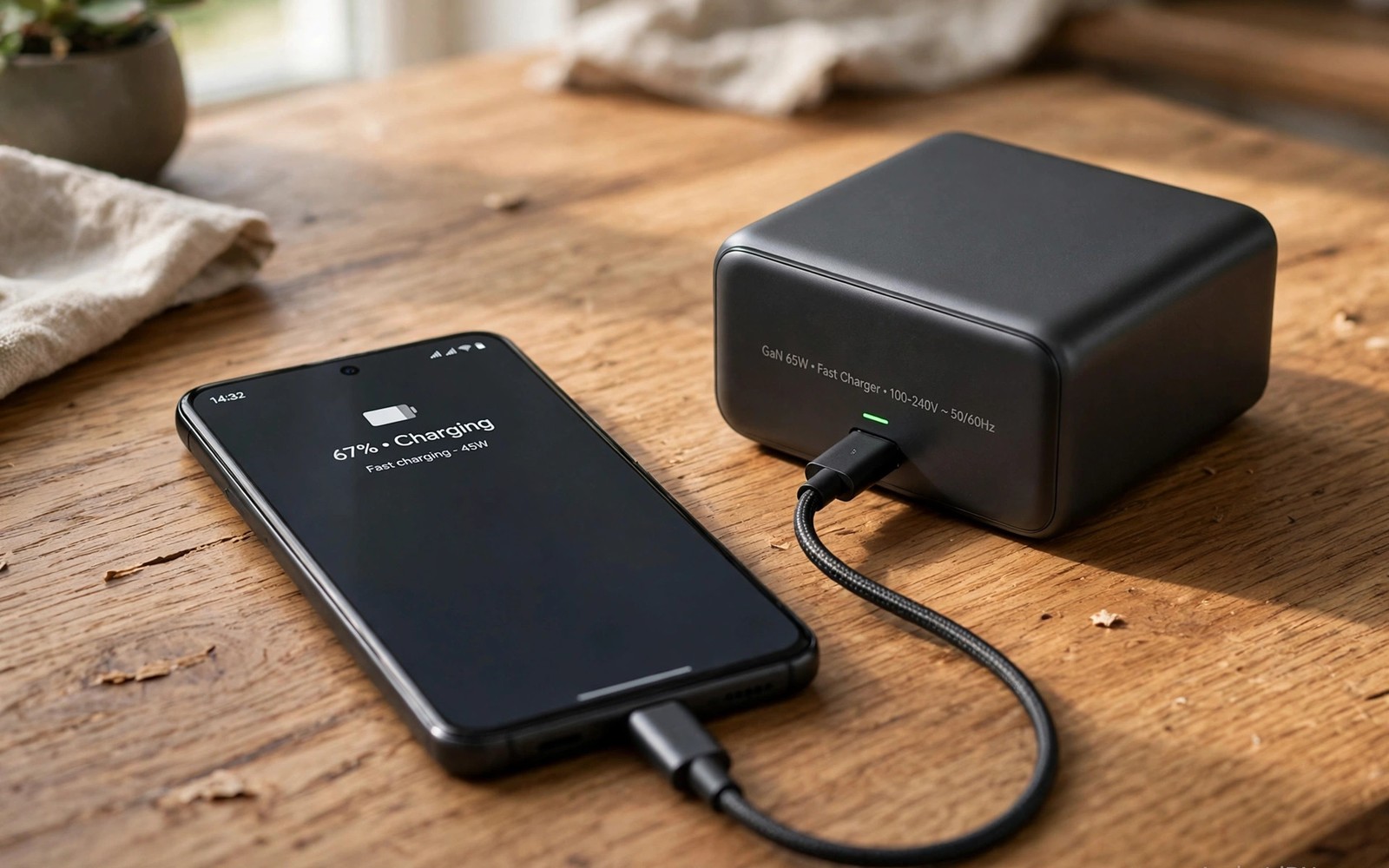
A charger that promises a full battery in twenty minutes sounds like freedom until you realise that your phone spends most of its charging life slowing down to protect itself from heat.
Headline wattage describes a peak rather than a constant rate. A 100 watt charger may hit that peak for a few minutes while the battery is low and cool. It then steps down as voltage rises and heat builds. The result is faster than a slow charger but far less dramatic than the headline suggests.
This guide compares real charging gains against heat and battery wear and cost. It helps you decide whether a super fast charger earns its price or whether a moderate charger gives you almost the same daily benefit.
How Fast Charging Actually Works
Charging follows a curve rather than a straight line. The first portion fills quickly because the battery accepts high current safely at low charge. The final portion fills slowly because high current at high charge stresses the cells and generates heat.
Phone makers design that curve to balance speed and longevity. A charger cannot force a phone past its own curve. If the phone caps input at a lower level then a 100 watt brick behaves like a smaller charger for that phone.
Check your phone specification for its maximum supported charging power. A charger above that limit wastes money unless you own several devices that can use the extra power. Shared chargers for a tablet and a laptop change the calculation.
The Heat Problem Nobody Advertises
Heat is the main enemy of battery longevity. Fast charging creates heat in the charger and in the cable and in the phone. Warm phones age faster than cool phones when the pattern repeats daily.
Charging while gaming or navigating adds heat from the processor to heat from charging. That combination pushes temperatures higher than charging alone. A phone that feels hot in your hand is telling you that the battery is under stress.
Cool charging habits extend battery life more than any charger brand. Charge on a hard surface with airflow. Remove a thick case during a fast top up when the phone feels warm. Avoid charging in direct sunlight or on a hot car dashboard.
Real Time Saved in Daily Life
Measure the gain on your own routine rather than on a marketing chart. A super fast charger saves the most time when you top up for ten minutes before leaving home. It saves far less when you charge overnight because a slow charger finishes long before you wake.
Many people charge at a desk for hours. In that pattern a 25 watt or 45 watt charger reaches full long before the workday ends. The extra speed of a 100 watt brick buys nothing except a warmer phone.
Travel changes the maths. Short airport stops and brief hotel breaks reward fast top ups. If you travel often then a compact fast charger may still be worth it. Buy it for travel rather than for nightly use.
Cost and Compatibility Traps
Super fast charging often needs a specific protocol and a specific cable. A generic high wattage brick may charge your phone slowly because the protocols do not match. Check protocol support before you assume that wattage alone guarantees speed.
Cables matter as much as bricks. A thin or damaged cable can limit current and generate heat. Replace cables that feel loose or that charge inconsistently. A certified cable from a known maker costs less than a replacement battery.
Cheap high wattage chargers deserve suspicion. Poor regulation and weak safety circuits risk damage to the phone and to the charger itself. The warning about cheap accessories that can brick devices applies directly to bargain fast chargers.
adb shell dumpsys battery | grep -E "level|temperature|voltage|health"
adb shell cat /sys/class/power_supply/battery/current_now
The commands above are an original illustration based on standard Android developer tools for reading battery level and temperature on a connected phone. They help you see how warm a phone becomes during a fast charging session.
Charging Speed by Battery Level
Charging speed varies dramatically across the battery range. The first half fills much faster than the second half on most phones. A super fast charger shines mainly in the low battery zone where current stays high. Once the battery passes seventy percent the advantage shrinks greatly.
Measure your own top up pattern to judge value. If you usually charge from twenty percent to sixty percent before leaving then fast charging saves meaningful minutes. If you usually charge from sixty percent to full then a moderate charger performs nearly as well. Your pattern decides the benefit more than any headline wattage.
Heat rises fastest during the early high current phase. A phone that feels warm within minutes of fast charging is working hard to manage that heat. Cooling the phone during that phase helps battery health more than any charger feature. Place the phone on a cool hard surface during fast top ups.
Consider a two charger strategy for best balance. Use a moderate charger at your desk and at your bedside for long sessions. Keep a fast charger in your travel bag for urgent top ups only. That split gives you speed when it matters without daily heat stress.
Battery Health Over Two Years
Battery health declines with cycles and heat and time. Fast charging adds heat to every cycle when used daily. Over two years that extra heat can reduce capacity by a noticeable amount compared with moderate charging habits. A phone that holds less charge forces more frequent charging which accelerates the cycle further.
Charge limit features help greatly when available. Limiting charge to eighty percent for daily use reduces stress at high voltage. Use full charge only before long days away from power. That habit alone often preserves more capacity than switching charger brands.
Monitor battery health through settings or a trusted app over months. A steady decline is normal while a sudden drop suggests heat damage or a faulty charger. Early detection lets you change habits before capacity loss becomes severe.
Replacement cost should factor into charger decisions. A phone with an expensive battery replacement makes gentle charging habits more valuable. A phone with cheap replacement makes fast charging less risky financially but still less ideal for daily convenience.
Charging Protocols Explained Simply
Charging protocols are agreements between phone and charger about voltage and current and safety limits and they decide real speed far more than wattage numbers on a box. A phone and charger that share a protocol negotiate the fastest safe rate together while mismatched devices fall back to a slow safe rate. That fallback explains why a powerful brick sometimes charges a phone slowly despite its impressive label. Always check protocol compatibility for your exact phone model before buying a premium charger.
Universal standards help but they do not erase brand specific protocols entirely. Some makers use proprietary protocols for their fastest speeds while supporting universal standards at moderate speeds. A universal charger gives you good speed across devices while a proprietary charger gives you maximum speed on one brand only. Choose universality when you charge many different devices and choose proprietary only when one phone dominates your life.
Cable protocol support matters as much as brick protocol support because a cable acts as a gatekeeper for power negotiation. A cable rated for low current limits charging even when brick and phone both support fast charging. Check cable ratings for current and data when buying replacements because a cheap cable silently caps your charging speed.
When Fast Charging Makes Sense Financially
Fast charging makes financial sense for professionals who bill by the hour and lose money during charging downtime. A consultant who tops up between client meetings gains billable time from every minute saved. That time value quickly exceeds the price of a quality fast charger and justifies the purchase easily.
Students and office workers who charge at desks for hours gain little financial benefit from super fast charging. Their phones sit idle during charging anyway so a moderate charger finishes long before they need the phone again. Spending on a premium charger in that pattern buys convenience that never gets used.
Families sharing chargers benefit from a single quality multi device charger more than from several specialised fast bricks. A shared charger that handles phones and tablets and earbuds reduces clutter and cost. Choose a shared charger with stable per port output rather than a charger that promises huge total wattage but sags under load.
Common mistakes
The biggest mistake is charging to full at maximum speed every single day. That habit combines high heat with high final voltage. A moderate charger for overnight use and a fast charger only for urgent top ups gives you speed when it matters without daily stress.
Another mistake is judging a charger by its box wattage alone. Protocol and cable and phone support decide real speed. Test a new charger with a timed top up from twenty percent and compare it honestly against your old charger.
FAQ
Will a 100W charger damage my phone immediately?
No reputable charger damages a phone immediately because the phone controls intake. Damage appears slowly through repeated heat and high voltage stress over many months.
Should I use fast charging at all?
Use fast charging when time matters and moderate charging when it does not. That split gives you most of the convenience with far less wear.
Does wireless fast charging heat the phone more?
Wireless charging often generates more heat than wired charging at the same speed. Remove the case and keep airflow around the pad when you use wireless fast charging.
Conclusion
A 100 watt charger is worth buying only when your phone supports its protocol and your routine includes frequent short top ups. For most people a moderate charger plus smart habits delivers nearly the same daily result with less heat. Your concrete next step is to time a ten minute top up with your current charger and decide whether the minutes saved justify a new purchase. Buyers comparing long term value should also weigh the ranking of smartphone brands ranked from worst to best value and the advice on cheap accessories that can brick devices and the guide to which processor handles sustained gaming heat best because heat affects charging and gaming alike.

