

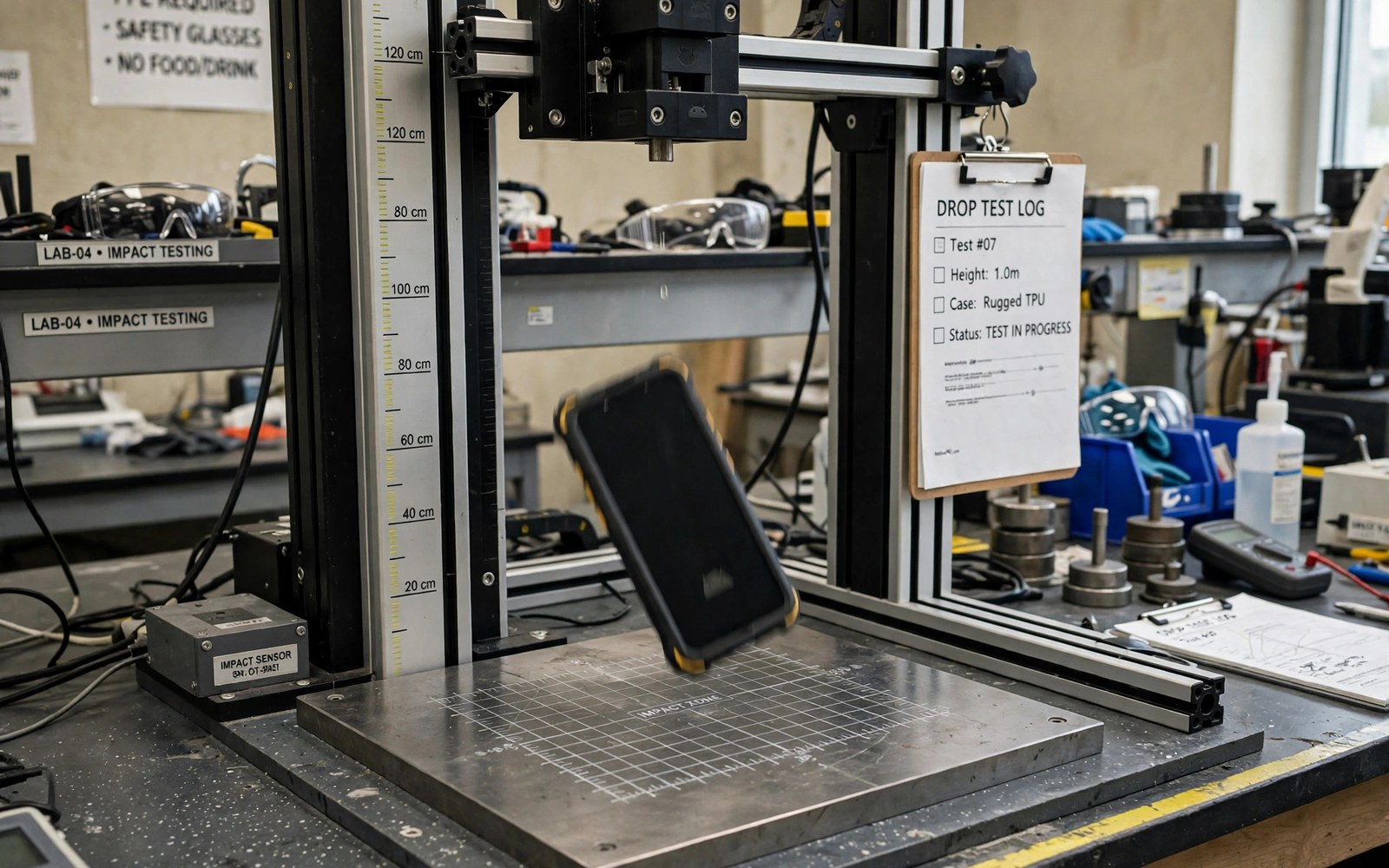
Drop test ratings appear on many rugged case boxes. MIL-STD claims sound official and tough. Buyers trust them quickly. Few buyers know what the tests actually involve. A rating can mean repeated lab drops or a single marketing fall. The difference matters for real protection.
MIL-STD is a military test standard family. One part covers drop and shock testing. Case makers adapt that part for phone cases. Adaptation varies widely between makers. Some follow the method strictly. Others borrow the name loosely. This guide explains the method and the marketing gaps.
It covers drop heights and surfaces. It covers pass criteria and sample counts. It also covers how to read claims critically. For corner design that tests target, see how air cushion corners absorb drop impacts as background reading.
What MIL-STD Drop Testing Means
The military drop method tests equipment after falls onto hard surfaces. Testers drop items from a set height many times. They vary the impact face and angle. They check function after every drop. A device passes if it still works after the full series. Cosmetic damage may still occur and pass.
Phone case makers adapt this method for cases. They fit a phone inside the case for drops. They drop the cased phone onto concrete or steel. They check the phone for cracks and function after drops. A case passes if the phone survives the series. The exact height and count vary by maker claim.
No single phone case standard exists across all makers. MIL-STD gives a method rather than a case grade. Makers choose height and drop count within that method. One maker may test twelve drops from one metre. Another may test twenty six drops from a greater height. Both may claim the same standard name.
Drop Heights Surfaces And Angles
Height decides impact energy directly. A fall from two metres hits far harder than a fall from one metre. Energy grows with height in a straight line. Doubling height doubles energy roughly. A case rated at a greater height guards harder falls. Always compare heights when comparing claims.
Surface hardness decides peak force. Concrete and steel stop a phone instantly. Wood floors stop a phone over a slightly longer moment. Lab tests use hard surfaces for worst case results. Real falls onto grass or carpet are gentler. A hard surface rating is the honest worst case.
Angles decide which part strikes first. Flat drops spread force widely. Corner drops concentrate force sharply. Edge drops stress the frame and screen edge. A full test series covers faces and edges and corners. A test that drops flat only proves little. Angle variety is a mark of a serious test.
Pass Criteria And Sample Counts
Pass criteria define what survival means. Full function after drops is the strictest rule. Screen crack free survival is also common. Some makers allow minor cosmetic scuffs. Others allow a cracked case if the phone survives. Read the fine print for the exact rule. A loose rule inflates pass rates.
Sample count affects trust in a claim. Testing one case proves little about production quality. Testing many cases reveals consistent design. Good makers test several units per model. They also test after ageing and temperature exposure. A single unit test is a weak basis for a bold claim.
Temperature and humidity also feature in strict methods. Cold plastic turns brittle. Hot glue softens. A case that passes at room temperature may fail in winter. Military methods include climate steps for this reason. Phone case claims rarely mention climate. Room temperature only tests are the common case.
Lab Limits Versus Real Falls
Lab drops are controlled and repeatable. Real falls are messy and varied. A phone may strike a sharp stone edge. It may bounce and strike twice. It may land on a stair edge. No lab series covers every real shape. A rating proves performance in lab conditions only. Real life adds variables labs cannot copy.
Phone model differences also limit ratings. A case line may test one popular model fully. Other models may share the rating by design similarity. Fit differences change real protection. A loose fit on one model guards worse than a tight fit on another. Model specific test data beats line wide claims.
Ageing lowers real protection over time. A new case absorbs drops well. A year old case with worn corners absorbs less. Lab tests use new cases. Real users drop old cases. Replace a case after hard falls or visible wear. A rating does not renew with age.
Reading Marketing Claims Critically
Look for numbers behind any rating claim. A good claim states height and drop count. It states the surface used. It states the pass rule. Vague claims without numbers deserve doubt. A claim that says military grade only may mean nothing testable. Numbers separate testing from slogans.
Check whether testing was independent. Third party labs add credibility. In house tests can still be honest. They lack outside verification. A lab name and a report number signal serious testing. Anonymous claims signal marketing copy. Ask the maker for test detail if numbers are missing.
Compare claims across cases you consider. A higher height with more drops beats a lower height with fewer drops. A clear pass rule beats a vague survival claim. A model specific test beats a line wide claim. Use those comparisons to shortlist cases. Owner drop stories add final evidence. Rugged versus slim trade offs are covered in heavy-duty cases compared with slim covers for lifestyle fit.
- Demand height drop count surface and pass rule in any claim.
- Prefer model specific tests over line wide claims.
- Prefer third party lab testing where available.
- Remember that lab ratings use new cases at room temperature.
- Replace a case after hard falls or visible corner wear.
- Treat vague military grade wording as marketing only.
Using Ratings When Buying
Use ratings as a shortlist tool rather than a guarantee. A strong rating signals serious design effort. It does not promise survival in every fall. Combine ratings with design checks. Check corner cushioning and raised lips. Check fit and grip. A rated case with poor fit still guards poorly.
Match rating height to your daily risk. Desk users need modest ratings. Outdoor workers need high ratings with many drops. Climbers and builders need the strongest ratings available. Higher ratings add bulk and cost. Pay for the rating your life actually needs.
Keep expectations honest after purchase. A rated case reduces crack risk sharply. It cannot remove risk fully. A bad fall onto a sharp edge can defeat any case. Handle a rated phone with the same care as an unrated phone. Ratings improve odds. Care improves them further. Water protection ratings differ from drop ratings and are covered in waterproof bags and sealed cases for water sports for wet settings.
DIY Drop Testing At Home
Home drop tests can compare cases roughly. Drop a cased old phone from waist height onto a soft surface first. Increase height gradually over several tests. Use the same phone and surface for each case. Record cracks and function after each drop. A fair comparison needs identical conditions. Different surfaces or heights ruin the comparison. Home tests never match lab precision. They still reveal a clearly weak case quickly.
Never test with your daily phone. A home test can crack a screen unexpectedly. Use an old spare phone for testing. A spare phone with a cracked screen already suits testing well. Its function after drops still tells a story. A case that guards a spare will guard a daily phone similarly. Risk a spare rather than a primary device. That rule keeps testing safe and useful.
Film the test for honest review. Video shows the impact angle clearly. It also shows bounce behaviour after impact. A case that bounces far may land on a second surface. Lab tests control bounce with catch nets. Home tests should use a contained area. A garage floor with walls nearby contains bounces well. Review video frame by frame for impact points. Corner strikes deserve special attention in review.
Warranty Ratings And Insurance Links
Case ratings rarely affect phone warranties directly. A cracked screen under a rated case still needs repair payment. Makers do not insure phones through case ratings. Some case makers offer their own screen guarantees. Those guarantees carry strict conditions. They may require registration within days of purchase. They may exclude certain drop types. Read guarantee terms before relying on them. A guarantee with many exclusions offers little real cover.
Phone insurance cares more about damage than case choice. Insurers ask about case use after a claim. A case may support a careful owner story. It does not change excess payments usually. Keep purchase receipts for cases and phones. Receipts prove ownership dates during claims. Photos of the cased phone also help claims. Documentation beats rating claims in insurance disputes.
Retail return windows matter more than ratings for buyers. Test a new case hard within the return window. Drop test it with a spare phone if possible. Check fit and button feel daily. Return a case that disappoints early. A rating cannot fix a poor fit. Early testing protects the purchase better than any label.
Courier and field phones face the hardest daily drops. They fall from vans and loading bays regularly. A high rating matters most for those users. A low rating case will fail within weeks there. Field workers should choose the highest rated case available. They should also replace cases quarterly. Quarterly replacement tracks wear honestly. A worn field case guards worse than a new cheap case. Replacement discipline beats brand loyalty for field work.
Second hand cases carry unknown drop histories. A used case may have survived many hard falls. Its cushioning may be exhausted invisibly. Buyers cannot see internal fatigue. A second hand rugged case is therefore risky. A new mid range case beats a used premium case often. Fresh cushioning matters more than a premium name. Avoid used cases for primary phone protection. Use them only for spare phones with little value.
Rating check:
- Height: stated in metres? higher = harder test
- Drops: count stated? more = stronger claim
- Surfaces: concrete or steel = worst case
- Angles: faces + edges + corners covered?
- Pass rule: phone functional and crack free?
- Lab: third party name or report number?
- Red flag: military grade with no numbers
The steps above follow the approach described in the official developer documentation for device care and accessory testing. The guidance draws on standard drop test method and common marketing practice. Ratings help buyers compare cases fairly. Numbers and methods matter more than bold labels.

