

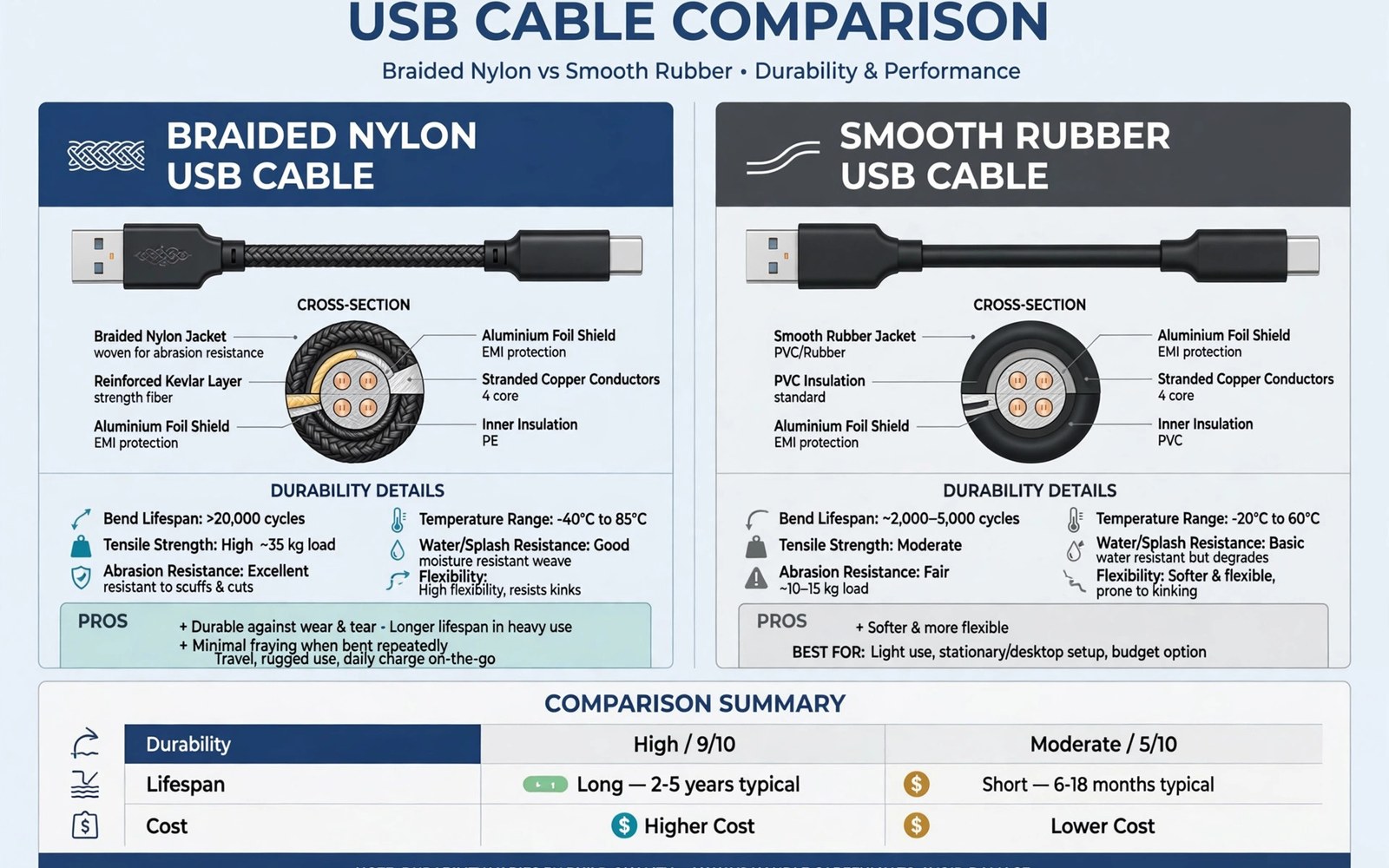
Cable covers affect daily life more than specs suggest. A cover decides how a cable feels. It decides how it bends. It decides how it survives a bag. Two cover types dominate the market. Braided nylon wraps fibres around the core. Rubber uses a smooth plastic sheath. Each type has strengths. Each type has weaknesses. This guide compares them honestly. It covers durability and tangling. It covers grip and cleaning. It helps you pick the cover for your routine.
A cable fails most often near the plugs. Bending stress concentrates there. The cover must protect the wires at that point. A good cover spreads stress over a longer area. A poor cover lets stress focus on one spot. That spot breaks first. The wires inside fray. Charging becomes intermittent. The cable then needs replacement. Cover choice affects that failure point. Braided covers resist fraying differently than rubber. Rubber covers flex differently than braided. The difference shows after months of daily use. A cover that suits a desk may fail in a pocket. A cover that suits a pocket may feel stiff on a desk.
How Braided Nylon Covers Are Built
Braided nylon weaves many thin fibres together. The weave forms a sleeve around the inner wires. The sleeve flexes without cracking. It spreads bending force across many fibres. One fibre can break without breaking the whole sleeve. That redundancy gives braided cables a tough feel. The weave also resists cuts from sharp objects. A key in a bag may scratch the weave. It rarely cuts through it at once. The weave texture gives grip. A braided cable stays in the hand better. It slips less on a smooth desk. That grip helps during plugging.
The weave adds thickness to the cable. A braided cable feels slightly bulkier than a rubber cable of the same rating. The bulk matters in a tight pocket. It matters less in a bag. The weave also adds stiffness. A braided cable holds a coil shape more than rubber. That shape memory can be a benefit. It can also be a nuisance. A cable that holds a coil may spring open in a bag. A cable that holds a bend may press against other items. The stiffness varies by weave density. A tight weave feels stiffer. A loose weave feels softer. Check the feel in hand when possible. A store sample reveals stiffness at once.
Braided covers resist heat better than many rubber covers. Nylon tolerates warm charging without softening quickly. Rubber may soften near a hot plug. Softening lets the cover deform. Deformation exposes inner wires over time. Braided covers also resist abrasion from rough surfaces. A cable dragged across a desk edge wears slowly. A rubber cable dragged the same way wears faster. That abrasion resistance suits travel. Travel exposes cables to rough bags and seats. A braided cable survives that exposure better. It still needs care. No cover survives deliberate abuse.
How Rubber Covers Are Built
Rubber covers use a smooth sheath extruded over the wires. The sheath is usually a flexible plastic. It feels soft and smooth in the hand. It bends easily in any direction. It lies flat on a desk without springing. It coils neatly for storage. That flexibility suits pocket carry. A rubber cable folds into a small space. It unfolds without holding a coil shape. It also slides easily into a bag pocket. The smooth surface slides past other items. That sliding prevents snagging. A rubber cable rarely catches on bag zippers. That ease matters for daily carry.
Rubber covers vary in quality widely. A thick rubber sheath protects well. A thin rubber sheath tears easily. Thin sheaths appear on bargain cables. They feel flimsy in the hand. They crack after months of bending. Thick sheaths feel sturdy. They resist cracking longer. They add some bulk. They still feel softer than braided covers. Check sheath thickness by touch. A cable that feels hollow likely uses thin rubber. A cable that feels solid likely uses thicker rubber. Price often reflects sheath thickness. A fair price usually buys a decent sheath. A bargain price often buys a thin one.
Rubber covers attract less dust than braided covers. The smooth surface wipes clean easily. A damp cloth removes most dirt. Braided covers trap dust in the weave. Dust in a weave is hard to remove fully. A dirty braided cable looks worn sooner. A rubber cable keeps a cleaner look longer. That cleanliness matters for light coloured cables. A white rubber cable stays white with wiping. A white braided cable greys with trapped dust. Users who value a clean look may prefer rubber. Users who value toughness may accept braided dust. The trade is cosmetic for most users. It rarely affects function.
Durability in Daily Use Compared
Bend tests favour braided covers for plug area survival. The weave spreads stress and resists fraying. A braided cable often survives thousands more bends than a thin rubber cable. A thick rubber cable narrows that gap. It may survive nearly as long. The gap depends on sheath thickness. A comparison between a good braided cable and a good rubber cable shows a modest braided advantage. A comparison between a good braided cable and a cheap rubber cable shows a large gap. Buy quality in either type. Quality matters more than cover type alone. A well made rubber cable beats a poorly made braided cable.
Pull strength also favours braided covers slightly. The weave grips the inner wires along the length. A pull spreads across the weave. A rubber sheath may stretch under a hard pull. Stretching can break inner wires. A braided sleeve stretches less. It transfers pull force to the plug area. That transfer can stress the plug instead. A good strain relief handles that stress. Strain relief design matters for both types. A long tapered relief spreads stress well. A short stiff relief concentrates stress. Check relief length before buying. A long relief signals careful design. A short relief signals cost cutting.
Environmental exposure affects both types differently. Sunlight degrades rubber faster than nylon. A cable left on a car dashboard ages quickly. Rubber may crack under strong sun. Nylon resists sun damage better. Cold weather stiffens rubber more than nylon. A rubber cable in winter feels rigid. A braided cable stays more flexible in cold. Heat from charging affects rubber more too. A hot plug may soften rubber. A braided cover tolerates that heat better. For outdoor and car use braided holds an advantage. For indoor desk use the advantage shrinks. Indoor conditions are gentle on both types.
Tangle Resistance in Bags and Pockets
Tangling frustrates every cable user. A tangled cable wastes time. It also stresses wires during untangling. Braided cables tangle less than rubber in many tests. The textured surface creates friction between loops. Friction prevents loops from sliding into knots. A braided cable coiled loosely stays coiled. A rubber cable coiled loosely may slip into a tangle. The smooth surface lets loops slide freely. Sliding loops form knots easily. That difference matters in a bag. A bag jostles cables constantly. A braided cable resists knot formation during jostling. A rubber cable forms knots more readily.
Coiling technique matters more than cover type. A proper coil prevents tangles for either type. Coil the cable in large loose loops. Avoid tight twists during coiling. Use a velcro tie to hold the coil. A tied coil stays neat in a bag. An untied coil tangles regardless of cover. The over under coiling method works best. It alternates loop direction to prevent twisting. That method takes practice. It pays off in tangle free storage. A cable stored with a tie lasts longer too. It avoids sharp bends at random points. Sharp bends stress wires. A neat coil avoids them.
Length affects tangling strongly. A long cable tangles more than a short cable. A three metre cable forms knots easily. A one metre cable rarely tangles badly. Choose the shortest length that fits your use. A short cable for a desk stays tidy. A long cable for a sofa needs careful coiling. A retractable cable avoids tangling entirely. It adds bulk and a mechanism that can fail. Most users prefer a simple short cable. A short braided cable gives the best tangle resistance. A short rubber cable also tangles little. Length control beats cover choice for tangling. For length effects on power see how cable length affects power delivery and charging speeds for the full picture.
Grip Cleaning and Feel
Grip affects plugging confidence. A braided cable grips well even with damp hands. The texture prevents slipping. A rubber cable may slip with damp hands. The smooth surface offers less friction. Users who plug cables in a kitchen or gym may prefer braided grip. Users with dry hands notice little difference. Grip also affects cable routing on a desk. A braided cable stays where placed. A rubber cable may slide off a desk edge. A sliding cable pulls the phone with it. A braided cable resists that slide. That small stability helps on a smooth desk. It prevents accidental phone drops.
Cleaning differs clearly between types. Rubber wipes clean in seconds. Braided needs brushing to remove dust from the weave. A soft brush works well. A damp cloth alone leaves dust in the weave. A dirty braided cable still works fine. It simply looks older. A user who cares about appearance should weigh that. A user who cares only about function can ignore dust. Dust in a weave rarely affects charging. It may affect the feel over time. A heavily soiled weave feels rough. Brushing restores a smoother feel. A monthly brush keeps a braided cable looking decent.
Feel in the hand is personal. Some users love the fabric feel of braided cables. They find rubber feels cheap. Others love the soft smooth feel of rubber. They find braided feels rough. Neither preference is wrong. Feel affects daily satisfaction. A cable that feels pleasant gets used with care. A cable that feels unpleasant gets tossed around. Care extends cable life. Choose the feel you enjoy. A pleasant cable lasts longer because you treat it better. That psychological factor matters. It is easy to overlook in spec comparisons. It shows up in real cable life.
- Choose braided for travel and rough bag use.
- Choose rubber for pocket carry and easy cleaning.
- Coil cables loosely and tie the coil for storage.
- Check strain relief length before buying either type.
- Pick the shortest length that fits your daily use.
Cable cover checklist:
1. Main use: travel desk or pocket
2. Cover type: braided or rubber
3. Strain relief: long and tapered
4. Length: shortest that reaches
5. Feel test: grip and stiffness
6. Cleaning: wipe or brush routine
7. Replace: fraying or loose fit
Which Cover Suits Which User
Travellers benefit most from braided covers. Bags expose cables to abrasion and tangling. Braided resists both better. A traveller who coils cables quickly gains from tangle resistance. A traveller who stuffs cables into a bag gains from abrasion resistance. The extra bulk matters little in a travel bag. The stiffness matters little when the cable stays in a bag. A braided cable is a travel workhorse. It survives the rigours of constant packing. It also looks rugged. That look matches travel gear. A travel kit with braided cables feels coherent.
Office users may prefer rubber covers. A desk cable stays in one place. It faces little abrasion. It needs to lie flat and look tidy. Rubber lies flat and wipes clean. It coils neatly for a drawer. It slides easily when routing behind a desk. A rubber cable suits a fixed desk setup. It also suits a bedside charger. A bedside cable faces gentle use. It needs softness for night handling. Rubber feels soft in the dark. It does not catch on bedding. That gentle feel suits night use. A braided cable may feel rough against skin at night.
Gamers and heavy users need durability above all. A gaming cable faces constant movement. It faces bending during play. A braided cable handles that movement better. It resists fraying at the plug. It also grips well during intense sessions. A rubber cable may slip during play. A slip can disconnect the charger mid game. That disconnect frustrates players. A braided cable stays put better. For gaming ergonomics see right-angle USB-C cables and ergonomic advantages for mobile gamers for plug shape benefits. Pair a braided cover with a right angle plug for the best gaming setup.
Final Thoughts on Cable Covers
Both covers serve well when built to a good standard. Braided wins on toughness and tangle resistance. Rubber wins on softness and cleaning ease. Quality beats cover type in both cases. A good rubber cable outlasts a poor braided cable. A good braided cable outlasts a poor rubber cable. Choose based on your main use. Travel and rough use favour braided. Desk and pocket use favour rubber. Coil neatly regardless of type. A neat coil prevents most tangles. A long strain relief prevents most plug failures.
Readers may also find identifying cheap counterfeit charging cables that can damage ports useful for a related setup.
Test the feel before committing to a bulk purchase. Buy one cable and use it for a month. Note tangling and fraying and cleaning ease. Note grip and stiffness in daily use. Keep the type that suits your routine. The steps above follow the approach described in the official developer documentation for accessory durability and safe handling. That approach stresses inspecting strain relief and replacing frayed cables promptly. Follow it and your cables will last longer with fewer surprises.

