

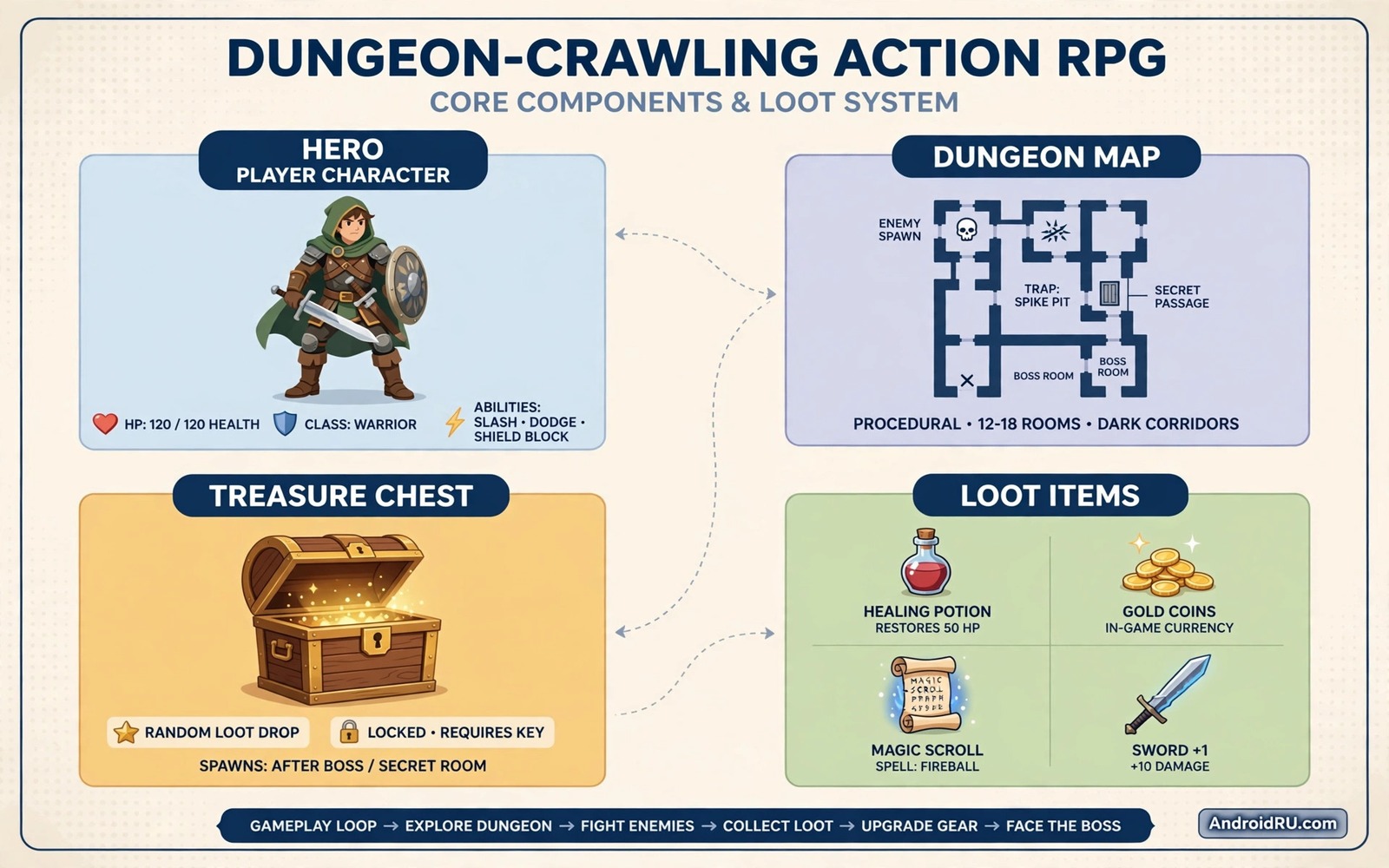
Action RPGs featuring dungeon crawling and loot collection deliver the most addictive loop in mobile gaming. You enter a dungeon and fight fast and grab loot and grow stronger and dive deeper. Each run feels fresh because layouts and drops change. Each victory feeds the next run.
The genre rewards reflexes and build sense in equal measure. Quick dodges save you from boss attacks while smart gear choices multiply your damage. If you love vast explorable worlds then open-world RPGs share some of this loot hunger and you can compare that scale through this guide to open-world RPGs that push hardware: open-world RPGs that push mobile hardware. This guide explains how dungeon crawlers work and how to master their loot chase.
The dungeon crawling loop
A dungeon run has a clear rhythm. You clear rooms and manage health and decide when to push deeper or retreat with your loot. Greed kills more players than bosses do. A full inventory tempts you into one more room and that room holds the trap that ends the run.
Layouts vary by game. Some dungeons are hand crafted with fixed rooms and secrets. Others generate randomly each run so no two dives match. Random generation favours adaptability while fixed layouts reward memorization. Both styles work when enemy variety keeps combat fresh.
Loot systems and gear power
Loot comes in rarity tiers from common to legendary. Higher tiers carry stronger stats and special effects. A legendary weapon can change your whole build with a single effect like chain lightning or life steal. That chase for one perfect drop keeps players diving for months.
Smart loot systems respect your time. They weight drops toward your class so you rarely get useless gear. They also offer crafting to convert bad drops into materials. Games without bad luck protection feel cruel fast. Check whether a game offers reroll or salvage systems before you commit.
Builds, skills, and combat flow
A build combines a class and skills and gear into a playstyle. A whirlwind build spins through crowds while a trap build controls space from afar. The best games let you respec cheaply so experiments cost little. Expensive respecs punish learning and push players toward copied builds.
Combat flow depends on controls. Virtual joysticks suit movement while skill buttons need good placement. A crowded screen hides telegraphs and causes unfair deaths. Try a game for an hour before judging its controls. Muscle memory forms fast when the layout is sensible. Players who prefer slower tactical combat can find it in grid-based tactics and you can explore that style through this guide to tactical grid-based RPGs: tactical grid-based RPGs.
Endgame: rifts, seasons, and leaderboards
Endgame dungeon crawlers offer escalating rifts or towers. Each level raises enemy power and loot quality. Leaderboards reward the fastest clears and the deepest dives. Seasons reset progress periodically and add fresh mechanics to keep veterans engaged.
Seasonal play suits casual players too. A new season means everyone starts fresh and early progress feels rewarding again. Join a season late only if catch up mechanics exist. Otherwise wait for the next season and start with the crowd.
Speedrunning dungeons and time attack
Time attack modes transform dungeon crawling from exploration into precision sport, and they attract a different kind of player entirely. Clearing a dungeon quickly demands route knowledge and damage optimization and risk taking that casual runs never require. You learn which enemies to skip and which shortcuts save seconds and where to spend precious resources for maximum speed. That mastery feels deeply satisfying, even when the leaderboard remains far out of reach.
Start time attacks only after you know a dungeon casually, because speed without knowledge produces deaths rather than records. Run the dungeon normally until enemy positions feel familiar, then begin trimming wasted movement. Skip optional rooms that offer little loot for their time cost. Save burst skills for bosses rather than spending them on trash mobs. These habits alone often cut clear times dramatically, and they improve your normal play too.
Hardcore modes and permadeath tension
Hardcore dungeon crawlers add permadeath, which turns every decision into a genuine gamble. A character you raised for weeks can die to one careless room, and that stakes transforms cautious play from boring into thrilling. Players who love tension adore hardcore modes, while players who hate loss avoid them entirely. Neither preference is wrong, but hardcore demands a different mindset from normal play.
Survive hardcore by playing far more conservatively than you think necessary. Retreat at half health rather than quarter health. Skip rooms with unknown dangers when your loot already satisfies you. Keep escape items ready at all times, and never enter a boss room without a full stock of healing. These habits feel cowardly in normal play, yet they are exactly what keeps hardcore characters alive long enough to become legends.
Cooperative dungeon crawling
Cooperative dungeon crawling adds teamwork to a genre often played solo, and it changes loot dynamics completely. Shared loot systems require trust, because one greedy player can ruin a group’s morale faster than any boss. Clear loot rules before the first run, whether drops go to whoever needs them most or rotate fairly between players. Written rules prevent arguments that voice chat alone cannot resolve.
Cooperation also changes combat roles, since a group can specialize in ways a solo player cannot. One player tanks while another heals and two more deal damage, which lets the group tackle content far above any individual’s power. Communication becomes a skill as important as gear, because calling out danger saves teammates who cannot see it. A good group feels like a well tuned machine, and that feeling keeps players returning long after solo content grows stale.
Procedural generation done well
Procedural generation promises endless fresh dungeons, yet quality varies wildly between games. Good generation creates rooms with purpose, where each area offers a distinct challenge or reward. Bad generation produces mazes of empty corridors that feel random without feeling designed. The difference lies in hand crafted building blocks, because the best generators assemble human designed rooms in new combinations rather than scattering tiles blindly.
Judge procedural dungeons by whether you remember them after playing. A memorable dungeon has landmarks and surprises and decisions that stick in your mind. A forgettable dungeon blurs into every other run within minutes. If your runs blur together, then the generator lacks the hand crafted pieces that make randomness meaningful. Seek games whose dungeons you can describe afterwards, because those are the ones worth diving into repeatedly.
The psychology of just one more run
Dungeon crawlers exploit a powerful psychological loop, because each run ends near a reward that promises a better next run. A near miss on a rare drop makes the next run feel luckier, even though probabilities never change. This loop is fun in moderation, yet it can consume evenings without players noticing. Awareness of the loop does not break it, but structural limits do, which is why session planning matters.
Set a run limit before you start playing, such as five runs or one hour, and honour it even when a great drop tempts you onward. The game will still exist tomorrow, and your future self will thank you for sleep and balance. Players who plan sessions enjoy dungeon crawlers longer than players who binge them, because moderation preserves the thrill that binging dulls. Treat the loop as a treat rather than a treadmill, and it stays delightful.
Boss design in dungeon crawlers
Boss design separates memorable dungeon crawlers from forgettable ones, because a great boss teaches you its patterns through fair telegraphs and then tests your mastery under pressure. The best bosses change phases as their health drops, forcing you to adapt rather than repeat one tactic endlessly. A boss that merely inflates health and damage feels like a longer trash mob, while a boss with distinct phases feels like a genuine climax worth reaching.
Learn bosses through observation rather than brute force, because rushing a boss you do not understand wastes revives and patience alike. Watch its first two attack cycles without worrying about damage, and note which attacks telegraph clearly and which punish positioning. That scouting run often reveals a simple pattern that turns an impossible fight into a manageable one. Patience during boss learning pays off faster than repeated blind attempts ever will.
Rate your loot drops quickly
Loot decisions slow down when every drop needs study. This plain text rating template works in any notes app. Score a drop in seconds and move on.
ITEM: name / rarity / slot
DAMAGE OR DEFENSE: higher than current? yes-no
SPECIAL EFFECT: fits my build? yes-no
VERDICT: equip / salvage / stash
RULE: stash only items with two yes answers
This rating template is an original tool written for this guide. It uses no data from any specific game. Its purpose is to stop inventory paralysis. Most drops fail one of the two tests and deserve salvage. Only rare items pass both tests and earn a stash slot. Apply it ruthlessly and your inventory stays clean.
Common mistakes
The most common mistake is hoarding every drop. A full stash slows decisions and hides good gear among junk. Salvage aggressively and keep only items that fit your current build or a planned second build. A clean stash is a fast stash.
Another mistake is ignoring defensive stats. New players chase damage numbers and die to the first elite pack. Survivability stats like life steal and damage reduction matter more than a small damage gain. A dead damage dealer deals zero damage.
FAQ
Are dungeon crawler RPGs playable in short sessions?
Yes. Most runs take ten to thirty minutes and checkpoints save progress. Short sessions suit the genre well since each run is self contained.
Do I need to pay for good loot?
Not in fair games. Loot drops from play and crafting converts bad drops into materials. Games that sell top loot directly are pay-to-win and deserve skepticism.
What is the difference from roguelikes?
Dungeon crawlers often keep your character progress between runs. Roguelikes often reset more on death. Many modern games blend both styles with partial progression.
Conclusion
Action RPGs with dungeon crawling and loot collection reward quick thinking and smart gear choices. Dive deep but retreat wisely. Salvage ruthlessly and build around effects rather than raw numbers alone.
Your next step is to pick one dungeon crawler and run ten dives with the loot rating template above. Notice which effects change your playstyle most. If slower tactical combat appeals to you then grid-based tactics offer a thoughtful counterpart and you can explore them through this guide to tactical grid-based RPGs: grid-based RPGs to exercise your brain.

