

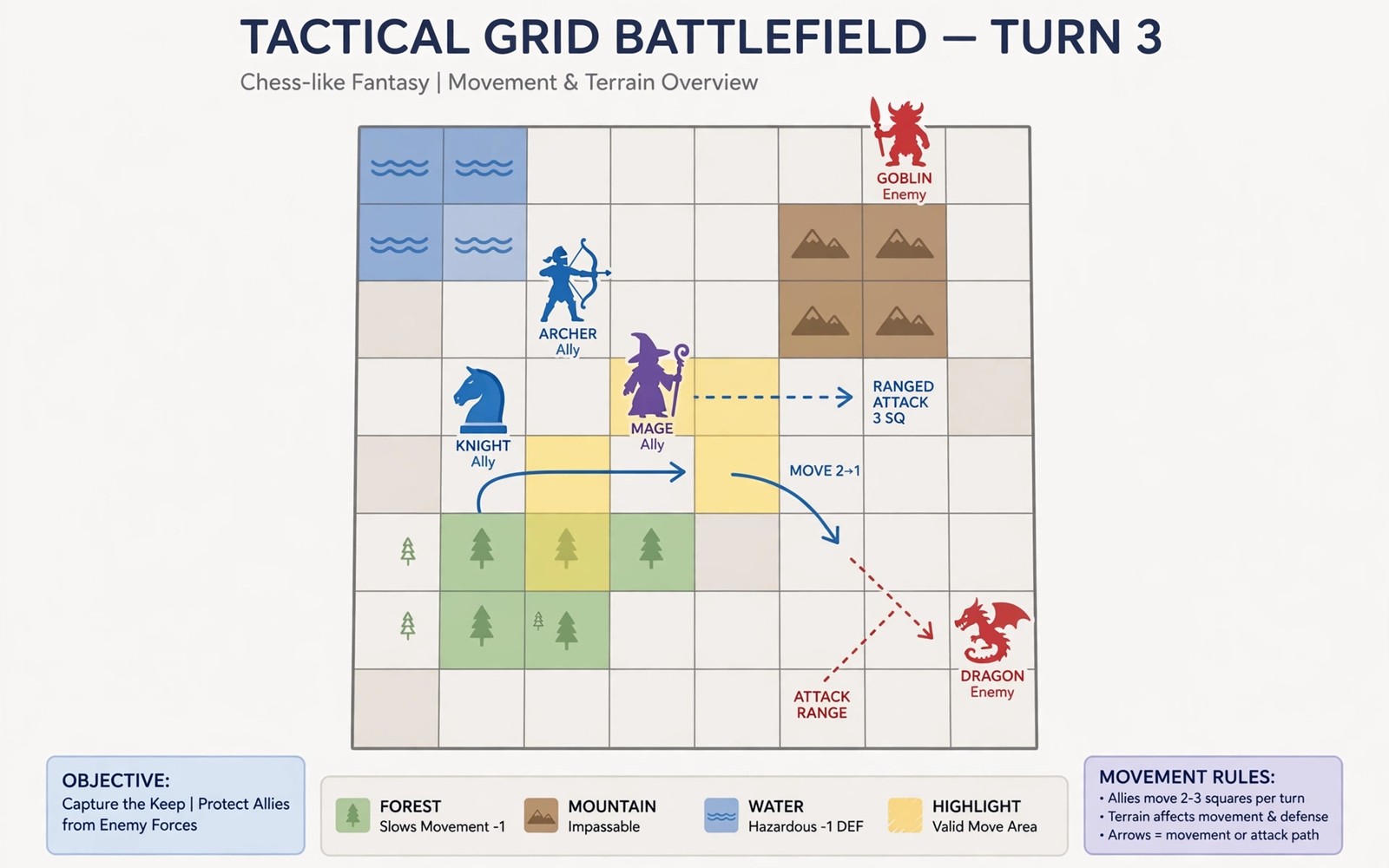
Tactical grid-based RPGs turn combat into a puzzle played on squares. Every step counts and every facing matters. You outthink enemies rather than outclick them. That deliberate pace makes the genre a perfect fit for phones.
Grid tactics reward spatial thinking. High ground and flanking and zone control decide battles before damage numbers do. If you enjoy slower strategic combat then turn-based strategy RPGs share this DNA and you can explore them through this guide to turn-based strategy RPGs: turn-based strategy RPGs. This guide explains how grid tactics work and how to master them.
How grid combat works
Battles happen on a map divided into squares. Each unit moves a set number of squares per turn. Terrain modifies movement and defense. Forests slow movement but grant cover. Water blocks some units entirely. Learning each map’s terrain is half the battle.
Turn order usually follows unit speed or initiative. Faster units act first and can cripple slow threats before they move. Some games use team turns where a whole side acts together. Others alternate single units. Both systems reward planning but they feel very different in practice.
Positioning principles that win
Height advantage is powerful in most grid games. Archers on cliffs hit harder and farther. Melee units below them struggle to reach. Always ask whether a move gains height or surrenders it before you commit.
Flanking multiplies damage in many systems. Attacking from the side or rear bypasses shields and bonuses. Surround a tough enemy with two units to force it to split attention. Never leave your own back exposed to a fast enemy that can exploit it.
Team composition on the grid
A balanced grid team needs range and melee and support. Ranged units punish enemies from safety. Melee units hold choke points and protect the back line. Support units heal and buff and remove debuffs. Missing any role creates a weakness enemies will exploit.
Mobility deserves special attention. A flying unit or a teleporter changes map control completely. They reach objectives fast and escape danger easily. Build at least one mobile unit into every team even if its damage looks modest on paper.
Permadeath and risk management
Some grid RPGs feature permadeath where fallen units stay dead. That rule transforms every decision. A risky attack becomes a real gamble with a character you raised for hours. Players who love tension adore permadeath. Players who hate loss should pick games without it.
Manage risk with retreat discipline. A battle going badly can still end in victory if you reposition and focus fire. Know when a map is lost and restart early rather than bleeding units slowly. A clean restart beats a pyrrhic victory that cripples your roster. For players who enjoy fast loot driven combat instead, dungeon crawlers offer a different thrill and you can explore them through this guide to action RPGs with dungeon crawling: action RPGs featuring dungeon crawling.
Initiative and turn order manipulation
Turn order manipulation separates advanced grid players from beginners, because acting first often decides battles before damage numbers matter. Speed buffs and initiative skills let your key units act earlier, which enables devastating opening moves. Delay skills push dangerous enemies later in the order, which buys your team time to eliminate them. Mastering these tools turns turn order from a fixed schedule into a weapon you control.
Plan turn order like a chess player plans move sequences, thinking two full rounds ahead rather than one action at a time. Ask which enemy must die before it acts, and which of your units can reach it in time. If none can, then use a delay or a buff to change the order until the math works. That calculation feels complex at first, yet it becomes instinctive with practice, and it transforms hard battles into puzzles with elegant solutions.
Zone control and area denial
Zone control means making parts of the map dangerous for enemies, which shapes their movement more effectively than direct damage. A unit guarding a bridge denies that crossing entirely, because enemies must either fight through or take a longer route. Area spells that linger on tiles create no-go zones that split enemy formations. Even the threat of an attack controls space, since enemies avoid squares where your archer could strike.
Build zone control into your team by including at least one unit designed for denial rather than damage. A tank with a large threat range or a mage with lingering area spells both serve this role beautifully. Position denial units at map features like doorways and bridges where their control multiplies. Enemies forced into predictable paths become easy targets, because you know exactly where they must go and can prepare accordingly.
Resource management across campaigns
Grid RPG campaigns demand resource management beyond single battles, because gold and experience and items persist across maps. Spending all your gold on one unit’s gear leaves the rest of the team vulnerable in later battles. Hoarding everything for a perfect future team leaves your current team too weak to survive until that future arrives. Balance spending between immediate needs and future plans, upgrading your core team steadily while saving a reserve for emergencies.
Experience distribution deserves equal care, since a team with one overlevelled hero and many weak units collapses when that hero falls. Spread experience deliberately by giving weaker units finishing blows on safe targets. Rotate bench units into easy battles so they stay relevant for harder ones. A campaign rewards depth over star power, because injuries and permadeath can remove any unit at any time, and only a deep roster survives those losses.
Adapting to unexpected enemy compositions
Unexpected enemy compositions test grid players more than any planned challenge, because they break routines built around familiar foes. A map full of flying enemies invalidates ground based choke points. A swarm of fast units overwhelms slow defensive lines. Adaptation begins with scouting, since knowing the composition before deployment lets you choose the right team rather than forcing a wrong team to cope.
Build flexible rosters that cover many threats rather than perfecting one strategy, because flexibility beats specialization across a varied campaign. Keep at least one anti-air unit and one fast unit and one healer ready for any map, even when your main strategy favours other roles. When surprise compositions appear mid-battle through reinforcements, retreat to defensible terrain and reassess rather than pushing forward with a broken plan. Flexibility is a skill, and it grows with every surprise you survive.
Grid RPGs as mental exercise
Grid RPGs offer genuine mental exercise, because they demand spatial reasoning and planning and probability assessment simultaneously. Studies of strategy gaming suggest these skills transfer modestly to other domains, though the main benefit is simply enjoyable challenge. Players who play grid tactics regularly report sharper focus during complex tasks, whether or not scientists can measure it precisely. The genre keeps minds active in a way passive entertainment never does.
Use grid RPGs deliberately as brain training by choosing higher difficulties once normal modes feel easy. Harder modes punish sloppy play and reward deep planning, which stretches your skills further. Analyse your defeats instead of blaming luck, because honest analysis builds the same reflective habits that improve any complex skill. Enjoyment remains the point, yet the mental workout is a welcome bonus that makes the genre doubly worthwhile.
Counterplay and enemy AI behaviour
Counterplay means every enemy strength has an answer, and grid RPGs live or die by whether their AI offers fair counters. A flying enemy that ignores terrain demands anti-air tools, while a healer enemy that sustains its team demands focus fire or silencing. Games that provide counters for every threat feel challenging yet fair, because defeat teaches you which tool to bring next time. Games that lack counters feel cheap, since no strategy could have saved you.
Study enemy AI behaviour across several battles before judging difficulty, because AI patterns reveal counters that first impressions hide. Some enemies always target the nearest unit, which lets you bait them with tanks. Others prioritize healers, which demands protective positioning. Learning these rules transforms seemingly unfair maps into puzzles with clear solutions. Patience in studying AI pays off across entire campaigns, not just single battles.
Score a map before your first move
A quick map read prevents early blunders. This plain text template works in any notes app. Fill it during the deployment phase before you move anyone.
MAP: name / objective / turn limit
TERRAIN: high ground spots / choke points / hazards
ENEMIES: ranged count / melee count / fastest unit
MY PLAN: first objective / fallback position / focus target
RISK: reinforcements? / ambush zones? / timer?
This map template is an original planning tool written for this guide. It uses no data from any specific game. Its purpose is to slow down the opening turns where most mistakes happen. A two minute map read reveals choke points and ambush zones that a rushed player discovers through dead units.
Common mistakes
The most common mistake is advancing the whole team together. A clustered team invites area attacks and traps. Spread units to cover multiple approaches while keeping support within range. Spacing is a weapon in grid tactics.
Another mistake is ignoring turn order. Moving a slow tank first can block a fast attacker behind it. Move blockers last or position them where they never obstruct allies. Turn order awareness separates good players from great ones.
FAQ
Are grid-based RPGs hard for beginners?
They can be but good tutorials help a lot. Start on normal difficulty and learn one system at a time. The genre rewards patience more than reflexes.
Do grid RPGs work well on small screens?
Yes. Touch input suits grid movement naturally since taps select squares precisely. Zoom controls help on dense maps.
What is the difference from turn-based strategy RPGs?
Grid RPGs are a subset of turn-based strategy RPGs. The grid is the defining feature. All grid RPGs are turn-based but not all turn-based games use grids.
Conclusion
Tactical grid-based RPGs reward players who think in space. Control height and flanks and choke points. Build balanced teams and respect turn order. Those habits turn hard maps into satisfying puzzles.
Your next step is to play one grid RPG map with the scoring template above. Note how often terrain decides the outcome. If the broader strategy genre appeals to you then turn-based strategy RPGs offer the same depth without grids and you can explore them through this guide to turn-based strategy RPGs: turn-based strategy RPGs for tactical players.

