

The future of Android and mobile technology will be shaped by AI and new form factors and longer support and stronger privacy. Those forces point toward phones that understand context and adapt to users rather than forcing users to adapt to menus. A phone in the future may anticipate a need and offer a helpful action before a user asks. That anticipation must respect privacy and avoid annoyance.
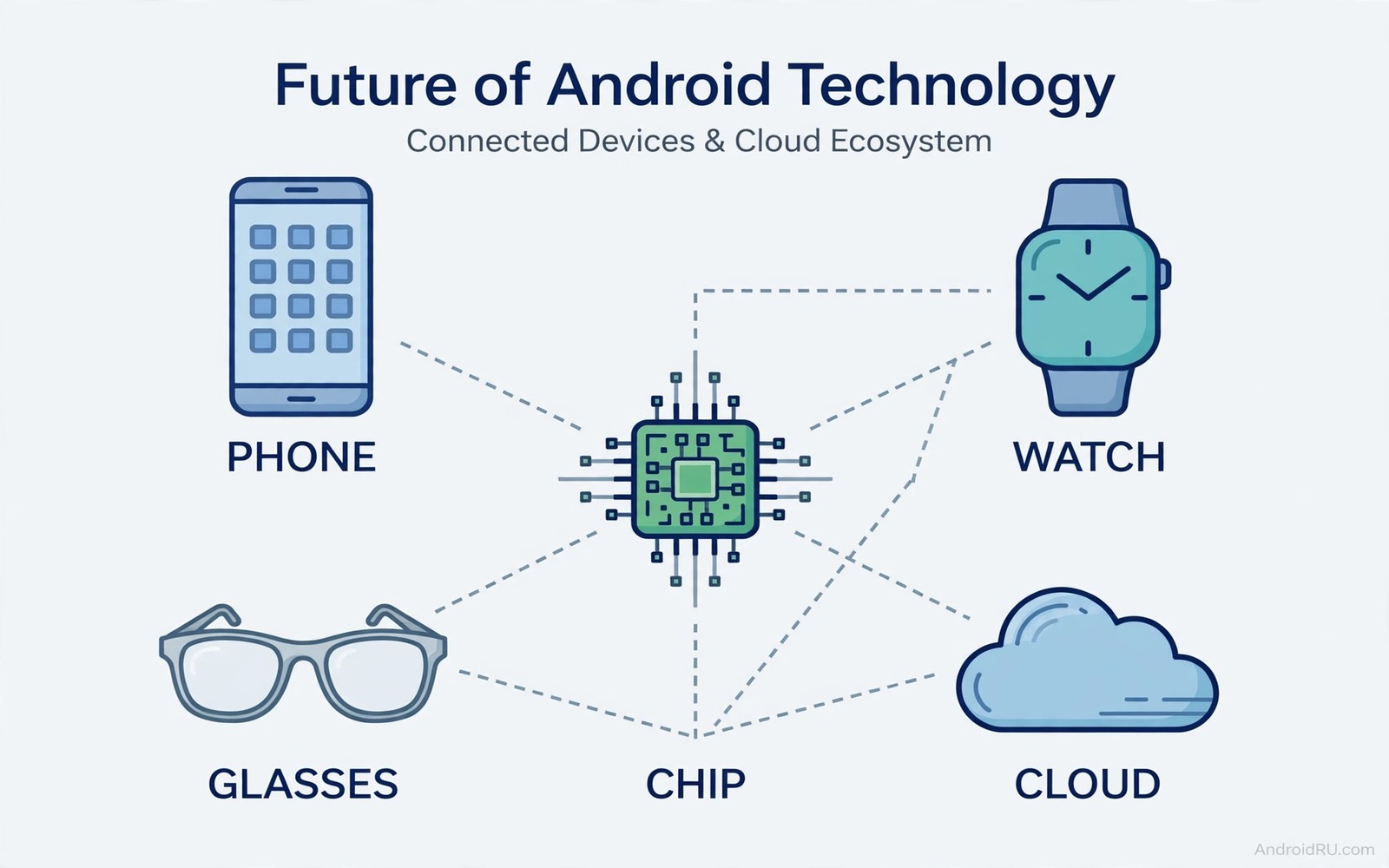
Mobile technology will also become less about a single phone and more about a system of devices that work together. A watch and glasses and earbuds and a phone will share information seamlessly. A user will start a task on one device and finish it on another without manual transfer. That ecosystem view is the ultimate outlook for Android because Android already runs on many device types.
AI as a core system layer
AI will become a core layer of Android rather than a set of separate features. The system will use on device models to summarise notifications and prioritise messages and suggest actions. A user with many messages will see the most important ones first. A user travelling will receive relevant travel information without searching. That system level AI must be transparent so that users understand why a suggestion appears.
AI as a core layer also raises questions about control because a system that predicts too aggressively can feel intrusive. Users need clear controls to adjust AI behaviour and to turn off predictions that do not help. A future Android that respects those controls will earn trust. A future Android that hides AI decisions will face backlash.
Form factors beyond the slab phone
Foldables and wearables and glasses will expand the definition of a mobile device. A foldable offers a larger screen for work and media. A watch offers glanceable health and notifications. Glasses offer hands free information. Each form factor serves a different moment in a day. Android must adapt interfaces for each form factor without fragmenting the app ecosystem.
Developers will need responsive designs that work across phone and tablet and foldable and watch. A single app that adapts to screen size and input method will succeed. An app that only works well on a slab phone will feel outdated as form factors diversify. Responsive design will become a core skill for Android developers.
Longer support and sustainable devices
Longer support will become standard as users keep phones for five years or more. Seven years of updates will move from a premium promise to a mainstream expectation. That shift will require durable hardware and repairable designs. A phone that receives updates for seven years but cannot replace its battery will still fail early.
Sustainability will also influence materials and packaging and recycling. Makers will use more recycled materials and offer take back programmes. Users will check repair scores before purchase. A sustainable phone will not merely claim green credentials. It will offer a long life and a clear repair path.
Privacy as a competitive advantage
Privacy will become a competitive advantage as users become more aware of data collection. A phone that offers on device AI and clear permission controls will attract users who value privacy. A phone that collects data aggressively will face regulation and user distrust. Privacy features that are easy to understand will matter more than complex settings that few users open.
Privacy also includes data portability because users should be able to move their data between services without losing photos and messages. Future Android may offer better export tools and interoperable formats. Those tools will reduce lock in and give users real choice. Portability turns privacy from a slogan into a practical right.
Connectivity and the end of the phone as an island
Connectivity will improve through faster networks and satellite features and better device to device links. A phone will connect to a watch and earbuds and a car and a home system seamlessly. That connectivity will make a phone a hub rather than an isolated device. A user will control a home from a watch and receive a call on glasses.
Connectivity also brings security risks because more connections create more attack surfaces. Future Android must secure device to device links with strong authentication. A watch that can unlock a phone must verify the wearer securely. A car that receives phone data must protect that data from interception.
What buyers should prioritise now
Buyers who want a future proof phone should prioritise update length and repairability and on device AI capability. Those factors will matter more over five years than a small camera improvement. A phone with seven years of updates and a replaceable battery will outlast a phone with a slightly better camera but short support.
Buyers should also prioritise ecosystem compatibility because future devices will work best together. A phone that pairs well with a watch and earbuds from the same ecosystem offers a smoother experience. Cross platform compatibility also matters for users who mix brands. Check pairing and sharing features before committing to an ecosystem.
Mobile technology and health
Mobile technology will increasingly support health through watches and sensors that track activity and sleep and heart rate. A phone will aggregate that data and offer insights without replacing a doctor. Users will benefit from early warnings about activity changes and sleep patterns. Privacy controls will decide whether health data stays local or moves to a cloud service.
Health features must be accurate and easy to understand or they will mislead users. A watch that reports heart rate with large errors can cause unnecessary worry. A system that explains accuracy limits helps users interpret data correctly. Future health features should focus on trends over time rather than single measurements.
Mobile technology and education
Mobile technology will transform education by giving students access to learning apps and videos and interactive lessons on affordable devices. A student with a budget phone and a good connection can access courses that once required a computer lab. That access can reduce education gaps in remote areas. It also requires teachers to design lessons that work well on small screens.
Education apps must work offline where connectivity is weak. A lesson that requires constant streaming will fail in areas with poor networks. Future education technology should offer downloadable lessons and local progress tracking. That offline capability makes mobile learning practical for more students around the world.
Common mistakes
People often buy a future proof phone based on a single futuristic feature such as AI or foldables. That narrow focus can lead to a phone that excels in one area but fails in daily durability. A balanced phone with long support and good basics will serve better over time.
- Choosing a phone only for AI features without checking privacy controls and battery impact.
- Buying a foldable without testing durability and software for daily work.
- Ignoring update length and repairability when planning for five years.
- Assuming that a new form factor will replace a phone completely in the near term.
- Overlooking ecosystem compatibility when buying watches and earbuds.
A careful buyer balances future features with present durability. That balance leads to a phone that feels modern today and remains useful tomorrow.
Frequently asked questions
What will Android look like in five years?
Android in five years will likely feature deeper on device AI and better foldable support and longer updates and stronger privacy controls. Interfaces will adapt more smoothly across phones and tablets and wearables. Core tasks will remain familiar even as AI features grow.
Users should expect gradual change rather than a sudden redesign. Each update will add AI and form factor improvements step by step.
Will phones disappear in favour of glasses and watches?
Phones are unlikely to disappear in five years because they offer a large private screen for reading and typing and banking. Glasses and watches will become companions that handle specific tasks. Phones will remain the hub for complex tasks.
Over a longer horizon, form factors may shift more dramatically. For now, a phone remains essential for most users.
How can I future proof my next phone purchase?
Future proof a purchase by choosing a phone with long update support and good repairability and strong on device AI. Check battery replacement options and storage size. Those factors determine real lifespan more than a single new feature.
Use a case and a screen protector to protect hardware. Plan for a battery replacement after three years to extend life.
Conclusion
The ultimate outlook for Android and mobile technology is a system of devices that work together with AI as a core layer and longer support and stronger privacy. Phones will remain central for complex tasks while watches and glasses handle glanceable and hands free moments. Buyers who prioritise update length and repairability and ecosystem compatibility will benefit most. The future will reward devices that respect users and last longer rather than devices that merely look futuristic. Related coverage includes smartphone industry predictions and MicroLED smartwatch screens and future Android neural APIs.
Take one concrete next step today. Review your current phone and wearable setup and identify one task that still requires too many steps. Choose a device or setting that simplifies that task and test it for a week before buying anything new.
A final check helps a buyer stay grounded about the future. Ask whether a new technology solves a real daily problem for you. If it does not, then wait for a version that does rather than buying on excitement alone.
# Check Android version and system features on a device
adb shell getprop ro.build.version.release
adb shell pm list features | grep -i -m 5 android
The commands above were written for this guide to show a simple way to check Android version and system features on a connected device. They are general diagnostic examples and they do not modify the phone.

