

Best Value Android Phones That Deliver Pro Camera Performance
A phone that costs half as much as a flagship can still take photos that look like they came from a camera costing twice the price, provided you pick the right sensor, the right stabilisation, and the right software. I learned this the slow way, by comparing shots from a midrange phone and a flagship side by side on a large monitor, and the gap in good light was far smaller than the gap on the price tag. The difference showed up in dim restaurants, in fast-moving kids, and in zoomed shots, not in a sunny park.
This guide names the value Android phones that genuinely deliver pro camera performance, explains how to judge them before you pay, and shows where each one trades away something to hit its price. It is written for people who take a lot of photos, who print some of them, who shoot family video, and who want a phone camera they can rely on every day without paying flagship money. Prices here are typical street ranges at the time of writing, so check the current official page before you buy, because offers move fast.
What Pro Camera Performance Really Means on a Value Phone
Pro camera performance on a budget phone does not mean it matches a flagship in every scene. It means the main camera is sharp in daylight, usable in low light, quick to focus, and honest about colour, and that video stays steady when you walk. A value phone that delivers pro-level photos in good light and respectable photos after dark is a genuine bargain, while a phone that only looks good in a bright shop display is not.
The best value Android phone for photography in 2026 is the one whose main camera you trust in the scenes you actually shoot. If you photograph children indoors, focus speed and low-light noise matter more than zoom. If you photograph travel landscapes, dynamic range and a decent ultrawide matter more. If you shoot food and portraits for social media, colour and portrait edge detection matter most. Start from your scenes, not from a spec sheet.
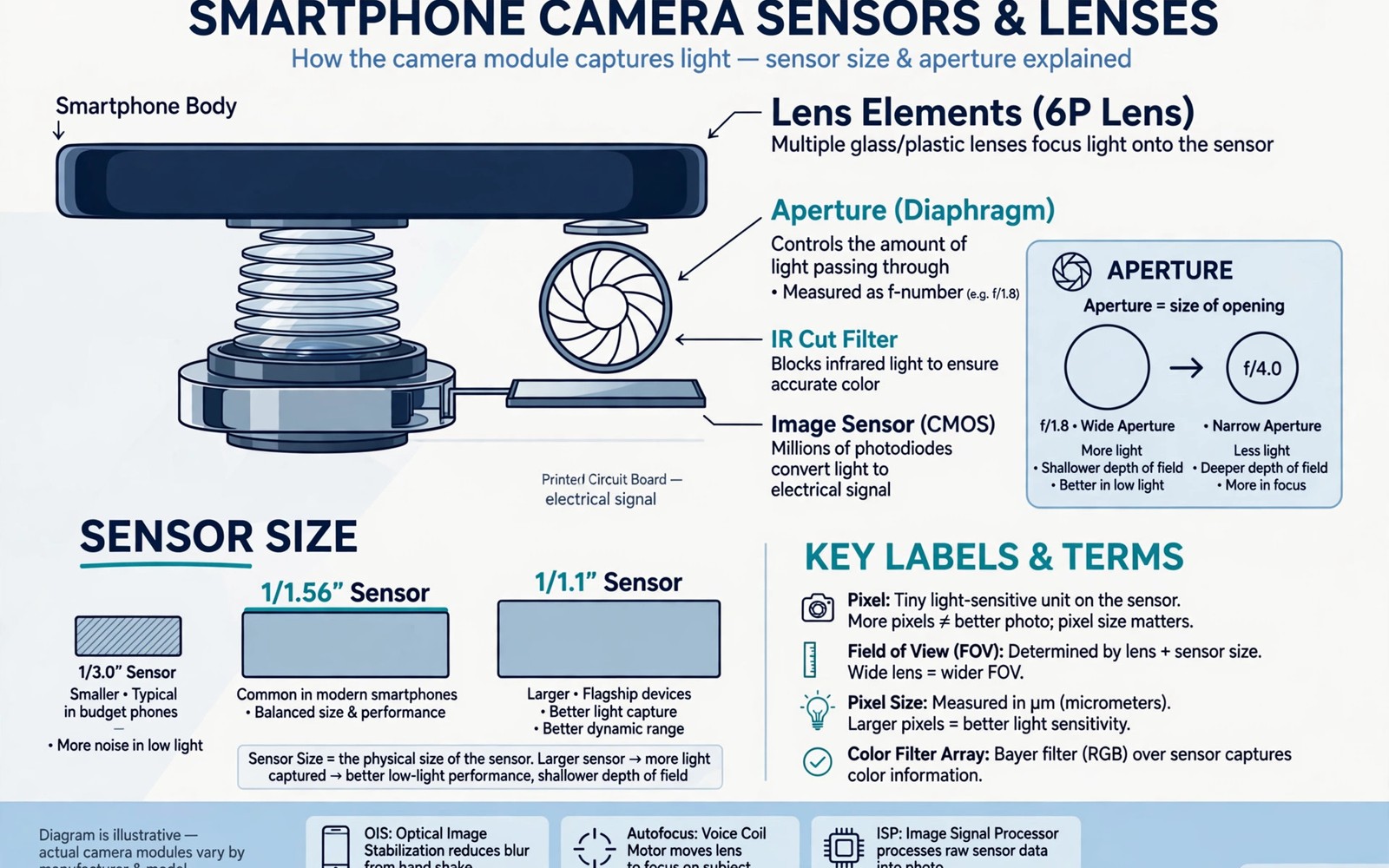
sensor size over megapixel count decides far more than the megapixel number on the box. A larger sensor gathers more light, which means cleaner shadows and less noise when the sun goes down. optical image stabilisation lets the camera hold a longer exposure without blur, which helps night shots and video alike. computational photography then cleans up noise, balances highlights, and keeps skin tones natural. When a budget phone gets all three right, its photos can surprise you.
Sensor size and stabilisation basics
How sensor size changes low light photos
A bigger sensor captures more light per pixel, so the phone needs less digital brightening, and less brightening means less noise. That is why a 50 megapixel camera with a large sensor often beats a 108 or 200 megapixel camera with a tiny sensor after dark. Check sensor size in reviews, look for phrases like 1/1.5 inch or larger, and compare night samples rather than headline numbers.
Why stabilisation matters more than zoom on a budget phone
Most people use zoom rarely, but they shoot in dim light constantly, in restaurants, at home in the evening, and on cloudy days. Stabilisation helps every one of those shots. A phone with optical stabilisation on its main camera will beat a phone with a longer zoom and no stabilisation in daily use, because sharp photos at normal zoom beat blurry photos at long zoom.
How to Judge a Value Phone Camera Before You Buy
Judge a value phone camera by samples, not by slogans. Search for sample galleries from ordinary users, shot in homes, streets, and restaurants, and view them on a large screen. Look at hair in portraits, text on signs at a distance, and faces in shade. If edges look smeared, if skin looks waxy, or if night shots look like watercolour, the processing is hiding weak hardware.
Test focus speed if you can handle the phone in a shop. Point it at a close object, then at a distant one, and watch how fast it locks on. Slow focus ruins photos of children and pets, and no amount of megapixels fixes a missed moment. Test the front camera in indoor light too, because many value phones spend their budget on the rear camera and leave the selfie camera weak.
Check what the phone does with video. Record a short walking clip, pan slowly across a room, and watch for judder and wobble. Stable 1080p video with good stabilisation often looks better than shaky 4K, and it also takes less storage. Check whether 4K recording has a time limit or crops the frame heavily, because both limits matter for longer clips.
Ask about software updates for the camera. Some brands improve night mode and portrait processing through updates during the first year, while others leave the camera exactly as it shipped. A brand with a good record of camera updates adds hidden value, because your phone can get better after you buy it. Read the update policy before you decide, and favour phones with at least three years of software support.
Best Value Android Phones for Pro Camera Performance in 2026
The seven phones below are the strongest value picks for photography right now, each with its own H3, its own price range, and an honest verdict. They cover different budgets, from around three hundred dollars to around five hundred, and different strengths, from night photography to portraits to video. No phone here is perfect, and the verdict for each one says who should buy it and who should look elsewhere.
1. Google Pixel 8a — Best Value Android Phone for Night Photos and Portraits
The Pixel 8a, usually around 450 to 500 dollars, is the camera-first pick in this list, and it earns that spot through software rather than raw hardware. Its main camera, around 64 megapixels with optical stabilisation, is paired with Google computational photography, which produces clean night shots, natural skin tones, and portraits with believable background blur. In dim rooms, where most value phones fall apart, the Pixel 8a keeps faces bright without turning them orange or waxy.
I would hand this phone to anyone who photographs family indoors, shoots a lot after sunset, or wants portraits that need little editing. Night Sight takes a few seconds, so it suits posed shots better than running children, and the ultrawide camera is decent rather than outstanding. Video is steady and colours stay consistent between lenses, which matters more than a spec sheet suggests.
Pros: excellent night mode and portrait mode for the price, reliable colours, long software support, clean Android with useful photo editing tools. Cons: slower charging than rivals, no dedicated telephoto lens, and the design feels plain next to flashier rivals. Verdict: buy the Pixel 8a if night photos and portraits are your priority and you can live without long zoom.
2. Samsung Galaxy A55 5G — Best Value Samsung Camera Phone for Everyday Photos
The Galaxy A55 5G, usually around 400 to 450 dollars, is the safe everyday choice, with a main camera around 50 megapixels, optical stabilisation, and Samsung colour that looks lively straight out of the camera. Daylight photos are sharp and punchy, portraits are flattering, and video stabilisation is strong for walking clips and family holidays. It also feels like a more expensive phone in the hand, with a metal frame and a bright screen that makes reviewing photos enjoyable.
This phone suits people who want a dependable camera without learning manual settings, and who value a long update promise and a wide service network. Night photos are good but a step behind the Pixel, with more noise in very dark streets and softer detail in shadows. The ultrawide camera is useful in daylight and weaker after dark, which is normal at this price.
Pros: consistent daylight quality, strong video stabilisation, good screen for photo review, long software support. Cons: night detail trails the Pixel 8a, ultrawide is soft in low light, and charging is slower than some rivals. Verdict: buy the Galaxy A55 if you want a reliable all-round camera phone from a brand with broad support.
3. Xiaomi Redmi Note 13 Pro+ — Best Budget Camera Phone Under 400 Dollars
The Redmi Note 13 Pro+, usually around 350 to 400 dollars, packs a high-resolution main camera, around 200 megapixels, with optical stabilisation, and it resolves a remarkable amount of detail in good light. Landscapes, architecture, and outdoor portraits look crisp, and the phone offers manual controls and RAW capture for people who like to edit. For a phone at this price, the amount of detail in daylight is genuinely impressive.
That said, the high megapixel count needs good light to shine, and night photos need a steady hand and a little patience. Colours lean vivid, which suits social media but can look strong on skin if you do not adjust it. This phone suits travellers and outdoor photographers who shoot mostly in daylight and want a big screen and fast charging as well.
Pros: very detailed daylight photos, fast charging, manual mode and RAW support, strong value for money. Cons: night photos need care, colours can look oversaturated, and software support is shorter than Samsung or Google. Verdict: buy the Redmi Note 13 Pro+ if you shoot outdoors in good light and want maximum detail per dollar.
4. Nothing Phone 2a — Best Value Phone for Natural Colours and Clean Photos
The Nothing Phone 2a, usually around 300 to 350 dollars, is the quiet surprise of this list, with a dual 50 megapixel camera setup and optical stabilisation on the main lens. Its photos look natural, with restrained colours and honest skin tones, which is rare at this price, where many rivals push saturation hard. Daylight shots are clean, portraits are tidy, and the phone feels fast and uncluttered to use.
I would recommend this phone to people who dislike heavy processing and want photos that look like the scene they remember. Night mode is respectable but not class-leading, and there is no telephoto lens, so distant subjects stay distant. The ultrawide camera is usable in daylight and best avoided after dark. For the price, though, the main camera punches above its weight.
Pros: natural colour, clean software, good main camera with stabilisation, distinctive design. Cons: no telephoto, night mode is average, and the brand has a smaller service network. Verdict: buy the Nothing Phone 2a if you value natural photos and clean software at a low price.
5. Motorola Edge 50 — Best Value Android Phone for Video and Vlogging
The Motorola Edge 50, usually around 350 to 400 dollars, is the pick for people who shoot as much video as stills. Its main camera, around 50 megapixels with optical stabilisation, records steady video, and its front camera is stronger than most rivals at this price, which helps vlogging and video calls. Colours are balanced, focus is quick, and the phone handles long recording sessions without fuss.
Still photos are solid rather than spectacular, with good daylight detail and decent night performance, but the real strength is consistency across photo and video. If you film family clips, record short videos for social media, or take a lot of selfies, this phone covers more of your day than a stills-only specialist. Readers who film often should also look at the guide to smartphones built specifically for vlog content creators before choosing.
Pros: strong video stabilisation, good front camera, clean Android, fast charging. Cons: stills trail the Pixel in very low light, ultrawide is average, and update support is shorter than Samsung. Verdict: buy the Motorola Edge 50 if video and selfies matter as much as still photos.
6. OnePlus Nord 3 — Best Value Phone for Fast Shooting and Portrait Colour
The OnePlus Nord 3, usually around 400 to 450 dollars, pairs a 50 megapixel main camera with optical stabilisation and a fast processor, so the camera app opens quickly and focus locks fast. That speed matters when you photograph children, pets, and street scenes, because the moment rarely waits. Portraits have warm, pleasing colour, and daylight detail is strong.
Night photos are good with a steady hand, though very dark scenes show more noise than the Pixel. The phone charges quickly, which helps when you are out shooting all day, and the screen is bright enough to review shots outdoors. This phone suits people who want a responsive camera phone that never feels slow.
Pros: fast camera app and focus, pleasing portrait colour, quick charging, strong daylight detail. Cons: night noise is higher than the Pixel 8a, no telephoto lens, and the ultrawide is modest. Verdict: buy the OnePlus Nord 3 if speed and responsiveness matter most to you.
7. Samsung Galaxy A35 5G — Best Cheap Camera Phone for Beginners
The Galaxy A35 5G, usually around 300 to 350 dollars, is the friendliest camera phone in this list for beginners, with a 50 megapixel main camera, optical stabilisation, and a simple camera app that gets good results without fiddling. Daylight photos are bright and sharp, portraits are flattering, and video is steady enough for family clips. It is the phone I would give to a parent or a first-time smartphone photographer.
It will not match the phones above after dark, and its ultrawide and macro cameras are best treated as extras, but its main camera is honest and reliable. Storage deserves a thought here, because photo lovers fill phones quickly, so read the warning about buying phones without SD expansion before you pick a storage size.
Pros: easy to use, reliable main camera with stabilisation, good screen, long software support for the price. Cons: night photos are softer than rivals, extra cameras are weak, and charging is slow. Verdict: buy the Galaxy A35 if you want a simple, dependable camera phone at the lowest price in this list.
Night Photos and Portrait Mode on Budget Camera Phones
Night mode is where value phones separate themselves, because it depends on sensor, stabilisation, and processing working together. A good night mode takes several frames, aligns them, and blends them into one cleaner image, which is why you need to hold still for a second or two. A weak night mode simply brightens one noisy frame, which looks bright on a small screen and messy on a large one.
Portrait mode depends on edge detection, and the test is hair, glasses, and busy backgrounds. Good portrait software separates a person from a hedge or a bookshelf cleanly, while weak software leaves a halo or cuts into hair. Test portraits with complex backgrounds before you buy, and view them at full size, because small previews hide edge errors.
Colour matters as much as sharpness in portraits. Some brands warm skin tones, some cool them, and some keep them neutral. None of these is wrong, but one will suit your taste better than the others. Compare the same face across two phones in the same light, and pick the rendering you would be happy to share without editing.
How to test night and portrait shots
Testing night mode in a dim room
Photograph a person sitting near a lamp in a dim room, with a dark background behind them, and look at the face, the hair, and the background separately. A good result keeps the face bright, the hair detailed, and the background dark but not crushed to black. If the face looks waxy or the background turns to grey mush, the phone is struggling.
Portrait edge detection on hair and glasses
Ask your subject to wear glasses and stand in front of a busy background, then check the edges of the frames and the hairline at full size. Clean edges mean the phone understands depth, while halos and missing strands mean it is guessing. Glasses are a fair test because reflections and thin frames expose weak processing fast.
Video, Vlogging and Front Camera Quality
Video quality at value prices has improved faster than stills, because stabilisation and processing now work well even on midrange chips. Look for smooth walking footage, natural skin in video, and audio that stays clear when you move. Record a clip while walking toward a window, because changing light exposes exposure hunting, where the brightness jumps up and down.
Front camera quality matters for video calls and selfies, and value phones sometimes neglect it while improving the rear camera. Test the front camera in indoor light, not in a bright shop, because indoor light is where you will actually use it. Check whether portrait video or beauty filters can be turned off, because heavy smoothing looks odd on a large screen.
Check video resolution and frame rate combinations before you buy. Some value phones offer 4K but with weak stabilisation or a heavy crop, while stable 1080p often looks better for everyday sharing. If you film for social media, 1080p at 60 frames per second with good stabilisation is usually the sweet spot, and it also saves storage.
Storage, Backup and Editing for Photo Lovers
Photo lovers fill storage faster than any other group, because high-resolution photos and 4K video accumulate daily. A value phone with limited storage forces constant deletion, which risks losing favourite shots. Plan storage before you buy: favour 256 GB if you shoot a lot of video, and set up automatic backup before your first important shoot.
Automatic backup to a cloud service protects photos when a phone is lost or damaged, but check whether it stores full-resolution originals or compressed copies, because that difference matters for printing. A monthly local backup to a computer adds a second layer of protection, and it takes only a few minutes. That habit matters most for family milestones and travel memories.
Editing transforms good value photos into excellent ones. Built-in editors now offer exposure, colour, and cropping tools that rival desktop basics, and learning them matters more than buying a more expensive phone. A phone with a decent processor edits smoothly without lag, so test editing with large photos before you buy if editing matters to you. Share photos at sizes suited to each platform, because social apps compress images heavily, while print quality rewards sensor quality.
Before you trust headline numbers, read the explanation of what really makes a photo crisp, because sensor size and stabilisation matter far more than megapixels alone. That guide will help you compare the phones in this list fairly, and it will stop you paying extra for a number that does not improve your photos.
Common Mistakes When Buying a Camera Phone on a Budget
The biggest mistake is choosing by megapixel count alone. Sensor size, stabilisation, and software matter far more, and a 50 megapixel camera with a large sensor will beat a 200 megapixel camera with a tiny sensor after dark. Always compare samples on a large screen, and always test in dim light.
Another mistake is ignoring the front camera, because many buyers test rear cameras thoroughly and discover weak selfies later. Test both cameras in the same light, and test video as well as stills. A third mistake is buying the smallest storage size to save money, then deleting photos constantly, which is a false economy for anyone who photographs daily.
A fourth mistake is trusting launch samples, which are shot by professionals in perfect light. Search for samples from ordinary users in lighting like your own life, because those predict your results better. A fifth mistake is ignoring update support, because camera processing often improves through updates, and a phone from a brand that abandons updates will never get better.
Brand choice matters here too, because processing philosophy differs: some brands favour vivid colours, others favour natural tones, and that philosophy affects every photo you take. The ranking of smartphone brands ranked from worst to best value gives useful context for overall value, though your own sample comparison should decide the camera question.
Frequently Asked Questions About Value Camera Phones
Can a value phone match a flagship camera in good light?
Yes, in bright daylight many value phones now match flagships for ordinary scenes, especially when you view photos on a phone screen or share them online. Flagships still lead in low light, in zoom range, and in video consistency, and they focus faster on moving subjects. If most of your photos are outdoors in daylight, a value phone will satisfy you, and the money you save can go toward storage or a trip worth photographing.
How much should I spend for a good camera phone in 2026?
Most buyers find the sweet spot between 300 and 500 dollars, where you get a large main sensor, optical stabilisation, and strong processing. Below 300 dollars, night photos and video drop off quickly, while above 500 dollars you pay mainly for zoom, premium build, and faster charging rather than a big jump in main camera quality. Set your budget, then pick the phone in this list whose strength matches your scenes.
Is optical zoom important on a value phone?
Optical zoom helps for concerts, sports, and wildlife, but most value phones lack a true telephoto lens, and digital zoom softens detail quickly. If you shoot distant subjects often, save for a phone with a real telephoto lens or accept softer zoomed shots. If you shoot people, food, and travel at normal distances, a sharp main camera matters far more than zoom.
What matters more for night photos, sensor size or megapixels?
Sensor size matters far more, because a larger sensor gathers more light and produces less noise. Megapixels decide how much you can crop, not how clean a dark photo looks. Look for a large sensor and optical stabilisation first, then check night samples, and only then look at the megapixel number. That order will steer you toward the right phone every time.
Which Value Camera Phone Should You Buy Next
If night photos and portraits are your priority, buy the Pixel 8a. If you want a dependable all-round camera with long support, buy the Galaxy A55. If you shoot outdoors and want maximum detail per dollar, buy the Redmi Note 13 Pro+. If video matters as much as stills, buy the Motorola Edge 50, and if you want the lowest price with honest photos, buy the Galaxy A35. Each of these phones delivers pro camera performance in the scenes it was built for, and none of them asks you to pay flagship money.
Your next step today is simple: pick two phones from this list, find dim indoor samples from both, and compare them on a large screen. Photograph the same indoor scene on each shortlisted phone if you can handle them in a shop, and let your own eyes decide. That personal test beats any ranking, including this one, because it uses your subjects, your light, and your taste.

