

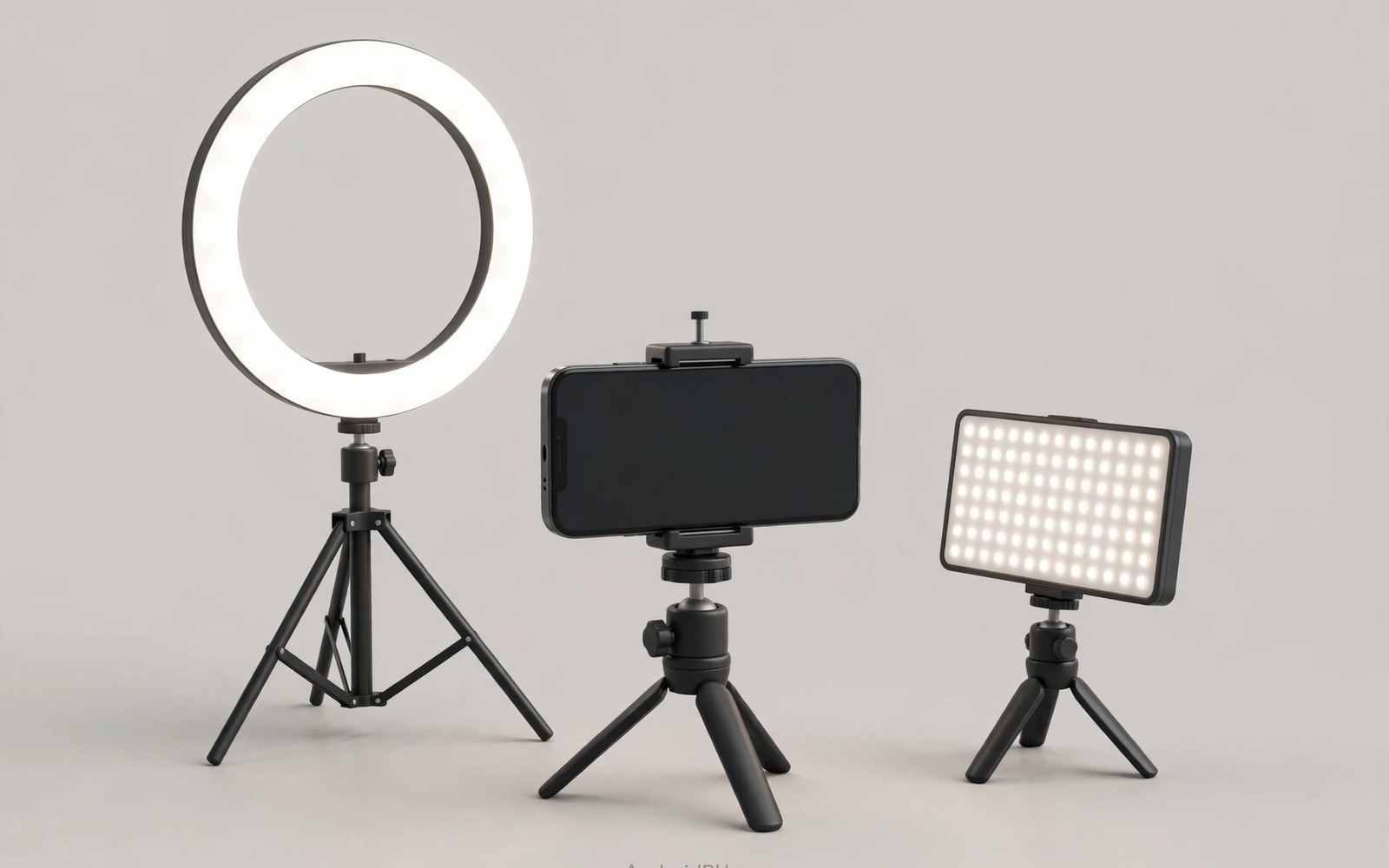
Ring Lights and Portable LED Panel Accessories for Mobile Video Shots
Good light changes phone video more than any other single purchase. Phone sensors are small, and noise grows fast in a dim room. A light placed near the phone lifts the subject, cleans up skin tones, and makes colours look the way they did in real life. Viewers forgive a shaky frame sooner than a dark, muddy face, and that simple fact decides most buying choices in this category.
Ring lights and LED panels solve lighting in different ways. A ring light wraps the lens in a circle of even light and puts a bright catchlight in the eyes. A panel throws a shaped beam that can sit to one side and give a scene depth. Both pack small enough for a bag and run on batteries, and both can look great or terrible depending on how you place them. This guide compares eight named lights, explains colour and power in plain terms, and covers the placement habits that matter more than brand or price.
Ring Light vs LED Panel: Which Light Does What for Mobile Video
A ring light puts light in a circle around the camera, so light reaches the face from all directions at once and softens shadows under the chin and nose. Skin looks smooth without heavy editing, which is why talking-head creators, beauty channels, and video-call regulars love them. The circular catchlight in the eyes is a signature look. Some creators build their whole style around it, while others find it artificial and prefer a panel placed off axis.
An LED panel is a flat board of many small lights behind a diffuser, and it produces a soft directional beam you can aim and shape. Place it to one side and the subject gains depth through gentle shadow. Panels suit interviews, product shots, and moody scenes where a flat ring would wash everything out. Panels vary from pocket cards to tablet-sized boards, and larger panels give softer light because the source is bigger relative to the subject.
When a Ring Light Wins
Choose a ring when the face is the whole video: tutorials, reactions, live streams, and calls. The even frontal light hides blemishes, keeps the eyes bright, and needs almost no skill to place. Put the phone in the centre, sit an arm length away, and you are lit. The trade-off is flatness. A ring alone removes shadows, and shadows are what give a face shape, so a ring-only setup can look like a passport photo if you never add a second source.
When an LED Panel Wins
Choose a panel when the scene matters as much as the face: cooking videos, unboxings, product demos, and interviews with a background worth seeing. A panel at 45 degrees gives the subject shape and lets the background fall into gentle shadow. Panels also travel better as fill lights, since a pocket panel can sit on a phone rig or a desk without a stand. The trade-off is skill. A panel in the wrong place creates harsh shadows, so you need to learn placement, which the later sections cover.
Using Both Lights Together
The best small kit I have used pairs a ring as the key light with a pocket panel as a side fill. The ring keeps the face clean, the panel adds shape from the side, and the whole kit fits in a backpack. Set the ring at about 60 percent brightness and the panel at 30 percent, then check the preview. That ratio keeps the face bright while the side light adds depth instead of competing with the ring.
8 Ring Lights and Portable LED Panels Worth Buying for Mobile Video
Every light below is a real product you can buy today, with a clear job, a clear audience, and honest drawbacks. Prices move with sales and region, so check the current price before ordering, and treat the prices here as a guide rather than a quote. The list runs from desk rings to pocket panels so you can match a light to your shooting style instead of buying the biggest light and hoping for the best.
1. Neewer 18-inch Ring Light Kit With Tripod Stand
The Neewer 18-inch ring is the default starter kit for talking-head video, and it earns that spot by being complete out of the box. You get the ring itself, a tripod stand that extends to standing height, a phone holder in the centre, and a remote shutter. The ring runs on mains power through an adapter, with adjustable brightness and colour temperature from warm to daylight, so one kit covers a bedroom studio and a living-room live stream.
It is for creators who shoot mostly in one room and want a set-and-forget setup. A beauty creator, a teacher recording lessons, or anyone doing daily video calls will use this every day. It is not for travel. The 18-inch ring and the tripod are bulky, and the kit needs a wall outlet, so it stays home while a pocket panel goes in the bag.
- Complete kit: ring, tripod, phone holder, and remote included, with nothing extra to buy.
- Adjustable brightness and colour temperature, so it matches most rooms without gels.
- Large diameter gives very soft, even light on the face at close range.
- Needs mains power, so it cannot run on a battery for outdoor shoots.
- Bulky to carry, and the tripod takes real floor space in a small room.
- Flat light can wash out facial shape unless a second light adds direction.
Verdict: the best first ring light for a home studio. Buy it if you shoot in one place most days, and skip it if you need a light that travels.
2. Godox LR150 Bi-Color Ring Light
The Godox LR150 is an 18-inch bi-colour ring aimed at creators who want finer control than a budget ring offers. It runs on mains power or two NP-F batteries, which makes it usable away from a wall, and it offers a wide colour temperature range with a remote control. Build quality is a step above the cheapest rings, with a sturdier mount and a cleaner diffuser that spreads light evenly without hot spots.
It is for semi-professional creators who already own NP-F batteries from other video gear and want one ring that works indoors and on location. A wedding videographer doing quick portrait clips or a creator filming in different rooms will get more from the battery option than a desk-only user will.
- Runs on mains or NP-F batteries, so it works away from a wall outlet.
- Wide bi-colour range for matching warm rooms and cool daylight.
- Clean, even diffusion with no harsh centre hot spot.
- Costs more than a basic ring kit, and batteries are usually sold separately.
- Still a large ring to carry, even without the tripod attached.
- Menu controls take a few sessions to learn by feel.
Verdict: a strong upgrade ring for creators who shoot in more than one location. Worth the extra cost if you already own NP-F batteries.
3. Ulanzi VL49 RGB LED Panel
The Ulanzi VL49 is a pocket-sized RGB panel that has become the default fill light for phone rigs. It is about the size of a credit card stack, weighs under 100 grams, and charges over USB-C. It offers white light with adjustable colour temperature plus a full RGB mode with colour effects, a small display, and a cold shoe mount on the back so it slides straight onto a phone rig or a small tripod.
It is for vloggers, travellers, and anyone who wants a light that lives in a jacket pocket. It works as a face fill on a rig, a small product light on a desk, or a colour accent light behind a subject. It is not a key light for a whole scene, because its output is modest, and at full brightness the built-in battery lasts roughly an hour.
- Tiny and light, with USB-C charging and a cold shoe mount built in.
- RGB colour modes add creative accent lighting without extra gels.
- Cheap enough to buy two, which solves most fill-light problems.
- Modest brightness, so it cannot light a whole room or a distant subject.
- Built-in battery cannot be swapped in the field when it runs flat.
- Small size means harder light than a large panel unless you diffuse it.
Verdict: the best pocket panel for the money. Buy two and you have a fill light plus a colour accent light for less than one large panel.
4. Aputure MC Portable LED Light
The Aputure MC is a small magnetic RGBWW panel built to a higher standard than most pocket lights. It offers accurate colour across a wide temperature range, a CRI rating around 96, and a companion app that controls brightness, colour, and effects over Bluetooth. Magnets on the back let it stick to metal surfaces, and it charges over USB-C with a battery that lasts around two hours at moderate brightness.
It is for creators who care about colour accuracy and already use Aputure lights in a larger setup, because several MC units can be grouped and controlled together. A product reviewer filming small items or a filmmaker adding a practical accent light will notice the colour quality. A casual vlogger may not need this level of accuracy and may prefer a cheaper panel.
- High colour accuracy with a CRI around 96, so skin and products look natural.
- App control and grouping for multi-light setups without touching each unit.
- Magnetic back and solid metal body that survives daily bag life.
- Costs several times more than a basic pocket panel with similar brightness.
- Small output, so it is an accent or fill light, not a key light.
- App control adds setup time for quick one-light shoots.
Verdict: the premium pocket light for colour-critical work. Buy it when colour accuracy matters to your channel, not as a first light.
5. Neewer 660 LED Video Light Panel
The Neewer 660 is a full-size LED panel with 660 individual LEDs behind a diffuser, and it is the workhorse of budget home studios. It offers adjustable brightness and colour temperature, runs on mains power or two NP-F batteries, and mounts on a standard light stand. The large surface gives soft light at a sensible distance, which makes it a real key light rather than a fill light.
It is for creators building a home studio on a budget: interviewers, course creators, and product reviewers who need a strong key light that can stay set up. It is not a travel light. The panel is roughly tablet-sized and needs a stand, so it suits a room you control rather than a street shoot.
- Strong output for its price, enough to key a seated subject at two metres.
- Runs on mains or NP-F batteries for indoor and outdoor use.
- Large surface gives soft light without a separate softbox.
- Needs a light stand, which adds cost and floor space.
- Plastic body feels less durable than metal panels at higher prices.
- Colour accuracy is good for the price but not as high as premium panels.
Verdict: the best budget key light for a home studio. Buy it when you need real output and have room for a stand.
6. Godox LEDP260C LED Panel
The Godox LEDP260C is a compact bi-colour panel with a built-in diffuser and a reputation for clean, even light in a small package. It runs on a built-in battery or USB power, offers brightness and temperature controls on the back, and mounts on a cold shoe or a small tripod. Its output sits between a pocket panel and a full studio panel, which makes it a flexible middle option.
It is for mobile creators who want one panel that can be a key light for a close subject and a fill light for a wider shot. A food creator filming overhead, a musician recording a practice session, or a vlogger shooting in a hotel room will find it covers most situations without a stand.
- Good brightness for its size, with a built-in diffuser for soft light.
- Built-in battery plus USB power, so it works on a desk or in the field.
- Simple rear controls with no app needed.
- Built-in battery cannot be swapped, so runtime limits long sessions.
- No RGB colour modes, only white light temperature control.
- Needs a small tripod or rig mount, which is not always included.
Verdict: a flexible middle-size panel for creators who want one light that does most jobs. A solid single-panel kit.
7. Lume Cube Panel Go
The Lume Cube Panel Go is a rugged pocket panel aimed at creators who shoot outdoors. It offers adjustable brightness and colour temperature, a built-in battery with USB-C charging, and a tough body that handles rain and rough handling better than most pocket lights. It mounts on a cold shoe or a tripod, and it can be used as a small key light for a close subject or a fill light for a wider scene.
It is for outdoor vloggers, hikers, and anyone filming in weather that would worry a plastic panel. A travel creator shooting at golden hour or a sports creator filming courtside will value the build quality. It costs more than a basic pocket panel, and its output is still modest, so it suits close work rather than lighting a whole scene.
- Tough, weather-resistant build that survives outdoor use.
- USB-C charging with a built-in battery for field shoots.
- Clean, even light with adjustable temperature for mixed outdoor light.
- Higher price than similar-sized panels with the same output.
- Modest brightness limits it to close subjects.
- No RGB modes for creative colour effects.
Verdict: the toughest pocket panel here. Buy it when your shoots happen outside, and choose a cheaper panel when they happen indoors.
8. SmallRig RM120 RGB LED Panel
The SmallRig RM120 is a compact RGB panel built for phone rigs and small cameras, with a metal body, a cold shoe mount, and a built-in battery that charges over USB-C. It offers white light with temperature control plus full RGB colour, and its controls are physical buttons rather than an app, so it is fast to adjust in the middle of a take. SmallRig designed it to sit on a rig without unbalancing the phone, which matters when you hold the rig for an hour.
It is for rig-based creators who already use SmallRig cages and mounts and want a light that matches that system. A street vlogger, a run-and-gun interviewer, or a creator filming with a cage and a microphone will find it integrates cleanly. It is not a key light, and its price sits above the cheapest pocket panels.
- Metal body and cold shoe mount built for rig use, not a desk afterthought.
- RGB colour plus white temperature control in one small unit.
- Physical buttons for fast changes without opening an app.
- Built-in battery cannot be swapped during a long shoot.
- Small output, so it works as fill or accent, not as a key light.
- Costs more than basic pocket panels with similar brightness.
Verdict: the best rig-mounted pocket panel for creators who already build around a cage. Buy it for integration, not for raw output.
Ring Lights and LED Panels Compared at a Glance
| Light | Type | Best use | Power | Colour control |
|---|---|---|---|---|
| Neewer 18-inch Ring | Ring | Home talking-head video | Mains | Bi-colour |
| Godox LR150 | Ring | Studio and location portraits | Mains or NP-F | Bi-colour |
| Ulanzi VL49 RGB | Pocket panel | Fill and accent on a rig | USB-C battery | RGB |
| Aputure MC | Pocket panel | Colour-accurate accent light | USB-C battery | RGBWW |
| Neewer 660 | Full panel | Home studio key light | Mains or NP-F | Bi-colour |
| Godox LEDP260C | Mid panel | Close key or fill light | Battery or USB | Bi-colour |
| Lume Cube Panel Go | Pocket panel | Outdoor and travel video | USB-C battery | Bi-colour |
| SmallRig RM120 | Pocket panel | Rig-mounted fill light | USB-C battery | RGB |
Colour Temperature, CRI, and Skin Tones in Mobile Video
Colour temperature describes whether light looks warm orange or cool blue. Indoor bulbs often run warm, around 3200K, while daylight runs cooler, around 5600K. A phone camera balances colour automatically, but mixed sources confuse it. Match your video light to the dominant room light for natural skin, and check the result on the phone preview before recording rather than trusting numbers alone.
Colour accuracy is measured by CRI, the colour rendering index, and by TLCI for video work. A CRI above 90 is a sensible target for skin, while cheaper lights can turn skin greenish or grey even at the right temperature. Real preview checks beat spec claims for skin work. Film a ten-second test, look at the skin on the phone screen and on a larger screen if you can, and only then commit to a full take.
Matching Your Light to the Room
Dial a bi-colour panel warmer in a lamp-lit room and cooler near a window. A ring light with fixed colour needs gels or a matching room to avoid casts, which is one reason adjustable panels are worth the small premium. Mixed lighting still happens in real rooms. A warm lamp plus a cool window plus a video light creates competing casts, so turn off or dim the weakest source to simplify the mix. Two matched sources beat three clashing ones every time.
Using RGB Colour for Accent, Not for Faces
RGB modes are fun and useful for backgrounds, but coloured light on a face rarely looks good. Keep the key light white and use RGB only for the wall behind you or a product on the side. A soft blue or warm orange glow behind the subject adds depth to the shot without changing skin tones, and it costs nothing once you own a panel with RGB.
Power on the Move: Batteries, USB-C, and Runtime
Small ring lights often run on USB power from a power bank or a laptop, which suits desk work and long indoor sessions. Battery-powered panels suit outdoor shoots where no outlet exists. Check runtime at full brightness, because makers often quote dim settings. A panel rated for two hours may last one hour at full power, and that hour can end in the middle of your best take.
Carry a power bank with enough capacity for the light plus the phone. A 10,000 mAh bank covers a small light for hours in most cases, and it can top up the phone between takes. Keep the bank and cable tidy so they never enter the frame. Rechargeable panels with built-in cells pack neatly but cannot swap cells in the field, while panels with removable NP-F cells let you carry spares and shoot all day. Choose built-in cells for short sessions and removable cells for event days.
Heat, Dimming, and Battery Health
Heat builds up in small lights at full brightness. Panels with metal bodies shed heat better than plastic ones, and dimming the light slightly when it feels hot protects the cells and the LEDs. A slightly dimmer light that lasts beats a bright light that shuts down, and moving the light closer often recovers the lost brightness anyway. If a panel gets too hot to hold comfortably, turn it down and let it cool for a few minutes.
Mounting Your Light: Cold Shoes, Tripods, and Overhead Arms
A light is only useful if it stays where you put it. Most pocket panels mount on a cold shoe, which is the small metal bracket on a phone rig or a camera cage. A ring light usually comes with its own tripod, while a full panel needs a light stand. Check the mount before you buy, because a panel with no cold shoe needs an adapter, and an adapter adds cost and wobble.
For rig-based shooting, read our guide to cold shoe mount adapters for lights and mics on phone rigs before you buy a mount, because a cheap adapter that slips will ruin more takes than a cheap light ever will. A good adapter locks the panel in place and lets you angle it without tools, which matters when you are adjusting light with one hand and holding the rig with the other.
Overhead Shots and Tabletop Setups
Overhead video, such as cooking or drawing, needs the light above the subject rather than in front of it. A tabletop arm holds the phone and the light over the table, and a panel on that arm gives even light across the whole surface. Our guide to studio tabletop arm stands for overhead smartphone video capture covers the arm options that work with a phone and a small panel together. Keep the light close to the arm and the phone in the centre, and check that neither the arm nor the light casts a shadow into the frame.
Placement Habits That Make Cheap Lights Look Expensive
Raise the light slightly above eye level and angle it down toward the face. Light from below creates unflattering shadows under the nose and chin, while light from directly above creates deep eye shadows. A gentle downward angle from the front flatters most faces, and it is the single easiest placement rule to remember. Move the light closer for softer light and further for harder light, because distance changes softness more than diffuser size alone. A close small light can look softer than a distant large light, so experiment with distance before buying a bigger panel.
Use a wall as a free bounce surface when you have no second light. Point a panel at a white wall and the wall becomes a large soft source, which is often softer than the panel itself. The trade-off is brightness, because bouncing loses light, so move the panel closer to the wall to compensate. Watch the background too. A light that is perfect on the face can leave the background black, which looks fine for a tutorial but odd for a vlog about a place. Add a small panel behind you or open a curtain to give the background some life.
A Five-Minute Lighting Check Before Every Shoot
- Turn on the room lights you plan to keep, and turn off the ones you do not need.
- Set the video light to match the room temperature, then check skin on the phone preview.
- Move the light closer or further until the shadows under the chin look soft, not sharp.
- Check the background for harsh bright spots or total darkness, and adjust a second light if needed.
- Record ten seconds, play it back, and only then start the real take.
Pairing Light With Sound for Better Mobile Vlogs
Good light makes viewers stay, but good sound makes them understand you, and a vlog with great light and bad audio still fails. A small lavalier microphone clipped to your shirt captures clear speech while the camera sits a metre away, which is exactly the distance a ring light wants. Our guide to external lavalier microphones that improve audio clarity in mobile vlogs explains which mics work with phones and how to keep the cable out of the shot.
Plan the rig as a whole: light on one cold shoe, microphone on the other, phone in the middle. That balance keeps the rig steady in the hand and keeps the mic close to your mouth while the light stays close to the lens. Test the full rig before a real shoot, because a mic that rubs against a shirt or a light that glares into the lens will both show up in the recording, and both are easier to fix at home than on location.
Frequently Asked Questions About Ring Lights and LED Panels
Do I need a ring light or an LED panel for phone video?
Buy a ring light if your videos are mostly your face talking to the camera, and buy a panel if your videos show products, places, or scenes as well as your face. If you can only buy one light and you shoot a mix of both, a mid-size bi-colour panel is the safer choice, because it can act as a key light for a face and a fill light for a scene, while a ring only does one job well.
What colour temperature should I use for skin tones?
Match the room. Use around 3200K in a warm lamp-lit room and around 5600K in daylight or near a window. A bi-colour light lets you dial between those values, and a quick preview check matters more than the number. If skin looks orange, cool the light down. If it looks blue, warm it up. Trust the preview, not the dial.
How long does a portable LED panel battery last?
Most pocket panels last 60 to 120 minutes at moderate brightness, and less at full brightness. Full-size panels on NP-F batteries can run two to four hours depending on the cell size. Always check runtime at full brightness before a shoot, carry a power bank or spare cells for anything longer than an hour, and dim the panel slightly if it gets hot.
Can one light be enough for mobile video?
One light is enough for a simple talking-head video in a room with decent ambient light. The ring or panel becomes the key light and the room light fills the shadows. For interviews, product shots, or outdoor video, a second small light makes a visible difference. Start with one good light, learn placement, and add a second pocket panel when you can see what the first light cannot do alone.
Ring Lights and LED Panels: A Practical Next Step
Start with the job, not the product. If your videos are mostly your face, get the Neewer 18-inch ring for home or the Ulanzi VL49 for travel. If your videos show scenes and products, get the Neewer 660 for a home studio or the Godox LEDP260C for a portable kit. Then spend an evening learning placement: raise the light above eye level, move it closer for softer light, match the colour to the room, and record a ten-second test before every shoot. That evening of practice will do more for your video than any second light you could buy.

