

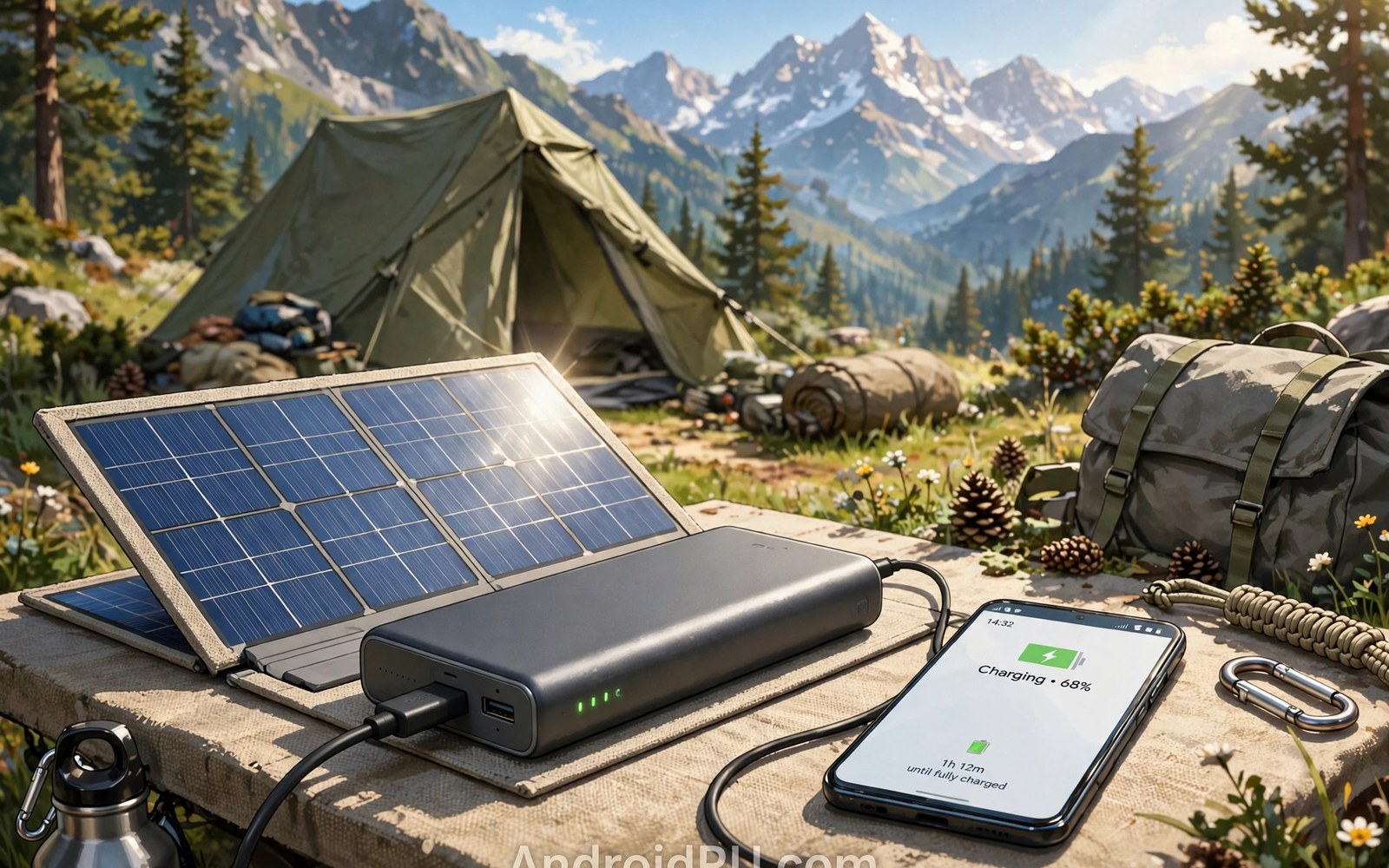
A solar power bank sounds perfect for camping. Sunlight charges the bank and the bank charges the phone. No outlet is needed for days in the wild. The reality is slower because built-in panels are small. A panel the size of a phone captures only a little solar power. That trickle may not keep up with daily phone use on a trip.
Panel size sets a hard limit on solar charging speed. A small panel in bright sun produces only a few watts. Conversion losses cut that figure further before power reaches the battery. A phone needs many watt hours for a full charge. A small panel may need days of sun for one phone charge. That maths surprises buyers who expect a panel to refill a bank overnight.
Solar banks still have a place in a camping kit. They work as emergency trickle chargers during long sunny days. They keep a phone alive for maps and emergency calls. They fail as a main charger for heavy phone use. This guide gives realistic numbers in plain terms. It also compares built-in panels with larger separate panels.
How Integrated Solar Panels Work
An integrated panel sits on the bank case and faces the sky. Sunlight hits photovoltaic cells and creates a small current. That current feeds the bank battery through a charge circuit. The circuit protects the cells from overvoltage on bright days. It also stops charging when the bank fills. The whole system is simple and rugged by design.
Panel output varies hugely with sun angle and cloud. Direct midday sun gives the best result by far. Morning and evening sun give far less. Cloud can cut output to a small fraction of the peak. Shade from a tent or a tree can stop charging almost entirely. Panel orientation matters too because a tilted panel catches less light.
Bank design adds another limit. The panel area is fixed by the bank size. A larger bank does not mean a larger panel. Most integrated panels share a similar small area. That area caps daily solar energy regardless of bank capacity. A huge bank with a tiny panel takes very long to refill by sun alone.
- Place the panel facing direct sun
- Keep the panel clean and unshaded
- Angle the bank toward midday sun when possible
Realistic Charging Times
Think in days rather than hours for solar bank refills. A small panel may add only a modest phone top-up per sunny day. Heavy phone use can outpace that daily solar gain. A phone used for photos and maps may drain faster than the panel refills. The bank then slowly empties across a multi-day trip. Solar input delays the empty point but it may not prevent it.
Season and latitude change the result a lot. Summer sun at low latitude gives the best daily gain. Winter sun at high latitude gives far less. A trip in bright summer desert sun differs hugely from a cloudy forest trip. Buyers should judge solar banks by their own trip conditions. A panel that works in summer may disappoint in autumn cloud.
Test the bank at home before a remote trip. Leave it in sun for a full day and note the battery gain. Repeat the test on a cloudy day for comparison. That pair of tests sets realistic expectations. A bank that gains little in a home test will gain little in the wild. Home testing prevents a nasty surprise far from help.
Solar Bank Versus Separate Panel
A separate folding panel offers far more solar area. It unfolds to several times the area of a built-in panel. That larger area charges a bank much faster in the same sun. It also lets the bank sit in shade while the panel sits in sun. That separation protects the bank from heat damage. Heat on a bank in direct sun can throttle charging and age cells.
Separate panels add bulk and cost to a camping kit. They need cables and a place to hang or lay flat. Integrated banks win on simplicity and ruggedness. They suit short trips and emergency use with minimal gear. Separate panels suit longer off-grid trips with heavy phone use. Choose based on trip length and phone demand rather than novelty.
A hybrid setup can work well for long trips. Carry a medium bank for daily phone charging. Add a folding panel to refill the bank during the day. Hang the panel on a pack while walking in sun. Refill the bank at camp from the panel in the evening. That system balances weight and solar gain across a week outdoors.
Heat Dust And Durability Outdoors
Outdoor use exposes solar banks to dust and drops and rain. Rugged cases protect the bank and the panel from trail damage. Dust on the panel cuts output until it is wiped clean. A quick wipe each morning restores most of the loss. Rain can pause charging but a sealed bank survives a shower. Check the water rating before trusting a bank in heavy rain.
Heat is a hidden enemy of solar banks. A bank left in direct sun heats up while its panel works. Hot cells accept charge slowly and they age faster. Shade the bank body while exposing only the panel when possible. A separate panel solves this problem neatly. An integrated bank needs careful placement to balance sun and heat.
Best Use Cases For Solar Banks
Solar banks suit emergency readiness and light use best. A day hiker with modest phone use gains a useful safety margin. A festival camper with sunny days gains top-ups between sets. A car camper can use solar as a backup to a car charger. These uses value a trickle of free power over fast refills. They do not demand a full bank refill by sun alone.
Solar banks suit less well for heavy off-grid work. A photographer shooting video all day will outpace a small panel. A navigator relying on live maps will drain faster than solar refills. Those users need a large bank plus a folding panel. They may also need a car charger or a second bank. Honest demand maths prevents a solar bank from becoming dead weight.
Buying And Testing Checklist
Check panel wattage in product notes with scepticism. Peak wattage assumes perfect sun that rarely lasts all day. Look for rugged build and a clear water rating. Check bank capacity against your phone battery size. Test solar gain at home across a full sunny day. Return a bank that gains almost nothing in good sun.
Pack a cable charger as well whenever possible. A car charger or a cafe stop can refill the bank fast. Solar then becomes a bonus rather than the only plan. That backup plan keeps a camping trip safe. Solar banks work best as one layer in a charging plan. No single solar bank should be the only power source far from help.
Solar Panel Types And Efficiency
Solar panel types differ in efficiency and cost. Monocrystalline panels convert sunlight most efficiently in small areas. Polycrystalline panels cost less but need more area for equal power. Thin film panels flex well but convert less efficiently. Integrated banks usually use monocrystalline cells for compact power. That choice maximises output from a small bank surface.
Panel efficiency ratings assume ideal laboratory sunlight. Real sunlight varies with angle and cloud and temperature. High panel temperatures actually reduce solar efficiency. A panel baking in summer sun produces less than its rating suggests. Shade on even part of a panel cuts output disproportionately. Real world output always trails laboratory ratings.
Panel angle matters as much as panel type. A panel flat on the ground catches less midday sun than a tilted panel. A panel facing the sun directly captures the most light. Camping setups should tilt banks toward the sun when possible. A simple prop can angle a bank for better gain. Small angle adjustments add meaningful energy across a day.
Panel cleanliness affects output more than buyers expect. Dust and fingerprints block light from reaching cells. A dirty panel can lose a noticeable share of output. Wipe panels each morning on dusty trails. A microfibre cloth cleans without scratching cell surfaces. Clean panels repay a minute of care with hours of gain.
Solar Charging And Emergency Preparedness
Solar banks serve emergency preparedness better than daily charging. A bank stored charged plus solar trickle covers power outages. Storms may cut grid power for days in some regions. A solar bank keeps a phone alive for emergency calls. It also powers a small radio or light in some setups. Emergency value justifies a solar bank even with slow charging.
Emergency kits should include a solar bank plus a cable bank. The cable bank provides immediate full charges after an outage. The solar bank extends power across multi-day outages. Together they cover short and long emergencies. Store both banks partly charged and check them seasonally. A dead emergency bank helps nobody during a crisis.
Solar banks in vehicles offer another emergency layer. A bank left on a dashboard gains trickle power in sun. Vehicle heat can damage bank cells over time though. Store the bank in a shaded vehicle spot with panel access. A windscreen shade can protect the bank body while exposing the panel. Balance sun access with heat protection carefully.
Practice emergency solar use before a real crisis. Test the bank in sun for a full day at home. Note gain and learn panel positioning. Teach household members the setup steps. A practised setup works under stress while an untested setup fails. Emergency gear earns trust only through practice.
Place the panel in direct sun
Wipe dust from the panel each morning
Note battery gain after a full day
Shade the bank body when possible
Carry a cable charger as backup
Readers who want more context on portable power can read Understanding Quick Charge (QC) Protocols Across Generations for a related view on the same topic.
Readers who want more context on portable power can read Wireless Charging Pads for Multi-Device Desk Setup for a related view on the same topic.
Readers who want more context on portable power can read Airplane Travel Restrictions for High-Capacity Lithium Power Banks for a related view on the same topic.
The steps above follow the approach described in the official developer documentation and standard industry guidance for safe charging practice.
Integrated solar panels are effective as trickle chargers. They are not effective as fast main chargers for heavy use. Panel size and sun conditions set hard limits. Realistic expectations make solar banks useful rather than disappointing. A sunny day can add a helpful top-up but rarely a full refill.
Judge a solar bank by a home sun test before a remote trip. Pair it with a cable backup for safety. Add a folding panel for longer off-grid stays. That layered plan keeps phones alive in the wild. Solar power helps most when it is treated as a bonus. The sun is free but it is also slow through a small panel.
Panel type and emergency use round out the solar picture. Monocrystalline panels maximise small area output. Real world sun and heat and angle cut laboratory ratings. Emergency preparedness values trickle power highly despite slow speeds. Practice and cleanliness maximise whatever sun is available.
Test any solar bank in real sun before trusting it outdoors. Clean the panel daily and angle it toward the sun. Pair solar with a cable backup for safety. That layered approach treats solar honestly. The sun helps most when expectations match panel reality. A solar bank is a slow friend rather than a fast charger.

