

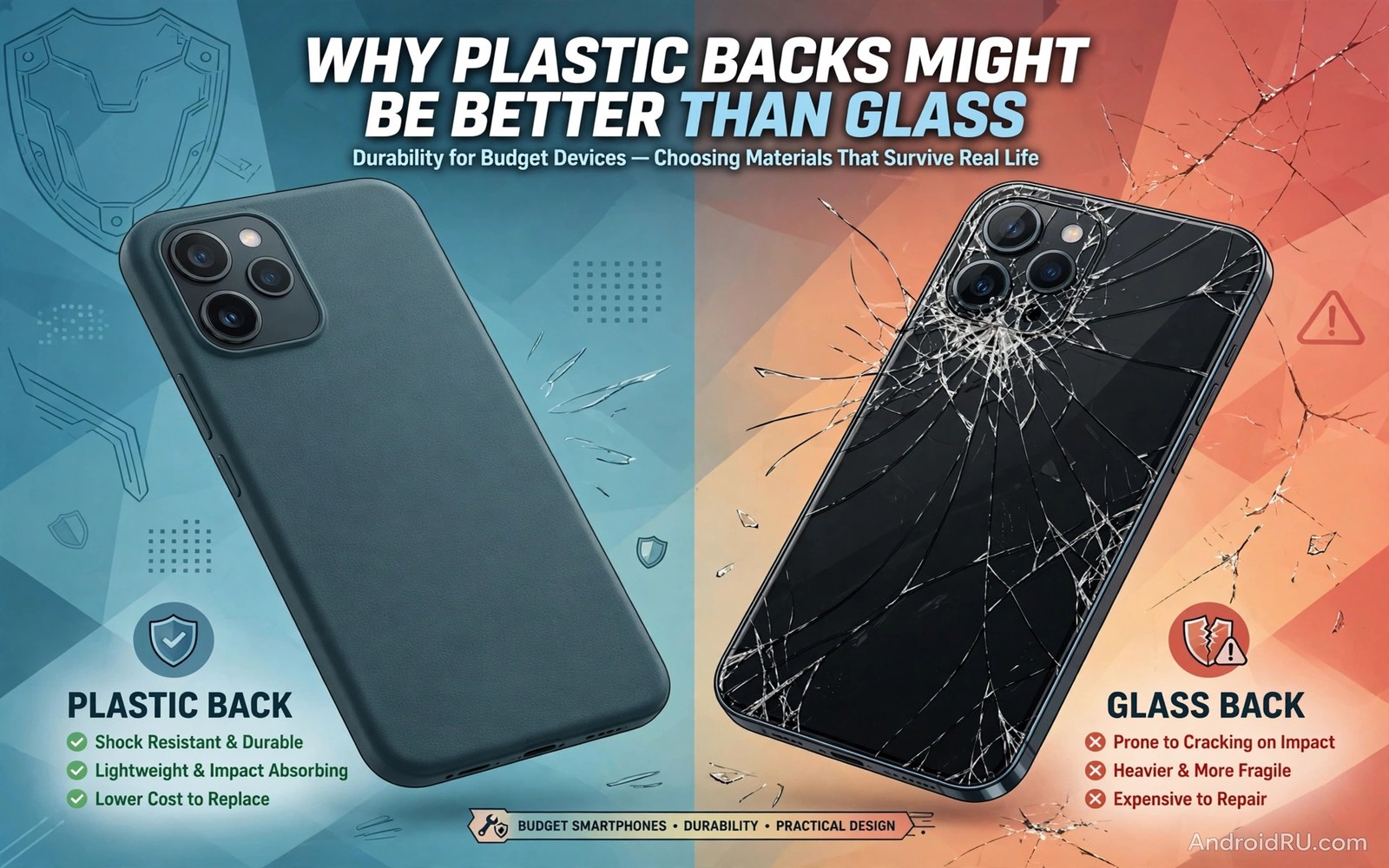
Why Plastic Backs Might Be Better Than Glass in Budget Devices
Pick up a budget phone in a shop and the first thing you notice is the back. Glass feels cool, smooth and expensive. Plastic feels warm, light and a little plain. Most buyers decide in that first second, and glass usually wins the showroom test. The problem is that the showroom test is the wrong test. You do not live in a showroom. You live with a phone that slips off a car seat, rattles around in a bag with keys, gets handed to a toddler, and spends two years being used one-handed on a crowded bus.
I have carried budget phones with both materials for years, and my honest experience is that the phone I worried about least was the plastic one. It fell more often, survived more falls, and cost me nothing in repairs. The glass one looked better in photos and made me nervous every time it slid across a table. This article is not a defence of cheap-feeling phones. It is a practical look at what each material actually does for you after the first month, when the novelty wears off and the phone becomes a tool.
What follows covers drop survival, grip, weight, signal, repair bills, scratches and resale, with real numbers where they exist and a comparison table so you can judge both sides on the same criteria. If you are shopping in the 150 to 350 dollar range, the back material is one of the few choices that affects your wallet twice: once at the till and again at the repair counter.
Plastic vs Glass Budget Phones: What Actually Changes in Daily Use
The back of a phone is not decoration. It is the part your palm touches thousands of times a day, the part that hits the floor first in a drop, and the part that sits between the antenna and the nearest cell tower. In a budget phone those jobs matter more than in a flagship, because budget phones have less room for expensive engineering tricks. A maker that spends its budget on glass has less left for the battery, the screen or the update policy.
That trade-off is the real story here. Nobody chooses plastic because it looks better. People end up preferring plastic because it behaves better in the situations that actually happen: the drop in the car park, the sweaty palm on a summer afternoon, the phone that has to last three years because the next upgrade is not coming soon.
What a Plastic Back Really Means in a 2026 Budget Phone
Modern budget phones do not use the brittle, creaky plastic of a decade ago. The material is usually polycarbonate, often with a matte or textured finish, sometimes with a fibreglass mix for stiffness. Samsung calls its version Glasstic on the Galaxy A series, a polycarbonate blend designed to look and feel closer to glass while keeping the toughness of plastic. Motorola, Xiaomi, Realme, Infinix and Tecno use similar polycarbonate shells across their budget lines, and the quality gap between a good polycarbonate back and a cheap one is mostly about the finish, not the material itself.
A well-made polycarbonate back flexes a fraction of a millimetre on impact and springs back. That flex is the whole point. Polycarbonate absorbs drop energy instead of turning it into a crack. It also lets makers shape the back with texture, ridges and soft-touch coatings that glass cannot copy without expensive etching. Before you compare models, think about how you use a phone each day from morning messages to evening video, and read how to pick a phone that fits your daily routine so the material choice lines up with your real habits instead of a showroom impression.
What Glass Backs Bring to a Budget Phone
Glass does have genuine strengths, and it would be dishonest to pretend otherwise. It resists scratches better than any plastic, it stays looking new for longer if you never drop it, and it gives a phone a dense, cool feel that many buyers read as quality. Glass also makes wireless charging easier to engineer, since makers already build glass-backed phones around charging coils, and it does not yellow or stain the way some light-coloured plastics can after a year of sun and pocket lint.
On budget phones the glass is rarely the top-tier Gorilla Glass Victus 2 you find on flagships. It is usually Gorilla Glass 3, Gorilla Glass 5, or a generic hardened glass from a smaller supplier. Those are solid materials, but they are thinner and less protected than flagship glass, and they sit on frames with less shock absorption. A budget glass back can still shatter from a waist-height drop onto concrete, which is exactly the drop most people experience.
Gorilla Glass Generations You Actually Find on Budget Phones
Gorilla Glass 3 dates from 2013 and is common on the cheapest phones. It handles keys and coins well but has no real drop protection. Gorilla Glass 5, from 2016, survives drops from around 1.6 metres onto rough surfaces in lab tests, and it is the most common glass on phones in the 200 to 350 dollar range. Some 2025 and 2026 budget models ship with Gorilla Glass 7i, a newer budget-focused glass that Corning rates for drops up to a metre, which is better than Glass 3 but still a long way from the Victus range. When a spec sheet just says “glass back” with no version named, assume the cheapest option and judge the phone accordingly.
Why Glass Still Feels Premium in the Hand
Feel is real, even when it is not logical. Glass is denser than plastic, so a glass phone feels heavier and more solid, and human hands tend to read weight as quality. Glass is also cool to the touch, which reads as expensive in the same way a cold metal watch does. Makers know this, which is why so many budget phones put glass on the back even when it adds cost and fragility. If that feeling matters to you, that is a fair reason to pick glass. Just be honest with yourself that you are paying for a feeling, not for durability.
Drop Test Reality: Plastic Backs vs Glass Backs After Real Falls
Lab drop tests and real drops are different things. Labs drop phones onto flat steel or smooth concrete from exact heights, with the phone landing on a chosen face. Real drops happen onto kerbs, gravel, tiled floors and the corner of a table, and the phone almost always lands on a corner first. Corner impacts concentrate force on a tiny point, and that is where glass fails.
Independent drop tests from channels that test dozens of phones a year tell a consistent story. Polycarbonate-backed budget phones such as the Galaxy A15, Moto G Power and Redmi Note series typically survive repeated waist-height drops onto concrete with scuffs and dents but no structural failure. Glass-backed phones in the same price range often crack the back panel on the first or second corner drop. The screen is a separate question, and a plastic back does not protect the screen, but a cracked back panel is still a real repair bill and a real loss of water resistance.
How Polycarbonate Absorbs Impact Instead of Passing It On
Polycarbonate has a high impact resistance for its weight. When it hits a hard surface it deforms slightly, spreads the force across a wider area, and returns to shape. Think of the difference between dropping a plastic lunchbox and a ceramic plate. Both hit the floor with the same energy, but only one of them turns that energy into a crack. That flex also protects the parts inside the phone. The battery, the camera module and the circuit board all feel less shock when the shell gives a little instead of shattering.
The trade-off is that plastic shows the hit. A hard drop leaves a dent or a scuff mark that glass might have hidden, if the glass had survived at all. A dented plastic back still works, still keeps dust out, and still holds the phone together. A cracked glass back lets in dust and moisture, can cut a finger on a raised shard, and usually means a repair shop visit within weeks.
Why Glass Cracks Even From Waist Height
Glass is strong in compression and weak in tension. A flat drop spreads the load and glass handles it well. A corner drop bends the panel for a split second, the outer surface goes into tension, and a flaw too small to see becomes a crack that runs across the whole panel. Every glass panel has microscopic flaws from manufacturing and daily wear, and each one is a starting point for a crack. Tempered glass helps, but the tempering on a thin budget back panel is far weaker than the tempering on a car window.
Height matters less than people think. A drop from a trouser pocket, about 90 centimetres, onto a concrete kerb edge carries enough energy to crack a budget glass back. A drop from a table onto a wooden floor usually does not. The surface matters more than the height, and the worst surfaces, rough concrete, asphalt and stone tiles, are exactly the surfaces in car parks, pavements and kitchens where phones actually fall.
Corner Drops Are the Worst Case for Glass Backs
If you only remember one thing from this section, remember the corner. Drop testers consistently find that corner impacts cause the most back-panel failures, and that a phone can survive ten flat drops and then crack on a single corner hit. Plastic handles corners far better because the corner itself can compress slightly. Some makers add a slightly raised plastic frame around the glass to absorb corner hits, which helps, but the frame is plastic doing the job that the glass cannot do.
Plastic vs Glass Weight, Grip and One-Hand Comfort Compared
Hold a 200-gram glass phone and a 175-gram plastic phone side by side for a minute and the difference is obvious. Twenty-five grams sounds trivial on paper. In the hand, after an hour of scrolling, a video call or a long read, it is the difference between a relaxed grip and a tired one. Budget phones tend to have large batteries, 5,000 mAh and above, and large screens, so every gram the back saves is a gram your hand does not have to carry.
Weight also changes how a phone falls. A heavier phone hits the ground with more energy, so a glass phone is not just more fragile, it also lands harder. That is a small effect, but it works in the same direction as everything else in this comparison: plastic is lighter, so it hits softer and breaks less.
Weight Savings You Can Feel on a Long Day
Typical numbers make the point clearly. The Galaxy A16 5G with its plastic back weighs about 192 grams. The similarly sized glass-backed phones in its class sit between 200 and 210 grams. The Moto G Power 2025, plastic back, weighs about 208 grams with a large battery, while glass rivals with the same battery sit closer to 220. Ten to twenty grams is not a headline spec, but it is the difference between a phone you forget in your pocket and a phone you notice every time you sit down.
Balance matters as well. Glass is denser, so a glass back shifts the centre of gravity toward the rear of the phone. That makes the phone feel slightly back-heavy and more likely to tip out of a loose grip. Plastic keeps the weight closer to the middle, and makers can shape a plastic shell with a gentle curve that sits in the palm. A curved plastic back often feels more secure than a flat glass slab, even before you add texture.
Grip in Wet Hands, Sweaty Palms and Winter Gloves
Smooth glass is slippery when dry and worse when wet. A sweaty palm on a summer afternoon, a phone used in the rain, or hands fresh from washing up all turn a glass back into a bar of soap. Matte and textured plastic grips far better in those conditions, and the difference is not subtle. I have watched a glass phone slide off a slightly tilted car dashboard that a plastic phone sat on without moving.
Texture is the key advantage. Makers can mould grip patterns, fine ridges and soft-touch coatings into plastic for almost no extra cost. Matte textured plastic grips better than smooth glass in wet or sweaty hands. Doing the same on glass needs etching or a coating that wears off. A vegan leather finish, used on some Motorola and Realme budget phones, is a plastic-based material that grips better than glass and hides fingerprints completely. If you use your phone without a case, grip is a daily safety feature, not a cosmetic detail.
Signal, Wireless Charging and NFC: Does a Plastic Back Help Reception?
Radio signals pass through plastic far more easily than through glass, and both pass signals far more easily than metal. This is physics, not marketing. A plastic back is effectively transparent to the cellular, Wi-Fi, Bluetooth and GPS signals your phone depends on, while glass absorbs and reflects a small part of each signal. The difference is small on a single measurement, but in a weak signal area, a basement, a lift, or a rural road, small differences decide whether a call drops or a page loads.
Real-world tests of signal strength are hard to run fairly because the antenna design matters more than the back material alone. Still, engineers consistently say that plastic gives antenna designers more freedom. They can place antennas closer to the back panel without worrying about the material blocking them, and they can use simpler antenna layouts that cost less to build. That saving can go into a bigger battery or a better screen.
Why Plastic Lets Radio Signals Through More Easily
Glass has a higher dielectric constant than polycarbonate, which means it interacts more with radio waves passing through it. In practice that shows up as a slightly weaker signal in marginal coverage. Most users will never notice the difference in a city with strong coverage. Users on the edge of coverage, in concrete buildings, or on networks with weak rural coverage are the ones who gain from a plastic back. Test call quality and signal strength in your usual places when possible, and ask friends on the same network about their experience, because real world signal beats lab numbers in daily life.
Wireless Charging on Budget Phones With Plastic Backs
Here is the one clear technical win for glass. Wireless charging coils work through both materials, but glass-backed phones are the ones that usually ship with wireless charging, because makers pair the premium feature with the premium material. Plastic does not block wireless charging at all, and a few plastic phones support it, but in the budget class wireless charging is rare on either material. If wireless charging is a must-have for you, check the spec sheet for the feature itself rather than assuming the back material tells you the answer. A glass back without a charging coil charges wirelessly exactly as well as a plastic back without one, which is to say not at all.
Repair Costs Compared: Replacing a Plastic Back vs a Glass Back
This is where the comparison stops being about feelings and starts being about money. A budget phone costs 150 to 350 dollars. A glass back replacement at a repair shop commonly costs 60 to 120 dollars including labour, and on some models the back glass is glued to the frame so tightly that the repair risks damaging the camera or the wireless charging coil. A plastic back replacement commonly costs 15 to 40 dollars, and on many models it is a simple clip-off, clip-on job that a shop finishes in twenty minutes.
Those numbers change the economics of a budget phone completely. A 90 dollar repair on a 200 dollar phone is nearly half the value of the phone, and many owners decide it is not worth doing, so they live with a cracked back or buy a new phone early. A 25 dollar repair on the same phone is an easy yes. Back panel replacement cost is the hidden price gap between plastic and glass phones. Over three years of ownership, the expected repair bill for a glass-backed budget phone is several times higher than for a plastic one, and that gap is larger than the price difference between the two phones at the till.
Typical Replacement Prices for Budget Phone Backs in 2026
Repair prices vary by country and by model, but the pattern is consistent. Third-party shops in most markets quote roughly 15 to 30 dollars for a polycarbonate back panel on a popular budget model such as a Galaxy A series or Redmi Note, with labour included. The same shops quote 60 to 120 dollars for a glass back on a comparable phone, and official service centres often charge more, sometimes 100 to 150 dollars once labour and taxes are added. The gap exists because glass panels cost more to make, take longer to remove safely, and carry a higher risk of collateral damage during the repair.
Availability matters too. Plastic back panels for popular budget models are widely stocked by third-party suppliers within months of launch. Glass back panels for less popular models can take weeks to arrive, and some repair shops will not stock them at all because the demand is too low and the breakage risk during fitting is too high. Check warranty terms and service centres in your area before you pay, and ask the seller about repair time and spare parts stock, because that question saves weeks of waiting when something breaks later.
DIY Repairs and What Breaks First on Each Material
Plastic backs are the friendlier material for home repair. Many budget phones with plastic backs open with a plastic pry tool and a little patience, and the back clips back on when you are done. Glass backs are usually glued with strong adhesive that needs heat, suction cups and a steady hand to remove, and a first-time repairer has a real chance of cracking the new panel while fitting it. If you like fixing your own gear, plastic is the obvious choice.
What breaks first also differs. On a plastic phone the first casualty is usually the screen protector or the frame corner, both cheap to fix. On a glass phone the first casualty is often the back panel itself, which is the most expensive simple repair on the device. what to check before you spend money on a new phone covers the wider buying checks that matter alongside the back material, including software support and storage, so read it before you finalise your shortlist.
How a Cracked Glass Back Affects Water Resistance
A cracked back panel breaks the seal that keeps dust and moisture out of the phone. Budget phones rarely carry a full IP68 rating, but many carry IP54 or an informal splash resistance that depends on the back panel being intact. Once the glass cracks, that protection is gone, and a phone that would have survived a rain shower can fail after a spill. A dented plastic back usually keeps its seal, because the dent does not open a gap. That is a hidden cost of glass that never appears on a spec sheet.
Plastic vs Glass Backs: Full Comparison Table for Budget Phones
Reading about each material separately makes it hard to compare them fairly, so here is the whole picture in one place. The table below uses the typical budget phone in the 150 to 350 dollar range, not a flagship with Victus glass and a titanium frame. Ratings are relative: a strength for one material is a weakness for the other, and the verdict column says who should care most about each row.
| Criteria | Plastic (polycarbonate) back | Glass back | Who should care most |
|---|---|---|---|
| Drop survival | Flexes on impact, rarely cracks, dents instead | Cracks from corner drops, even at waist height | Parents, commuters, anyone without a case |
| Scratch resistance | Scratches more easily, marks show on glossy finishes | Resists keys and coins far better | Buyers who skip cases and screen protectors |
| Weight | Typically 10 to 25 grams lighter at the same size | Heavier, denser feel that reads as premium | One-handed users, long reading and call sessions |
| Grip | Matte and textured finishes grip well wet or dry | Slippery when wet, needs a case for secure grip | Outdoor workers, gym users, rainy climates |
| Signal reception | Nearly transparent to cellular, Wi-Fi and GPS signals | Slightly more signal loss in weak coverage areas | Rural users, basement offices, weak coverage zones |
| Wireless charging | Works fine through plastic, but rarely fitted on budget plastic phones | Commonly paired with wireless charging on pricier models | Buyers who already own a charging pad |
| Back replacement cost | About 15 to 40 dollars including labour | About 60 to 120 dollars, sometimes more at official centres | Buyers keeping a phone for 3 years or more |
| Repair difficulty | Often clips off, easy for shops and home repairers | Glued on, needs heat and skill, higher risk of extra damage | DIY repairers and small-town owners |
| Fingerprints and smudges | Matte plastic hides prints well | Shows every fingerprint unless wiped constantly | Anyone who dislikes cleaning their phone daily |
| Long-term looks | Can scuff and fade, light colours may yellow slightly | Keeps a new look longer if never dropped | Resale-focused buyers who use a case from day one |
| Heat in sunlight | Stays cooler to the touch in direct sun | Heats up faster and holds heat longer | Drivers, outdoor workers, hot climates |
| Resale value | Slightly lower demand, but fewer cracked phones on the used market | Higher asking price when flawless, steep drop when cracked | Buyers who resell after one year |
The table shows why there is no single winner. Plastic wins on toughness, weight, grip, signal and repair cost. Glass wins on scratch resistance, looks and the feeling of quality. Your life decides which column matters more. A phone that lives in a case on a desk all day gets little benefit from a tough plastic back. A phone that lives in a pocket, a bag and a child’s hands gets little benefit from scratch-proof glass.
Scratches, Fingerprints and Long-Term Looks: Plastic vs Glass After a Year
After a year of daily use, the two materials age in opposite ways. Glass looks new until the day it does not, and then it looks broken. Plastic looks slightly worn from the first month, and then stays about the same for years. Which of those ageing patterns bothers you more is a personal question, but it is worth thinking about before you buy, because a year is a long time to look at a phone you dislike.
Fingerprints are the daily annoyance that glass owners know best. A glossy glass back shows every touch within minutes of wiping, and in a warm room the back can look smeared by lunchtime. Matte plastic hides fingerprints almost completely, and a textured finish hides them even better. This sounds trivial until you realise you touch the back of your phone hundreds of times a day and see it every time you pick it up.
How Each Material Ages After Twelve Months of Daily Use
Plastic ages through fine scratches, edge wear and a slow loss of the original finish. A glossy plastic back picks up swirl marks from pockets and bags, and those marks catch the light. A matte plastic back hides the same wear far better, which is why most good budget phones now use matte finishes. Light-coloured plastic can yellow slightly after long sun exposure, though modern UV-stable polycarbonate has reduced this a lot compared with the plastics of ten years ago.
Glass ages through micro-scratches that are invisible at first and gradually dull the shine, plus the constant risk of a crack. A glass back that has never been dropped still looks good after a year, just a little less mirror-like. The real ageing problem for glass is not wear but the single bad day. A phone can look perfect for 364 days and be worth half its value on day 365 because of one fall in a car park.
Keeping Either Material Looking Good Without a Case
If you use your phone without a case, a few habits keep either material in good shape. Wipe a glass back with a microfibre cloth once a day and it stays clear. Keep a plastic phone in a pocket without keys or coins and the swirl marks stay minimal. A thin skin or a clear film on the back protects both materials for a few dollars, and it is the cheapest insurance against both scratches and the first small drop.
One habit matters more than the rest: do not put your phone face-down on rough surfaces. A table in a cafe, a stone wall or a concrete step will scratch a plastic back and can chip a glass one. Put the phone in a pocket or on a soft surface instead. practical tips for getting more value from a mid-range phone has more habits like this that stretch a mid-range phone further, including charging routines that protect the battery over the same three-year ownership period.
Matte Finishes: The Best Compromise Between the Two Materials
If you want the look of glass and the grip of plastic, look for a matte finish. Matte glass, found on some pricier phones, resists fingerprints and feels soft, but it is still glass underneath. Matte plastic gives you the same fingerprint resistance with the toughness of polycarbonate, and it is the finish most budget makers now use by default. When you test a phone in a shop, run your thumb across the back and look at it under the shop lights. A matte back that still shows a faint sheen will look good for years, while a high-gloss back will show every mark within a week.
Which Back Material Fits Which Buyer? Verdicts per Use Case
A neutral comparison has to end with honest verdicts, and honest verdicts depend on the buyer. There is no single best back material for everyone, and anyone who tells you otherwise is selling you a phone, not giving you advice. Here is how the choice breaks down for the people who actually buy budget phones.
Best Choice for Parents, Kids and Clumsy Hands: Plastic
If the phone will be dropped, and you know it will be dropped, plastic is the clear pick. A phone handed to a child, carried on a building site, or used by someone who has already cracked two screens should have a polycarbonate back. The repair savings alone justify the choice, and the lighter weight and better grip reduce the number of drops in the first place. Put the money you save on repairs toward a better screen protector or a larger storage option.
Best Choice for Careful Owners Who Use a Case: Either, Lean Glass
If you fit a case on day one and the phone rarely leaves it, the back material barely matters, and glass is a fair choice for the premium feel and the scratch resistance. A case absorbs the drop that would have cracked the glass, and the glass underneath stays looking new. In this use case you are buying glass for the feeling, and that is a legitimate reason, as long as the case stays on. The moment the case comes off for a photo or a clean, the risk returns.
Best Choice for Outdoor Work, Travel and Hot Climates: Plastic
Outdoor workers, travellers and anyone in a hot climate should pick plastic. It grips better with sweaty hands, stays cooler in direct sun, survives drops onto rough ground, and costs little to replace when it does get damaged. A phone used on a beach, a hike or a construction site has no business having a fragile glass back, however pretty it looks in the shop. The same logic applies to a phone used as a sat-nav on a motorbike or in a car mount in summer heat.
Best Choice for Resale After One Year: Glass, With a Case
If you upgrade every year and resell the old phone, a flawless glass back usually earns a higher resale price than a plastic one, because buyers pay for the premium look. The catch is the word flawless. A single crack wipes out the whole premium and then some, so this verdict only holds if you use a case and a skin from the first day. If you are honest with yourself and you know the case will come off within a month, plastic will probably resell better, because a scuffed plastic phone still sells while a cracked glass phone barely sells at all.
What Matters More Than the Back Material at This Price
Before you finalise a shortlist, remember that the back material is not the most important choice on a budget phone. Update support, battery life, screen brightness and camera quality all shape daily life more than the back does. A plastic phone with four years of updates beats a glass phone with two years of updates every time. A glass phone with a dim screen is worse in sunlight than a plastic phone with a bright one. Compare at least three phones in the same price band before you decide, look at screen brightness and speaker quality and update length, and let the back material be the tiebreaker, not the deciding factor.
Frequently Asked Questions About Plastic and Glass Phone Backs
Does a plastic back always feel cheap?
No, and the gap has narrowed a lot. A well-made polycarbonate back with a matte or textured finish feels solid, warm and secure in the hand, and many buyers cannot tell it from glass without looking closely. What feels cheap is thin, glossy, hollow-sounding plastic with visible flex, and that is a sign of a badly made phone, not of the material itself. Test the phone in a shop, press the back gently, and listen for creaks. A good plastic back is silent and firm, and Samsung’s Glasstic on the Galaxy A series is a good example of plastic done well.
Is glass stronger than plastic in every way?
No. Glass is stronger against scratches and it resists pressure better, but plastic is far stronger against impact and bending. Each material wins in a different test, which is why the honest answer is that neither is stronger overall. Glass wins the key test, plastic wins the drop test, and most phones die from drops, not from keys. If you carry your phone loose in a pocket with keys every day, glass has a real advantage. If you drop your phone even once a year, plastic has the bigger advantage.
Should I still use a case on a phone with a plastic back?
Yes, if you care about resale value or about the screen. A plastic back protects itself well, but it does nothing for the screen, and a case with a raised lip is still the best protection for the display. A slim case on a plastic phone also adds grip and covers the scuffs that build up over time, so the phone looks better when you eventually sell it. The difference is that a case on a plastic phone is optional insurance, while a case on a glass phone is close to a requirement.
Do plastic backs affect resale value?
Slightly, and in both directions. A flawless glass phone usually lists for a little more than a comparable plastic phone, because buyers associate glass with a higher tier. But a plastic phone in good condition sells reliably, while a glass phone with even a small crack loses a large part of its value at once. Over a large number of used sales, the average resale outcome for plastic and glass is closer than the asking prices suggest, because so many glass phones on the used market are already cracked.
Can a plastic back phone support wireless charging?
Yes. Plastic does not block wireless charging at all, and the charging coil works through polycarbonate just as well as through glass. The reason few budget plastic phones offer wireless charging is cost and product positioning, not physics. Makers reserve wireless charging for higher-priced models, and those models usually have glass backs, which creates the false impression that glass is required. If you see a plastic phone with wireless charging listed in the specs, trust the spec sheet, not the assumption.
The Bottom Line on Plastic vs Glass Budget Phones
Glass wins the first five seconds. Plastic wins the next three years. That is the short version of this whole comparison, and it holds up across almost every budget phone I have used. A glass back looks better in the shop, resists scratches better, and feels more expensive in the hand. A plastic back survives drops better, weighs less, grips better, lets signal through more easily, and costs a fraction as much to replace when something finally goes wrong.
Your next step is simple and takes one afternoon. Go to a shop, hold your top two choices without a case, and be honest about how you will actually use the phone. If it will live in a case and you love the feel of glass, buy the glass phone and enjoy it. If it will be carried bare, handed to kids, used outdoors or kept for three years, buy the plastic phone and spend the money you save on repairs on a bigger storage option or a better screen protector. Either way, test the phone in your own hands before you pay, because the back you touch every day matters far more than the back you admire in a photo.

