

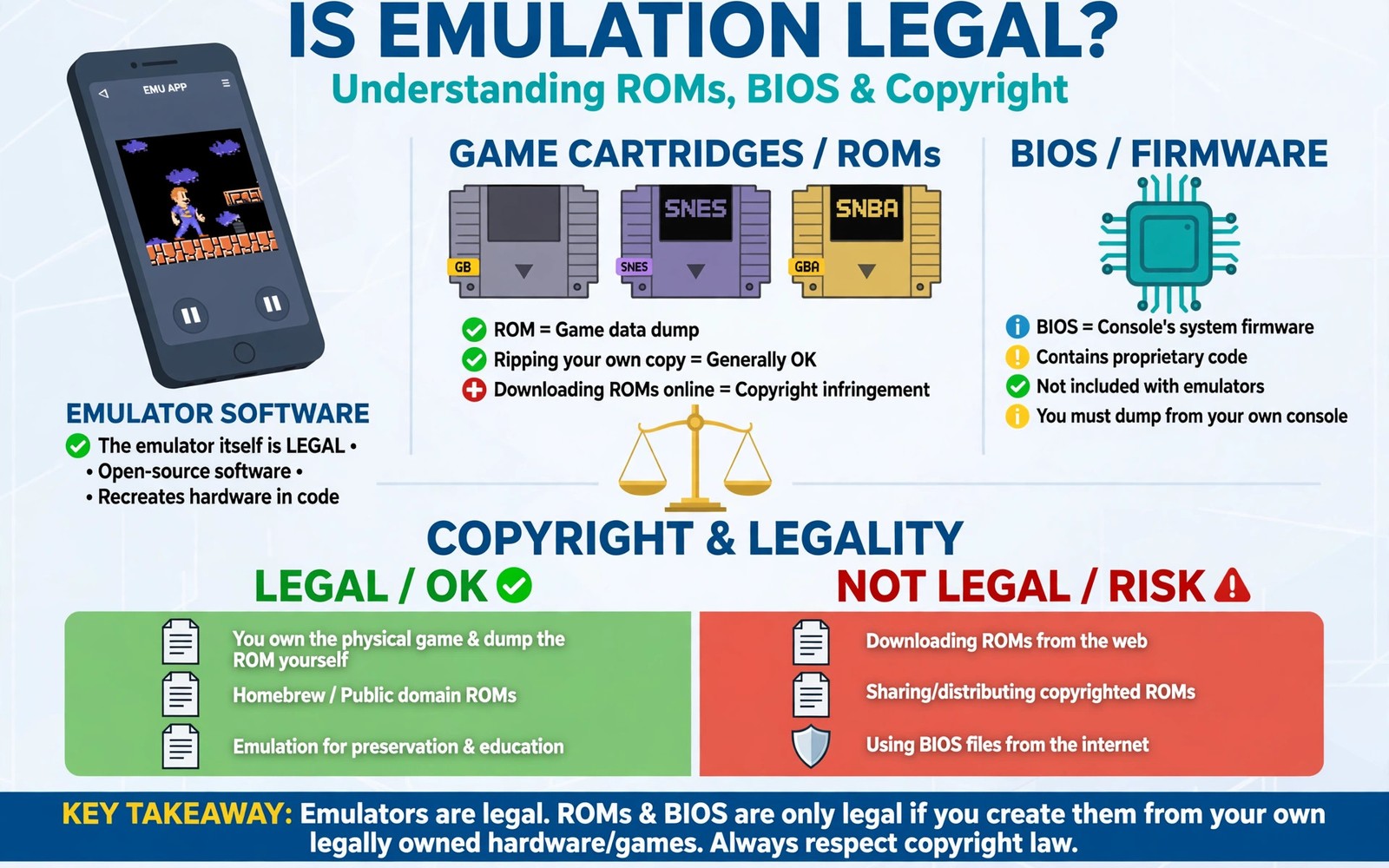
This guide covers emulation legality and ROMs in plain terms. Players ask one question more than any other about retro games. Is emulation legal? Understanding ROMs, BIOS, and copyright starts with a simple split. Emulator software and game files are different things. The law treats them differently in most places. This article explains that split in plain language.
Emulators themselves are generally lawful software. They are programs that copy hardware behaviour. Courts have treated clean room emulation as lawful in famous cases. That general rule does not cover every detail. Implementation details and included files can change the picture.
Game files and BIOS files carry the real legal risk. They contain copyrighted code from the original makers. Downloading a game you do not own is risky in most regions. A careful emulation start respects that boundary from day one. Ownership is the key idea throughout this topic.
Emulators versus game files
An emulator is like a virtual console with no games inside. It contains no game code by itself. That emptiness is why emulators are widely sold and shared. A game file contains the actual game code and art. Copying that code without permission is where copyright applies.
Think of a music player and a song. The player is a tool. The song is the copyrighted work. Emulators are the player in this picture. Game files are the songs. The distinction guides almost every legal question in this area.
What owning a game usually means
Owning a physical cartridge gives you certain rights in some regions. Those rights may include making a personal backup copy. The exact rights differ by country and by law. No single rule covers every place on earth. Check the law where you live for the precise position.
A backup copy is normally for your own personal use. Sharing that copy with others is a different act. Uploading a backup to a public site crosses a clear line. Keep personal backups private and limited to your own devices. Private personal use is the safest frame for backups.
BIOS files and system software
A BIOS is the startup software inside a console. It is copyrighted code like a game file. Some emulators need a BIOS to run correctly. You should obtain a BIOS only from hardware you own where the law allows it. Never treat a BIOS as a free download with no questions.
Some emulators avoid BIOS files by reimplementing startup behaviour. Those emulators are simpler to set up legally. They may run fewer games or run them less accurately. The tradeoff is real but the legal clarity helps beginners. Choose the path that fits your comfort level.
Abandonware and old games
Abandonware is a community word and not a legal category. A game does not lose copyright because it is old or un sold. Copyright lasts for many decades after release. An old game can still belong to a company or an estate. Age alone does not make copying lawful.
Some rights holders re-release old games on modern stores. Buying a re-release supports the makers and gives a lawful copy. Official mini consoles also offer lawful ways to play classics. Lawful options grow every year. Explore them before you assume no option exists.
Practical safe habits
Keep your game files private on your own devices. Do not upload them to public folders or sharing sites. Do not distribute BIOS files to friends. Private personal use is far safer than any form of sharing. Sharing multiplies legal risk for everyone involved.
Buy games when a lawful purchase exists for your platform. A purchase gives a clear conscience and a clean file. It also supports future re-releases of classics. Your money signals demand for old games. That signal helps the whole retro community.
Regional differences in copyright law
Copyright law differs between countries in important details. Backup rights that exist in one country may not exist in another. A rule that feels universal online may be local law only. Players should check the law where they actually live. Online guides often describe one country without saying so. That omission causes confusion for international readers. Local law is the only law that governs your actions. General guides can never replace local legal knowledge.
Some countries allow format shifting for personal use. Format shifting means converting a game you own to another format. Other countries restrict even personal format shifting strictly. The difference matters for backup creation directly. A backup that is lawful in one place may be unlawful elsewhere. Travellers should note that laws change across borders. Physical location at the time of copying matters legally. Keep copies private regardless of location for safety.
Enforcement also varies between regions in practice. Some regions focus enforcement on large scale distribution. Others pursue individual downloading more actively. Practical enforcement patterns do not change the written law. A low enforcement risk still means a legal risk exists. Do not confuse rare enforcement with lawful behaviour. Safe habits matter even when enforcement seems unlikely. Lawful choices protect you regardless of enforcement trends.
Supporting official re-releases
Official re-releases give old games a lawful modern home. Mini consoles bundle classics with legal licences included. Digital stores sell old titles for modern devices often. Buying a re-release supports the rights holders directly. That support encourages more re-releases in future. Consumer demand shapes which classics return to stores. Your purchase is a vote for preservation through commerce. Commercial preservation complements community preservation efforts nicely.
Re-releases sometimes improve old games with modern features. Save anywhere and rewind features appear in many collections. Those features mirror emulator conveniences in a lawful package. A re-release may offer the best experience for a favourite. Compare the re-release with emulation honestly for each title. Lawful convenience can beat grey area convenience. The best version is the one you can enjoy without worry.
Some classics never receive an official re-release. Rights may sit with defunct companies or unclear owners. Those games pose the hardest questions for players. No purchase option exists to resolve the dilemma. Players must weigh personal ethics and local law carefully. This article cannot answer that dilemma for you. General information guides but personal judgment decides. Seek qualified advice for specific hard cases.
Public domain and homebrew games
Public domain games carry no copyright restrictions at all. Their creators released them freely for everyone. Public domain titles offer a fully lawful library instantly. Homebrew games are new games made by independent creators. Homebrew developers often share their games freely. Both categories avoid the legal worries of commercial games. A lawful library can still be large and fun. Freedom from worry enhances enjoyment noticeably.
Homebrew games showcase creativity within old hardware limits. Developers build new adventures for decades old systems. Those games often rival commercial titles in quality. Homebrew communities welcome new players warmly. Try a homebrew title to support independent creators. Your play and feedback encourage more homebrew development. Independent development keeps old systems alive creatively. Alive systems attract new players continuously.
Public domain status requires verification before assuming freedom. A game labelled free online may still carry copyright. Check the source and licence for each title carefully. Trusted homebrew sites document licences clearly. A clear licence statement gives confidence to download. Unclear licences deserve caution and further checking. Verification takes minutes and prevents legal confusion. Trustworthy sources matter for lawful libraries.
Mixing lawful free games with owned commercial games works well. A library can hold both categories side by side. Keep free games in a separate folder for clarity. Separation makes licence status obvious at a glance. Clear folders help future audits of the library. An auditable library stays lawful without effort. Organisation supports legality as well as browsing. Tidy lawful libraries are the easiest to enjoy.
Common mistakes
The most common legal mistake is assuming old means free. Copyright does not expire just because a game is old. Decades must pass before works enter the public domain. Treat every commercial game as owned until proven otherwise. That caution keeps you safe.
Another mistake is sharing backups with friends casually. A personal backup and a shared copy are different acts. Sharing turns a private matter into distribution. Keep backups on your own devices only. Friends should make their own lawful choices.
Do not rely on forum claims about the law. Forums mix opinion and myth freely. Laws differ by country and change over time. This article is general information and not legal advice. Consult a qualified source for a specific legal question.
A practical example you can try
# this is a checklist, not legal advice
# keep backups private
# buy a lawful copy when one is sold
This snippet is an original example written for this article. It shows the idea in a compact form that you can adapt to your own setup and change as you learn what works best on your phone.
Frequently asked questions
Are emulators illegal to download?
Emulator apps themselves are generally lawful tools. They contain no game code on their own. Problems arise from game files and BIOS files. A private library habit keeps the tool separate from risky files. Keep the distinction clear in your setup.
Emulator apps themselves are generally lawful tools. They contain no game code on their own. Problems arise from game files and BIOS files. A private library habit keeps tools separate from risky files. Keep that distinction clear in your setup.
Does owning a cartridge allow any download?
Not automatically in every country. Some regions allow a personal backup you make yourself. A download from a third party is a different act. A console setup still needs lawful game sources. Check your local law for the exact rule.
Owning a cartridge does not automatically allow any download. Some regions allow a personal backup you make yourself. A download from a third party is a different act. A console setup still needs lawful game sources. Check your local law for the exact rule.
What is abandonware really?
Abandonware is an informal label for old unsupported games. It is not a legal status that frees a game. Copyright still applies even when a game is un sold. Official re-releases are the safest path to old favourites. Support them when they exist.
Abandonware is an informal label for old unsupported games. It is not a legal status that frees a game. Copyright still applies even when a game is un sold. Official re-releases are the safest path to old favourites. Support them when they exist.
Conclusion
Your concrete next step is a simple audit of your own library today. List where each game file came from in plain notes. Remove any file you cannot trace to a lawful source. Replace favourites with official re-releases when they exist. That audit turns a vague worry into a clear and lawful collection.
Write a personal policy for your game library this week. State in plain words what sources you accept and what you avoid. A written policy makes future decisions fast and consistent. Share the policy with friends who ask about your setup. A clear policy turns a complex topic into a calm habit.

