

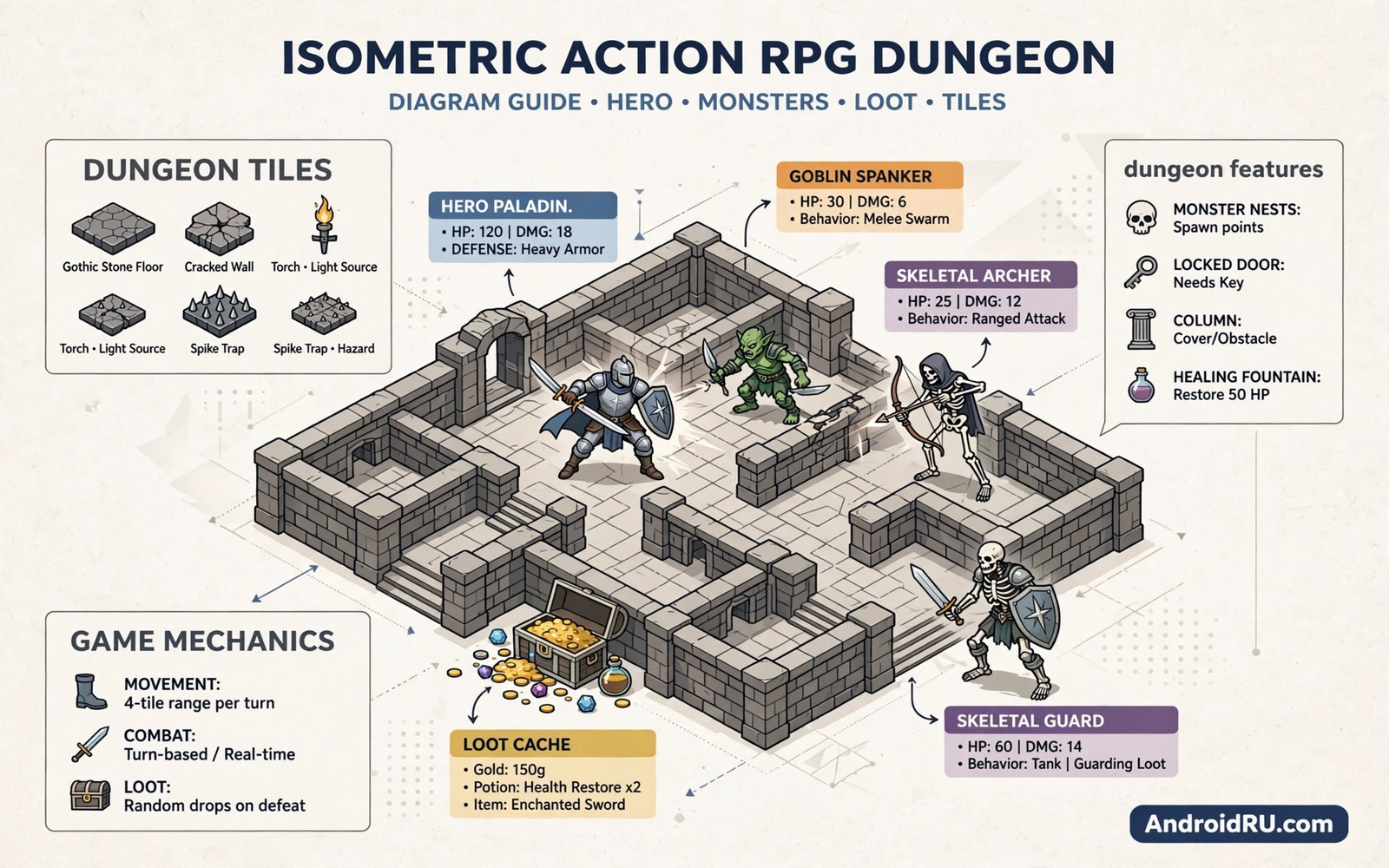
Isometric action RPGs reminiscent of Diablo deliver fast combat from a tilted top-down view. You click or tap to move and unleash skills on swarms of enemies. Loot explodes across the screen. That loop has hooked players for decades and mobile does it proud.
The isometric view suits phones surprisingly well. You see the whole battlefield at a glance and taps direct movement naturally. This guide explains what makes Diablo-like ARPGs work and how to master them. Fans of dungeon diving will find kindred systems here and you can explore those through this guide to action RPGs with dungeon crawling: action RPGs featuring dungeon crawling and loot collection.
Why the isometric view works
The tilted camera shows a wide battlefield without camera juggling. You see enemies approaching from all sides and position accordingly. That awareness matters in games where swarms surround you constantly. A first person view would hide half the danger.
Touch controls map well to this view. Tap to move and tap to attack feels intuitive after minutes. Virtual joysticks offer an alternative for players who prefer analog movement. Both schemes work because the camera never fights you.
The loot chase and build crafting
Loot drives isometric ARPGs completely. Every enemy can drop gear and every boss can drop something transformative. Rarity tiers and random affixes create endless combinations. A single perfect item can redefine your build overnight.
Build crafting turns loot into strategy. Skills and gear synergies multiply power far beyond raw stats. A fire skill paired with burn gear and crit bonuses creates a build that melts crowds. Experimentation is cheap when respecs cost little. Try strange combinations before copying popular builds.
Seasons, ladders, and endgame
Seasons refresh isometric ARPGs regularly. A new season resets progress and adds mechanics and rewards. Veterans return for fresh starts and new players join on equal footing. Seasonal play keeps the genre alive for years.
Endgame offers rifts and maps and dungeons with scaling difficulty. Each tier raises rewards and danger together. Leaderboards track the deepest clears and fastest times. Push your limits gradually rather than jumping to brutal tiers unprepared.
Playing isometric ARPGs on mobile
Mobile ARPGs need good performance since screens fill with effects. Lower particle density if your phone stutters during huge fights. A stable frame rate matters more than maximum effects when dodging matters. Controller support also helps long sessions by reducing thumb fatigue.
Battery life deserves attention. Effect heavy combat drains power fast. Play near a charger for long sessions or lower brightness and effects for travel. A phone that dies mid rift loses progress and patience alike. For players who love huge explorable worlds, open-world RPGs offer a different scale of adventure and you can compare them through this guide to open-world RPGs: open-world RPGs that push mobile hardware.
Camera angles and battlefield awareness
Camera control in isometric ARPGs seems automatic, yet skilled players manipulate it constantly for battlefield awareness. Zooming out reveals more enemies and hazards, which prevents ambushes that a narrow view would hide. Zooming in shows detail during precise boss mechanics, where telegraphs matter more than peripheral vision. Switching zoom levels situationally, rather than leaving one setting forever, gives you the best of both views throughout a dungeon.
Learn your game’s camera options thoroughly, because many players never discover zoom and rotation features that transform awareness. Some games allow camera rotation that reveals hidden areas behind walls, while others lock the angle for simplicity. Test camera settings during safe exploration before relying on them in combat, since unfamiliar controls during a boss fight cause mistakes. A camera you control deliberately beats a camera you merely accept.
Damage types and resistances
Damage types and resistances add strategic depth that raw damage numbers hide, because enemies resist some damage and weaken against others. A fire build melts ice enemies yet struggles against fire resistant bosses, which forces adaptation across content. Resistance penetration gear and damage conversion skills let builds overcome these barriers, though they cost slots that could boost raw power. Balancing specialization against flexibility defines advanced ARPG building.
Study enemy resistances before committing to a single damage type, because a pure build that encounters immune enemies hits a wall. Keep a secondary damage source ready, whether through a backup skill or gear swap, for resistant encounters. That flexibility costs little during normal play yet saves entire builds during endgame. The best ARPG players treat damage types as a toolkit rather than an identity, switching tools as each encounter demands.
Trading in isometric ARPGs
Trading transforms isometric ARPG economies, because loot you cannot use becomes currency for gear you need. A legendary item for another class holds no value in your stash, yet it may fund your entire build through trade. Learning market values takes time, but it rewards players who study demand rather than salvaging everything blindly. Trade chat and auction systems both offer opportunities, though each carries different risks and etiquette.
Trade safely by verifying item values through multiple sources before accepting deals, because scammers exploit players who trust first offers. Avoid trades that feel rushed or secretive, since legitimate traders welcome verification. Use official trade systems whenever available, because they protect both parties from fraud. Trading well turns bad luck into progress, since every drop becomes potential wealth rather than potential disappointment.
Solo versus group play in ARPGs
Solo and group play offer different isometric ARPG experiences, and both deserve appreciation for their strengths. Solo play lets you set your own pace and keep all loot, which suits players who value independence and careful building. Group play accelerates clearing and shares loot opportunities, yet it demands coordination and splits rewards. Neither style is superior, yet each attracts players with different priorities and schedules.
Choose your style by session rather than by identity, because mixing both maximizes enjoyment. Play solo when learning a new build or exploring at leisure, since pressure from teammates hinders experimentation. Play in groups when pushing difficult content or farming efficiently, since teamwork multiplies power. Flexible players enjoy ARPGs longest, because they match their style to their mood rather than forcing one approach onto every session.
The legacy of Diablo-like design
Diablo-like design shaped action RPGs for decades, establishing conventions that players now take for granted. Random loot and isometric cameras and skill trees and seasonal content all trace their popularity to early Diablo titles. Modern mobile ARPGs inherit that legacy while adapting it for touch controls and shorter sessions, which proves the design’s flexibility across platforms and generations. Understanding that legacy deepens appreciation for games that refine rather than merely copy it.
Celebrate innovation within the Diablo-like tradition by supporting games that add fresh ideas to classic formulas. A new movement system or a novel loot mechanic or an original setting can revitalize a familiar loop without betraying it. The genre stays alive through such innovations, not through repetition alone. Players who reward creativity ensure the next generation of ARPGs surprises them, rather than merely reminding them of past glories.
Skill trees and character progression
Skill trees in isometric ARPGs define character identity, because the paths you choose shape combat style more than gear alone. A tree that offers genuine branching choices lets you build a lightning mage or a fire mage from the same class, creating distinct playstyles from shared foundations. Trees that funnel every player toward identical optimal builds fail their purpose, since choice without consequence is merely decoration. Judge skill trees by how differently two players can build the same class.
Plan skill trees before spending points, because respec costs vary enormously between games and mistakes can cripple a character for hours. Study community guides for your class during early levels, yet adapt their advice to your own playstyle rather than copying blindly. Save respec options for major balance patches or playstyle changes, since frequent respecs waste resources better spent on gear. A planned tree grows smoothly, while an improvised tree often needs expensive correction later.
Rate an ARPG build in seconds
Build decisions get easier with a quick scorecard. This plain text template works in any notes app. Score your build after ten rifts and adjust the weakest line.
BUILD: name / core skill / damage type
CLEAR SPEED: 1-5 (how fast rooms fall)
SURVIVAL: 1-5 (deaths per ten rifts)
BOSS POWER: 1-5 (single target damage)
FUN: 1-5 (do I enjoy playing it?)
FIX FIRST: lowest score line
This scorecard is an original tool written for this guide. It uses no data from any specific game. Its purpose is to balance the four things that make a build good. A build with high clear speed but terrible survival fails hard content. A build with great numbers but low fun will be abandoned. Fix the lowest line first.
Common mistakes
The most common mistake is chasing damage while ignoring survival. Glass cannon builds look impressive until an elite pack one shots them. Balance damage with life and resistances. A living build clears content while a dead build clears nothing.
Another mistake is copying endgame builds too early. Popular builds assume gear you do not own yet. Level with a simple build and transition gradually as key items drop. Patience beats imitation in ARPG progression.
FAQ
Are isometric ARPGs playable on small phones?
Yes. The wide camera view works well even on compact screens. Zoom options help if text or enemies feel small.
Do isometric ARPGs need an internet connection?
Many offer offline solo play while seasons and leaderboards need a connection. Check the store listing for your preferred mode.
What makes a game Diablo-like?
Isometric camera and fast combat and heavy loot focus and dark fantasy tone. Games sharing most of those traits earn the label even with original twists.
Conclusion
Isometric action RPGs reminiscent of Diablo offer the purest loot chase on Android. Master the camera and chase synergies and balance damage with survival. Seasons will keep your build evolving for years.
Your next step is to pick one isometric ARPG and play ten rifts with the build scorecard above. Fix your weakest line first and watch your clears improve. If dungeon diving calls to you then action RPGs with dungeon crawling share the same thrill and you can explore them through this guide to dungeon crawling ARPGs: action RPGs featuring dungeon crawling.

