

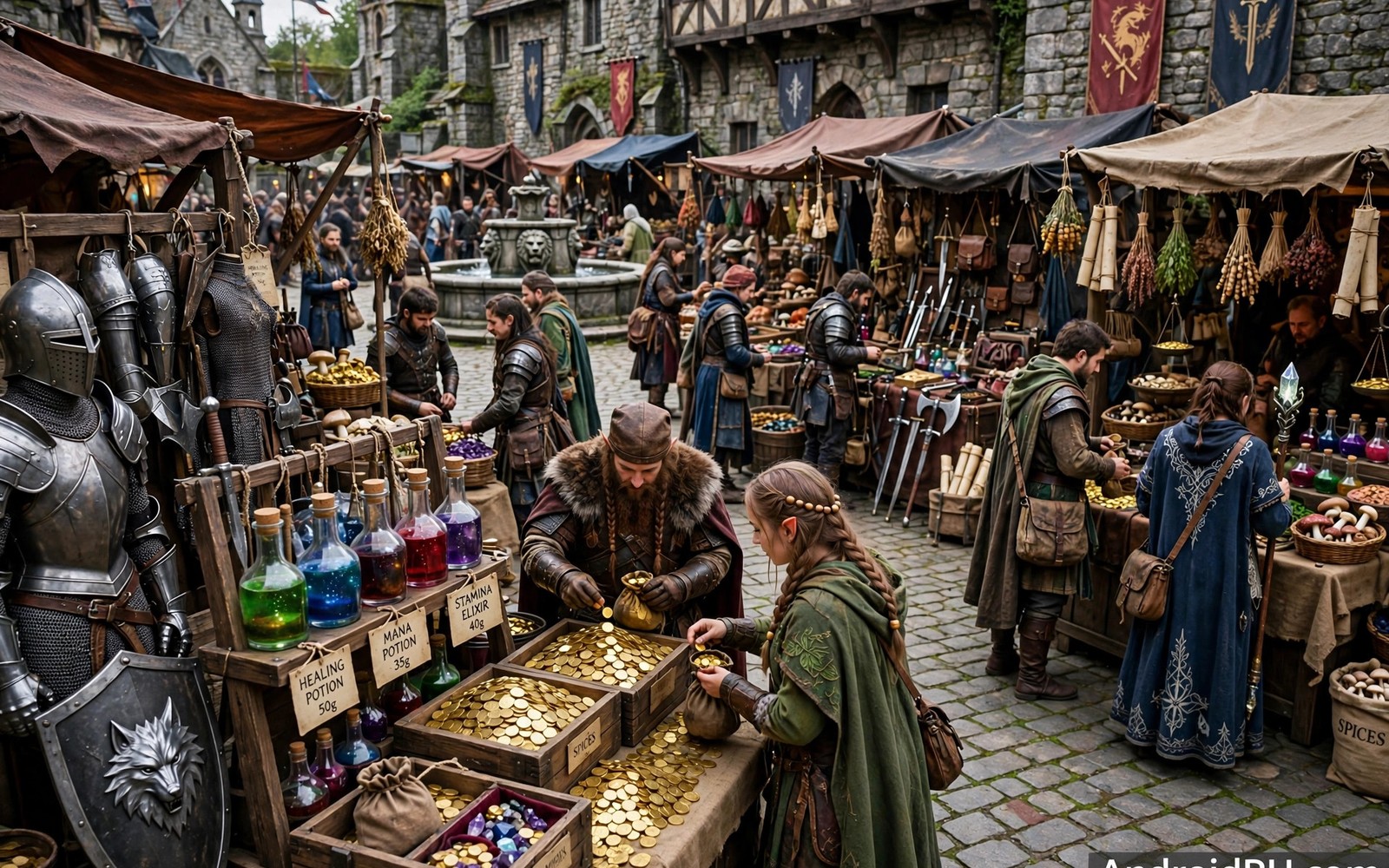
MMORPG Comparison: Finding the Best Player Economy on Mobile
A player economy decides whether a mobile MMORPG feels alive or rigged. When players can trade freely, craft goods, and set prices, the world gains a pulse that no scripted quest line can fake. When a cash shop sells power directly and the market is decoration, that pulse fades fast. I learned this the slow way, by sinking months into a game whose auction house looked busy on day one and turned into a ghost town by month three, while a friend in a different game was still flipping crafting materials for a profit a year later.
The gap between those two experiences comes down to design choices that are easy to miss at install time. Open trading, honest price data, real crafting demand, and gold sinks that actually drain currency all matter more than graphics or class count. A game can have gorgeous zones and still feel empty if nothing you gather is worth selling. Another game can look plain and still hold you for years because every herb you pick has a buyer waiting.
This comparison puts six well-known mobile MMORPGs side by side on the same criteria: how open trading is, where currency comes from, whether crafting pays, how hard pay-to-win pressure bites, and who each economy suits. The games are Old School RuneScape Mobile, Albion Online, Black Desert Mobile, Lineage 2M, EVE Echoes, and Toram Online. Each one takes a different approach, and each one is the right answer for a different kind of player.
What makes a mobile MMORPG player economy worth your time
Strip away the art and the lore and every player economy runs on the same four parts: ways to earn currency, ways to spend it, ways to trade it, and systems that remove it from circulation. Earn too fast and prices explode. Spend too little and gold piles up until numbers lose meaning. Trade with hidden fees and casual players get punished for every listing. Skip the removal systems and inflation eats newcomers alive.
The strongest economies give ordinary players more than one honest income. Gathering, crafting, flipping, boss drops, and guild work should all pay something. When only one path pays, the whole server crowds into it, prices crash, and everyone else feels locked out. Variety is not a bonus feature here. It is the thing that keeps a player-driven economy breathing through patches, new raids, and population swings.
The three signs of a healthy player market
First, prices are visible. A market with search, recent sale history, and clear listing fees lets anyone judge a fair price in seconds. Hidden fees and missing history are a warning sign. When a game hides market data, it usually profits from the confusion, and casual traders pay the price.
Second, crafted goods stay useful. In a healthy economy, a crafter at mid-level can sell gear that real players wear, not just vendor trash. That demand chain runs from gatherers to crafters to fighters, and every link earns. When endgame gear only drops from raids and crafting is a side hobby, the middle of the market hollows out.
Third, the market survives a patch. New content should shift prices, not break them. A rare material that triples in price before a new raid is a market working as intended. A material that becomes worthless overnight because a patch removed its only use is a design miss. Healthy games keep old materials relevant through layered recipes and upgrade paths.
Gold sinks and why inflation ruins casual players first
Inflation is the slow poison of virtual economies, and it hurts casual players first. When gold flows into the world faster than it leaves, prices rise and new players find everything unaffordable. A potion that cost one hundred gold at launch may cost ten thousand a year later, while a new player still earns starter amounts. Veterans with old fortunes barely notice, but newcomers face a wall that feels deeply unfair.
Developers fight inflation with a gold sink, which is any system that permanently removes currency from the world. Repair bills, housing costs, fast travel fees, and listing taxes all drain gold steadily. The strongest sink is often a luxury market where rich players spend fortunes on cosmetics or rare mounts, which pulls gold out of circulation without hurting gameplay. When you evaluate a game, look for visible sinks, because an economy without them will inflate until trading becomes meaningless for everyone except the richest players.
How to spot a weak sink in one week
Watch the price of a common consumable, such as a basic healing potion or a stack of low-level ore, over seven days. If the price climbs every day while supply looks steady, gold is entering the world faster than it leaves. Check whether repair costs scale with gear level or stay flat. Flat repair bills stop mattering once players get rich. Check whether the game has any big-ticket vanity spending at all. A world with nothing expensive to buy has nowhere for rich players to park their gold, so that gold keeps chasing the same goods and pushing prices up.
Repair bills, housing fees and fast travel as quiet drains
The best sinks are the ones players barely notice. A repair bill after a raid night, a weekly housing fee, and a fast travel charge each take a small bite. Multiplied across thousands of players every day, those bites add up to real deflation pressure. The worst sinks are sudden and punishing, like a single upgrade fee that costs a month of savings. Good design spreads the drain across daily play instead of dropping it on one unlucky moment.
Bots, gold sellers and real-money trading
Bots and gold sellers distort player economies in ways that honest players feel daily. Bots farm materials around the clock and flood markets, crashing prices for legitimate gatherers. Real-money traders sell gold for cash, which injects wealth that nobody earned through play. Both forces push honest players toward grinding harder or paying themselves, which corrodes the fairness that makes an economy fun.
Healthy games fight back with detection and trade limits. They monitor farming patterns and ban bot accounts in waves. They cap daily trades for new accounts to slow gold sellers. They add bind-on-pickup rules for the most powerful gear so it cannot be bought at all. As a player, you can help by reporting obvious bots and refusing to buy gold from third parties. Every purchase from a gold seller funds more bots, which makes your own honest farming worth less tomorrow.
Mobile MMORPG player economy comparison table: six games side by side
Before the per-game detail, here is the whole comparison on one screen. Read the rows first, then jump to the game that matches your style. No single row wins on every column, and that is the point. The right economy is the one whose trade-offs you can live with for a year, not the one with the flashiest launch trailer.
| Game | Open trading | Main currency flow | Crafting income | Pay-to-win pressure |
|---|---|---|---|---|
| Old School RuneScape Mobile | Very open, Grand Exchange with price history | Gold from skilling, bossing, flipping | Strong at every level, most gear is crafted or gathered | Low, membership is the main cost |
| Albion Online | Fully open, every item is player-made | Silver from gathering, crafting, black-market sales | The core of the game, not a side activity | Low to medium, premium speeds progress |
| Black Desert Mobile | Managed marketplace with price caps | Silver from grinding, bosses, marketplace sales | Moderate, life skills support combat gear | Medium, convenience and enhancement items |
| Lineage 2M | Managed trading with diamond currency | Adena from hunting, diamonds from sales | Moderate, crafting feeds enhancement and consumables | High, top gear leans on paid enhancement |
| EVE Echoes | Very open, regional player market | ISK from missions, mining, industry, trade | Strong, ships and modules are player-built | Low to medium, skill points can be bought |
| Toram Online | Open consignment board with player-set prices | Spina from farming, boss drops, crafting | Strong for specialists, alchemy and smithing pay well | Low, cosmetics dominate the cash shop |
Two patterns jump out of that table. First, the games with the most open trading also have the strongest crafting, because open markets give crafters real customers. Second, the games with managed markets cap the damage a rich player can do, but they also cap the profit a smart trader can make. Neither pattern is better in the abstract. Open markets reward knowledge and punish carelessness. Managed markets protect newcomers and frustrate veterans who want to play the market itself as a game.
Guild life ties closely to markets, since shared goals drive demand for crafted gear, consumables, and raid materials. If your group runs organised team content, read the guide to mobile RPGs with multiplayer guild raids before you pick a game, because a guild that raids together will burn through potions and gear far faster than a solo player ever will. The same guide doubles as a check on whether a game’s group content is deep enough to keep your guild together for months rather than weeks.
Old School RuneScape Mobile: the open market benchmark
Old School RuneScape Mobile runs the most transparent player economy in this comparison. The Grand Exchange is a central market where players list items at prices they choose, with recent trade history visible for every item. You can check what an item sold for yesterday, this morning, and five minutes ago. That visibility is the single biggest reason the economy has stayed functional for over two decades across desktop and mobile.
Gold comes from everywhere. Skilling pays: cutting logs, mining ore, fishing, and farming all feed items that other players need. Bossing pays in rare drops. Flipping pays for players who read price charts and buy low during quiet hours. A new player with no combat level at all can earn steady gold by gathering, which is rare in this genre. Most mobile MMORPGs make new players poor until they reach endgame. RuneScape lets them earn from the first week.
The trade-off is pace. RuneScape is deliberately slow. Skills take real time to level, travel takes time, and the grind is the game rather than a barrier in front of it. Players who want fast action and flashy combat will bounce off it. Players who enjoy watching a bank balance grow one careful trade at a time will find nothing else like it on a phone.
The Grand Exchange and honest price discovery
The Grand Exchange works because it shows its work. Every item page carries auction house price history and recent trade data, so a new trader can tell a bargain from a trap without asking a veteran. Listing fees are small and visible. There is no hidden tax that eats your margin after the sale. That transparency keeps the market honest in a way that games with blind listings never manage.
Price limits on the exchange stop wild manipulation of low-volume items, which protects newcomers from a classic scam: buying up a cheap item, relisting it at ten times the price, and hoping a new player does not check history. The limits are loose enough for real speculation and tight enough to stop the worst abuse. It is a balance most other games in this list never attempt.
Skilling income for new players
Skilling is the great equaliser here. A player who spends an evening cutting magic logs or mining runite ore earns gold that a raider would respect. The income scales with skill level rather than with gear score, so a free player with patience can out-earn a paying player who never touches a skill. That design keeps the economy broad: thousands of small sellers instead of a few rich farmers.
The habit that pays best is picking one skill, learning its money-making methods at each level band, and selling in small stacks. Buyers with modest gold can afford a stack of one hundred ore. They cannot afford a stack of ten thousand. Small stacks sell faster, and fast sales compound into more gold per hour than a single big listing sitting unsold for a week.
Flipping without a big bankroll
Flipping means buying an item below its usual price and reselling it at the normal price. Start with high-volume consumables such as runes, arrows, or food, where the spread between buy and sell prices is small but the volume is huge. A two percent margin on a thousand sales beats a fifty percent margin on one sale that never happens. Keep a simple log of buy price, sell price, and fees, and drop any item that loses gold twice in a row.
Pros and cons of the Grand Exchange economy
Pros: fully transparent prices with history and graphs; many honest income paths for new players; membership is the main real-money cost, not power; a huge, stable player base keeps markets liquid at all hours.
Cons: slow, grind-heavy pace that turns off action-first players; dated graphics and interface on mobile; bots still target high-value gathering spots despite regular ban waves; membership is needed to reach the best money-making methods.
Verdict: pick RuneScape Mobile if you want the fairest, most transparent market on a phone and you enjoy slow, steady progress. Skip it if you want fast combat and modern graphics, because the economy is the best part of the game and the grind is the price of entry.
Albion Online: a fully player-driven crafting economy
Albion Online takes the player economy further than any other game in this comparison: nearly every item in the world is crafted by a player. There are no monster drops for top gear. A sword exists because someone gathered the ore, refined it, and forged it. That single design choice makes the economy the game, not a feature bolted onto it.
The market is split by city, and prices differ between cities because transport takes time and carries risk. Buying cheap in one city and selling dear in another is a real profession, and the black market in Caerleon buys crafted gear from players and sells it to the game itself as loot drops. A crafter who understands which items the black market wants can earn steadily without ever fighting another player.
The catch is full-loot PvP in the black zones. Die there and you lose what you carried. That risk makes gathering in rich zones tense and profitable at the same time, but it also means a bad evening can wipe out a week of farming. Albion respects your time less than RuneScape does, and it pays you more for the risk.
Gathering, refining and crafting as one chain
Gathering in Albion is a skill tree of its own. Fibre, hide, ore, stone, and wood each have tiers, and higher tiers live in more dangerous zones. Refining turns raw materials into usable inputs, and crafting turns those inputs into gear. Each step adds value, and specialists at each step earn a margin. A player who only gathers can earn well. A player who only crafts can earn well. A player who does the whole chain earns the most but spends the most time.
Focus points are the quiet mechanic that decides who profits. Refining and crafting with focus returns extra materials, which widens the margin on every batch. Premium status grants focus points daily, which is the game’s main real-money pressure point. A free player can still craft, but a premium player crafts more efficiently, and that gap adds up over months.
City markets and the black market
Each royal city specialises in one refining or crafting bonus, so smart crafters move materials to the city where their craft is cheapest. That movement creates trade routes, and trade routes create opportunities for transporters and for ambushers. The market interface shows prices across cities, so the information is there for anyone willing to read it. The skill is acting on it before the margin closes.
The black market deserves a special mention. It buys player-crafted items and feeds them into the loot tables for open-world content. When a new meta build becomes popular, black market demand for its gear spikes, and crafters who stock that gear earn fast. It is the closest thing in this comparison to a market that pays you for understanding what other players actually want to wear.
Verdict for traders and crafters
Pick Albion Online if you want crafting to be the whole game and you enjoy risk, spreadsheets, and city-to-city trade runs. Skip it if losing your gear to a gank would ruin your week, because the black zones are not optional for the best income, and the economy rewards players who accept that danger.
Black Desert Mobile and Lineage 2M: managed markets with fixed prices
Black Desert Mobile and Lineage 2M sit on the opposite side of the design spectrum from RuneScape and Albion. Both use managed markets where the game sets price ranges for items, and players trade inside those ranges. You cannot list a rare item for a hundred times its usual price, and you cannot crash a market with a flood of undercuts. That control protects newcomers and keeps the economy readable, but it also removes the wild profits that open markets offer.
Black Desert Mobile runs a central marketplace with price floors and ceilings that shift with supply and demand. Silver flows mainly from grinding, world bosses, and selling loot on the marketplace. Life skills such as gathering, fishing, and cooking support the combat loop and earn steady silver, but they rarely match the income of high-level grinding. The market is a place to convert loot into silver, not a game in itself.
Lineage 2M leans harder on paid enhancement. Its trading uses diamonds, a currency tied closely to real money, and top gear enhancement is where the pay-to-win pressure concentrates. A free player can still progress, hunt, and trade, but the gap between a paying player and a free player at the top end is the widest in this comparison. That matters if you plan to compete. It matters less if you play for the world, the clan, and the large-scale siege content.
Black Desert Mobile: price caps that protect newcomers
Price caps in Black Desert Mobile mean a new player can look at the marketplace and understand it in minutes. Items have a visible range, sales happen near that range, and nobody gets scammed into paying ten times the going rate. The marketplace also supports pre-orders, so a player who wants a rare item can place a standing order and wait for supply instead of camping the listing page.
The downside is that caps blunt skill. A trader who spots a coming shortage cannot profit much, because the ceiling stops the price from rising to meet demand. Crafting and life skills pay, but their margins are thin, and the best silver per hour still comes from combat grinding with good gear. Players who love markets will find this one tame. Players who hate markets will find it a relief.
Lineage 2M: diamonds, clans and enhancement pressure
Lineage 2M is built around clan play, castle sieges, and long hunting sessions. Its economy serves that loop: adena from hunting pays for consumables and basic gear, while diamonds buy the rare items and enhancement materials that decide top-end power. Clan members share hunting grounds, trade inside the clan, and fund siege preparation together, which makes the economy feel social even when the market itself is tightly managed.
The pressure point is enhancement. Upgrading high-end gear consumes materials that are scarce and expensive, and the cash shop sells shortcuts. A player who refuses to pay can still reach a respectable level, but the ceiling for free play sits lower than in any other game here. Go in with open eyes: Lineage 2M rewards clan loyalty and patience, and it charges heavily for impatience.
Guild demand is intense in both games, since siege preparation and world bosses burn consumables by the thousand. If your clan raids on a schedule, the companion guide to RPGs supporting multiplayer guild raids helps you judge whether a game’s group content is worth the supply cost. Both anchors point to the same guide on purpose: guild play shapes demand in every economy in this comparison, and the guide is the fastest way to check whether a game’s raids justify the market prices you will pay.
Verdict for managed-market players
Pick Black Desert Mobile if you want a beautiful, low-stress market where prices make sense and scams are rare, and you are happy to earn mainly through combat. Pick Lineage 2M if you want clan warfare and siege content above all else, and you accept that top-end power leans on paid enhancement. Skip both if playing the market itself is your main hobby, because price caps will frustrate you within a month.
EVE Echoes and Toram Online: niche economies for specialists
EVE Echoes and Toram Online are the specialists of this list. Neither has the population of the bigger names, but both reward deep knowledge more than raw spending. In both games, a player who understands one corner of the market deeply can out-earn a richer player who spreads thin.
EVE Echoes is a mobile adaptation of a famous space economy. Its market is regional, which means prices differ by station and hauling goods between regions is a profession. ISK comes from missions, mining, industry, and trade, and almost every ship and module is built by players from mined minerals. The learning curve is steep: industry chains, blueprint research, and market orders take weeks to understand. The payoff is an economy with real depth, where a careful industrialist can build a fortune without firing a shot.
Toram Online is smaller and quieter. It has no class system, so any character can learn any skill, and its consignment board lets players set their own prices for crafted gear, materials, and boss drops. Alchemy and smithing pay well for specialists, and the cash shop focuses on cosmetics rather than power. Toram’s market is thin, which means prices swing more on small supply changes, and a patient seller can wait out a dip that a hurried seller cannot.
EVE Echoes: regional markets and industrial depth
The regional market is EVE Echoes at its best. A module that sells cheap in a busy trade hub may sell for double in a remote null-sec station where supply is thin. Haulers who move stock between regions earn the difference, and they accept the risk of pirates on the route. Industrialists buy minerals, research blueprints, and build ships in stations with low tax rates, then sell where demand is highest.
Skill points are the pressure point. They can be bought, which lets a paying player skip training time, but they cannot buy market knowledge. A new industrialist with bought skills and no understanding of margins will still lose ISK. A veteran with modest skills and a good spreadsheet will win. That is the fairest version of pay-to-progress in this comparison.
Toram Online: a small market where specialists win
Toram’s consignment board rewards patience and specialisation. A smith who perfects one weapon type, or an alchemist who masters one potion line, can dominate a small niche that bigger sellers ignore. Boss drops feed the board too: rare materials from world bosses sell to crafters who need them for high-end gear. Because the player base is smaller, a single guild’s demand can move prices, which makes market reading a social skill as much as a numbers skill.
The risk is liquidity. Thin markets mean your listing may sit unsold for days, and a sudden patch can strand your stock. Toram suits players who enjoy a quiet, craft-led game and who do not need instant sales. It does not suit players who want to flip items every hour.
Verdict for specialists
Pick EVE Echoes if you love spreadsheets, logistics, and long-term industrial plans, and you can tolerate a steep learning curve. Pick Toram Online if you want a calm, low-pressure market where crafting skill matters more than wallet size. Skip both if you need a huge, fast-moving market with instant sales, because neither game offers that.
Auction house tactics that work in any mobile MMORPG
Good trading habits transfer across every game in this comparison. The details change, but the principles hold: buy when supply is high, sell when demand spikes, keep fees in the math, and never bet your whole bankroll on one item.
Buy low during events. When a festival floods the market with a material, prices dip. That dip is your buying window, provided the material has a real use after the event ends. Sell into demand spikes: a new raid announcement, a new class, or a balance patch that buffs a weapon type will all lift the price of related materials within days. Read update notes and test server news carefully, because developers often signal changes weeks in advance.
Undercut by small amounts rather than huge drops. A one percent undercut still puts your listing first while keeping prices stable for everyone. Massive undercuts crash markets and hurt your own future sales, because the next seller undercuts you in turn and the price spirals down. Sell in small stacks so buyers with modest gold can afford your goods, and keep a simple log of buy price, sell price, and fees so that failed crafts and hidden taxes show up in your numbers instead of hiding in vague memory.
Big installs create a practical problem that traders forget until it bites: a huge game plus years of patches can fill a phone at the worst moment, right before a raid night when you need the game running. Plan around that with the guide to managing storage for massive MMORPGs, and clear space before a major update lands rather than during it. A trader who cannot log in during a price spike loses more gold than any listing fee ever cost.
The 30 percent rule and the weekly log review
Never invest more than 30 percent of your gold in one item. A patch can destroy a single material’s value overnight, and a diversified stash survives that shock. Keep operating funds separate from investment funds: the gold you need for repairs, potions, and daily play should never sit in speculative stock.
Review your trade log every week and drop any item that loses gold twice in a row. Feelings lie about profitability. A written log does not. The players who profit most from speculation are usually the ones who treat it like a hobby with rules, not a shortcut to riches.
Speculation: profit and danger in the same trade
Speculation means buying goods cheap now because you believe a future update will raise their price, and it is the fastest way to grow rich or go broke in a virtual economy. A new raid can triple a material’s price overnight. A balance patch can just as easily destroy it. The difference between investing and gambling is research and diversification: spread investments across several materials, read patch notes, and never speculate with gold you need for daily play.
Which mobile MMORPG economy fits your playstyle: a verdict per use case
There is no single best economy here, only a best fit for how you actually play. Match the game to your habits, not to a review score, and you will still be trading happily a year from now.
For the trader who loves the market itself: Old School RuneScape Mobile first, Albion Online second. Both reward price reading, flipping, and patience, and both have the volume to support daily trading. For the crafter who wants to make things that matter: Albion Online first, EVE Echoes second, Toram Online third. In all three, crafted goods are the economy rather than a side activity. For the casual player who wants fair prices without a second job: Black Desert Mobile first, Toram Online second. Managed prices and cosmetic-led cash shops keep the pressure low.
For the clan player who lives for sieges and group content: Lineage 2M first, Albion Online second. Both tie the economy to group goals, and both reward a guild that organises its supply chain. For the solo player with limited time: Toram Online first, Old School RuneScape Mobile second. Both let you earn in short sessions without falling behind the server. For the player who wants the lowest pay-to-win pressure overall: Old School RuneScape Mobile and Toram Online share the top spot, with Albion Online and EVE Echoes close behind.
Before you commit, spend a week purely inside the economy of your top pick. Gather, craft, and trade without worrying about story progress, and notice how it feels. Does trading feel rewarding or exhausting? Do prices make sense? Do other players trade fairly? That week of economic tourism reveals more about your future enjoyment than any review can, because economies are lived systems that only show their true character through daily use.
Frequently asked questions about mobile MMORPG player economies
Which mobile MMORPG has the best player economy for a free player?
Old School RuneScape Mobile and Toram Online are the strongest picks for a free player. RuneScape offers many earning paths without paying, and its main real-money cost is membership, which unlocks content rather than power. Toram’s cash shop focuses on cosmetics, so a free player competes on crafting skill rather than spending. Albion Online is close behind, though premium status widens crafting margins over time.
Can you actually earn gold without spending real money?
Yes, in every game in this comparison, though the effort differs. Gathering and crafting pay from the first week in RuneScape, Albion, and Toram. Black Desert Mobile and Lineage 2M pay more slowly for free players because their best income comes from high-level grinding and enhancement. The honest answer is that free income is real everywhere, but the hourly rate depends on knowledge: a player who learns one profitable method well earns far more than a player who grinds randomly.
Do mobile MMORPG economies suffer from inflation?
All of them do, to different degrees. Inflation is driven by how fast gold enters the world versus how fast sinks remove it. Games with strong sinks, such as repair costs, housing fees, and luxury cosmetic markets, hold prices steadier. Games with weak sinks see prices climb until new players cannot afford basic goods. Watch the price of a common consumable over a week before you commit: steady prices signal working sinks, and daily climbs signal trouble.
Is buying gold from third-party sellers ever safe?
No. Third-party gold buying risks a ban in every game in this comparison, and it funds the bots that crash prices for honest gatherers. Sellers also collect account details that can lead to theft. The safer path is slower but real: learn one gathering or crafting method, sell in small stacks, and let the gold compound. A ban wipes out months of progress in a way that no shortcut is worth.
What is the safest first game for a new trader?
Black Desert Mobile is the safest first step because price caps limit both scams and losses while you learn. Once you understand supply, demand, and fees there, move to Old School RuneScape Mobile for the full open-market experience with price history and graphs. That two-step path teaches the skills in a safe room before you risk real gold in an open market.
Your next step before you commit months to one economy
Pick one game from the verdict section that matches your playstyle, install it, and spend your first week as an economic tourist: gather, craft, check prices daily, and sell in small stacks. Keep a simple log of every trade, and at the end of the week ask whether trading felt rewarding or exhausting. If it felt rewarding, you have found your world. If it felt like a second job, try the next game on the list. The market you enjoy is the market you will still be playing in a year, and that is the only comparison result that matters.

