

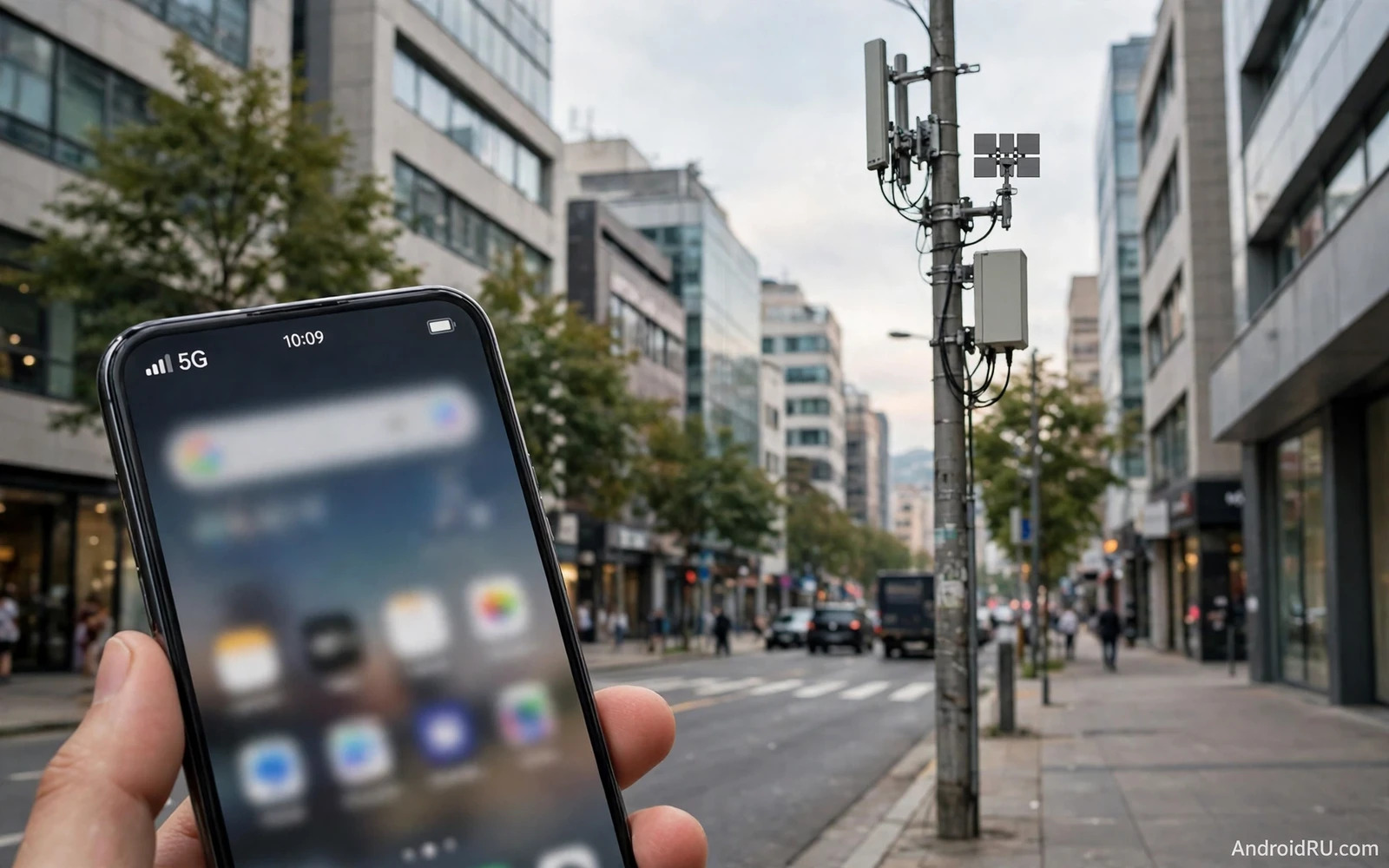
Two Flavours Of The Same 5G Label
The 5G label hides two very different technologies. Sub-6GHz 5G uses frequencies below 6 gigahertz. Millimetre wave 5G uses much higher frequencies with very short wavelengths. Both technologies belong to the 5G family but they behave almost like opposites. Sub-6GHz travels far and penetrates buildings reasonably well. Millimetre wave travels short distances and struggles with walls and windows and even foliage. Understanding that contrast explains why 5G experience varies so wildly between cities and neighbourhoods.
Carriers deploy both flavours for different jobs. Sub-6GHz provides broad coverage across cities and suburbs and rural areas. Millimetre wave provides extreme capacity in dense hotspots such as stadiums and airports and busy downtown streets. A phone that supports both flavours handles every deployment. A phone that supports only sub-6GHz handles most daily use but misses hotspot peaks. A phone that supports only millimetre wave would fail badly outside hotspots so makers rarely sell such a phone alone.
Sub-6GHz Coverage And Everyday Speed
Sub-6GHz coverage feels like an evolution of 4G. Towers cover large areas and signals pass through walls with moderate loss. Speeds improve over 4G noticeably in good conditions but they rarely reach headline 5G peaks. Latency improves as well which helps video calls and cloud gaming and real time apps. Most users spend most of their 5G time on sub-6GHz because it covers where they live and work and travel.
Low band sub-6GHz travels furthest and penetrates best but offers the smallest speed gain. Mid band sub-6GHz balances coverage and speed most effectively and it has become the workhorse of modern 5G. A phone with strong mid band support delivers the best everyday 5G experience for most buyers. Check mid band support for your carrier specifically because band lists vary by region and by carrier. A phone imported from another region may lack a key local band.
mmWave Speed And Fragility
Millimetre wave speed can astonish in ideal conditions. Downloads that take minutes on sub-6GHz can take seconds on a clear millimetre wave link. Capacity also impresses because high frequencies offer wide channels that serve many users at once in a stadium or a transit hub. Those strengths matter enormously in dense crowds where sub-6GHz cells congest quickly.
Fragility limits millimetre wave severely. Walls block it strongly. Windows with certain coatings block it strongly. Rain and foliage weaken it. Your own body can block it when you hold the phone a certain way. Carriers answer with dense small cells placed on poles and buildings throughout hotspot zones. Outside those zones the phone falls back to sub-6GHz automatically. That fallback keeps service working but it removes the speed peak. Millimetre wave therefore functions as a hotspot booster rather than a coverage foundation.
What Your Phone Actually Supports
Phone specification sheets list 5G bands in dense codes that confuse buyers. Focus on three questions instead. Does the phone support your carrier mid band frequencies. Does it support millimetre wave when your carrier deploys it in places you visit. Does it support carrier aggregation that combines bands for higher speed. Answering those three questions beats memorising band numbers.
Carrier compatibility tools help when available. Enter your carrier and your region into an official compatibility check before importing a phone. A phone that lacks one mid band may still work but it may deliver slower speeds or weaker coverage in certain areas. A phone that lacks millimetre wave still works everywhere on sub-6GHz. The cost of missing millimetre wave is missing peak speeds in hotspots rather than losing service entirely. Carrier and SIM context also appears in the carrier locked versus unlocked phones comparison where network freedom affects long term value.
Speed Tests Versus Daily Experience
Speed tests flatter millimetre wave because testers stand near a small cell with a clear line of sight. Daily experience flatters sub-6GHz because it works consistently across rooms and streets. A user who downloads huge files at a stadium benefits hugely from millimetre wave. A user who streams video on a train benefits more from consistent sub-6GHz coverage. Most users fall into the second group most of the time.
Latency and reliability often matter more than peak download speed. Video calls need stable latency rather than gigabit peaks. Cloud gaming needs stable latency and low jitter. Navigation needs reliable coverage rather than extreme speed. Sub-6GHz usually wins these daily metrics because its signal stays connected through movement and obstacles. Millimetre wave wins only when you stand still near a cell with a clear path.
SIM Choices And Network Access
SIM type affects network access less than band support but it still matters for convenience. Physical SIM cards swap easily between phones during travel or repair. Embedded SIM profiles activate digitally and allow multiple plans on one phone. Dual SIM phones can hold a work plan and a personal plan or a home plan and a travel plan. Network band support stays the primary factor while SIM flexibility shapes convenience.
Travel plans deserve attention for 5G users. A travel eSIM may offer sub-6GHz only even when your home carrier offers millimetre wave. A local physical SIM may offer better band access than a roaming profile. Check travel plan details before a trip when fast uploads matter for work. SIM setup guidance appears in the physical SIM versus eSIM setup comparison and in the single versus dual versus hybrid SIM explanation where slot types affect plan flexibility.
Fixing Weak 5G Signal
- Move near a window when indoor 5G drops repeatedly
- Toggle airplane mode briefly to force a fresh tower connection
- Check whether your plan includes full 5G access or a speed cap
- Update carrier settings when the phone prompts for an update
- Test outdoors to separate building blockage from network problems
- Contact the carrier when a known coverage area stays dead for days
Final Verdict
Sub-6GHz wins for everyday coverage and for consistent daily experience. Millimetre wave wins for extreme speed and capacity in dense hotspots. Most buyers should prioritise strong mid band sub-6GHz support and treat millimetre wave as a bonus rather than a requirement. City users who frequent stadiums and airports gain real value from millimetre wave. Rural and suburban users gain almost nothing from it today. Buy band support for the places you actually live and travel rather than for a headline speed you may never encounter.
Rural Coverage And Indoor Dead Zones
Rural 5G coverage depends on tower density and terrain in ways city users rarely experience. Hills and forests attenuate signals that travel freely across flat urban streets. Low band sub-6GHz reaches furthest into rural areas but offers modest speed gains over 4G. Mid band coverage thins quickly outside towns because fewer towers serve larger areas. A rural user who buys a phone for headline city speeds may find daily rural performance barely above 4G. That reality is a deployment limit rather than a phone failure.
Indoor dead zones frustrate urban users almost as much as rural gaps frustrate travellers. Modern building materials such as coated glass and concrete and metal framing block high frequencies strongly. A phone that shows strong 5G outdoors may drop to 4G or to weak 5G indoors. Wi-Fi calling and indoor Wi-Fi data solve most indoor dead zones when home internet is solid. A phone with strong Wi-Fi performance therefore matters alongside 5G bands for indoor heavy users. Treat Wi-Fi and cellular as a combined system rather than as rivals.
Vehicle travel creates moving dead zones as well. A phone in a moving car hands over between towers constantly. Handover quality affects call stability and streaming continuity. A phone with good modem design holds calls through handovers more smoothly. A car with a metal body attenuates signals slightly compared with outdoor use. External antennas or vehicle signal boosters help in fringe areas but they cost money and need installation. Most drivers manage fine with offline maps and downloaded media as a buffer against signal gaps.
Future deployment will narrow these gaps gradually as carriers densify networks and add spectrum. Low band coverage will improve first because it uses existing tower sites efficiently. Mid band densification follows in suburbs and along transport corridors. Millimetre wave will remain a hotspot technology for the foreseeable future rather than a rural solution. Buyers should judge 5G by current coverage maps for their actual routes rather than by future promises. A phone bought for today coverage serves better than a phone bought for a deployment that may arrive years later.
Future Talk And Why 5G Still Matters
Talk about future network generations already circulates while most users still explore 5G fully. Future generations will build on the same fundamentals of spectrum and densification and device support. A phone bought for strong 5G today will serve for years before any successor generation becomes practically relevant for daily use. Chasing future labels at purchase time wastes money because early future generation devices cost more and cover less. Practical buyers focus on the network that exists on their routes today.
5G relevance will grow as more services assume reliable mobile broadband. Remote work tools and cloud gaming and high quality video calls all benefit from stable 5G where Wi-Fi is absent. Augmented reality applications will demand low latency and consistent throughput that only mature 5G can offer widely. Those services arrive gradually rather than overnight which gives current 5G phones a long useful life. A phone with strong mid band support and good modem efficiency will age gracefully through this transition without needing a premature upgrade.
Signal Bars And Real Speed
Signal bars on a phone screen summarise a complex radio situation into a simple icon that often misleads. Bars reflect signal strength for the currently connected band but they do not reflect congestion or backhaul capacity or latency. A phone showing full bars on a congested cell can deliver slower real speeds than a phone showing fewer bars on a quiet cell. Speed tests at different times of day reveal congestion patterns that bars hide completely. Morning commute hours and stadium events and evening streaming peaks all load cells differently. Judge network quality by real app behaviour such as video start time and call stability rather than by bar count alone. A phone that holds a stable mid band connection with moderate bars usually serves daily needs better than a phone that chases a fragile millimetre wave signal with full bars for a few seconds before dropping back. Stability beats peak icons in every practical sense for calls and navigation and messaging that must simply work without drama.

