

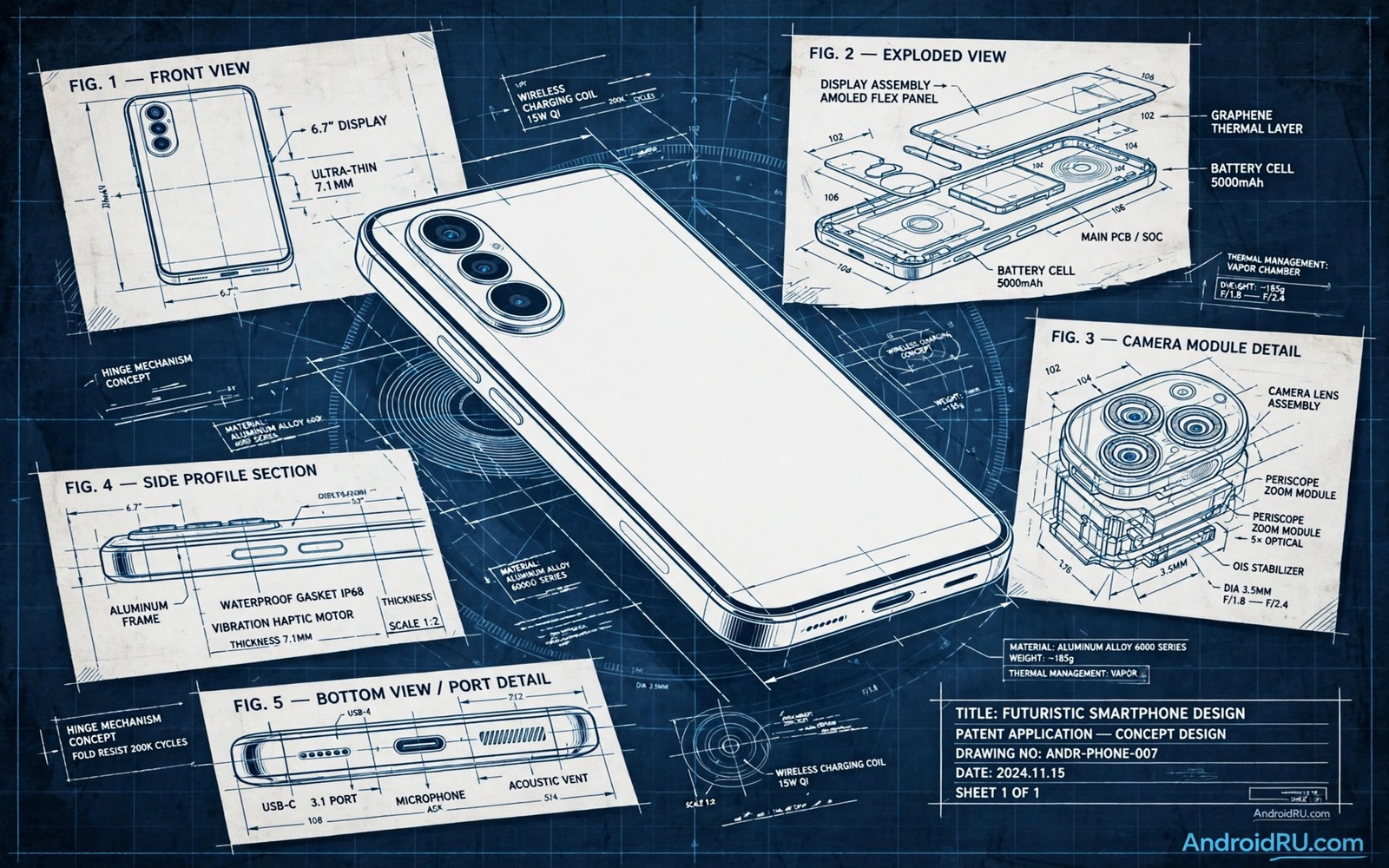
Patents often reveal where hardware makers are thinking. A patent filing describes a mechanism or a layout in detail. Enthusiasts read these filings and imagine future phones. Some patent ideas reach products within a few years. Many never leave the filing stage. A patent is a legal protection for an idea rather than a product announcement.
Reading patents wisely means looking for patterns. A single filing for a novel hinge may be an experiment. Several filings for similar hinges across years suggest a sustained research direction. A filing with detailed manufacturing steps is stronger than a filing with a vague sketch. Context matters more than a single drawing.
This guide looks at five types of hardware patent designs that appear often for flagships. It explains what each design could enable. It also explains the practical obstacles for each design. The goal is to enjoy patent leaks without treating every filing as a coming phone.
1. Rollable and Expandable Displays
Rollable designs let a screen expand from a phone size to a tablet size. A motor or a manual slide pulls extra display area from inside the body. This idea promises a large screen without a fold crease. It also promises a compact phone when the screen is retracted.
Obstacles are durability and thickness and cost. A rolling mechanism must survive thousands of cycles without dust damage. The display must bend repeatedly without creasing. The body must house the motor and the extra display without becoming thick. These challenges explain why rollable phones remain prototypes rather than mass products.
2. Under Display Cameras With Better Light Paths
Under display cameras hide the selfie camera beneath the screen. The screen area above the camera must let light through while it still shows pixels. Patent designs explore new pixel layouts and light guides to improve image quality. A better under display camera would remove the need for a hole punch.
Image quality remains the main obstacle. Light passing through a display loses clarity and colour accuracy. Software can correct some loss but it cannot fully restore detail. A hole punch camera still produces a sharper selfie today. Under display designs will need a major optical gain before they match a visible camera.
3. Modular Camera and Battery Attachments
Modular designs propose attachable camera lenses or battery packs that connect magnetically. A user could add a larger lens for a special shoot. A user could add a battery pack for a long day. Magnets and smart connectors make attachment quick.
Modularity faces a market obstacle. Most users prefer a simple phone without accessories to manage. Accessory ecosystems need sustained support to succeed. Past modular phones struggled because accessories were expensive and short lived. A new modular idea must solve the ecosystem problem rather than only the connector problem.
4. Advanced Hinge and Multi Fold Mechanisms
Multi fold designs fold a device twice to create a larger tablet from a phone body. Patent filings explore hinges that distribute stress across several joints. A multi fold phone could offer a tablet screen in a pocket sized device. This idea extends the foldable trend in an ambitious direction.
Durability and software are the main obstacles. Each hinge adds a failure point. Each fold adds a crease risk. Software must adapt to three screen sizes rather than two. Cost will also be high for a device with several hinges and a large flexible display. Multi fold devices may appear first as premium experiments rather than mainstream phones. This direction echoes whether glass backs will be replaced by self healing materials because new form factors need new materials to survive daily use.
5. Integrated Cooling and Vapour Systems
Cooling patents describe vapour chambers and heat pipes integrated into the phone frame. Some designs use the frame itself as a heat spreader. Others propose active cooling with tiny fans for gaming phones. Better cooling would sustain performance for longer sessions.
Cooling designs face space and noise trade offs. A larger vapour chamber takes space from battery. An active fan adds noise and a failure point. Passive designs are safer but less powerful. Gaming phones accept these trade offs more readily than mainstream phones. Mainstream phones will adopt cooling improvements gradually as processors become more efficient.
How to Judge a Patent Leak
Ask whether the patent solves a real user problem. A rollable screen solves the large screen in a small pocket problem. A modular lens solves a niche photography problem. Real problems attract sustained investment. Novelty alone does not.
Ask whether the patent appears in a family of filings. A family shows continued work over time. A single filing may be a defensive protection for an idea that the maker never intends to build. Families with manufacturing details are stronger signals than isolated sketches.
Patent check 1: Solves a clear user problem
Patent check 2: Appears in a filing family over time
Patent check 3: Includes manufacturing detail
Patent check 4: Matches a broader industry trend
Verdict: Strong only when checks 1 and 2 both pass
The checklist above is an original example written for this guide. It is not copied from a vendor document and it does not require a special app or a paid tool. Use it before you treat a patent drawing as a future phone.
Common mistakes
One mistake is to assume that a patent filing means a product is coming soon. Companies file patents years before a product. Many filings are defensive. A filing protects an idea from competitors even if the maker never builds it.
Another mistake is to judge a patent by its drawing alone. Drawings are schematic. They may show an idea in simplified form. Manufacturing details and claims in the text matter more than the visual style of a drawing.
A third mistake is to ignore cost. A brilliant mechanism that costs too much will not reach a mainstream phone. It may appear in a limited premium model first. It may also appear in a different product category where cost matters less.
A final mistake is to share a patent leak without its date. Old patents resurface as new rumours. Always check the filing date and whether newer filings supersede it. An old idea may have been abandoned for a better approach.
Frequently Asked Questions
Do patents guarantee a future phone feature?
No. Patents protect ideas. They do not promise products. Many patented ideas never reach consumers. Treat patents as research directions rather than product announcements.
Why do companies file patents they never use?
Patents protect against competitors and support future research. A filing can also block a rival from using a similar idea. Defensive filings are a normal part of hardware development.
How long after a patent does a product appear?
It varies widely. Some ideas appear within two years. Others take a decade or never appear. A family of filings over several years is a better predictor than a single filing.
Patents Versus Real Products
The gap between a patent and a product is often measured in years. A hinge patent filed today may need several generations of material research before it works reliably. A cooling patent may need a new processor that generates less heat before it becomes unnecessary. Time changes the value of an idea.
Some patents become relevant only when another technology matures. A rollable display patent becomes more valuable when flexible display durability improves. An under display camera patent becomes more valuable when light transmission through displays improves. Patents often wait for a partner technology to catch up.
Other patents become obsolete before they are used. A connector patent may lose value when wireless standards improve. A battery attachment patent may lose value when battery life improves enough. Obsolescence is a normal part of hardware research. Not every good idea survives a changing market.
For users the lesson is patience. A patent that excites you today may reach a phone in five years in a different form. It may also never reach a phone at all. Buy a phone for what it does today rather than for a patent that may shape a future model.
From Patent Sketch to Store Shelf
A patent sketch becomes a product through many stages. First engineers build a prototype to test the mechanism. Then they test durability with repeated use. Then they test manufacturing at small scale. Each stage can reveal a flaw that sends the design back for revision. A sketch that survives all stages is rare.
Cost testing follows durability testing. A mechanism that works in a prototype may cost too much for mass production. Engineers may simplify the design to reduce cost. Simplification can change the final product significantly. A product that reaches a store may look simpler than the original patent sketch.
Market testing is the final stage before mass production. A maker may show a concept device at an event and gauge reaction. Positive reaction can justify investment in mass production. Weak reaction can send a design back to research. A patent that never reaches market testing remains an idea rather than a product plan.
Patent News That Deserves Attention
Patent news deserves attention when it shows a sustained research direction. A single filing for a novel idea is interesting but weak. Several filings over years for the same problem show sustained investment. Sustained investment is a better predictor than a single headline.
Patent news also deserves attention when it matches a user problem. A patent for better foldable durability addresses a real complaint. A patent for a novelty feature addresses no clear problem. Judge patent news by the problem it solves rather than by its novelty.
Patent news deserves less attention when it lacks manufacturing detail. A vague sketch without materials or process steps is early research. A detailed filing with materials and tolerances is closer to production. Detail separates a concept from a plan.
Finally patent news should be dated carefully. A filing from five years ago that resurfaces today may be obsolete. Check the filing date and whether newer filings supersede it. An old patent that is still cited in newer filings remains relevant. An old patent that is never cited again is likely abandoned.
Use these filters to enjoy patent news without being misled. A filtered view shows real directions and hides noise. It also prevents purchase delays based on a weak patent rumour.
Conclusion
Leaked hardware patents show where flagship makers are exploring. Rollable displays and under display cameras and modular attachments and multi fold hinges and advanced cooling each address a real limitation. Each also faces durability and cost and ecosystem obstacles. The most likely winners are designs that solve a clear problem with a manufacturable solution.
Your concrete next step is to apply the patent checklist to the next hardware leak you read. Note the filing date and whether the idea appears in a family and whether it solves a problem you actually have. If the evidence is weak then enjoy the idea as a concept and do not delay a purchase waiting for it. For more design futures read about how next generation mobile GPUs plan to bring ray tracing to phones and industry trends that show where mobile tech is heading to compare patent ideas with broader trends.

