

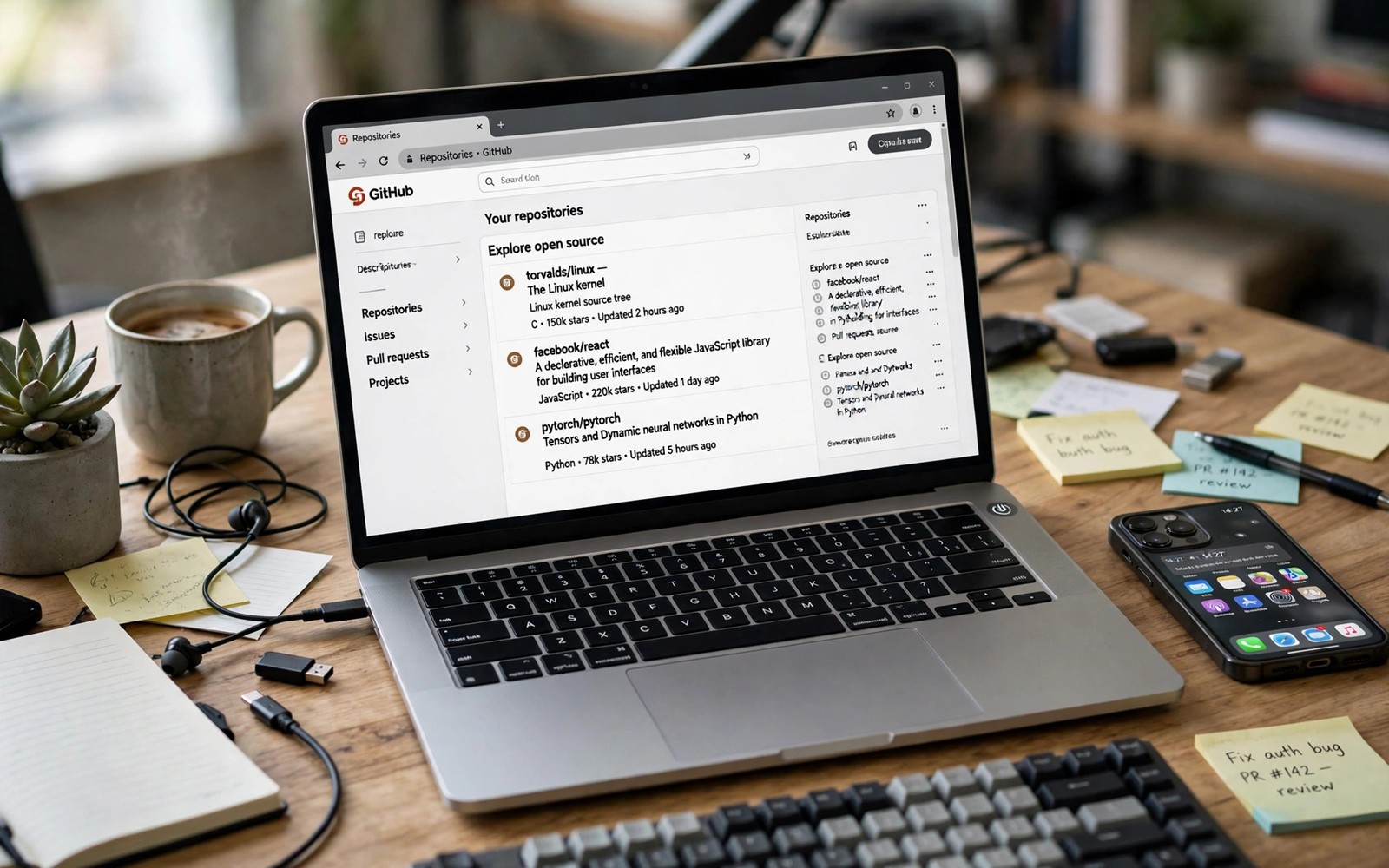
Reading real code teaches more than reading a tutorial alone. A tutorial shows a small example in isolation. A real repository shows how that example survives contact with a large app. It shows trade offs and compromises and refactoring history. Open source Android repositories give developers a free library of those lessons. This guide highlights seven types of repositories that every developer should study and it explains what to look for in each one.
Study code with a question in mind. A vague browse through a large repository rarely teaches much. A focused question such as how does this app handle offline data will guide your reading. Follow that question through the code from the user interface down to the data layer. Note the patterns that appear repeatedly. Those repeated patterns are the architecture of the app. They matter more than any single clever trick.
Choose repositories that are actively maintained. An abandoned project may teach outdated patterns. A maintained project shows current library versions and current Android APIs. Check the last commit date and the issue activity before you invest study time. A project with recent releases and responsive maintainers is a safer guide. It also gives you a chance to contribute a fix once you understand the code.
Architecture And Sample Apps
Architecture sample repositories show how to structure a complete app. They separate the user interface from business logic and from data access. They use view models and repositories and use cases in a consistent way. Studying one sample end to end teaches more than studying ten fragments in isolation. Follow a single feature from a button tap to a network call and back to the screen. That trace reveals the full data flow.
Compare two architecture samples that solve the same problem differently. One may use a single activity with many fragments. Another may use multiple activities or a navigation graph. One may use coroutines heavily. Another may use reactive streams. Neither approach is universally correct. The comparison teaches you when each approach fits. It also teaches you to recognise the cost of each choice in code size and in testability.
Sample apps from platform teams often show recommended patterns first. They may not show production complexity such as feature flags or analytics. That simplicity is useful for learning. It is not a complete production template. Use samples to learn patterns and then adapt those patterns to the constraints of your own app. Do not copy a sample structure blindly into a large team project without considering team size and release cadence.
UI Libraries And Design Systems
User interface libraries show how to build reusable components. A good library exposes a small clear API and hides internal complexity. Study how it handles theming and state and accessibility. A component that looks simple on the outside often contains careful handling for edge cases. Those edge cases include large font sizes and dark mode and right to left layouts. A library that handles them well is worth studying in detail.
Design system repositories show how a team keeps a consistent look across many screens. They define colours and typography and spacing as tokens. Screens then use tokens rather than hard coded values. That indirection makes a redesign possible without editing every screen. It also makes dark mode easier because tokens can change value by theme. Study the token structure and the naming rules. A clear naming rule is as important as the colours themselves.
Animation libraries teach timing and easing and state transitions. A smooth animation feels natural because it follows physical motion principles. Study how a library interpolates values and how it cancels an animation cleanly. A cancelled animation that leaves a view in a broken state is a common bug. Libraries that handle cancellation well show the value of careful state management. Apply that lesson to your own custom animations.
Networking Data And Testing Repositories
Networking libraries show how to handle retries and timeouts and caching. A robust client retries a failed request with backoff rather than failing at once. It also caches responses when the network is unavailable. Study the retry policy and the cache policy in a mature library. Those policies determine how an app behaves on a train or in a rural area. A good policy balances freshness against battery use and data use.
Data layer repositories show how to model local storage and synchronisation. An offline first app must handle conflicts when the same record changes on two devices. Study how a library queues changes and how it resolves conflicts. Some libraries use last write wins. Others use a more detailed merge strategy. The choice depends on the data type. A note app can merge text changes. A banking app must not merge balance changes loosely. That contrast teaches the importance of domain rules.
Testing repositories show how to write tests that survive refactoring. A test that depends on internal details breaks whenever the code changes. A test that checks observable behaviour survives internal refactoring. Study the test structure in a well tested project. Note how it uses fakes and mocks and how it names tests. A clear test name describes the behaviour being checked. That naming habit makes a failing test easy to understand months later.
Code That Explores A Repository Structure
The code below shows a simple script pattern for listing the main modules in a cloned repository. It helps a new reader map the project before diving into individual files. Adapt the directory path to the repository that you are studying. Use the output as a study map rather than as a final answer.
#!/bin/bash
find . -maxdepth 2 -type d -name "src" | sort
echo "---"
ls app/src/main/java/com/example/ 2>/dev/null || ls app/src/main/kotlin/ 2>/dev/null
echo "---"
cat settings.gradle* 2>/dev/null | grep include
The snippet above is an original example written for this guide. It shows a generic repository exploration pattern that you can adapt to your own study. It does not copy code from any outside source.
Adapt the snippet by adding a note file where you record what each module does. A short note per module helps you remember the structure after a break. Share those notes with a study partner if you are learning together. Teaching a module to someone else is a strong test of your own understanding. If you cannot explain a module simply then study it again with a narrower question.
How To Learn From Code Without Copying Blindly
Copying code without understanding it creates hidden debt. A copied snippet may work in the original project because of a dependency that your project lacks. It may also rely on a configuration that you have not set. Before copying a snippet read its surrounding code and its tests. Check the library versions that it requires. Check the permissions that it assumes. That context check prevents many integration failures.
Licensing matters when you study open source code. Most open source licences allow learning and allow reuse with attribution. Some licences require that derivative work use the same licence. Check the licence file before you copy a large portion of code into a commercial app. A short study note is different from a large copy. When in doubt ask a maintainer or choose a repository with a permissive licence for the parts you plan to reuse.
Contribute back when you find a bug or a documentation gap. A small fix to a README or a test can be a first contribution. That contribution deepens your understanding because maintainers will review your change. Their feedback often reveals a design reason that was not obvious from reading code alone. Over time those reviews build a relationship with the project and a reputation as a careful contributor.
Common Mistakes
One common mistake is to study only popular repositories. Popularity can reflect marketing or age rather than code quality. A smaller repository with clear code can teach more than a huge repository with tangled code. Judge a repository by its structure and its tests and its documentation. Popularity is a starting signal and not a final verdict on quality.
Another mistake is to read code passively without running it. Running the app and changing a small value teaches more than reading alone. Change a colour or a string and see where the change appears. Break a test on purpose and read the failure message. Those experiments build a mental model of the code. Readers who explore how reverse engineers deobfuscate code protected by ProGuard will recognise the value of hands on experimentation over passive reading.
A third mistake is to treat a repository as a template for every project. A pattern that fits a large team may be overkill for a solo developer. A pattern that fits a simple app may fail in a complex app with many features. Adapt patterns to your team size and your release needs. The goal is understanding and not imitation. That adaptation skill is what separates a senior developer from a developer who only copies examples. The same judgement applies when studying the master guide to Android development and modding because a broad guide must be filtered through the needs of a specific project.
A further mistake is to study code in isolation from its community. Issues and pull requests reveal why a design changed. A pull request discussion may explain a trade off that code alone cannot show. Read a few closed issues for a repository that you study deeply. Those discussions often contain the reasoning behind a pattern that looks odd at first glance.
Frequently Asked Questions
How much time should I spend studying open source code?
A regular short session beats an occasional long session. Thirty minutes of focused study a few times a week builds understanding steadily. Pick one question per session and follow it through the code. Keep notes so a later session can build on the earlier one. Over months that habit compounds into deep knowledge.
Should beginners study large repositories?
Beginners should start with small focused samples and then move to larger projects. A small sample teaches one pattern clearly. A large project teaches how patterns interact. Jumping straight to a huge codebase can be overwhelming. Build up gradually and use the study map technique from this guide to navigate larger code.
Can studying open source code replace formal courses?
Studying real code complements courses and it does not fully replace structured learning. Courses teach concepts in a logical order. Real code shows those concepts in messy production contexts. Use both sources together. A course gives you vocabulary and a repository gives you examples of that vocabulary in action.
Conclusion
Start today by cloning one well maintained architecture sample and by mapping its modules with the script from this guide. Follow one feature from the user interface to the data layer and write a short note about the pattern you found. Repeat that exercise weekly with a new question. That habit will improve your code faster than any single tutorial. It will also prepare you to contribute to implementing push notifications with Firebase in a real project because you will have seen how mature projects structure that feature.

