

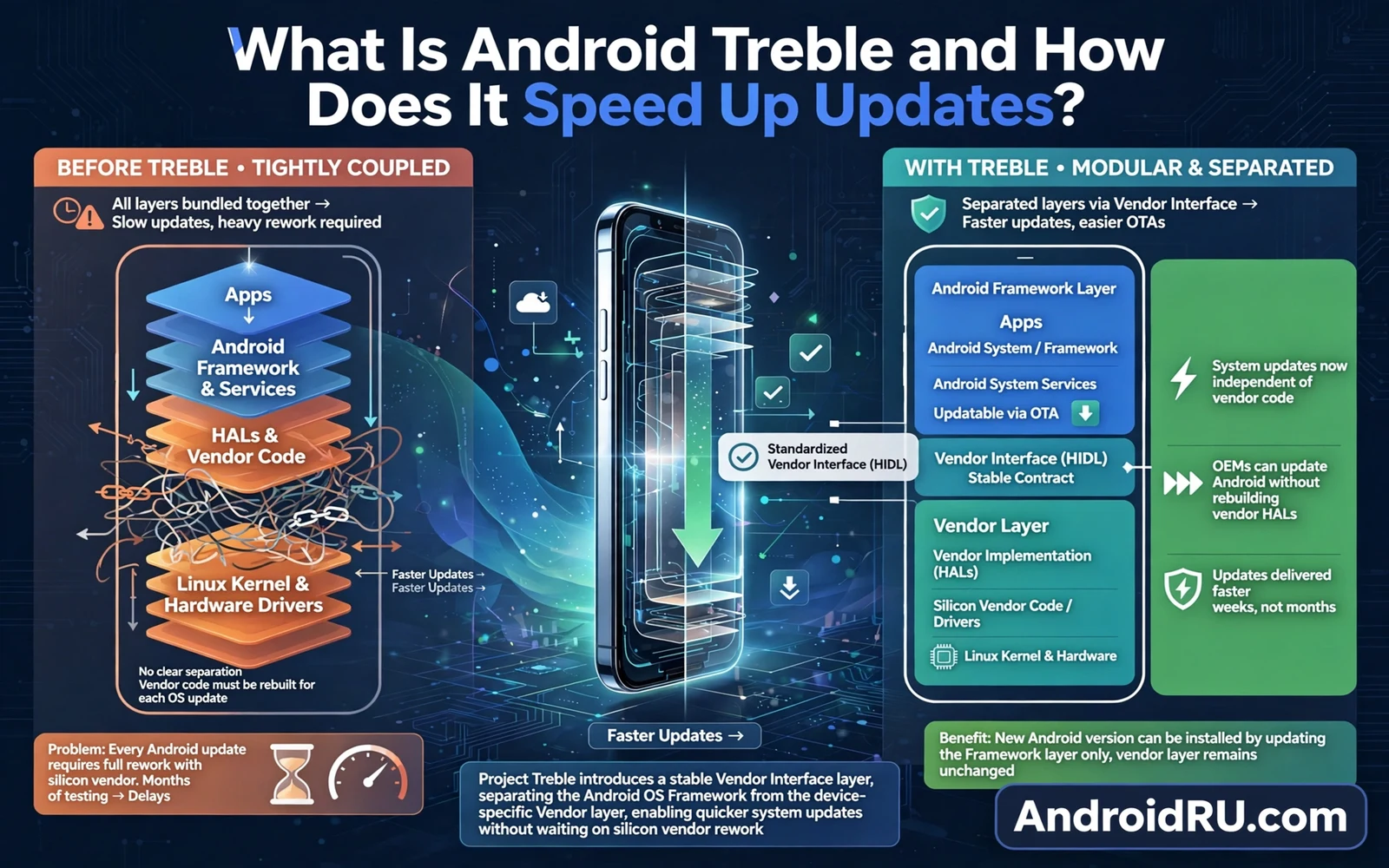
Android Treble is a redesign of Android that separates the Android framework from the vendor implementation on a phone. The framework holds the system code that Google updates with each new Android version. The vendor implementation holds the hardware code that chip makers and device makers supply for a specific phone. A stable vendor interface sits between those two layers and lets them work together without constant rework. This guide explains what Android Treble is and how it speeds up updates in plain language. It also explains the limits that still shape how fast an update can reach your phone.
Before Treble arrived a new Android version often forced a long chain of rework across the whole system. A chip maker had to adapt low level hardware code for the new version. A device maker then had to adapt that code again for each phone model. A carrier test phase could add more delay after that work finished. Security fixes could wait while that chain moved slowly from one team to the next. Many phones therefore received major updates late or never received them at all. Treble was built to break that chain by letting the framework move forward while much of the vendor code stays in place.
A companion explanation of how Project Mainline changes Android updates shows how modular updates complement the Treble split and shorten the path from a fix to a phone. Mainline updates core system parts through the store while Treble keeps the vendor boundary stable. The two ideas solve different parts of the same delay problem. Together they give device makers fewer reasons to hold back a framework update. Readers who grasp both ideas can judge update promises with far more confidence.
How Treble Splits Android Into Two Layers
The Android framework layer includes the apps and services and system behavior that users see every day. The vendor layer includes hardware abstraction layers that talk to the camera and the modem and the sensors and the audio hardware. Treble defines a vendor interface that both layers must respect so that a new framework can talk to an existing vendor layer. The interface uses versioned hardware abstraction definitions that change only in controlled ways. A device maker can therefore test a new framework against a vendor layer that already passed earlier checks. That stability is the technical core of the whole Treble idea.
The Vendor Test Suite checks that a vendor implementation honors the interface before a device ships with Treble support. The suite runs a large set of compatibility tests against the hardware layers on the device. A failure means that the vendor code needs repair before the device can claim Treble support. A pass gives framework developers a firm target to build against. This testing discipline matters because an unstable interface would erase the speed gain that Treble promises. Device makers still run their own tests after that suite passes. Those tests cover the full phone experience rather than the interface alone.
Why Updates Arrived Faster After Treble
With Treble in place a device maker can often bring up a new Android framework on existing vendor code with far less porting work. The engineering team focuses on framework changes and on device specific polish rather than on rewriting hardware support from scratch. Security patches can move faster for the same reason because a patch to the framework does not demand a fresh vendor port. Major version upgrades also become cheaper to attempt on older models. Cheaper upgrades do not guarantee that every model will receive one. They only remove one large technical excuse for skipping an upgrade.
For the wider picture of how Android system updates work behind the scenes start there and then return to the Treble layers described above for the full context. System updates involve staged rollouts and device checks and rollback protection in addition to the Treble split. A fast framework port still needs careful rollout control so that a bad build does not reach millions of phones at once. Treble shortens the engineering phase while rollout control protects the release phase. Both phases matter for a safe and speedy update.
What Treble Does Not Fix
Treble does not extend hardware support forever and it does not force a device maker to ship an update. Chip makers still end driver support at some point and that limit can block an upgrade even when the framework is ready. Kernel versions also age and newer frameworks may need kernel features that an old vendor layer cannot supply. Device makers still decide which models receive an upgrade based on cost and product strategy. Carrier testing can still add delay on carrier sold models. Owners should therefore read update promises as policy statements rather than as technical guarantees.
Treble also does not remove the need for a full device test after a framework upgrade. Camera tuning and modem behavior and battery behavior can all shift when the framework changes. A device maker must verify those behaviors on real hardware before release. A rushed framework update could still break a feature that worked well before the upgrade. Treble reduces the porting burden but it never removes the testing burden. That distinction explains why two Treble phones from different makers can still receive updates at very different speeds.
Treble And Custom ROMs
Treble opened a new path for community developers through Generic System Images that run on many Treble phones. A Generic System Image is a framework build that targets the stable vendor interface rather than one single phone model. Developers can boot such an image on a Treble phone and test new Android versions without a full vendor port. This path helped community builds reach more devices and helped developers test ideas faster. It also gave owners a way to try newer Android versions on phones that makers had abandoned. The path still demands care and testing on each device.
The story of stock Android versus custom ROMs for performance explains why a framework update can move without a full vendor rebuild and why community builds still vary in polish. A Generic System Image may leave a camera feature or a modem feature working less well than the stock build. Owners who try such an image should back up all personal data first. Owners should also know that unlocking a bootloader can void a warranty and can weaken device security. A backup and a clear recovery plan turn an experiment into a reversible test rather than a gamble.
How To Check Treble Support On Your Phone
Most phones that shipped with Android 8 or later include Treble support by design. Owners can check device info apps for a Treble support flag on a phone that already runs a recent Android version. A phone that shipped with an older Android version and later upgraded may lack full Treble support. The distinction matters for community builds because a Generic System Image needs the stable vendor interface to boot well. Owners who only care about official updates can ignore this check entirely. Official updates depend on maker policy far more than on a support flag.
- Check the Android version in system settings first
- Look for Treble support in a trusted device info app
- Confirm that a community build targets your exact model
- Back up photos and chats and documents before any experiment
- Keep the stock firmware package ready for recovery
Treble remains one of the most important structural changes in modern Android even though most owners never see it directly. It cut the cost of framework upgrades and it made security patches easier to ship. It gave community developers a shared target across many devices. It also exposed the remaining limits of hardware support and maker policy with unusual clarity. Owners who understand Treble can read update news with realistic expectations. Faster updates became possible through Treble while guaranteed updates still depend on the maker behind the phone.
Treble In Daily Phone Ownership
Daily phone ownership rarely exposes Treble directly yet its effects appear in update timing and in security patch speed. Owners notice Treble when a phone receives a major version upgrade sooner than a similar older phone did. Owners notice Treble when monthly security patches arrive in a steady rhythm rather than in long gaps. Owners rarely need to know partition names or interface versions to enjoy those benefits. The benefit shows up as a phone that stays current longer with less waiting. That quiet benefit explains why Treble matters even for owners who never open developer settings.
Phone buyers can use Treble knowledge when comparing models with similar prices and similar hardware. A model from a maker with a strong update record will use Treble well. A model from a maker with a weak update record may still lag despite Treble support. Buyers should therefore weigh maker update history beside Treble support. Reviews that track update speed over two years give better evidence than launch day promises. A buyer who checks both signals chooses a phone that stays fresh longer.
Support length still decides the final value of Treble for any single phone. A phone with five years of promised updates gains more from Treble than a phone with two years of promised updates. Treble lowers engineering cost across those years and makes each yearly upgrade cheaper to build. Lower cost does not force a maker to extend support beyond a promise. Owners should read promised support years as the ceiling and Treble as the tool that helps makers reach that ceiling. Both facts together give a realistic ownership picture.
Treble And Security Patch Speed
Security patches benefit from Treble because framework fixes can move without a full vendor rebuild. A framework patch that fixes a system service flaw can ship while vendor code stays untouched. That speed matters when attackers exploit a known flaw quickly after disclosure. Device makers can test a framework patch against a stable vendor interface and release it sooner. Owners receive protection sooner and attackers lose window time. Treble therefore serves security goals as much as it serves feature upgrade goals.
Monthly patch reports help owners verify whether a maker actually uses that speed advantage. A maker that ships patches monthly shows Treble working as intended. A maker that ships patches quarterly despite Treble support shows a policy gap rather than a technical gap. Owners should track patch dates on their own phone over several months. A steady monthly rhythm signals a healthy update pipeline. An erratic rhythm signals a pipeline that needs owner pressure through support channels.
Community developers also use Treble speed to test security ideas on more devices. A Generic System Image with a new framework can boot on many Treble phones for testing. That broad testing surface helps developers find interface problems early. It also helps security researchers test patches across hardware without waiting for maker builds. Community testing never replaces official patches for ordinary owners. It does strengthen the ecosystem that official patches come from.
Treble And Long Term Phone Value
Long term phone value depends on update support more than on launch specifications. A phone that receives four years of updates stays useful and secure far longer than a phone with stronger hardware yet short support. Treble helps makers deliver those years with lower engineering cost. Buyers who prioritize longevity should ask about support years before asking about benchmark scores. A phone that stays current protects resale value as well because buyers pay more for supported models. Treble therefore connects engineering design directly to owner wallet outcomes.
Resale markets reward updated phones because buyers fear unsupported devices. A phone on a recent security patch sells faster than a phone stuck on an old patch. Owners who keep phones updated through Treble era support enjoy easier resale. Owners who neglect updates face lower offers and longer selling times. Update habits thus carry financial value beyond security value. A few minutes per month on updates protects both safety and resale price.

