

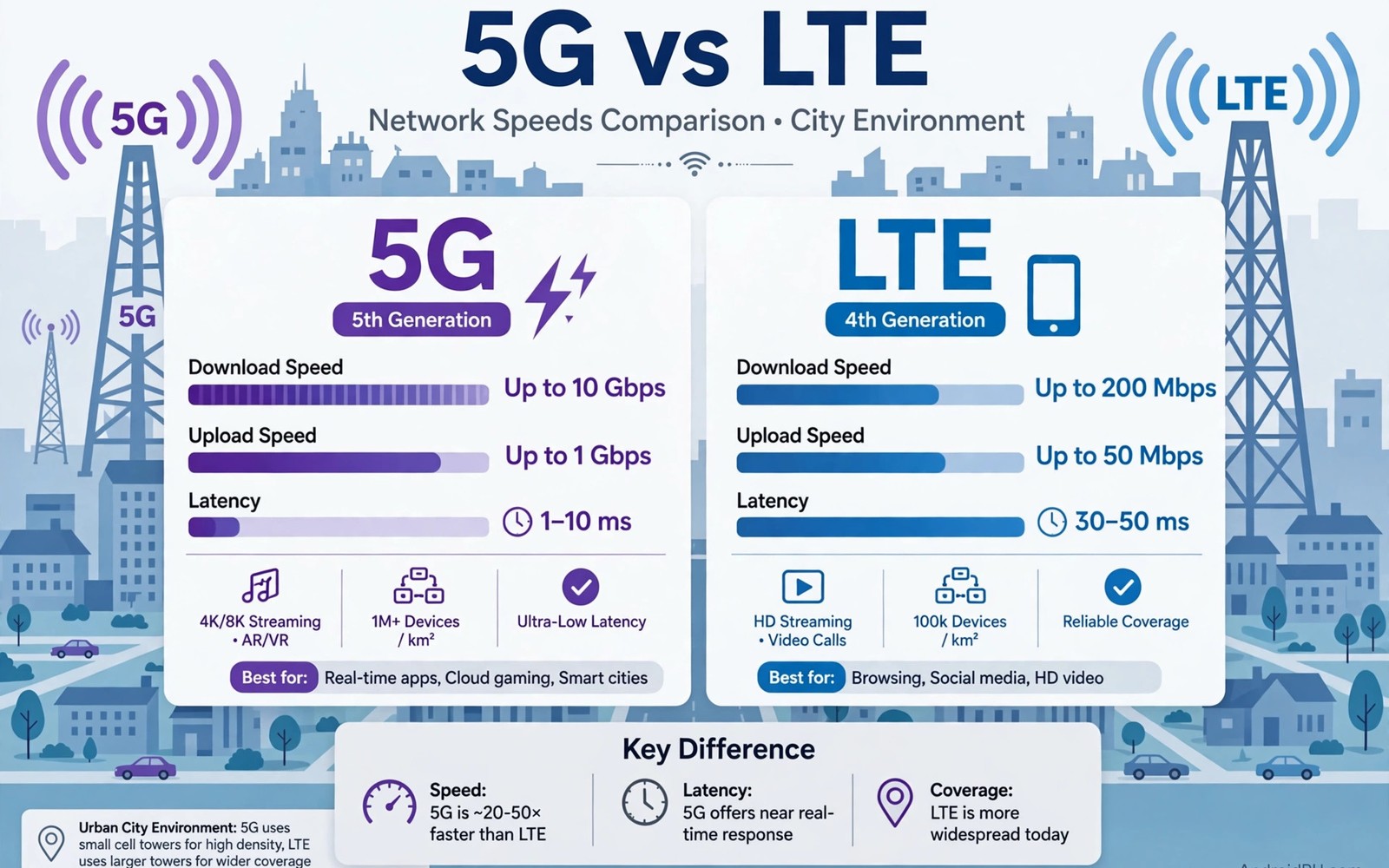
5G wins speed tests in city centres and then disappears behind a building or a hill where LTE keeps working steadily at a speed that actually loads your video.
Real world 5G performance varies enormously by location and network and phone. Peak speeds in ideal spots tell you little about your commute or your home or your office. Coverage and consistency matter more than peak numbers for daily use.
This city benchmark guide explains what real tests show. It covers download speed and latency and coverage and battery impact in everyday locations.
Download Speed in Real Streets
Downtown 5G often delivers far higher download speeds than LTE. Large files and app updates finish quickly in those spots. Video streams start faster and buffer less.
Suburban 5G often delivers speeds close to good LTE. Mid band 5G improves on LTE moderately rather than dramatically. Low band 5G may match LTE speeds while offering better capacity.
Indoor 5G weakens quickly through walls. High frequency 5G struggles indoors while LTE penetrates buildings better. A phone that shows 5G indoors may still use LTE speeds in practice.
Latency and Everyday Responsiveness
Latency measures delay rather than raw speed. Lower latency makes video calls and gaming feel more responsive. 5G can lower latency but network load and server distance also affect results.
Real city tests show latency improvements that are noticeable but not transformative for most users. Browsing and messaging feel similar on good LTE and good 5G. Competitive gaming benefits most from lower latency.
Test latency in your actual locations rather than trusting national averages. A congested downtown cell can show worse latency than a quiet suburban LTE cell at the same hour.
Coverage Gaps That Decide Daily Value
Coverage maps overstate real 5G availability. A map may show 5G across a city while individual streets drop to LTE frequently. Phones switch networks silently so users may not notice the switch.
Travel routes expose gaps clearly. Train lines and highways and rural roads often lack consistent 5G. LTE coverage remains broader and more reliable outside city centres.
Check coverage with users in your area rather than with maps alone. Local reports reveal dead zones and congestion that maps hide. Your home and workplace coverage matters more than citywide averages.
Battery Impact of 5G
5G radios consume more power than LTE radios especially when signal is weak. A phone hunting for 5G in a weak area drains battery faster than a phone settled on strong LTE. That drain surprises users who expected 5G to improve everything.
Many phones offer smart 5G modes that switch to LTE when 5G offers no benefit. Enable smart switching when available. That setting preserves battery without noticeable speed loss for most tasks.
Forcing 5G always on makes sense only when you need maximum speed and have strong signal. For daily browsing and messaging LTE often delivers the same experience with less battery cost.
adb shell dumpsys telephony.registry | grep -i -A 1 -B 1 "5G\|LTE\|NR"
adb shell ping -c 4 8.8.8.8
The commands above are an original illustration based on standard Android developer tools for checking network type and measuring ping latency on a connected phone. They help you compare responsiveness between locations.
Testing Speed Where You Live
Test speed at home during peak evening hours when networks face heaviest load. Peak hour speeds reveal real capacity better than early morning tests. A network that stays fast at peak times serves daily needs reliably.
Test speed at work and on your commute as well. Those locations shape your daily experience more than a single home test. A network that performs well at home but poorly at work still frustrates daily use.
Use the same test method for both networks. Test 5G and LTE from the same spot at similar times. That fair comparison reveals true differences rather than time of day effects. Repeat tests on different days for reliability.
Record results over a week rather than trusting a single test. Network performance varies with load and weather and maintenance. A week of tests gives a clearer picture than any single snapshot.
When LTE Still Wins
LTE wins in rural areas where 5G coverage remains sparse. A stable LTE connection beats a weak 5G signal that drops frequently. Rural users should prioritise LTE coverage and battery life over 5G headline speeds.
LTE also wins indoors in many buildings where 5G signals weaken. Offices and homes with thick walls often favour LTE penetration. A phone that switches intelligently gives you the best of both networks without manual toggling.
Battery conscious users also benefit from LTE in weak signal areas. Forcing 5G in weak areas drains battery quickly for little speed gain. Smart switching preserves battery while keeping speed when 5G truly helps.
Budget users benefit from LTE plans that cost less than premium 5G plans in some markets. A cheaper LTE plan with good coverage may serve daily needs better than an expensive 5G plan with limited benefit. Compare plan value rather than network labels alone.
5G Use Cases That Benefit Most
Large file downloads benefit most from strong 5G because a multi gigabyte game or video download finishes in minutes rather than tens of minutes. That benefit matters for users who download large files frequently on mobile data. Casual browsers gain little from the same speed because web pages load quickly on good LTE already.
Live video streaming in crowded places benefits from 5G capacity because many users share the same cell during events. A stadium or concert with strong 5G keeps streams smooth while LTE cells congest and stall. Event goers and live streamers gain real value from 5G in those crowded settings.
Cloud gaming benefits from low latency 5G when the connection stays strong and stable. A stable low latency link makes cloud games feel responsive while a fluctuating link causes stutter regardless of peak speed. Cloud gamers should test latency stability rather than download speed alone.
Future Proofing and Network Evolution
Network evolution continues as carriers expand mid band coverage and improve capacity over time. A phone bought today will experience better 5G in two years as coverage fills gaps that exist now. That future improvement favours buying a 5G capable phone even when current coverage disappoints in your area.
Device longevity also affects future proofing because a phone that lasts five years will see several network improvements during its life. A short lived phone gains less from future network expansion. Choose a durable phone with long support to maximise future network benefits.
Plan pricing will evolve alongside coverage as 5G becomes standard rather than premium in many markets. Early adopters paid premiums for 5G plans that later became standard inclusions. Buyers today should avoid overpaying for 5G as a premium feature when standard plans increasingly include it.
Choosing a Plan for 5G Reality
Choose a plan based on coverage at your home and workplace rather than on national 5G marketing because local coverage decides your daily experience. A plan that advertises nationwide 5G may still offer only LTE where you live. Local testing beats national claims.
Choose a data allowance based on your actual usage rather than on 5G speed hype because faster speeds do not increase your need for data automatically. A user who streams moderately needs the same allowance on 5G as on LTE. Speed and allowance are separate decisions.
Choose a plan with smart network switching support because a phone that switches intelligently preserves battery while using 5G only when beneficial. That feature matters more than peak speed for daily battery life. Ask your carrier about smart switching support.
Test a prepaid SIM on the network before committing to a long contract because a short prepaid test reveals coverage and speed honestly. That test costs little and prevents a two year regret. A carrier confident in its network welcomes such testing.
Review your plan yearly because network coverage and pricing evolve quickly. A plan that suited you last year may no longer offer the best value after coverage expansion. Annual review keeps your plan aligned with reality.
Test network performance during your actual commute because train and bus routes expose coverage gaps that home tests miss entirely. Run a speed test at each major stop along your route over several days. That route map shows whether 5G helps your daily travel or whether LTE remains the reliable choice for you.
Save your speed test screenshots with location notes so you can compare networks fairly across different days and times.
Common mistakes
The biggest mistake is buying a 5G phone for speed without checking coverage at home and work. A fast network elsewhere does not help where you actually live. Check local coverage first.
Another mistake is leaving 5G forced on in weak signal areas. That habit drains battery for no benefit. Use smart switching and let the phone choose the best network. Network shoppers should also read the carrier lock warning on locked phones and carrier deals because plan freedom affects network choice.
FAQ
Is 5G always faster than LTE?
No 5G is faster in strong coverage areas and similar to LTE in many suburban and indoor locations. Weak 5G can feel slower than strong LTE.
Do I need a 5G phone today?
Most new phones include 5G anyway. Buy for overall phone quality rather than for 5G alone unless your area has strong 5G coverage.
Does 5G use more battery?
Yes 5G often uses more battery especially with weak signal. Smart switching reduces that cost greatly.
Conclusion
5G is really faster than LTE in strong city coverage but LTE remains more consistent and efficient in many everyday locations. Your concrete next step is to test download speed and latency at your home and workplace on both networks before you choose a plan. Shoppers should also read the carrier lock guide on locked phones and carrier deals and the value ranking of smartphone brands ranked from worst to best value and the rugged guide on rugged smartphones built to survive extreme drops for field coverage needs.

