

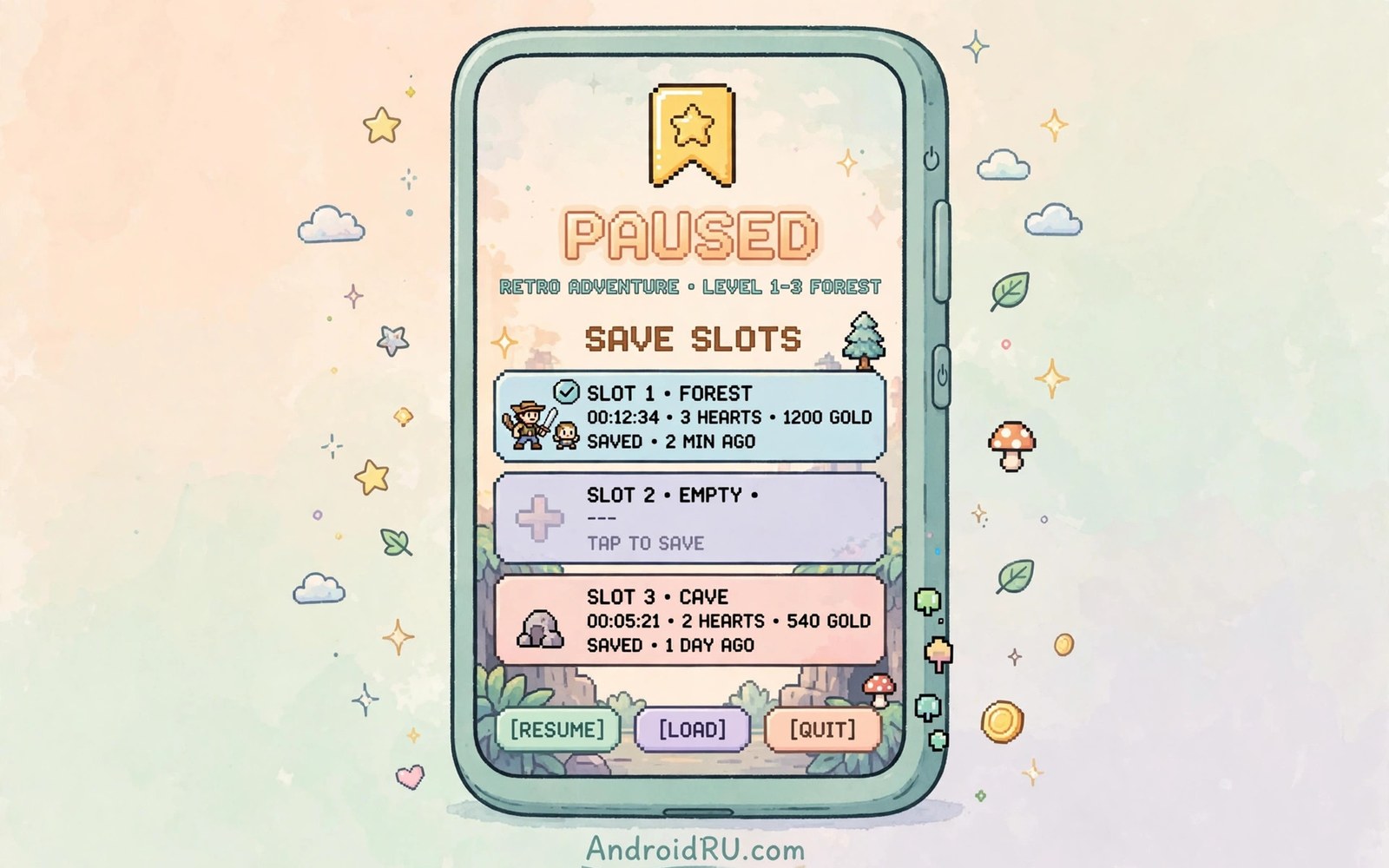
This guide covers save states in retro games in plain steps. Old games were often brutally hard. Limited lives and rare save points punished every mistake. How save states make classic retro games more accessible is a story about removing unfair barriers. A save state freezes the game at any moment. You can return to that moment instantly.
Save states change who can enjoy classic games. Players with little time can play in short bursts. Players with less skill can practise hard sections safely. The games stay challenging but they stop wasting your evening. Accessibility does not mean the game becomes trivial.
Use save states as a tool and not as a crutch for every second. A well placed save before a boss keeps tension alive. A save every ten seconds removes all stakes. A backed up save folder protects both kinds of progress. Balance keeps games fun.
What a save state actually stores
A save state stores the full memory of the virtual system at one moment. It captures processor state and graphics state and sound state. Loading it restores that exact moment perfectly. The game continues as if no time passed. That completeness is why save states feel like magic.
A save state differs from an in-game save. An in-game save stores only progress data the game chose to record. A save state stores everything including your exact position. That difference explains why save states work anywhere. It also explains why they can break after updates.
Using save states for practice
Practice is the best use of save states. Save before a hard jump or a boss fight. Retry the section many times without replaying the level. Each retry teaches the timing a little better. Mastery arrives faster with focused practice.
Use one slot for practice and another for real progress. Mixing practice saves with progress saves causes confusion. A clear slot habit keeps both safe. Label slots in your head by purpose. Slot one for progress and slot two for practice is a simple rule.
Save states and short play sessions
Short sessions suit busy lives. A save state lets you stop anywhere without losing progress. You can play for ten minutes and resume exactly there later. That freedom turns a phone into a true pocket console. Old games fit modern schedules through save states.
End each short session with a fresh save state. Also use an in-game save when the game offers one. Two forms of progress protect against either system failing. A double save habit takes seconds. It saves hours of replay after a problem.
Save states across devices
Moving save states to a new phone needs care. Save states depend on the emulator version and core. A state from one version may fail on another. Test one state on the new device before you move the rest. A failed test saves a frustrating full transfer.
In-game saves transfer more reliably across versions. They store game progress in a standard form. Move in-game saves first when changing devices. Add save states after the in-game saves work. That order protects the progress that matters most.
When save states hurt the game
Overuse can drain tension from a well designed game. Horror games lose fear when death costs nothing. Puzzle games lose satisfaction when every move is reversible. Use save states to remove unfair punishment. Keep enough risk to preserve the game design.
Some players set personal rules for save state use. A rule like one save per level keeps challenge alive. Another rule allows saves only before bosses. Personal rules turn a powerful tool into a fair aid. Choose rules that keep the game fun for you.
Save states in speedrunning practice
Speedrunners use save states to practise difficult sections repeatedly. A state before a tricky jump allows dozens of attempts quickly. Each attempt builds muscle memory for the exact timing. Without states practice would require replaying whole levels. States compress practice time dramatically for runners. They also allow testing different routes through a level. Route testing reveals faster paths that casual play hides. Practice states are a legitimate training tool for runners.
Speedrun rules usually forbid save states during official timed runs. Practice use and run use follow different rules. Learn the rules of the community before submitting a run. A practice tool must never enter a verified run. Keep practice and official runs clearly separate. Honest separation protects the integrity of leaderboards. Respect for rules keeps speedrunning fair for everyone.
Save states also help runners learn glitch techniques safely. A glitch attempt can corrupt a run in progress. A state before the attempt allows safe experimentation. Failed glitches cost seconds instead of whole runs. Safe experimentation accelerates glitch discovery for communities. New glitches often emerge from fearless state backed practice. The tool serves discovery as well as mastery.
Save states and game difficulty design
Old games used difficulty to extend short content. Limited lives forced replay of early levels often. That design padded short games into longer experiences. Save states remove that padding entirely. A short game can finish in one evening with states. Some players enjoy that faster pace greatly. Others feel the game loses its intended challenge. Both reactions are valid and personal to each player.
Modern players value time more than old designers assumed. A busy adult cannot replay a level twenty times casually. Save states respect adult time constraints honestly. They let a classic game fit a modern schedule. Difficulty remains available through personal rules. Players can limit states to preserve challenge deliberately. The tool gives choice where old hardware gave none. Choice is the real accessibility gain here.
Game designers today build save systems into games directly. Checkpoints and autosaves serve the same purpose as states. Old games lacked those modern conveniences entirely. Save states retrofit modern convenience onto old design. That retrofit keeps classics playable for new audiences. Accessibility tools preserve cultural history through play. A game nobody can finish fades from memory faster. States help classics survive through actual play.
Save states in puzzle games
Puzzle games benefit from save states in a special way. A state before a hard puzzle allows safe experimentation. Failed experiments cost nothing with a state ready. Experimentation reveals puzzle mechanics faster than caution. Try bold moves with a state as safety net. Bold attempts often discover solutions cautious play misses. States turn puzzle fear into puzzle curiosity. Curiosity solves puzzles faster than fear ever will.
Puzzle solutions deserve a state after each major breakthrough. A breakthrough state protects progress through harder sections. Later sections may require backtracking to earlier choices. A saved breakthrough allows clean backtracking without replay. Keep a chain of breakthrough states for long puzzles. A chain lets you step back one breakthrough at a time. Chains beat single states for complex puzzle games. Stepwise safety suits stepwise puzzle design.
Some puzzle games punish wrong moves with instant failure. Save states remove that punishment entirely. Removing punishment changes the puzzle experience deeply. Players can focus on logic instead of fear. Logic focused play suits thoughtful puzzle fans best. Other players prefer the tension of real consequences. Personal rules can restore tension deliberately. Limit states to one per puzzle for a balanced challenge.
Sharing puzzle states with friends is rarely useful directly. States depend on emulator version and game state exactly. A friend with a different version cannot load your state. Share puzzle hints instead of state files. Hints preserve the joy of solving for the friend. A good hint points toward the solution without giving it. Hint sharing builds community around puzzle games. Community hints outlast any single state file.
Common mistakes
The worst save state mistake is relying on a single slot. One slot can be overwritten at the wrong moment. A bad overwrite erases a good position instantly. Use at least two slots for important progress. Two slots turn a mistake into a small setback.
Another mistake is never using in-game saves beside states. Save states can break after an emulator update. In-game saves survive updates far more often. Use both systems together always. The extra seconds protect hours of play.
Do not save over a good state during a risky experiment. Create a new slot for experiments instead. Experiments include glitch attempts and hard route tests. A separate slot keeps the safe position intact. Safe progress deserves its own protected slot.
A practical example you can try
ls -lh ~/Games/Saves/ | head -20
# check save state file sizes per game
# back up the Saves folder before emulator updates
This snippet is an original example written for this article. It shows the idea in a compact form that you can adapt to your own setup and change as you learn what works best on your phone.
Frequently asked questions
Can save states corrupt my game?
They rarely corrupt game data itself. They can fail to load after an emulator update. A regular save backup protects against that failure. Keep in-game saves beside states for safety. That pair covers almost every problem.
Save states rarely corrupt game data itself. They can fail to load after an emulator update. A regular save backup protects against that failure. Keep in-game saves beside states for safety. That pair covers almost every problem.
How many save slots should I use?
Use two slots as a minimum for important games. One slot holds progress and one holds practice. A tidy library makes it easy to find the game again later. More slots help for branching games with choices.
Two slots are the minimum for important games. One slot holds progress and one holds practice. A tidy library makes finding the game easy later. More slots help for branching games with choices. Extra slots cost nothing and prevent regret.
Do save states work for every game?
They work for most games in most emulators. Some games with special hardware behave oddly. A handheld game usually handles states very well. Test a state load early in a new game to confirm it works.
Save states work for most games in most emulators. Some games with special hardware behave oddly. A handheld game usually handles states very well. Test a state load early in a new game. An early test confirms the feature works there.
Conclusion
Your concrete next step is to set a save habit for your current game today. Create a progress slot and a practice slot. Make an in-game save at the next save point as well. Back up the save folder this week. That habit protects every hour you invest from now on.
Teach a friend the two slot save habit this week. Show them a progress slot and a practice slot in action. A shared habit protects both players from lost progress. Teaching also reinforces the habit for yourself. Good habits spread best through demonstration and not lectures.

