

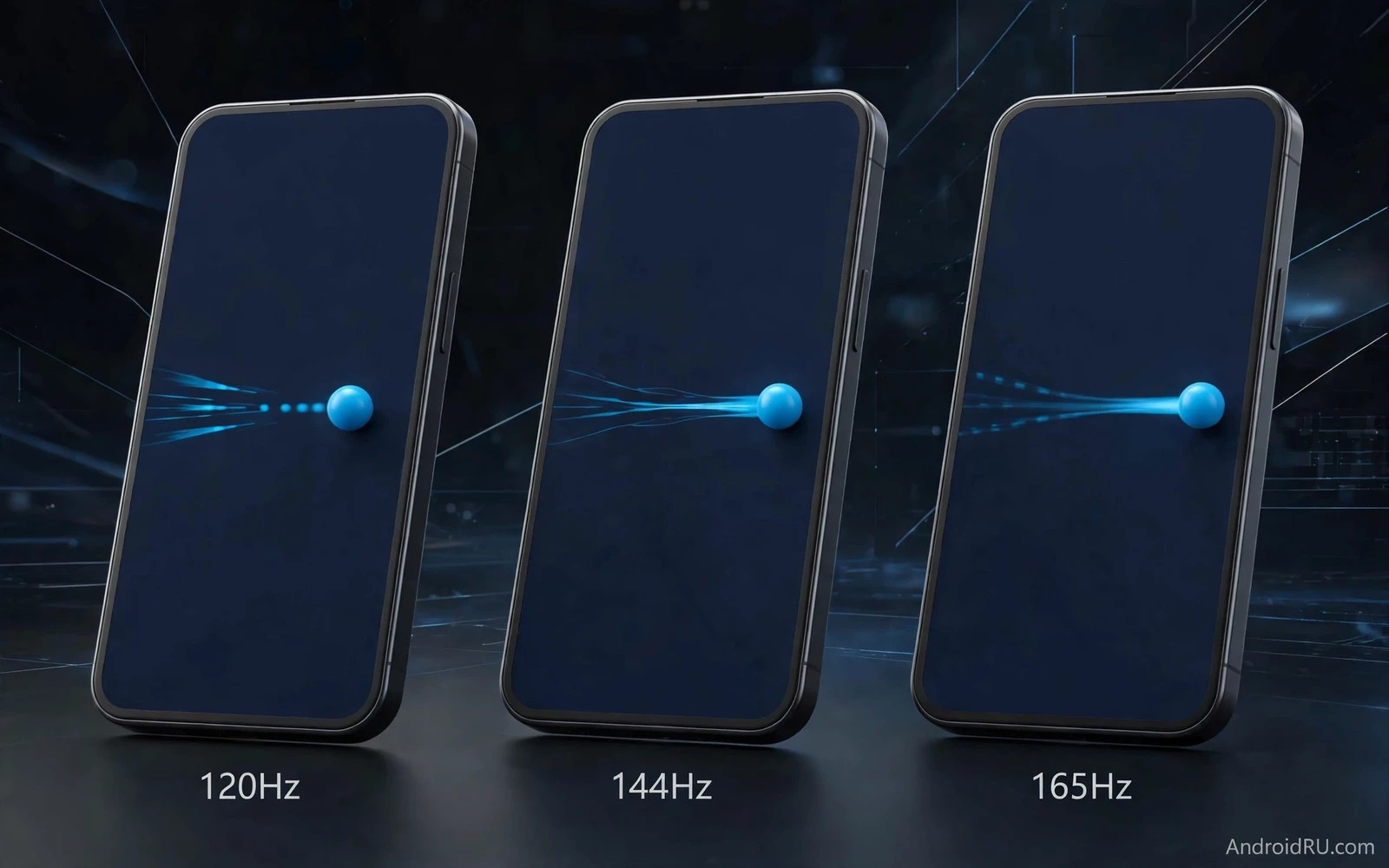
What Refresh Rate Actually Means
Refresh rate measures how many times a screen redraws its image each second. A 120 hertz screen redraws 120 times per second. A 144 hertz screen redraws 144 times per second. A 165 hertz screen redraws 165 times per second. Higher numbers mean motion updates more often which makes scrolling and animations and game movement look smoother. The eye notices the jump from 60 hertz to 120 hertz immediately. The jump from 120 hertz to 165 hertz is subtler and it depends on content and on individual sensitivity.
Refresh rate is not the same as touch sampling rate. Touch sampling measures how often the screen checks for finger input. A high touch sampling rate makes controls feel responsive even on a moderate refresh screen. Gamers should check both numbers because a fast screen with slow touch sensing can still feel laggy. Everyday users should focus on refresh rate because it shapes scrolling and animation smoothness across the whole system.
Where You Notice The Difference
Scrolling reveals refresh differences fastest. A long social feed or a long article scrolls with less blur and less judder at higher rates. Animations for opening apps and switching screens also look calmer. Games reveal differences when frame rates can match the screen rate. A game locked at 60 frames per second gains nothing from a 165 hertz screen because the screen repeats frames. A game that runs at 120 frames or higher gains visible smoothness at each step up.
Video rarely benefits because most video runs at 24 or 30 or 60 frames per second. A high refresh screen cannot invent missing frames in standard video without motion smoothing that many viewers dislike. Reading static text gains nothing either. The benefit concentrates in interaction heavy moments such as scrolling and swiping and fast gaming. Users who mostly read and watch video may never justify the battery cost of the highest rate.
120Hz The Sweet Spot For Most Users
120 hertz has become the sweet spot for good reasons. It doubles the smoothness of older 60 hertz screens while keeping battery cost manageable. Most apps support 120 hertz well. Most games that support high frame rates target 120 hertz as a standard tier. Adaptive refresh technology helps further by dropping to a low rate for static content and rising to 120 hertz only during motion. That adaptivity preserves battery without sacrificing feel.
Display quality matters alongside rate. A bright and accurate 120 hertz screen beats a dim and tinted 165 hertz screen for daily satisfaction. Panel type and brightness and colour tuning shape the experience as much as hertz count. Buyers should compare screens in person when possible because specification sheets hide tuning differences. The AMOLED versus IPS display comparison explains panel traits that interact with refresh smoothness.
144Hz The Gaming Middle Ground
144 hertz grew from PC gaming where 144 hertz monitors became a standard tier. On phones it serves gamers who want a step above 120 hertz without the steepest battery penalty. The visual gain over 120 hertz is modest but competitive gamers may feel it in fast shooters where targets cross the screen quickly. Frame time drops from about 8.3 milliseconds at 120 hertz to about 6.9 milliseconds at 144 hertz. That small drop can matter in twitch gameplay even when casual observers see little change.
Support is the catch. Fewer games offer a 144 hertz mode on phones than offer a 120 hertz mode. A phone may run its interface at 144 hertz while games cap at 120 hertz or lower. Check game specific support for your favourite titles before you pay for 144 hertz as a gaming feature. Battery cost also rises because the processor and the display work harder to render extra frames. Adaptive modes help but they cannot erase the cost during sustained high frame gaming.
165Hz The Enthusiast Tier
165 hertz targets enthusiasts who want the maximum smoothness a phone screen can offer. Frame time drops to about 6.1 milliseconds. Scrolling looks exceptionally fluid and fast competitive games feel tightly connected to finger input. The gain over 144 hertz is small and many users cannot distinguish it in a blind test. Enthusiasts who play supported competitive titles daily are the audience most likely to value it.
Heat and battery costs peak at 165 hertz. Sustained high frame gaming warms a phone faster and drains the battery faster. Cooling design therefore matters more at this tier. A phone with weak cooling may throttle before it sustains 165 frames in a demanding game. Gaming phone cooling context appears in the gaming phone versus regular flagship comparison where thermal design decides whether headline specs survive real sessions.
Battery Cost In Plain Terms
Battery cost rises with refresh rate because the screen and the graphics processor do more work each second. The size of the cost depends on adaptive behaviour and on content. Scrolling heavy use shows a clear cost. Static reading shows almost no cost when adaptive refresh drops the rate. Gaming shows the largest cost because the processor must render many more frames. Users who charge nightly may accept the cost gladly. Users who need two day endurance may prefer a capped 120 hertz or an adaptive 60 hertz mode.
Settings give you control. Most phones let you cap refresh rate or force adaptive behaviour or choose a battery saver mode that lowers the rate. Use a high rate when you game or scroll heavily and use a lower rate when you travel without a charger. That manual control turns refresh rate from a fixed cost into a flexible tool. Battery endurance context also appears in the longest battery runtime comparison where screen settings feature among the largest endurance variables.
Adaptive Refresh And LTPO Technology
Adaptive refresh technology changes the value calculation. Screens with variable refresh can drop to very low rates for static images and rise instantly for motion. That behaviour preserves battery while keeping motion smooth. LTPO panels enable this wide range most effectively. A 120 hertz LTPO screen can beat a fixed 165 hertz screen on battery while feeling nearly as smooth in most use. Check whether a phone uses true variable refresh or only a few fixed steps because the distinction affects real endurance.
Software tuning matters too. Some phones drop refresh rate aggressively to save power and scrolling can feel uneven as a result. Other phones hold a high rate longer and feel smoother at a battery cost. Reviewers who measure refresh behaviour over time reveal these tuning choices. A specification sheet alone cannot show whether a phone sustains its headline rate or drops it after a few seconds of scrolling.
Choosing Your Refresh Tier
- Choose 120Hz when you want smooth daily use with sane battery life
- Choose 120Hz with LTPO when battery endurance tops your priority list
- Choose 144Hz when your favourite games support it and you play competitively
- Choose 165Hz when you play supported fast games daily and accept higher drain
- Check touch sampling rate beside refresh rate for gaming responsiveness
- Use adaptive mode or a manual cap to match refresh rate to your day
Final Verdict
120 hertz wins for most buyers because it delivers the big smoothness jump at a reasonable battery cost. 144 hertz suits competitive gamers who play supported titles and who notice small frame time gains. 165 hertz suits enthusiasts who want the maximum and who accept heat and drain as the price. Do not buy hertz alone. Compare panel brightness and colour and adaptive behaviour and cooling together. The smoothest phone is the one that sustains its rate without overheating and without dying before your day ends.
Content That Actually Uses High Refresh
High refresh support varies enormously by app and by game which means headline hertz numbers often overpromise. System animations and scrolling in most major apps support high refresh well. Social feeds and browsers and messaging apps feel smoother at 120 hertz in everyday use. Games form a patchwork because each developer must enable high frame modes individually. Some popular games offer 120 hertz modes while others cap at 60 hertz for stability or for competitive fairness. Check your favourite games specifically rather than assuming a high refresh phone improves every game equally.
Video content rarely uses high refresh directly because films and shows run at fixed lower frame rates. A high refresh screen can still improve video interface smoothness around playback controls and scrolling. It cannot add detail to video frames themselves without motion interpolation that many viewers find unnatural. Reading apps gain nothing from high refresh once text sits still. The benefit concentrates in interaction moments when content moves under your finger. Users who scroll heavily gain the most while users who read statically gain the least.
Competitive gaming communities track high frame support closely because frame rate affects reaction time perception. A shooter that runs at 120 frames gives smoother target tracking than the same shooter capped at 60 frames. A strategy game that runs at 60 frames gains little from a faster screen because gameplay pace is slow. Puzzle games gain smoothness in animations but not in strategic depth. Match refresh investment to game genres you actually play rather than to gaming in general. A puzzle player who buys 165 hertz for animation smoothness overspends while a shooter player who buys 60 hertz handicaps reaction feel.
Developer support evolves over a phone lifetime. Games that launch capped may add high frame modes later through updates. Apps that stutter at high refresh may improve through optimisation. Conversely a phone that sustains high refresh today may throttle sooner as apps grow heavier. Adaptive refresh technology helps future proofing because it matches rate to content automatically. A phone with good adaptive behaviour delivers smoothness where it matters and saves battery where it does not. That intelligence matters more than a headline number that only applies in ideal conditions.

