

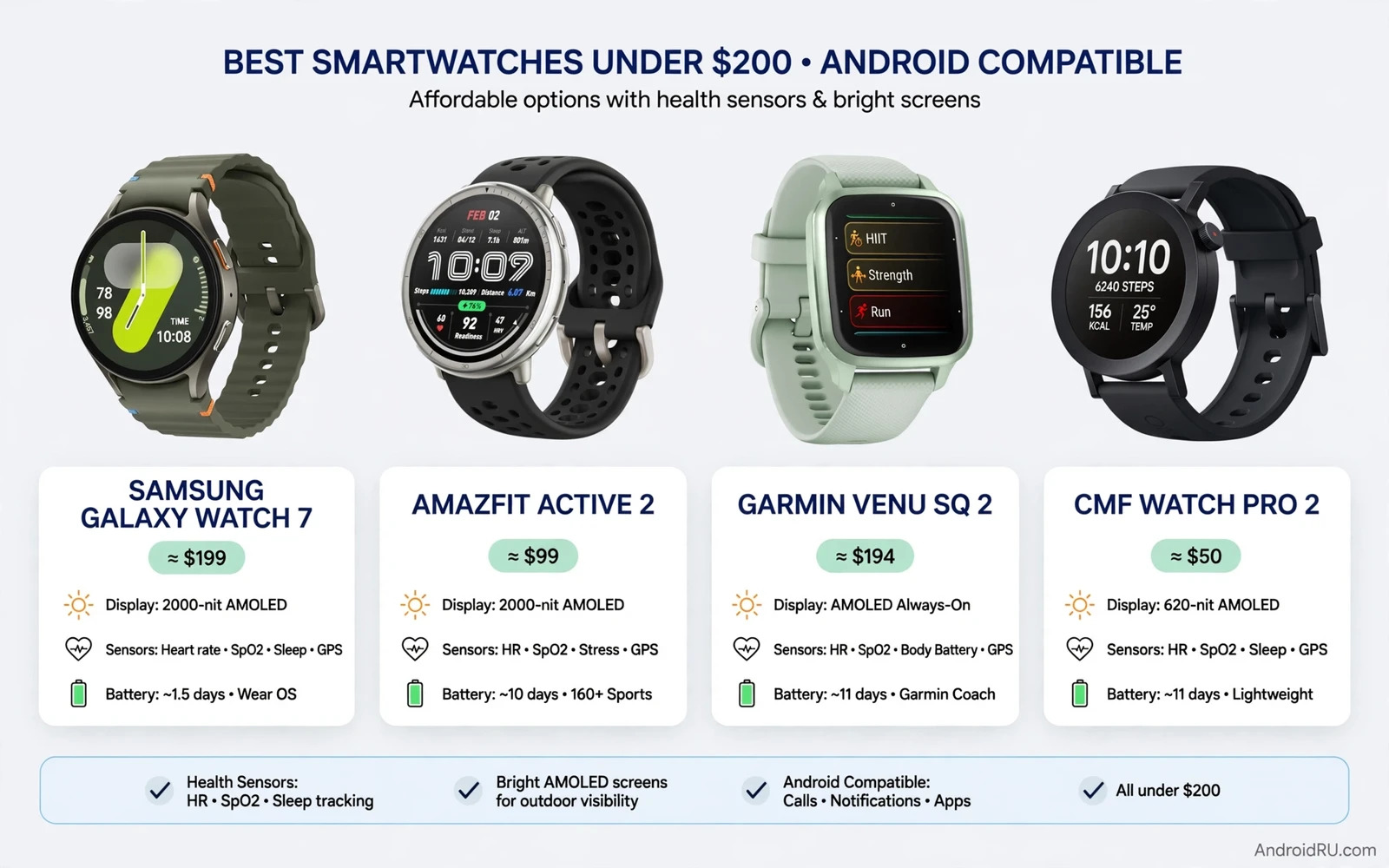
Best Smartwatches Under $200 Compatible with Android
A good smartwatch under 200 dollars can extend your Android phone in a useful and calm way. The best smartwatches under 200 dollars compatible with Android focus on clear notifications, steady health tracking, and simple daily control. They do not need to replace your phone. They need to reduce the times you pull your phone from your pocket. They need to show what matters at a glance. They need to keep working through a full day without fuss. This guide explains what to check before you buy, and where cheaper models cut corners that matter in real life.
Start with your phone and your daily routine before you compare watch faces or strap colours. A watch that pairs cleanly with your Android phone will feel quiet and reliable. A watch that fights the companion app will feel noisy and tiring. Think about how you read messages, how you track walks, and how you handle calls on the move. Think about whether you swim, run, or work outdoors in bright light. Think about whether you want a watch that looks like a tool or a watch that looks like jewellery. Your answers will narrow the field faster than any long feature list. Prices in this guide are approximate list prices, and many of these watches sell below list on sale, so check the current price before you buy.
Compatibility Comes First
Android compatibility means more than a basic Bluetooth pairing. It means stable notifications, reliable call handling, and a companion app that stays connected. It means health data that syncs to your phone without repeated setup. It means watch faces and settings that you can change from the phone without a fight. Test the pairing idea early by reading the app reviews in plain language and by checking which phone features the watch supports. A watch that hides key settings behind a second account or a second app will cost you time every week.
Some watches work best with one brand of phone and only partly with others. Samsung watches offer their full feature set on Samsung phones, including ECG and blood pressure in supported regions, while some features are limited on other Android phones. Amazfit, Garmin, and Fitbit watches offer full features on any Android phone, which makes them safer picks if you switch phone brands. Some watches limit message replies or voice control on certain phones. Ask which limits apply to your exact phone before you pay. A limit that sounds small in a store can feel large when you miss a reply on a busy day. A watch that works fully with your phone will feel like a natural part of your Android setup.
Shoppers who care about the wider Android setup will also enjoy reading Best Android Phone Brands Ranked by Reliability and Support, because brand support shapes how long a watch and a phone stay useful together. Brand support shapes update speed, repair access, and app quality. A phone brand that supports its devices well often supports its wearables well too. That link gives you a broader view of reliability before you commit to one ecosystem.
The 8 Best Smartwatches Under $200 for Android
These eight watches all pair fully with Android, and each one earns its place for a different kind of user. Compare them on compatibility, sensors, battery, and comfort, in that order, and ignore features you will not use weekly.
| Watch | Price | Battery | System | Best for |
|---|---|---|---|---|
| Samsung Galaxy Watch FE | About $199 | About 2 days | Wear OS | Samsung phone owners |
| Amazfit GTR 4 | About $199 | About 14 days | Zepp OS | Long battery life |
| Amazfit Active 2 | About $99 | About 10 days | Zepp OS | Best value |
| Garmin Venu Sq 2 | About $199 on sale | About 11 days | Garmin OS | Runners |
| Fitbit Versa 4 | About $199 | About 6 days | Fitbit OS | Health tracking |
| Huawei Watch Fit 3 | About $159 | About 10 days | HarmonyOS | Design and value |
| Amazfit T-Rex 2 | About $199 | About 24 days | Zepp OS | Outdoor and rugged use |
| CMF Watch Pro 2 | About $69 | About 11 days | Nothing OS | Budget buyers |
1. Samsung Galaxy Watch FE: The Best Wear OS Watch Under $200
The Galaxy Watch FE brings Wear OS, Google apps, and Samsung Health to the sub-200-dollar range. It runs the full Play Store on your wrist, supports Google Pay, and pairs best with Samsung phones, where it offers ECG and blood pressure in supported regions. Battery life is about two days with normal use, which is the weakest in this list, but the experience is the most complete. Who it is for: Samsung phone owners who want the full smartwatch experience. Pros: full Wear OS apps, Google Pay, strong health sensors, and a polished interface. Cons: two-day battery, best features limited to Samsung phones, and the small case can feel cramped for large wrists. Verdict: the most capable watch here, if you can live with charging every other day.
Galaxy Watch FE battery in numbers
With always-on display off and normal notifications, expect roughly 40 to 48 hours per charge. Turn the always-on display on and that drops to about a day and a half. A 30-minute top-up adds roughly half a charge, so a morning routine top-up keeps it going indefinitely.
2. Amazfit GTR 4: The Battery Life Champion
The Amazfit GTR 4 lasts about 14 days on a charge with typical use, and it still offers dual-band GPS, heart rate, SpO2, sleep tracking, and over 150 sport modes. The 1.43-inch AMOLED display is bright outdoors, and the Zepp app syncs cleanly with any Android phone. Who it is for: anyone who hates charging and wants a watch that simply keeps going. Pros: outstanding battery life, accurate dual-band GPS, bright display, and a low price on sale. Cons: no third-party app store, replies to messages are limited, and the interface is simpler than Wear OS. Verdict: the best balance of battery and features under 200 dollars.
3. Amazfit Active 2: The Best Value Smartwatch
At about 99 dollars, the Active 2 is the cheapest watch on this list that still feels like a real smartwatch. It offers a bright AMOLED display, heart rate and sleep tracking, dual-band GPS, and about 10 days of battery life. It pairs with any Android phone through the Zepp app. Who it is for: first-time buyers and budget hunters. Pros: remarkable value, long battery, accurate GPS, and a light, comfortable case. Cons: no speaker for calls on some versions, limited smart features, and a smaller app ecosystem. Verdict: the watch to buy if you want 80 percent of the experience for half the price.
4. Garmin Venu Sq 2: The Runner’s Pick
Garmin’s Venu Sq 2 lists above 200 dollars, but it regularly sells for around 199 dollars on sale, and it is worth waiting for that price. It offers Garmin’s excellent GPS accuracy, heart rate, sleep, and stress tracking, plus Garmin Pay and music storage. Battery life is about 11 days in smartwatch mode. Who it is for: runners and walkers who want trustworthy GPS and health data. Pros: best-in-class GPS accuracy, excellent health trends, long battery, and a mature app. Cons: the screen is smaller than round rivals, the interface is plain, and the list price is above budget. Verdict: the most accurate fitness watch here, and the right pick if running matters most.
5. Fitbit Versa 4: The Health Tracking Specialist
The Fitbit Versa 4 focuses on health: heart rate, sleep stages, stress, SpO2, and a daily readiness score in the Fitbit app. Battery life is about six days. It pairs with any Android phone, supports Google Pay and Google Maps, and includes Alexa. Who it is for: buyers who care most about health trends and sleep. Pros: strong health app, good sleep tracking, six-day battery, and Google services built in. Cons: some features need a Fitbit Premium subscription, the app can feel busy, and there is no app store to speak of. Verdict: the best health-focused watch under 200 dollars, with a subscription asterisk.
6. Huawei Watch Fit 3: The Design Pick
The Watch Fit 3 looks like a premium watch at about 159 dollars, with a bright AMOLED display, a slim aluminium case, and about 10 days of battery life. Health tracking covers heart rate, sleep, SpO2, and over 100 workout modes. The catch is the ecosystem: it pairs with Android through the Huawei Health app, and it lacks Google services, so no Google Pay and no Play Store on the wrist. Who it is for: buyers who want a beautiful, long-lasting watch and do not need Google services. Pros: striking design, long battery, bright display, and a low price. Cons: no Google Pay, no third-party apps, and the companion app needs sideloading on some phones. Verdict: the best-looking watch here, with an ecosystem trade-off you must accept.
7. Amazfit T-Rex 2: The Rugged Outdoor Watch
The T-Rex 2 is built for outdoor use: military-grade toughness, 10 ATM water resistance, dual-band GPS, and a battery that lasts about 24 days in typical use, or about 26 hours with GPS running continuously. It tracks over 150 sports, including hiking, skiing, and open-water swimming. Who it is for: hikers, swimmers, and anyone who works outdoors. Pros: huge battery, tough build, accurate GPS, and a bright display. Cons: large and heavy, no speaker for calls, and the interface is utilitarian. Verdict: the toughest watch here, and the best pick if your watch takes a beating.
8. CMF Watch Pro 2: The Budget Surprise
Nothing’s CMF Watch Pro 2 costs about 69 dollars, yet it offers an AMOLED display, Bluetooth calling, heart rate and sleep tracking, GPS, and about 11 days of battery life. The companion app is simple and clean. Who it is for: buyers who want the most watch for the least money. Pros: very low price, long battery, Bluetooth calls, and a clean design. Cons: health data is basic, the app is young, and long-term support is unproven. Verdict: the best ultra-budget pick, with the understanding that you get what you pay for in software polish.
How the battery numbers compare in real use
Manufacturer battery claims assume light use and calm settings. In practice, always-on display, frequent workouts, and loud notifications all draw power. A watch rated for 14 days may last 10 with heavy use, and a watch rated for two days may last one. Read battery reports that describe real daily use with notifications and workouts included, and judge by those numbers rather than the headline claim.
Health Tracking You Can Trust
Health tracking on a budget watch should be steady and honest rather than flashy. Step counts, heart rate trends, and sleep patterns matter more than a long list of rare metrics. A watch that records the same walk in the same way each day gives you a trend you can use. A watch that jumps wildly from day to day gives you noise that teaches you nothing. Look for clear graphs and simple explanations in the app, and an easy way to see weekly change without digging through menus.
Sleep tracking deserves special care in this price range. A good budget watch can show sleep length and timing in a readable form. A weak budget watch can invent detail that looks precise but means little. Focus on whether the sleep record matches how rested you feel, whether the watch stays comfortable through the night, and whether the battery still has charge in the morning. Comfort and consistency beat a long list of sleep stages that you cannot verify. Workout tracking should match the sports you actually do: a runner needs steady pace and distance and a readable screen in daylight, a swimmer needs water resistance that matches real swimming and not just splashes, and a gym user needs simple workout starts and clear heart rate zones. Pick a watch that covers your main sport well, and ignore a watch that covers twenty sports poorly when you only need three done right.
Screen, Battery, and Comfort
The screen sets the tone for daily use on a wrist device. A bright screen helps outdoors, helps older eyes, and helps quick glances. A dim screen forces you to shade the watch with your hand, and that habit grows tiring. A large screen shows more text but also adds weight and bulk. A small screen feels light but may cut message text short. Try to judge screen size against your wrist and your reading comfort rather than against a photo alone. A screen that you can read at a glance is worth more than a screen that looks sharp in a product shot.
Battery life on a budget watch often depends on how you use it. Always-on display, frequent workout tracking, and loud notifications all draw power. A watch that lasts several days with light use may last only one day with heavy use. That gap matters when you travel or when you forget a charger. Look for charging that is quick and simple, and for a charger that is easy to replace. A watch that charges fast can forgive a forgotten overnight charge, while a watch that charges slowly will punish small lapses. Comfort decides whether a watch stays on your wrist or ends up in a drawer. A strap that irritates skin will ruin even the best sensor set. A case that digs into the wrist bone will ruin long wear. Light cases, soft straps, and smooth backs tend to wear well through long days. Readers weighing other wearables may also like Wireless Earbuds Showdown: Sony vs Bose vs Samsung, since earbuds and watches often share the same daily routine of calls, music, and movement.
Notifications, Calls, and Daily Control
Notifications are the daily job of a smartwatch. A good watch shows the sender and the first lines of a message in a readable size. A good watch lets you dismiss or reply without reaching for your phone. A good watch lets you mute noisy apps while keeping urgent contacts loud. A bad watch floods you with every alert and teaches you to ignore your wrist. Set notification rules on the first day and keep them strict. A calm wrist is a useful wrist.
Call handling on a budget watch varies more than buyers expect. Some watches let you talk through the watch speaker and microphone. Some watches only let you accept or reject a call. Caller ID clarity matters too: some watches show caller names clearly while others show only numbers. Think about how often you take calls while driving, cooking, or walking. If calls matter, test this feature early and treat it as a deal breaker. If calls rarely matter, a simpler watch may suit you better and save money. Daily control covers music, timers, alarms, and quick settings. A watch that controls music well will save many times you pick up your phone during a workout. A watch that sets timers fast will help in the kitchen and at work. A watch that vibrates firmly will wake you without waking a partner. These small controls add up across weeks of use, so judge them by speed and by how few taps they need. A control that needs five taps is a control you will stop using.
Mistakes to Avoid
One common mistake is buying the brightest screen and ignoring the app. The app is where your health data lives and where your settings live. A weak app can make strong hardware feel broken. Another common mistake is buying for a sport you plan to start and not for the sport you do now. Plans change, and the watch must serve your present life first. A third mistake is ignoring strap cost and charger cost. Replacement straps and spare chargers add up and they affect long-term value.
Another mistake is trusting a single glowing claim about battery life. Battery claims assume light use and calm settings, while your use may be heavier and your settings may be brighter. Read battery reports that describe real daily use with notifications and workouts included. Another mistake is ignoring water resistance ratings in plain terms: a watch that survives rain may not survive swimming, so match the rating to your real water exposure and do not guess. A final mistake is buying a watch that locks your data inside one closed app. You may want to move your health history to a new phone or a new app later. A watch that exports data in a standard way gives you freedom, while a watch that traps data gives you a hard choice later. Ask about export options before you buy. Freedom to move your own data is a quiet form of value that grows over time.
How to Choose
Make a short list of three watches that fit your phone, your budget, and your main sport. Compare them on compatibility, sensors, battery, and comfort, in that order. Ignore features that you will not use weekly. Ignore colours that distract from fit and function. Read user notes about pairing stability, app updates, and strap comfort. Then choose the watch with the fewest serious weaknesses rather than the watch with the single best feature. A balanced watch ages better than a flashy watch.
Set the watch up slowly on the first day. Pair it fully, set notification rules, and set health goals that match your real life. Wear it for a full week before you judge battery life or sleep tracking. A week of normal use reveals more than a day of testing. Adjust the screen brightness, the vibration strength, and the workout defaults during that week. Small tweaks in the first week can turn a good watch into a great daily tool.
Best Smartwatches Under $200: Your Questions Answered
What is the best smartwatch under $200 for Android?
For most Android users, the Samsung Galaxy Watch FE is the most capable pick, because it runs full Wear OS with Google apps. If battery life matters more, the Amazfit GTR 4 lasts about two weeks. If your budget is tight, the Amazfit Active 2 at about 99 dollars covers the essentials. The best answer depends on your phone, your sport, and how often you are willing to charge.
Do cheap smartwatches track health accurately?
Budget watches track trends well, especially steps, heart rate, and sleep length. Absolute accuracy is lower than medical devices, and single readings can be off, but the trends over weeks are usually reliable. Look for consistency: a watch that records the same walk the same way each day gives you a trend you can use, while a watch that jumps wildly gives you noise.
Can I reply to messages from a smartwatch under $200?
Most watches in this range let you reply with quick preset responses, and Wear OS watches such as the Galaxy Watch FE support full keyboard and voice replies. Amazfit and Garmin watches offer quick replies on Android, with some limits. Check whether replies work with your exact phone and messaging app before you buy, because that feature varies more than buyers expect.
How long should a budget smartwatch battery last?
A good budget watch should last at least five to seven days with normal use, and the best last two weeks or more. Wear OS watches are the exception, at about two days, because they run a fuller system. If a watch dies before the weekend on a normal week, its battery is not good enough for daily wear, no matter how good the screen looks.
Your Next Step: Try One on Your Wrist
Your final choice should feel boring in the best sense. It should pair without drama, track without drama, and charge without drama. Boring reliability is the real luxury under 200 dollars. If you also plan a phone upgrade soon, then Top Phones with Longest Battery Runtime Tested Side-by-Side will help you think about battery runtime across the whole pocket setup. A phone that lasts long and a watch that lasts long make a calm pair. Together they reduce charger anxiety and keep your day moving without interruption. Pick your shortlist of three, try one on your wrist if you can, and wear it for a full week before you judge it.

